Physical Address
304 North Cardinal St.
Dorchester Center, MA 02124
Physical Address
304 North Cardinal St.
Dorchester Center, MA 02124


A clear guide to microcap runner slang, risk, and exits.
A microcap runner is a tiny crypto token that is moving fast, or that traders expect to move fast, as attention and liquidity chase momentum.
The phrase sounds like a prize. It is closer to a warning label with better marketing. In crypto chat, a runner can mean volume, social heat, and chart speed are building, but it does not mean the token is safe, cheap, fair, or easy to sell.
A microcap runner in crypto is a very small token that traders believe is already running, or could run soon, because momentum is building. The “microcap” part points to tiny market value. The “runner” part points to price action.
That split keeps the term useful. Microcap describes size, and runner describes movement. A token can be tiny and dead quiet, or it can be tiny and suddenly active after volume, posts, and wallet activity appear.
Keep the boundary simple:
The term is common around meme coins, new DEX launches, and low-cap narratives. You may see it in Telegram groups, X posts, scanner dashboards, or Discord chats where people are hunting early moves before a wider crowd notices.
But a microcap runner is still only a label for movement, pressure, and timing. It can be a real early trade, a temporary hype cycle, a coordinated pump, or a setup where earlier wallets need someone else to buy their exit.
Use the phrase as a prompt to ask better questions before the chart rushes the decision:
Those answers decide whether the label points to a trade worth studying or a chart already hunting for late buyers. A real runner still needs a real exit, and tiny markets often make that the hardest part.
A microcap runner is different from a low-cap gem or small-cap crypto because each phrase measures something else. These labels overlap in chat, but they do not carry the same meaning.
The clean way to separate them is to split valuation, promotion, and price behavior:
| Term | Practical Meaning |
|---|---|
| Microcap crypto | A very small crypto asset by market value, often with thin liquidity |
| Low-cap crypto | A broader label for smaller assets, sometimes much larger than microcaps |
| Small-cap crypto | Usually less tiny than microcaps, but still higher risk than large caps |
| Microcap runner | A tiny token already moving fast, or expected to move fast |
| Low-cap gem | Promotional slang for a small token someone thinks is overlooked |
| Moonshot | Hype language for a trade with extreme upside hopes |
Token price alone tells you almost nothing. A token under one cent can still have a large valuation if the supply is huge. Another token can trade at a higher unit price and still be smaller because fewer tokens circulate.
“Gem” is the softest word in the pile. It can mean careful discovery, but it often means sales pitch. “Runner” is more honest because it describes movement, not merit.
That distinction matters during a live trade. A low-cap gem pitch usually asks you to believe the token is overlooked. A microcap runner claim asks you to notice that the chart is already moving, or that someone expects it to move soon.
Neither label gives you an exit. A runner may be useful, funny, hyped, manipulated, or some messy mix of all four. The practical check is the same: verify the market size, the available liquidity, the holder spread, and the reason people are arriving now.
A microcap runner can move fast because small markets need less money to shift the price. When liquidity is thin and attention arrives at once, even modest buying can create a dramatic chart.
The setting is usually chaotic. Traders in the trenches watch new launches, wallet activity, social posts, and DEX charts for signs that a token is catching fire. That speed can create real moves before slower traders understand what happened.
Several forces can push a runner upward:
None of these forces proves lasting demand. They only explain why the first move can be violent. Microcaps are light enough that a burst of buying can make the chart look stronger than the market underneath.
That is the trap. The same thin structure that helps a token run can make it hard to exit. If $20,000 of new buying pushes the chart up, less selling may drag it back down when the pool is shallow.
So a fast move should raise two questions at once. What caused the demand, and who can sell into it? If the answer is mostly “attention arrived,” the trade may still move, but the risk is now out in the open.
Market cap, liquidity, and FDV tell different stories about a microcap runner. Confusing them is one of the easiest ways to mistake a chart for an exit.
Crypto references use loose thresholds, not one official rule. Gate Learn frames microcap coins as typically below about $10 million to $50 million in market cap, with low liquidity and high volatility, and flags a single address holding more than 20% of supply as a substantial sell-off risk. In live crypto chat, users may use the word even more loosely.
| Number To Check | What It Tells You |
|---|---|
| Market cap | Current token price times circulating supply |
| Liquidity pool | How much depth supports buys and sells |
| Slippage | How far execution may move from the quoted price |
| FDV | Value if all tokens existed at today’s price |
| Holder concentration | Whether a few wallets can dominate the chart |
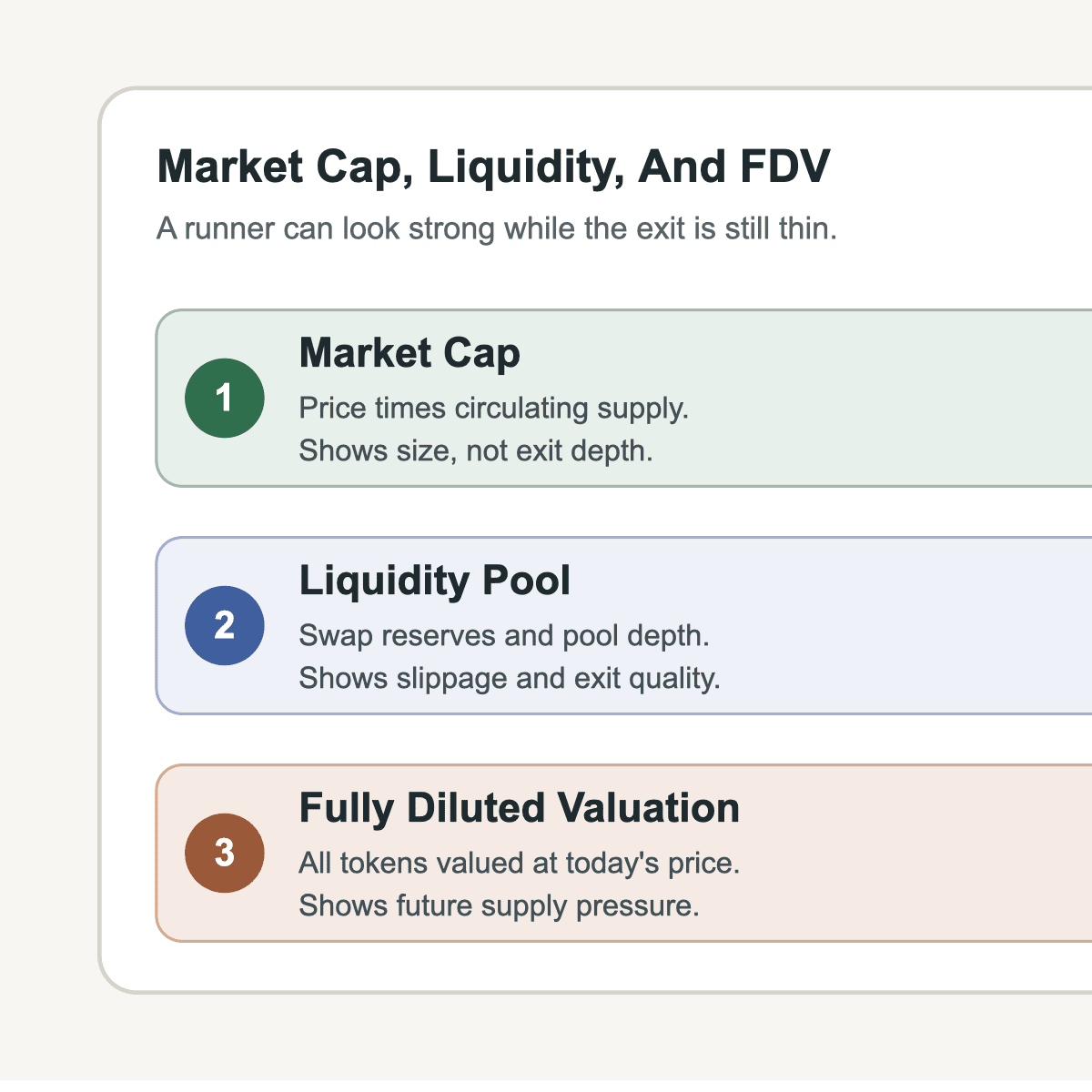
Market cap can make a token look tiny and exciting. Liquidity tells you whether a sale can actually clear. FDV adds the future-supply problem, especially when circulating supply is low and scheduled supply releases may arrive later.
So do not read a microcap runner by the green candle alone. Check whether the pool can absorb your exit, whether slippage is already ugly, and whether future supply can dilute today’s excitement.
A microcap runner can crash fast because the same thin market that fuels the pump also weakens the exit. When attention fades or sellers appear, there may not be enough demand to absorb them.
The clean version is simple. Early wallets buy before the crowd, the chart rises, social posts multiply, and late buyers arrive. Then a few holders sell into that demand. If liquidity is shallow, the price can drop harder than the entry looked.
The risk can be obvious or slow:
Fake volume and wash-like activity can add another layer. A runner may look active because trades are firing, but independent demand still has to remain after promotion cools. If every new post sounds urgent and every sell gets shamed, the market may already be looking for slower exits.
The crash does not need a dramatic villain. Sometimes the move simply runs out of new buyers. Microcap charts often depend on a narrow stream of attention, and attention leaves quickly when another ticker starts moving.
That is why “it already pumped” is not proof of strength. It can also mean the easy liquidity has already been used. Before chasing the second candle, ask whether fresh buyers are still arriving for a reason beyond the candle itself.
Checking a microcap runner before buying means slowing the trade down enough to separate a real setup from a trap. These checks do not make the trade safe. They only remove the most obvious bad reasons to hurry.
Start with the contract address, not the ticker. Fake tokens can copy names, symbols, websites, and profile pictures. The contract is the identity. If you get that wrong, every other check starts from the wrong asset.
Then work through the practical risk stack:
Wallet hygiene deserves its own pause. A tiny token trade can expose much more than the amount you planned to risk if you sign bad approvals from a main wallet. Keep high-risk trading away from long-term holdings and use a safer wallet workflow when approvals, unknown contracts, or rushed swaps enter the picture.
Scanners and alert tools can help, but they are filters. They can flag liquidity, holders, taxes, contract traits, or sudden volume. They cannot prove honest intent, future demand, or your ability to sell when the next candle turns.
A microcap runner starts to look like exit liquidity when the trade depends more on new buyers than on any durable reason to hold. The chart may still rise, but the risk has shifted toward late entrants.
Watch the behavior around the move. Vertical candles, repeated shill posts, recycled profit screenshots, and a chat that gets louder as liquidity gets thinner are not strength by themselves. They may show that earlier holders need attention to keep arriving.
Common warning signs include:
The phrase exit liquidity means late demand that lets earlier sellers leave. In microcaps, that can happen quickly because small pools cannot absorb many exits at once, especially when top wallets bought early and start trimming into public hype.
The end state is the bagholder outcome: a wallet still holds the token, but the market has moved on, liquidity is worse, and the old reason to buy has become a hope that someone later will care.
The warning is not that every rising microcap is doomed. The warning is that a runner becomes more dangerous when the pitch stops explaining why people want the token and starts demanding that nobody sell. Markets do not owe loyalty to a group chat.
So look for independent demand. If the only fuel is pressure, shame, urgency, and screenshots from earlier entries, the setup is probably less about discovery and more about distribution.
Sizing a microcap runner starts with the amount you can lose without changing your week. If that sentence feels too boring, the position is probably already too large.
This part of the market can produce large percentage moves, but percentages are emotional bait. A 200% candle means little if you entered late, cannot sell size, or doubled down after the move failed.
Use rules before the chart starts arguing with you:
The useful mindset is boring by design. A microcap runner should not decide your rent, your long-term holdings, or your mood for the week. If it can, the trade is too large.
Profit-taking also needs a plan. Waiting for the perfect top can turn a fast win into a slow lesson. In microcaps, the exit door often gets narrower after everyone notices it.
Think in dollars, not only percentages. A tiny position that triples may still be a small win. A large position that drops 60% can damage the rest of your plan, even if the chart looked like a perfect setup for five minutes.
The cleanest rule is written before entry. Decide what you will sell into strength, what breaks the trade, and where the proceeds go if the move works. If those answers are blank, the position is not a plan. It is a mood with a ticker.
Microcap runner examples are best understood as scenarios, not recommendations. Naming live tokens can turn education into promotion, and this corner of crypto already has enough people yelling tickers.
A meme launch can become a runner when a joke spreads, liquidity appears, and early charts pull in attention. The move may have no product behind it, but the market can still react to speed, humor, and group energy.
Other runner setups show up in different clothes:
The common thread is attention meeting a small market. The reason can differ, but the checks stay similar: liquidity, holders, supply, contract controls, and whether the move still has buyers after the first noise fades.
A utility-flavored runner deserves the same caution as a meme runner. Utility can support demand, but it cannot fix a shallow pool, a concentrated holder base, or a chart that already spent its best move before public buyers arrived.
That is why examples work better as patterns than picks. Look at what changed, who benefits from the move, and whether the token can survive a normal sell wave. If the setup needs constant promotion to stay upright, the example is teaching risk, not just upside.
Microcap runner myths usually make tiny tokens look easier than they are. The dangerous ones confuse cheap price, small valuation, active chat, and real liquidity.
Drop these before they get expensive:
Turn every claim into a check. If someone says the token is early, check holder concentration. If they say liquidity is locked, check how much and for how long. If they say the chart is ready, check whether you are buying after the easy move.
Microcap runners are not magic. They are small, fast markets where information, liquidity, and incentives collide. That collision can create opportunity, but it can also create the cleanest-looking trap on your screen.
The biggest myth is that caution means missing every move. It does not. It means refusing trades where the only edge is being louder, faster, or more willing to ignore obvious red flags.
Good filters will make you skip some runners that keep going. That is fine. The goal is to avoid setups where one bad signature, one oversized entry, or one vanished pool makes the lesson much more expensive than it needed to be.
There is no official crypto threshold for a microcap runner. Many crypto references discuss microcaps around the sub-$10 million to sub-$50 million range, while traders use the term more loosely. The key is not the exact line. A runner is a small asset moving fast, usually with thin liquidity and higher exit risk.
No. A microcap runner describes a tiny token with fast price action or expected momentum. A low-cap gem is promotional language for a small token someone believes is overlooked. One describes movement. The other suggests quality or opportunity, sometimes without enough proof.
Sometimes, but not always at the price shown on the chart. Selling depends on liquidity, slippage, pool depth, taxes, contract behavior, and whether buyers still exist. A wallet balance can look valuable while the actual exit would crush the price.
Not all microcap runners are scams, but the category has high scam and manipulation risk. Some are normal speculative trades. Others involve bad contracts, fake liquidity, paid promotion, insider selling, or abandonment. The safer assumption is that every runner needs verification before exposure.
Traders usually watch DEX scanners, wallet activity, social channels, launchpads, and narrative rotations. That can identify activity early, but it does not prove safety. Early discovery should lead to checks, not instant buying. The first job is to avoid fake contracts and exits that barely exist.
No. A token under one cent is not automatically a microcap runner. Unit price means little without circulating supply. A token can look cheap per coin and still have a large market cap or FDV. Runner status comes from small size plus fast movement, not the number of zeros in the price.
Start with risk, not the chart. A microcap runner can be exciting because it moves quickly, but that speed is also why mistakes become expensive before you finish thinking.
Before opening a swap screen, write the trade in one line: why this token, where the idea breaks, how you plan to exit, and what you will do if slippage is worse than quoted.
Use this order before you touch a trade:
Run those checks in sequence. If liquidity fails, no price target fixes it. If the contract cannot be verified, the ticker is noise. If a main wallet holds long-term assets, do not let a rushed approval from a tiny token put the rest of the account in range.
Then decide whether the trade still deserves attention. Many microcap runners are worth watching and not worth buying. If the setup only works because someone else arrives later, faster, and less careful, you are not early. You are standing near the exit door.
That sounds harsh because the trade is harsh. A microcap runner gives you less time to think, less room to exit, and fewer reliable facts than a larger market. Slow the decision down before the market speeds it up for you.
The best next step may be no trade. If the setup still passes your liquidity, holder, wallet, and size checks, you at least know what risk you are choosing. If it fails them, the green candle can continue without your funds in the room.