Physical Address
304 North Cardinal St.
Dorchester Center, MA 02124
Physical Address
304 North Cardinal St.
Dorchester Center, MA 02124


Learn what mint authority controls before trusting a token's supply claim.
Mint authority is the permission on a Solana token mint that can create more units of that token, increasing supply.
You will usually see the phrase while checking a new Solana token, a meme coin, or a scanner result before buying. The real question is simple: can someone still create more supply after you enter, or has that power been removed?
That answer can change how you read a fixed-supply claim, a launch post, or a green scanner badge. Mint authority is not the whole risk picture, but ignoring it is how a “small position” becomes a lesson with tuition.
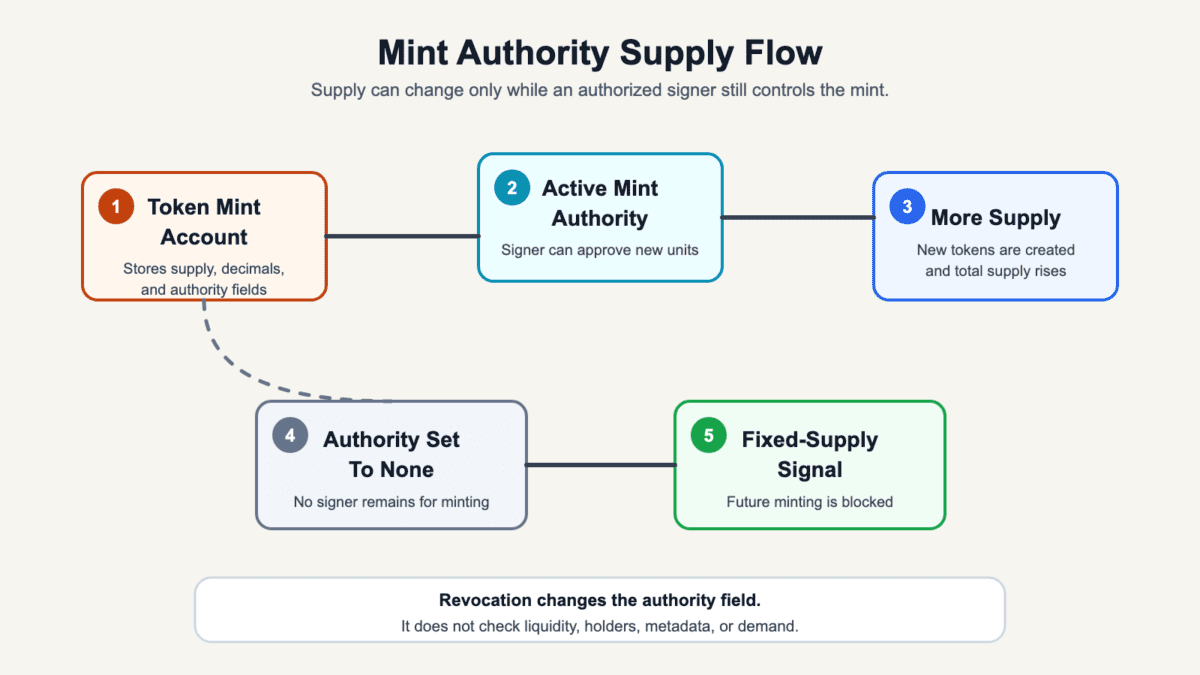
Mint authority on Solana is the address or signer allowed to create more units for a token’s mint account. If that authority is active, new tokens can still be minted when the authorized signer approves the transaction.
A mint account is the shared on-chain record for a token. It tracks fields such as supply, decimals, mint authority, and freeze authority. The official Solana Documentation separates this mint account from token accounts, which track who holds units of that token.
That split keeps the check precise. Mint authority is not wallet ownership. A project wallet can hold tokens without controlling future supply. A trader can hold a token account without controlling the mint. The mint authority field answers a narrower question: who can increase supply?
It is also not the same as liquidity, metadata, or freeze authority. Liquidity decides how easily buyers and sellers can trade. Metadata controls name, symbol, image, and related token presentation. Freeze authority can block movement from specific token accounts.
This language shows up most often around SPL tokens, including fresh Solana meme coins and utility tokens. The same buyer question stays the same across tools: does this mint still have a signer that can expand supply?
So the clean read is this:
For a buyer, mint authority is a supply-control signal. For a creator, it is a launch-design choice. For a scanner, it is one field in a wider risk set, not a magic verdict machine.
Mint authority changes token supply by letting an authorized signer approve minting instructions that create more units of the same token. On Solana, that usually means the mint authority signs a transaction using instructions such as MintTo or MintToChecked.
The result is not a new token. It is more supply of the existing token. If the market thought there would only ever be 1 billion units, and the authority later mints more, every existing holder now owns a smaller share of the token supply.
Because the change happens at the mint level, the new supply can affect every holder’s share of the token. The chart may not show the risk until the new tokens move into wallets, pools, or sell orders.
Status labels can vary by explorer or scanner, but the meaning is usually similar:
This is where fixed-supply claims get tested. A token can market itself as capped, fair, or scarce, while the mint account still shows active supply control. That mismatch is not a small footnote. It means the promise and the chain state disagree.
There are legitimate reasons to mint more tokens later, but they need plain disclosure. If supply is still meant to expand, users should be able to find the schedule, the controller, and the reason without solving a scavenger hunt.
Check mint authority before you buy a token because it tells you whether future supply can still be created after your purchase. For fast Solana launches, that can be the difference between a risky trade and a completely lopsided one.
The risk is dilution. If insiders can mint more tokens into thin liquidity, your share of the supply can shrink while sell pressure rises. That is especially ugly when a token sells a fixed-supply story, then keeps a live route to more supply.
This is one reason scanner-led traders put mint authority near the top of the pre-trade checklist. It sits beside freeze authority, liquidity status, holder concentration, and sell activity. A token can look exciting on a chart while still carrying a supply-control problem.
> If a token claims fixed supply while mint authority is active, slow down. The chart may be fast, but the contradiction is faster.
Active mint authority does not automatically prove a hard rug. Some tokens need future issuance for a stated purpose. But on a brand-new meme coin with anonymous control, thin liquidity, and no supply schedule, the warning deserves real weight.
The useful question is not “is this instantly a scam?” It is “what can the controller still do to supply, and did buyers get told clearly?” If the answer is unclear, the market is asking you to trust a lever you cannot see.
A good pre-buy check should connect the authority field with the project’s public claims:
That last point keeps the check honest. Mint authority answers supply risk. It does not bless liquidity, holders, metadata, or sellability.
Mint authority, freeze authority, and update authority control different parts of a token. Scanners often show them together because they all affect trust, but each one answers a separate question.
Mint authority is about supply. Freeze authority is about movement from token accounts. Update authority is about metadata, usually the token’s displayed name, symbol, image, or linked information. Close authority can also appear around token accounts, but it is not the main supply-risk field.
Use this table as a map before you read scanner results:
| Authority | What It Controls |
|---|---|
| Mint authority | Whether more units of the token can be created. |
| Freeze authority | Whether specific token accounts can be frozen, blocking token movement. |
| Update authority | Whether token metadata can still be changed. |
| Close authority | Whether a token account can be closed under its control rules. |
These fields can combine in nasty ways. A token may have revoked mint authority but active freeze authority. That means future supply may be capped, yet selected token accounts could still face movement restrictions.
Scanners compress these controls into small labels, which is convenient and dangerous. A green supply label can sit next to a red movement label. A clean metadata field can sit beside a live mint authority. Read each field as its own answer.
Another token may have active mint authority and mutable metadata. That creates two separate questions: can supply expand, and can the token’s presentation change after launch? The answers do not cancel each other out.
Read the fields in layers. Check mint authority for supply, freeze authority for movement risk, update authority for presentation risk, and liquidity controls for exit risk. A scanner that shows all four fields is helpful. A trader who understands the difference is harder to fool.
You check mint authority before trading by finding the exact token mint address, opening it in an explorer or scanner, and reading the mint authority field before comparing it with the token’s public supply claim.
Start with the mint address, not just a ticker. Tickers are cheap. Duplicate names are common. Fake pairs can borrow a logo, a symbol, and a loud chat without sharing the same mint account.
The workflow is quick once you know what to look for:
Do the check on the mint, not on a screenshot of a scanner. Screenshots age quickly, and launch posts can use stale or selective status. If a token migrates, relaunches, or changes pool routes, repeat the check on the current mint address.
This is part of the fast workflow traders call the trenches. The point is not to become a protocol engineer before every swap. The point is to avoid buying a token whose risk was visible in the first 30 seconds.
A simple example helps. Say a token page claims “fixed 1B supply” but the mint authority field is still active. That does not prove the controller will mint more. It does prove the fixed-supply claim is not fully backed by the current mint state.
Now flip the example. If the field is revoked, the supply-control branch is closed. That is useful. Then you keep checking. Is freeze authority also removed? Is liquidity deep enough? Are top wallets clustered? Can normal sells clear through the pool?
The mistake is stopping too early. A scanner badge is a starting point, not a seat belt.
Active mint authority means someone still has the power to increase token supply, so the risk depends on who controls it, what the project promised, and whether future issuance is disclosed. Context decides how severe the warning is.
For speculative meme coins, active mint authority is often a major red flag. These tokens usually sell scarcity, speed, and social belief. If supply can still change without a clear plan, buyers face dilution risk on top of ordinary chart risk.
The warning gets stronger when several conditions appear together:
But not every active mint authority is dishonest. Some token designs require future issuance. Stablecoin issuers may need to mint against reserves. Games may mint reward tokens. A migration may require controlled supply movement. Governance may approve emissions over time.
Disclosed use is the difference. A legitimate setup should explain why minting remains possible, who controls the signer, and what limits exist. Cleaner control paths include multisig, timelock, governance votes, published emissions, and public monitoring.
The risk also changes by market structure. Active mint authority on a deep, disclosed stablecoin model is not the same as active mint authority on a two-hour-old meme coin with one controller and a tiny pool. Same field, different blast radius.
Still, “legitimate use” should not become a fog machine. If a project keeps mint authority for future rewards, users should know how much can be minted, who approves it, and where changes will be announced.
That still does not remove risk. It just makes the risk inspectable. If future supply is part of the design, users should not have to infer it from a scanner field after the buy button already did its little victory dance.
Revoked mint authority proves only that the normal mint-authority path can no longer create more units of that token. It does not prove the token is safe, liquid, fairly distributed, or worth buying.
This is the green-check trap. A token can honestly show revoked mint authority and still have bad liquidity, concentrated holders, fake demand, mutable metadata, active freeze authority, or insiders ready to sell existing balances.
Use the boundary clearly:
| Signal | What It Does Not Prove |
|---|---|
| Revoked mint authority | Liquidity is locked, deep, or safe to exit. |
| Locked or burned LP | Holders are clean or demand is real. |
| Freeze authority revoked | Supply cannot change or metadata is immutable. |
| Low holder count | The launch is early, fair, or organic. |
| Strong volume | Sells are clearing normally or wallets are unrelated. |
Imagine a token with revoked mint authority and a tiny liquidity pool. The supply-control risk is lower, but a few large wallets can still sell into weak depth. The chart can fall hard without any new tokens being minted.
That is where exit liquidity enters the check. If buyers cannot leave without crushing the pool, revoked mint authority will not save them from being the last clean bid.
Revocation also does not burn existing insider balances. If insiders already hold a large share, they do not need to mint more tokens to hurt buyers. They can sell what already exists.
Metadata is another separate lane. A token can have capped supply while its image, links, or displayed identity remain changeable through metadata controls. That can confuse users after a launch, especially when copycat tokens and recycled brands appear.
The same applies to team behavior. A project can slowly bleed confidence through missed promises, insider selling, or vague “community” updates after launch. Revocation lowers one mechanical risk. It does not prevent every soft rug pattern.
So read revoked mint authority as a useful supply signal. Then keep moving through the remaining checks.
Creators should revoke mint authority when the token is meant to have fixed supply and all planned supply has already been minted. If future issuance is part of the design, transferring authority to safer controls may be better than pretending revocation fits.
For a simple fixed-supply meme coin, revocation is usually the cleaner trust step. Mint the final planned supply, verify the token details, then remove the mint authority so future minting is no longer possible through that role.
For tokens with ongoing issuance, revoking too early can break the plan. Rewards, migrations, stablecoin minting, treasury distribution, and game loops may need controlled future supply. In those cases, the problem is not active authority by itself. The problem is hidden or sloppy control.
Creators usually face three choices:
Transfer is the middle path many small teams miss. It does not remove future minting, but it can move control away from one private key. That helps only if the destination control is clear enough for users to inspect.
The wrong move is keeping one private signer while marketing the token as fixed, fair, or impossible to dilute. That asks buyers to trust a single key over the chain state. The chain state tends to win arguments.
Creators should also separate mint authority from other launch controls. Revoking mint authority does not remove freeze authority, lock liquidity, make metadata immutable, or prove holder distribution is clean. If a launch claims safety, each claim needs its own check.
The best builder habit is boring disclosure. Say why supply can or cannot change. Show who controls the authority. Explain what would trigger future minting. Boring is underrated when money is involved.
The most common mint authority mistakes come from reading one label as the whole truth. Traders either panic at every active authority, or they relax too much when one field turns green.
The first mistake is trusting a launch post over the mint account. A project can write “fixed supply” in a graphic while the authority field still says otherwise. The graphic is marketing. The mint account is the control surface.
Another mistake is checking the wrong asset. On Solana, similar names, duplicate tickers, and copycat pages can point users toward the wrong mint. If you verify the wrong mint, every later check gets cleaner and more useless at the same time.
A third mistake is outsourcing the check to social proof. A known wallet buying, an influencer posting, or an anon dev sounding confident does not remove supply control. Smart wallets can be early. They can also exit before you finish reading the thread.
Watch for these mistakes before you trade:
The smaller mistake is using a scanner. Scanners are useful. The bigger mistake is using one as a substitute for understanding the fields.
One more: do not assume a failed sell always means mint authority abuse. Sell failures can come from freeze authority, route issues, slippage, liquidity depth, token account problems, or interface errors. Mint authority is about supply, not every painful exit.
Once you know what mint authority controls, the label becomes less mysterious. It also becomes less comforting. That is the point.
Mint authority sits inside a wider language of token risk. The terms can blur together during a fast launch, but they point to different failure modes. Keeping them separate stops one clean scanner flag from covering a different problem.
A hard rug usually means immediate hostile action, such as pulling liquidity or abusing controls. Active mint authority belongs in that conversation only when the supply power is part of the threat.
Soft-rug risk is slower and messier. It often comes from insider selling, weak execution, broken promises, or trust decay after launch. Revoked mint authority does not stop that pattern, because insiders can still sell existing balances and confidence can still drain out of the chart one red candle at a time.
Exit liquidity describes the buyer side of the trap, where late demand gives earlier holders a way out. It is useful after a mint authority check because supply risk and exit risk can appear together, but they are not the same check.
The fast-trading environment adds pressure. Developer identity adds another layer, because anonymous control can make authority and liquidity risks harder to assess. A supply-control issue needs a supply-control check. A liquidity issue needs pool and sell-depth checks. A trust issue needs wallet, holder, and disclosure checks.
Keep the terms separate when you inspect a token. Mint authority answers the supply question. Liquidity answers the exit question. Holder distribution answers who can sell into you. Developer identity answers how much trust is being asked of you before proof appears.
Start with mint authority checks by verifying the exact mint address, reading the authority field, and comparing it with the token’s public supply story. Do that before the chart persuades you that speed is a substitute for inspection.
A practical check sequence is enough for most users:
If mint authority is active and the token claims fixed supply, pause. If authority is active for a disclosed reason, inspect the controls around it. If authority is revoked, keep going through the other fields instead of celebrating early.
For small trades, this may feel like too much work. That feeling is exactly why the check helps. Fast markets reward people who can reject bad setups before the chart starts negotiating with their ego.
For creators, start with the supply promise. Fixed supply usually points toward revocation after the final supply is minted. Ongoing issuance points toward better controls and clearer disclosure.
For buyers, the rule is simpler. Never let a token’s branding answer a question that the mint account can answer better.
Mint authority means the permission that allows an authorized address to create more units of a token. On Solana, the term usually refers to the authority stored on the token’s mint account.
The key check is whether that authority is active or removed. Active authority means future supply may still be created. Revoked, null, or none means the normal mint-authority path has been closed.
No, mint authority is not the same as freeze authority. Mint authority controls new supply, while freeze authority controls whether specific token accounts can be frozen.
A token can have one revoked and the other active. That is why scanners list them separately and why users should check both before trading.
In normal SPL token authority flows, mint authority cannot simply be restored after it has been set to none. Once no authority remains, there is no signer left for that mint-authority role.
That is why creators should plan supply before revocation. If future issuance is required, they may need a controlled transfer path instead of removing the authority too early.
No, revoked mint authority does not make a token safe. It lowers one supply risk, but it does not prove liquidity, holders, freeze authority, metadata, team behavior, or demand are safe.
Use it as one green signal in a wider checklist. If other controls look bad, the token can still be dangerous.
You know mint authority is revoked by opening the exact token mint address in an explorer or scanner and checking whether the mint authority field is null, none, or marked revoked.
Do not rely only on a launch post. Verify the mint address, then compare the field with the token’s public supply claim.