Physical Address
304 North Cardinal St.
Dorchester Center, MA 02124
Physical Address
304 North Cardinal St.
Dorchester Center, MA 02124


A moonbag is the small crypto position you leave after reducing risk.
A moonbag is a small crypto position kept after selling most of a trade or taking profits, usually to keep upside without risking the full position.
The term shows up most often after a coin pumps, a trader takes initials, or a meme coin holder wants one last shot at a wild move. Used well, a moonbag is planned leftover exposure. Used badly, it is just a bagholder origin story with better lighting.
Moonbag also creates real-world confusion because MoonBag, MBAG, and BAG can appear as token names or tickers. So the first job is simple: separate the slang strategy from any specific token page before money, wallets, or FOMO enter the room.
A moonbag in crypto is a remaining position kept after most of the original trade has been sold. The basic idea is simple: reduce the risk first, then keep a smaller piece in case the asset keeps running.
Traders often use the term after a sharp move. They may sell enough to recover the original stake, lock in profit, or move funds into a safer asset. The leftover position becomes the moonbag.
The common meanings split like this:
The cleanest strategy meaning is the disciplined one. The trader has already taken something off the table, so the remaining position is no longer carrying the whole trade.
That usually means four things:
The review rule does the heavy lifting. A moonbag is not smarter because it is small. It becomes useful when the trader has already reduced risk and can explain what would make them sell the rest.
The loose slang version is messier. People also call a tiny, hopeful holding a moonbag even when no profit was taken first. That usage is common, but it is less disciplined. If the position was never reduced, you may simply be holding a risky bag and hoping the chart gets charitable.
Moonbag strategy and MoonBag token pages can look almost identical at first glance. Lowercase moonbag usually refers to the trading slang. MoonBag, MBAG, or BAG may refer to a specific token, price page, ticker, or project name.
That overlap can send people down the wrong path. Someone trying to learn partial exits may land on a live token page. Someone researching a token may land on a strategy article and mistake general trading language for project research.
Here, moonbag means the trading term. It is not a claim about any MoonBag project. Token supply, liquidity, access, and contract details can change quickly.
> If you came here looking for a MoonBag token, verify the exact contract, chain, ticker, liquidity pool, and official channels before acting.
Default to the strategy meaning unless the page clearly names a specific asset. A trading term can teach you how people manage exits. A token page needs separate verification, because tickers and logos are cheap.
That early split prevents a common mistake. A person trying to learn profit-taking can end up reading a buy flow. A person trying to research a token can end up with generic slang. Neither route should be confused with actual due diligence.
A boring check works. If the page talks about contract addresses, presales, market cap, exchanges, or wallets, you are probably in token territory. If it talks about taking initials, trimming a position, and leaving a small amount behind, you are in moonbag strategy territory.
A moonbag works by turning a full position into smaller leftover exposure after the trade has moved enough to justify selling some of it. The usual sequence is entry, price move, partial exit, leftover position, then review.
Say a trader buys a low-cap token. The price rises sharply. Instead of selling everything or holding the whole amount, the trader sells enough to recover the initial stake and lock in some profit. Some proceeds may rotate into stablecoins, Bitcoin, or another setup, which is why bag rotation often sits next to moonbag talk.
The simple flow looks like this:
After that, the leftover can keep upside exposure if the token runs again. But it is not free money. The position still has opportunity cost, wallet risk, liquidity risk, and a sell decision waiting later.
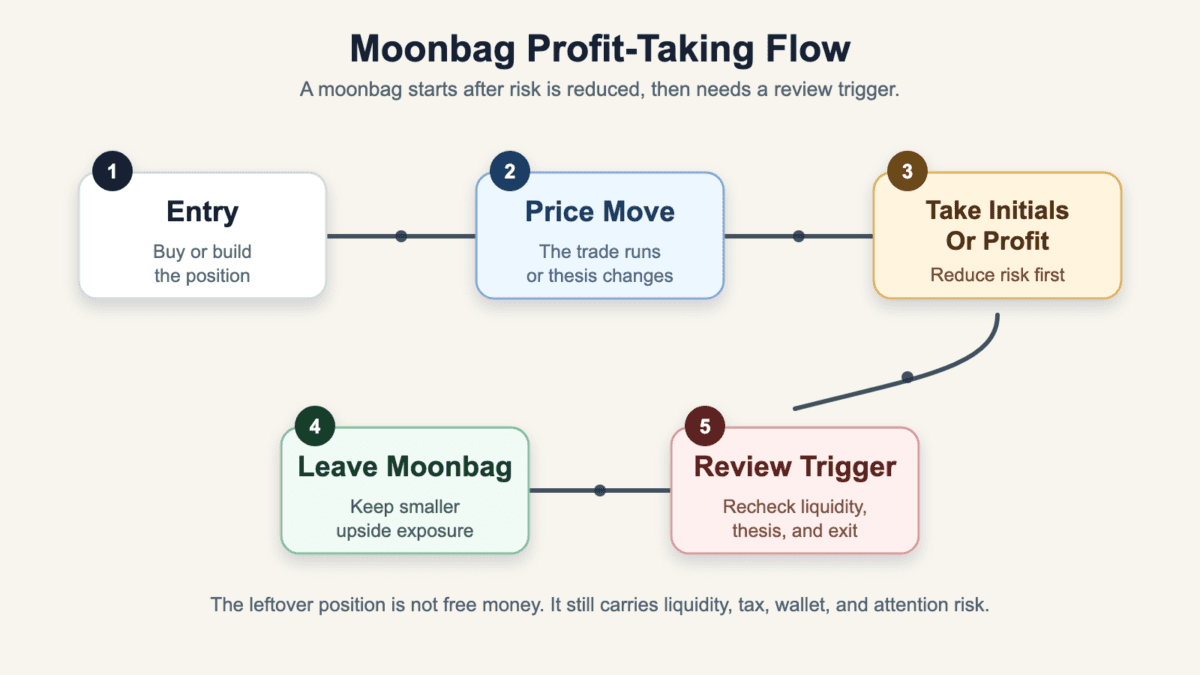
_A moonbag starts after risk is reduced, then needs a reason to keep existing._
There is also a tax wrinkle. In the U.S., selling or exchanging crypto can create capital gain or loss reporting obligations under the IRS digital asset transactions FAQ. The FAQ now runs through 111 numbered questions after Dec. 15, 2025 additions on sales, exchanges, transaction costs, and reporting.
That does not make a moonbag bad. It means records belong in the plan when the partial exit happens.
So the strategy is not “sell once and forget it.” It is a trade management choice. Take something off the table, keep a smaller amount if it still fits, and write down what would change your mind.
Traders keep a moonbag because selling everything can feel brutal when a coin still has momentum. The leftover position reduces the sting of watching a token run after a full exit.
That emotional role is real. Crypto moves fast, and social feeds can make every partial sale feel like cowardice. A small moonbag lets a trader stay exposed without keeping the entire position at risk.
There are valid reasons to keep one:
The trade-off is attention. A leftover position can calm FOMO, but it can also keep you staring at a weak chart long after the easy trade is over.
Crowded moves, late hype, and loud victory laps can all be warnings. If the chart already looks exhausted, a moonbag may be the compromise between a full exit and blind loyalty. The key is keeping the compromise small.
It also helps to separate regret control from strategy. Leaving a little behind can make the sell decision easier, but it should not become a rule that every token deserves a souvenir. Some trades end cleanly. Some coins lose the reason they were interesting. A moonbag should give you optionality, not a permanent excuse to babysit every chart that once looked alive.
Run a simple gut check. Ask what job the moonbag still performs. If it preserves upside after a planned exit, fine. If it only protects you from feeling wrong, the position may be managing your ego instead of your risk.
A moonbag becomes bagholding when the leftover position stops being a planned risk and turns into refusal. The trader no longer has a reason to keep it. They just dislike the idea of closing the story.
The warning signs are usually plain. Volume fades. Liquidity thins. The token loses attention. The original catalyst passes. Team communication disappears. The holder keeps moving the sell rule because selling would feel like admitting the trade is over.
The difference looks like this:
| Moonbag Behavior | Bagholder Behavior |
|---|---|
| Initial risk was reduced first | Full risk remains by accident |
| Position size is small and planned | Position size is too large to ignore |
| Exit trigger is written down | Exit rule changes after every dip |
| Liquidity is checked before holding | Liquidity is assumed until it fails |
| Thesis can still be explained | Hope replaces the thesis |
A disciplined moonbag can still lose money. The difference is that the loss is contained and expected. A bagholder is usually stuck with a position that now needs a miracle, a new cycle, or a louder group chat. Low liquidity makes the shift nastier because your leftover may become part of someone else’s exit liquidity problem.
The shift often happens quietly. The trader stops checking liquidity and starts collecting reasons to wait. Then the next sell rule becomes “after one more bounce,” and the one after that becomes “when the market comes back.” That is not a moonbag strategy anymore. It is a delayed exit with better branding.
Use one blunt test. If you would not open the same small position today with fresh money, ask why you are still holding it. Sometimes the answer is a valid thesis. Sometimes it is just nostalgia with a ticker.
A moonbag should be sized small enough that a total loss would not damage your portfolio, your sleep, or your next trade. There is no universal percentage that works across Bitcoin, large caps, fresh meme coins, and thin DEX launches.
The cleanest sizing starts with risk already removed. If you took initials or locked profit, the leftover can be smaller and easier to manage. If you never reduced risk, calling the position a moonbag may be too generous.
Before deciding the size, check the real constraints:
That last question is the useful one. A conviction-based position has a reasoned thesis. A moonbag may only be leftover upside after a trade already paid.
Sizing also changes by market type. A small leftover in Bitcoin or a large-cap token is not the same as a small leftover in a thin meme coin pool. In one case, the exit route may still be deep. In the other, the quote on the screen may be a polite fiction until you actually try to sell.
The right size should make the next decision easier, not harder. If the leftover is big enough to control your mood, it may still be too large. If it is so tiny that fees eat the exit, it may be better handled as dust, not a strategy.
Moonbags get riskier in meme coins and low-cap tokens because the market structure is fragile. A small position can still face thin liquidity, wide slippage, fake contracts, and fast-moving promotion.
Meme coin traders often use moonbag language after taking initials. That can be sensible. But low-cap markets can turn “let the rest ride” into “watch the sell route disappear” surprisingly fast.
The main risks cluster together:
> A meme coin label does not remove fraud risk, contract risk, or manipulation risk. It usually adds more ways to meet them.
A hard rug is the sharp failure case. Liquidity can be drained, selling can break, or control can be abused. A moonbag does not protect you from those mechanics. It only limits the amount still exposed if you sized it properly.
The quiet failure case is slower. The coin does not rug. It just loses volume, stops attracting buyers, and becomes hard to exit without accepting a worse price. That can be enough to turn a tiny leftover into an annoying portfolio chore.
So keep meme coin moonbags boring. Confirm the token address, check liquidity, test the sell route if needed, and avoid granting fresh wallet permissions just because the chart looks alive again.
A moonbag checklist turns the strategy from a feeling into a repeatable review. It cannot remove risk. It can stop hope from impersonating a plan.
Run through the checks before leaving the position alone:
The checklist should be stricter when the token is newer, thinner, or heavily promoted. It should also be stricter when the only reason to hold is that someone online said sellers are weak.
The order helps. Start with capital at risk, then move to execution risk, then wallet hygiene, then records. That keeps the review grounded in things you can actually check instead of whatever the latest candle is doing.
If the checklist feels annoying, that is useful information. A disciplined moonbag can survive a few boring questions. A bad one usually needs speed, pressure, and vibes to stay alive.
The final check is the sell trigger. Write it before the next pump or dump forces the decision. A moonbag without a trigger is just a future argument with yourself, and those rarely settle cleanly.
Related moonbag terms help separate planned exposure from stuck exposure. They are useful when they make the risk clearer, not when they become a word salad for holding longer.
Two nearby concepts are especially helpful when you are deciding whether a moonbag still deserves space:
Those concepts also keep nearby slang in its lane. A stuck holder, a bad exit path, a contract failure, and capital rotation are different problems. If you blur them together, every leftover token can start sounding strategic.
A trader may take profit, rotate proceeds elsewhere, and leave a small position behind. That is cleaner than calling every leftover token a strategy.
After the first big move, the distinction becomes practical. One trader may be managing a planned partial exit. Another may be stuck because the sell window closed. A third may still have a real thesis, but that thesis needs to be stated plainly instead of implied by hope.
Keep the terms separate. Crypto slang earns its keep when it makes risk clearer. It becomes expensive when every word becomes a permission slip to hold longer.
A moonbag in crypto is a small position kept after selling most of a trade or taking profits. Traders leave it to keep possible upside while reducing the larger risk.
The cleaner version starts after a partial exit. If the original risk was never reduced, it may be more accurate to call it a normal holding or a risky bag.
No. A moonbag is usually a planned leftover position after taking profit or reducing exposure. Holding a bag usually means being stuck with a position that has lost value or lost its original reason.
The line can blur. If the moonbag has no liquidity, no thesis, and no exit rule, it can turn into bagholding.
Moonbag can be a trading strategy term, while MoonBag, MBAG, or BAG may also appear as token or ticker names. The capitalization, context, chain, and contract address matter.
If you are researching a token, verify the exact asset. If you are learning the slang, focus on profit-taking, position size, and exit rules.
Leave only an amount you can afford to lose without changing your plan. A common approach is to reduce the position first, then keep a smaller piece that does not control your next trade.
There is no magic percentage. Liquidity, volatility, fees, portfolio size, and conviction all change the answer.
Yes. A moonbag can go to zero, especially in meme coins, low-liquidity tokens, or projects with contract and team-risk problems.
Small size limits damage. It does not remove market risk, rug risk, tax records, or the chance that nobody wants to buy the token later.
A moonbag strategy can help beginners understand partial exits, but it can also encourage sloppy holding. The beginner-safe version starts with tiny size, simple rules, and no borrowed money.
The goal is not to catch every pump. The goal is to reduce risk first, then decide whether a small leftover position still deserves space.
Start a moonbag strategy before the pump, not after the group chat gets loud. Decide what you will sell, what you might keep, and what would make you close the rest.
Use a short plan:
Write the plan while the trade still feels boring. Once the token is pumping, the timeline gets noisy and every decision starts pretending to be urgent. A simple sell rule is easier to follow when you made it before the chart started negotiating with you.
Then be boring about execution. If the moonbag still has a reason, keep it within the planned risk. If the reason is gone, close it or mark it as speculation.
Do not wait for the chart to make the plan for you. Charts are excellent at creating urgency and terrible at doing your bookkeeping. A written trigger, a realistic sell route, and a small position size make the strategy easier to follow when the market starts shouting.
The best moonbag is the one you can explain later without rewriting history. You reduced risk, kept a measured amount, and knew what would change your mind. Anything looser than that may still work, but it is not really a plan.