Physical Address
304 North Cardinal St.
Dorchester Center, MA 02124
Physical Address
304 North Cardinal St.
Dorchester Center, MA 02124


Learn what a multisig signer does before approving crypto movement.
A multisig signer is an authorized person, account, or device that can approve a transaction inside a multisig wallet.
That label sounds tidy until real funds enter the picture. A signer might be a hardware wallet in a drawer, a phone app, a smart-account owner address, or a teammate who controls a key. The label matters less than the approval power behind it. Bad backups, rushed clicks, weak devices, or absent humans can still turn good security design into expensive theater.
A multisig signer in crypto is any approved signing authority that can produce one valid approval for a multisig transaction. The signer may be controlled by a person, a hardware wallet, a mobile wallet, a desktop app, an institutional custodian, or a smart-account owner address.
The confusing part is that people use “signer” for several layers at once. In one sentence, it can mean the human responsible for approving. In another, it can mean the device holding the private key. In a smart-account wallet, it can mean an owner address listed in the wallet’s settings. The common thread is approval power, but the form changes:
A multisig wallet normally requires more than one valid approval before funds move or sensitive settings change. If Alice, Bob, and Cara are three approved signers in a 2-of-3 setup, any two of them can approve. One signer alone cannot complete the transaction. That is the promise: one stolen key should not be enough.
But the signer role also creates a duty. A signer who approves a malicious transfer is not a rubber stamp with vibes. They are part of the control system. If multiple signers trust the same fake screen, the threshold can still be reached. The clean definition helps, but the operational lesson is sharper: a signer is useful only when it is independent, recoverable, and careful at approval time.
A multisig signer fits into a wallet as one approval source in a larger spending rule. The wallet holds or controls the funds, signers approve movement, and the threshold decides how many approvals are enough.
That sequence matters. The wallet is the account or script that controls assets. The signers are the keys or owner addresses allowed to approve. The threshold is the rule, such as 2-of-3 or 3-of-5, that decides when the wallet can execute a transaction.
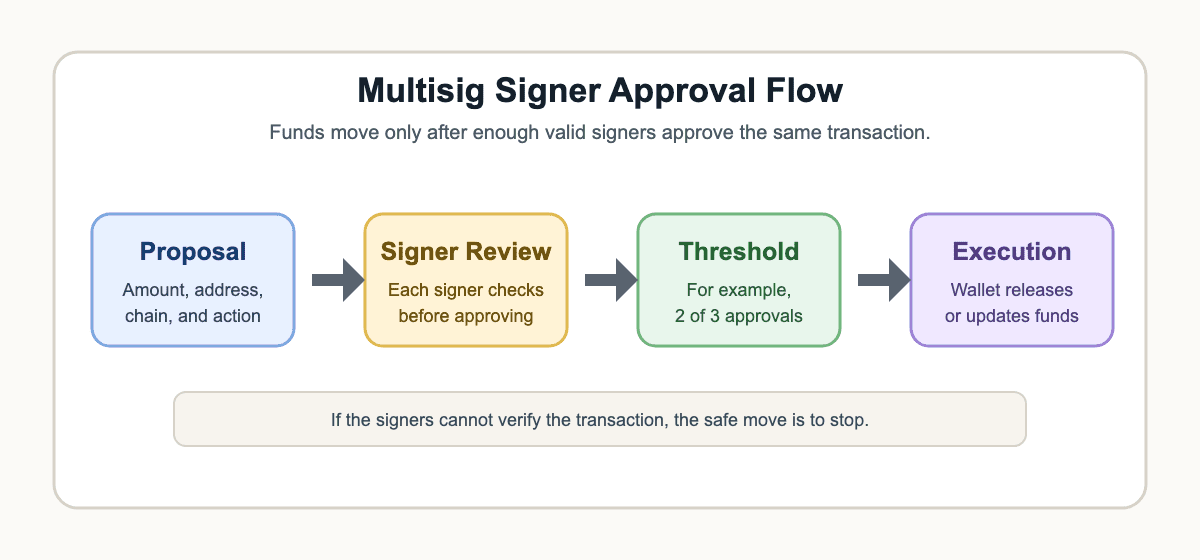
The approval flow usually looks like this:
Bitcoin and smart-contract wallets express this flow differently. A Bitcoin multisig setup may use a PSBT, or partially signed Bitcoin transaction, that signers review and sign before the signatures are combined. A smart-account wallet may show owner addresses, confirmation status, and an execute button once the threshold is met.
The details vary by chain and wallet stack. The risk pattern does not. A signer needs enough information to confirm the transaction, and the wallet needs enough valid approvals before it acts. So signer education comes before device shopping. If you do not understand where the signer sits in the flow, a shiny device only makes the mistake feel more professional.
A 2-of-3 multisig signer setup means three signers exist, and any two valid approvals can move funds or approve a wallet change. It is popular because it can survive one missing signer without letting one signer act alone.
Picture a long-term holder with three signer sources: a hardware wallet at home, a second hardware wallet stored elsewhere, and a trusted co-signer or backup device. If one signer is lost, the other two can still approve. If one signer is stolen, the attacker still needs another valid approval. The simple version is threshold math. The harder version is recovery.
| Situation | What It Means |
|---|---|
| One signer is unavailable | Two remaining signers can still approve if the threshold is 2-of-3. |
| One signer is stolen | Funds should not move unless the attacker also controls another signer. |
| Two signers approve | The wallet can execute, so both approvals must be checked carefully. |
| Wallet metadata is missing | Valid seeds may not be enough to rebuild the setup cleanly. |
| Two signers are lost | A 2-of-3 setup may become unrecoverable. |
The metadata caveat is where beginners get burned. A multisig wallet may depend on more than seed phrases. Bitcoin setups can need xpubs, descriptors, derivation paths, and wallet coordination files. Smart-account setups can need the right chain, owner list, threshold, and wallet contract address.
So the backup plan is not “store three seeds somewhere.” A serious setup documents the wallet policy, signer identities, recovery steps, and test process. Threshold math tells you how many approvals are needed. It does not remember your wallet details for you.
A multisig signer should check what the transaction does before approving it. That includes the recipient, amount, chain, token, contract action, and any change to the signer set or wallet permissions.
This is where multisig either works or becomes a group-clicking exercise. Multiple signers do not help much if all of them rely on one compromised web interface, one rushed chat message, or one vague “please approve” request. Before a signer approves, the review should cover:
A useful operator rule appears in Lido’s multisig signer guide: stop when the transaction purpose, destination, or signer action is unclear. The public guide is only eight general rules long, and that compactness is the point. Signers need checks they can actually follow when pressure rises. Boring saves wallets.
Pay extra attention to actions that change control:
Those changes can be more dangerous than a plain token transfer. The screen may look less dramatic, but the blast radius can be larger. Contract interactions are also harder than transfers because a signer may see a method name, calldata, or simulation result instead of a simple send.
If the signer cannot explain what the transaction does, they should not approve it just because another signer is waiting. Teams should separate proposal creation from approval pressure with a plain-language summary, a verified address source, and an independent confirmation channel. A signer can still pause. That pause is not bureaucracy. It is the job.
A hardware wallet, phone, desktop app, smart-account owner, or institutional co-signer can be a multisig signer if it controls an approved signing key or owner account. The right choice depends on value at risk and how clearly the signer can verify transactions.
Hardware wallets are common because they keep private keys away from a general-purpose computer. Air-gapped signers go further by moving signed data without a live USB or Bluetooth connection. Phones and desktop wallets can be convenient, but convenience is not a security model by itself.
| Signer Option | Best Use Plus Weak Point |
|---|---|
| Dedicated hardware wallet | Good for high-value approvals, but the screen must show enough detail to verify. |
| Air-gapped signer | Strong isolation, but setup and recovery can be less forgiving. |
| Phone signer | Useful for lighter setups, but seed import and phishing risk need strict limits. |
| Desktop wallet | Flexible for PSBT or smart-account flows, but the computer is a larger attack surface. |
| Smart-account owner address | Useful on account-based chains, but owner changes and modules need careful review. |
| Institutional co-signer | Helpful for policies and controls, but it adds a service dependency. |
If you are comparing custody products rather than signer duties, CryptoProcent’s wallet tools hub covers that broader product layer. This section is narrower: what makes something fit for signer duty. Brand names can be useful examples, not magic words. Coldcard, SeedSigner, Ledger, Trezor, Passport, Nunchuk, Sparrow, and Safe all appear in multisig conversations, but the question is not which logo sounds safest.
A good signer generates keys safely, protects seed material, displays transaction details, supports backups, and fits the user’s recovery plan. A cheap secondary signer can still help if it protects the key and shows enough context to review. An expensive device can still fail the job if the human approves blindly. The signer is a system, not a shopping cart.
Multisig signer setups still fail when the people, devices, backups, or approval process all break in the same direction. The threshold can reduce one-key failure, but it cannot fix correlated mistakes.
The most common weakness is pretending the threshold is the whole plan. If all signers are stored in one room, backed up in one drawer, managed on one laptop, or coordinated through one compromised chat, the setup is less distributed than it looks.
> Threshold math is not a magic spell when all humans click the same bad link.
Failure usually comes from a few patterns:
Multisig also does not remove trust. If two authorized people in a 2-of-3 treasury approve an intentional drain, the wallet may work exactly as configured. That can look like a hard rug when funds leave fast and users learn the controls were not protecting them.
The fix is not paranoia. It is separation. Use different locations, avoid shared approval links, test recovery, document signer replacement, and make one signer responsible for stopping unclear approvals. Security improves when the setup gives people room to say no.
A multisig signer setup makes sense when the cost of one lost or stolen key is higher than the cost of slower approvals and more careful recovery work. It fits vaults better than impulse wallets.
Long-term cold funds, family custody, DAO treasury funds, company wallets, and protocol admin keys are common fits. In those cases, the goal is not speed. The goal is to make one compromised key, one lost device, or one unavailable person less disastrous.
The fit changes by use case:
Active traders should be careful. If you need to move funds during a volatile market, a bridge pause, or an urgent liquidation window, a clumsy multisig process can become a delay machine.
That is not a flaw for cold storage. It is a bad match for funds that need speed. A signer process should match the money’s job: slow and deliberate for vault funds, faster and smaller for active use.
Small hot wallets may not need multisig at all. A clean single-sig wallet, limited balance, and good device hygiene may beat a complex setup the user does not understand.
Before using multisig, ask what failure you are trying to survive. Theft, loss, family handoff, and team churn point toward signer separation. Fast trading, tiny balances, and casual testing usually point toward simpler controls. Multisig is strongest when the user can operate it calmly before stress arrives.
Multisig signer rotation means adding, removing, or replacing an approved signer after the wallet is already live. In most setups, the existing threshold must approve the change.
That approval requirement is the safety feature and the catch. If one signer is compromised, the remaining valid signers may need to approve a replacement. If one signer is simply gone, the setup must still have enough available approvals to rotate them out.
Common rotation triggers include:
All-signers-required setups can be brittle. A 3-of-3 wallet may feel strict, but a missing signer can block the very transaction needed to replace them. That is why many users prefer thresholds that tolerate one unavailable signer.
Rotation should also update the boring records. The owner list, threshold, wallet address, recovery notes, device labels, and signer responsibilities should all match the new setup. Old signer material should be retired cleanly so nobody keeps approving from a key the group thinks is gone.
Rotation should end with a test. After changing signers, send or approve a small transaction, confirm the new signer set, and update recovery notes. Do not wait for an emergency to discover that the new setup only works in a screenshot.
For teams, rotation is also a people process. A departing employee, inactive DAO signer, or family member who no longer wants the role should not linger forever because nobody planned the replacement. Good multisig signer rotation is routine maintenance, not drama reserved for the day something breaks.
Multisig signer privacy and OpSec are about reducing human attack surfaces. If attackers know exactly who signs, where they sign, and how approvals are coordinated, they get a map instead of a mystery.
Some signer information may be visible on-chain, especially in smart-account systems where owner addresses or transactions can be inspected. Human identities can also leak through governance posts, team pages, social accounts, or casual “I am a signer” comments.
Practical signer privacy is simple:
A doxxed signer can face phishing, pressure, impersonation, or targeted social engineering. Public accountability can be useful for DAOs, but it should not mean publishing routines, devices, locations, or backup habits.
The communication channel deserves as much care as the devices. A fake proposal link in the main chat can reach every signer at once. A second-channel confirmation, saved address source, or independent explorer check gives the group a way to break that pattern.
The goal is not to act mysterious for sport. The goal is to make compromise harder to coordinate. If every signer receives the same fake request in the same channel, the setup is quietly acting like one nervous signer.
Public signers can still be useful, especially when a DAO wants accountability. The safer compromise is to publish the role without publishing the routine. Names may be public, but signing locations, backup habits, device models, and emergency contacts should stay private.
Multisig signers can prove that a wallet requires approved signing authority before certain actions happen. They cannot prove the signers are independent, honest, reachable, skilled, or immune to pressure.
That distinction is useful when evaluating projects and treasuries. A multisig badge can show that one private key is not supposed to control everything. It does not show who controls the signers, whether they coordinate privately, or whether admin powers can still be abused.
A multisig setup cannot prove:
For investors, the follow-up questions are plain. Who are the signers? How many approvals are needed? Are there timelocks, public proposals, audit trails, or spending reports? Can one insider influence enough signers to move funds anyway?
That last point is where multisig confidence gets slippery. A project can avoid a dramatic theft and still bleed value through authorized treasury decisions, vague expenses, or slow extraction. That starts to resemble a soft rug when users discover the approvals were legal but the incentives were ugly.
So multisig is evidence of process, not proof of virtue. It can reduce one form of key risk, but it does not replace transparency, clear roles, timelocks, audits, or plain accountability. The badge tells you a rule exists. It does not tell you the humans behind it are using that rule well.
A multisig signer is not always the same as an MPC approver. Multisig usually means multiple visible approvals, keys, owners, or smart-contract rules. MPC, or multi-party computation, can let several parties jointly produce one signature without assembling one full private key.
The user-facing experience may look similar: more than one party must participate. The technical path and audit trail can differ. Multisig often exposes the approval rule in the wallet, script, or smart contract. MPC may hide more of the coordination behind a signing service, device policy, or institutional workflow.
| Model | Plain Difference |
|---|---|
| Multisig signer | Multiple approved signers or keys meet a wallet threshold. |
| MPC approver | Multiple parties help create one valid signature through split key material. |
| Smart-account owner | An address or account has approval rights inside a wallet contract. |
| Institutional policy approver | A service may enforce approval rules before a transaction is signed. |
Neither model is automatically safer. Multisig can be transparent and understandable, but it may reveal signer structure and add on-chain complexity. MPC can improve privacy and operational flexibility, but users must understand the provider, recovery model, and policy controls.
The comparison also changes by chain. A Bitcoin multisig signer may work through PSBTs and wallet metadata. A smart-account owner may approve through a wallet contract. An institutional MPC approver may never look like a classic wallet signer to the user at all.
The main takeaway is vocabulary. A multisig signer approves under a multisig rule. An MPC approver participates in a different signing design.
Both can reduce single-person control when implemented well, and both can fail when people approve bad transactions. The setup still needs clear approval checks, recovery rules, and people who understand when to stop.
A multisig signer in crypto is an approved person, device, account, or wallet owner that can produce one valid approval for a multisig transaction. It is one part of the wallet’s spending rule, not the wallet itself.
Yes, a hardware wallet can be a multisig signer when it controls one of the approved keys. It still needs proper backup, clear transaction display, and a signer who checks before approving.
Yes, a phone can be a multisig signer if the wallet setup allows it and the phone controls an approved key or owner account. The tradeoff is higher exposure to phishing, seed import mistakes, and everyday device risk.
If one multisig signer is lost, the result depends on the threshold. In a 2-of-3 setup, two remaining signers can still approve, but the user still needs wallet metadata and backups to recover cleanly.
Yes, many multisig signer setups allow signer changes later. The existing threshold usually must approve the change, so rotation is harder if too many signers are missing or compromised.
No, a multisig signer and an MPC approver are related but different. A multisig signer approves under a multisig wallet rule, while MPC participants can jointly create one signature through split key material.
Start a multisig signer setup by defining what the wallet is for. A treasury, cold-storage vault, family inheritance plan, and active trading wallet should not all use the same approval process.
Then choose the threshold before choosing devices. Decide how many signers exist, how many approvals are needed, and what failure the setup must survive. If the answer is “I just heard 2-of-3 is safer,” slow down.
Use this starter checklist:
Device choice comes after those basics. A hardware wallet, phone signer, desktop app, or institutional co-signer only helps if it fits the threshold, backup plan, and approval workflow. Buying devices first can make the setup feel finished before the recovery plan exists.
Someone also needs veto power. If a signer cannot explain a transaction, they should be able to stop the approval without being treated like a bottleneck. That is the point of having multiple humans in the loop.
Run one small test before storing meaningful funds. Then test the recovery notes while nobody is panicking. A signer setup that works only when the original installer is present is not a recovery plan. It is a dependency with a good haircut.
Multisig works best when it is boring, tested, and written down. The clever setup you cannot recover is not advanced. It is just a puzzle box with money inside.