Physical Address
304 North Cardinal St.
Dorchester Center, MA 02124
Physical Address
304 North Cardinal St.
Dorchester Center, MA 02124


A practical guide to path dependence in crypto markets.
Path dependence means the route matters: earlier events, prices, trades, adoption, or protocol states can change the final outcome.
In crypto, that route can be an entry path, a liquidity path, a leverage path, a network-adoption path, or a DeFi state path. The final chart may look tidy later. The middle decides who held, who sold, who got liquidated, and who became someone else’s exit.
Path dependence in crypto means the route to an outcome can matter as much as the final snapshot. Two users can see the same final BTC price, token price, or pool state and still end with different results.
An endpoint-only view asks, “Where did price finish?” A path-dependent view asks, “What happened before it got there?” That middle can include a liquidation wick, a thin exit, a panic sell, a forced rebalance, or years of adoption that made one network harder to displace.
Keep these two views separate before the crypto examples get messy:
The classic economics example is QWERTY-style lock-in: an early standard keeps winning partly because people, tools, and habits build around it. Crypto has its own version. It cuts faster because money, margin, liquidity, and attention can all move at once.
Path dependence usually shows up in three buckets:
That split keeps the phrase useful. Bitcoin network effects, leveraged trades, and AMM pool states are not the same thing. They are different places where sequence can change the result.
The takeaway is plain: a chart’s endpoint can hide the damage, choices, and constraints that appeared on the way. A clean candle after the fact may not show who survived the drawdown, who paid funding, who took poor execution, or who still had the liquidity to keep going.
Path dependence changes crypto investing outcomes because entry route, drawdown path, and exit pressure shape what a user can actually do. The same long-term view can feel calm for one investor and brutal for another.
Imagine two BTC buyers who both later see a higher price. One bought before a large drawdown and spent months underwater. The other used smaller staged buys and kept cash available during fear. The final price may reward both, but the route changed stress, confidence, tax records, and optionality.
That difference is not a moral scorecard. A conviction play still needs a route the holder can survive.
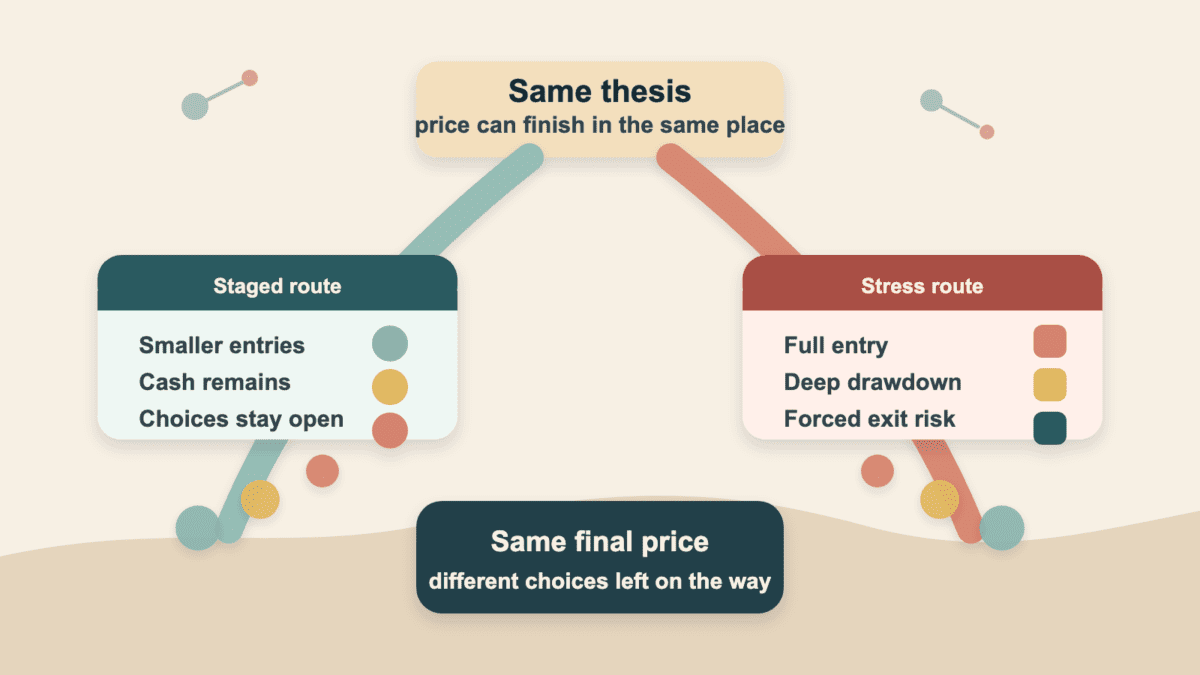
The common investor paths look different in practice:
| Investor Path | What The Path Changes |
|---|---|
| Lump-sum buyer | Takes full exposure early, so the first drawdown can test the whole thesis. |
| DCA buyer | Spreads entries, which can reduce timing pressure but may miss a sharp move. |
| Dip waiter | Keeps optionality, but can freeze if the market never offers the perfect entry. |
| Forced seller | Turns a temporary drawdown into a realized exit because cash is needed. |
| Tax-aware holder | May choose different lots or timing because selling has recordkeeping effects. |
The table shows why path dependence is more than timing dressed in nicer shoes. Timing is one part. The larger issue is whether the route preserves choices or removes them.
This is where bottom signals can help, but only as clues. Waiting for confirmation changes the path. It can reduce blind falling-knife entries, but it can also leave a user chasing after the recovery starts.
Path dependence does not say DCA always beats lump sum, or that waiting is always smart. It says the route changes risk, behavior, and flexibility before the final price gets its tidy screenshot.
Path dependence in trading is the reason a directionally correct idea can still lose money. With leverage, the trade must survive the path before the final move can help.
A trader might be right that an altcoin is overvalued and will fall later. But if price squeezes upward first, funding gets expensive, liquidity thins, and the liquidation price gets hit, the trade is gone. The later drop does not refund the mistake.
That is why path dependency in trading is harsher than ordinary volatility. The route can trigger constraints that spot holders do not face.
Watch the path-sensitive pressure points:
> A correct price view can still fail if the path hits liquidation before the thesis plays out.
Short-term crypto markets often feel like PVP trading because one user’s stop, liquidation, or panic exit can become another user’s fill. That adversarial setup makes the route more than background noise.
Path-dependent options are the finance textbook cousin here. Some options depend on the price path, not only the final price. Crypto perps, liquidations, and LP positions are different products, but the lesson carries over: the middle can decide the payoff.
Lower leverage helps only if the route still leaves room for error. Know the path that can close the trade before the idea has time to work.
Path dependence in Bitcoin means its history can compound into real market advantages. First-mover status alone is not the whole story, but early survival gave the market time to build around BTC.
That path includes liquidity, exchange listings, wallet support, hashrate, custody products, brand recognition, developer attention, and social trust. Each layer makes the next one easier. A later coin may have a cleaner feature list and still face a harder adoption path.
This is where path dependence in economics and path dependence in business translate cleanly to crypto. Switching costs are not only software settings. They include liquidity, habits, regulation, accounting systems, collateral policies, and the mental default that many users already have.
Forces that can compound over time include:
None of that proves Bitcoin always wins. It explains why “better tech” is not enough by itself. Markets do not reset to a blank spreadsheet every cycle. Annoying for pitch decks, useful for reality.
Capital can still move. Rotation in crypto shows how attention and liquidity shift between BTC, ETH, sectors, and smaller alts during different market phases. Those rotations can form new paths, but they also reveal how hard durable adoption is.
So the balanced answer is simple: Bitcoin is path-dependent, but not invincible. The past can create inertia, not immunity.
Path dependence in DeFi appears when trade order, pool inventory, liquidity changes, or exit sequence changes the result. This is especially clear in automated market makers, or AMMs.
An AMM does not wait for a human market maker to quote both sides. It uses pool reserves and rules to price swaps. When swaps, deposits, withdrawals, and rebalances happen in different orders, the pool can end in a different state.
A recent arXiv paper on AMM-based markets found 25 distinct ETH/USDC pool cases where operation order had a measurable effect on the final state. That is the DeFi-native version of path dependence.
Here is how that shows up for users:
| DeFi Situation | Why The Route Matters |
|---|---|
| AMM swaps | The order of trades can change pool reserves and execution prices. |
| LP inventory | A liquidity provider may end with more of the weaker asset after the path moves. |
| Bonding curves | Earlier buys can move the curve for later buyers before the token trades elsewhere. |
| Yield exits | Rewards can look attractive until liquidity thins when many users exit together. |
| Oracle or collateral changes | State updates can affect borrowing, liquidations, or pool behavior before users react. |
The table is not an argument that every AMM user needs a math proof. It shows why final token prices can be too simple.
Late exits are the human version. If liquidity gets thin before a user leaves, that user may become exit liquidity for faster sellers. The path changed who absorbed the bad trade.
LPs should care because pool value is not only about where two token prices finish. It also depends on trade order, inventory mix, fees earned, rewards claimed, slippage, rebalancing, and whether the exit path remains open when they need it.
Checking path dependence means asking what can hurt you before your thesis gets a chance to be right. The question is not only, “What happens if price reaches my target?”
Start by mapping the route. A spot investor needs a plan for drawdowns and forced selling. A trader needs liquidation and funding math. A DeFi user needs liquidity, contract, bridge, oracle, and exit assumptions.
Use this checklist before sizing a position:
Start with the forced-exit question. If a position can survive only when the route is smooth, the position is fragile. Crypto routes are rarely smooth. They prefer stairs down, elevators down, and occasional trapdoors.
Write the path before the trade. For a long-term holding, that can be a simple plan for staged entries, maximum exposure, and when to stop adding. For a leveraged trade, it means knowing the liquidation level before the position opens. For DeFi, it means testing the exit path, not only the deposit screen.
This work will not make every outcome comfortable. It turns hidden constraints into visible ones, which beats hoping the final chart forgives everything.
Path dependence does not mean destiny. It does not predict the next candle, prove old projects deserve to win, or turn hindsight into a trading signal.
The concept is useful because it shows how earlier choices and market states can shape later outcomes. It becomes useless when users apply it to every trend, every winner, or every loss. Then it is just academic confetti.
The clean split is below:
| Bad Reading | Better Reading |
|---|---|
| The old winner always wins. | Early advantages can compound, but shocks and better paths can still form. |
| The past predicts the next price. | The past can shape constraints, incentives, and liquidity. |
| Every trend is path dependence. | The sequence must change the outcome, not merely precede it. |
| Timing the market is the same thing. | Timing is one path input, not the whole concept. |
| A stuck bag is justified by history. | Lock-in can explain inertia without making the position good. |
This distinction protects users from lazy certainty. A project can benefit from path-dependent adoption and still lose relevance. A trader can understand route risk and still be wrong. A DeFi pool can be path-sensitive without being dangerous by default.
Path dependence can also explain bagholder risk when a user stays after the easy exit disappears. That does not mean the user was doomed from the start. It means the route removed choices slowly, then all at once.
Use the concept as a risk lens. It helps users ask sharper questions about route, constraints, and optionality. It does not answer the market for them.
Several adjacent concepts make path dependence easier to understand. They are not synonyms, but they often create or amplify path-dependent outcomes in crypto.
Network effects are one mechanism. A network becomes more useful as more users, liquidity, tools, and integrations gather around it. That can make later competitors work harder for the same trust.
These next concepts are useful when the article’s examples move from theory into market behavior:
These terms work best as a toolkit. A Bitcoin example may rely on network effects and switching costs. A leveraged trade may rely on liquidation and funding. An AMM example may rely on liquidity depth, slippage, and pool state.
The mistake is forcing every example through one term. A network can be path-dependent without involving leverage. A trade can be path-dependent without creating a durable network. A pool can be path-dependent because of state changes, even when the user never thinks about economics theory.
The core question stays the same: did the route change the choices available later?
Path dependence in crypto means the sequence of earlier prices, trades, liquidity changes, adoption, or protocol states can affect the final outcome. A user may see the same final price as someone else but experience a different result because their entry, drawdown, liquidation risk, or exit path was different.
Yes. Bitcoin is path dependent because its early survival, liquidity, hashrate, wallet support, exchange access, and social trust helped create advantages that later assets must compete against. That does not mean Bitcoin is guaranteed to win forever. It means the market path around Bitcoin affects how hard displacement becomes.
Network effects are one way path dependence can form. A network becomes stronger as more users, tools, liquidity, and attention gather around it. Path dependence is broader. It can also come from liquidation paths, trade order, switching costs, liquidity exits, protocol state, or investor behavior.
Yes. A trade can be directionally right later and still lose if the route hits liquidation, funding costs, slippage, or a forced exit first. This is common in leveraged markets because survival depends on the path, not only the final price direction.
No. Path dependence means history can create inertia, switching costs, liquidity advantages, and trust. It does not mean old projects are automatically better or permanent. New paths can form after technical improvements, incentive changes, regulatory shifts, security failures, or user migration.
No. Timing the market is one part of path dependence, mainly around entry and exit. Path dependence also includes liquidity, leverage, network effects, protocol state, forced selling, and DeFi operations. The route can matter even when a user is not trying to pick the perfect top or bottom.
Start with path dependence by mapping the route that can hurt you before the endpoint looks good. The work is simple. The discipline is less simple, because every chart is friendlier after the dangerous middle has disappeared.
Pick the version that matches your exposure first. A spot holder, a perp trader, and an LP can all use the same concept, but they are not checking the same failure point.
Use these actions before adding risk:
Then match the check to the position. Spot holders should focus on drawdown, cash needs, and exit planning. Traders should focus on liquidation, funding, and slippage. DeFi users should focus on pool state, liquidity, contract risk, and whether exits can close when everyone wants the door.
If the answer is vague, reduce the size or slow the action. A plan that only works in the final screenshot is not a plan. It is a hope with a chart attached.
Path dependence is not a fancy way to sound cautious. It is a reminder that crypto rarely pays users for ignoring the middle. If the route can break the plan, it belongs in the plan.