Physical Address
304 North Cardinal St.
Dorchester Center, MA 02124
Physical Address
304 North Cardinal St.
Dorchester Center, MA 02124

A plain-English guide to RWA crypto, tokenized assets, rights, and risk.
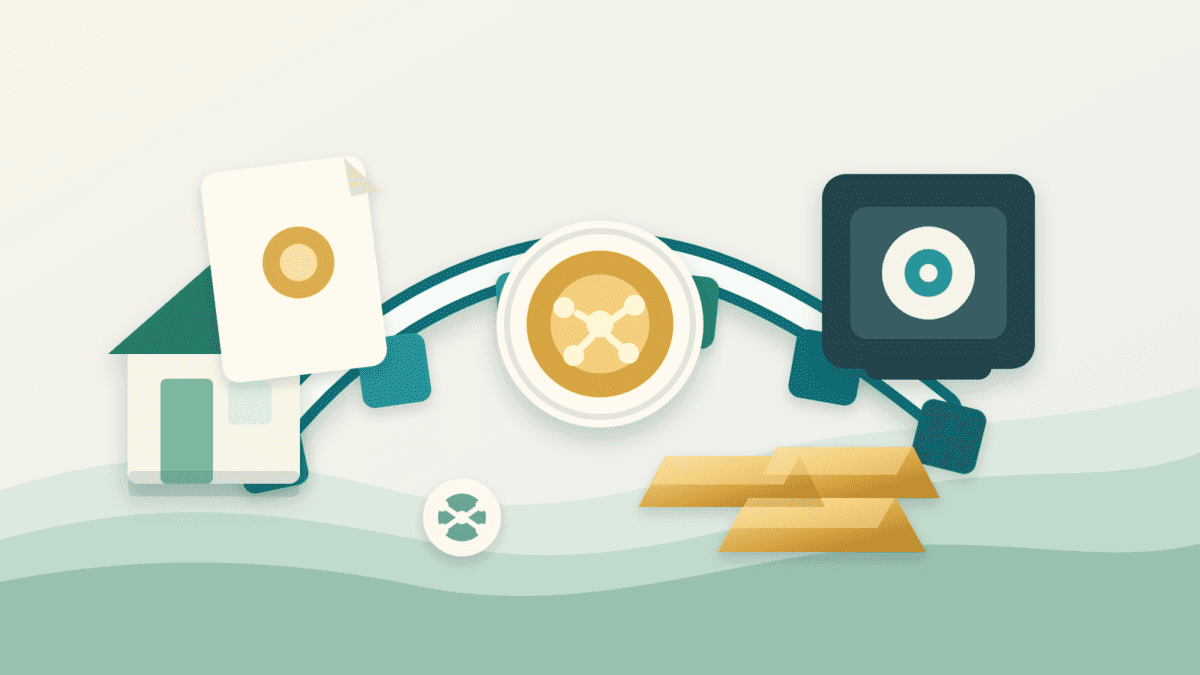
RWA means real-world assets in crypto, usually tokens that represent offchain assets, rights, or exposure such as Treasuries, stocks, gold, property, private credit, invoices, carbon credits, or cash-equivalent reserves.
The phrase sounds simple until a token enters the chat. An RWA token is only as strong as the issuer, custodian, legal wrapper, redemption terms, liquidity, and data behind it.
It might be a claim on an asset, a share of a fund, a receipt, a debt claim, a protocol token, or only a market story with an RWA badge taped to it.
RWA in crypto means real-world assets connected to blockchains through tokens, records, contracts, or DeFi markets. The asset itself usually stays offchain. The blockchain records ownership, transfers, restrictions, or claims linked to that asset.
That puts RWA in a different box from native crypto assets like BTC or ETH. Bitcoin is not backed by a warehouse, bank account, fund, or loan book. An RWA token usually points outside the chain to something that must be held, valued, serviced, insured, audited, or redeemed.
Simple examples make the idea less slippery:
In each case, the token is the onchain part of a wider structure. The asset, legal claim, cash flow, and enforcement path still depend on people and institutions.
Yes, the token can move on a blockchain. No, that does not make the office building, gold bar, loan agreement, or fund administrator magically decentralized.
So the RWA crypto meaning is best understood as a bridge. One side is crypto rails. The other side is legal paperwork, custody, asset servicing, and market demand. If either side is weak, the bridge wobbles.
RWA tokenization exists because some offchain assets are slow, expensive, restricted, or hard to move across digital markets. Tokenization tries to put ownership records, transfer rules, settlement, and asset economics into a format that wallets and smart contracts can use.
The serious case is modest. A token can make certain records easier to transfer, split, verify, or plug into DeFi. That can help when an asset normally sits inside a slow broker system, private fund, custodian account, or paper-heavy vehicle.
The useful parts come with caveats:
RWA tokenization gets attention from both crypto users and traditional finance firms because it promises better rails for assets that already exist. But rails are not the cargo. A fast train still needs cargo that exists, clear ownership, and a route that actually reaches the station.
For users, the useful question is narrow: does tokenization improve access, settlement, transparency, collateral use, or redemption for this asset? If the answer is vague, the token may be selling a wrapper more than a product.
RWA tokenization works by linking an offchain asset or claim to an onchain token through legal, custody, issuance, data, and redemption steps. Smart contracts can automate token movement, but they do not remove the offchain dependencies.
The process usually starts with an asset. That asset might be a Treasury bill, fund share, commodity, property interest, loan, invoice, or reserve asset.
Then an issuer creates a legal wrapper, such as a fund, trust, company, or special purpose vehicle. That wrapper defines who owns what and what token holders can claim.
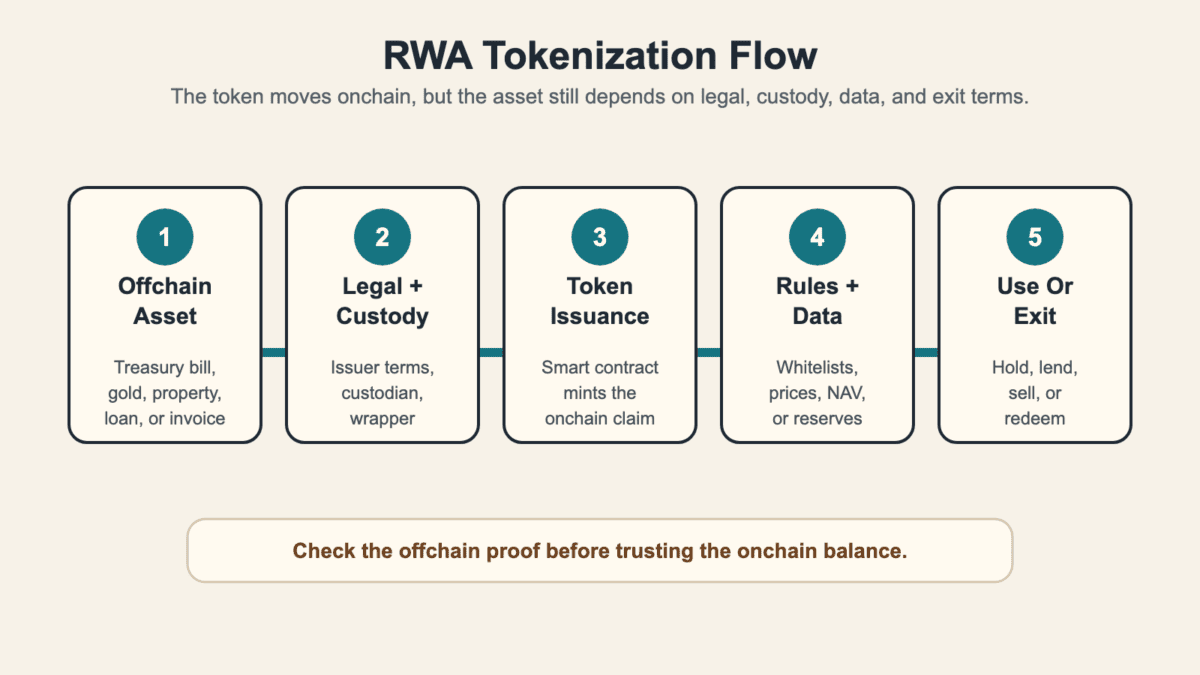
_A clean RWA flow starts with the asset, then checks the legal and custody path before the token reaches wallets or DeFi._
The issuer or a custodian then handles the asset. A custodian may hold securities, gold, cash, or records. A loan servicer may collect payments. An administrator may calculate net asset value.
Then an oracle or data provider may push prices, reserves, yields, or fund values onchain.
Here is the basic workflow to inspect:
| Step | What The User Should Check |
|---|---|
| Choose The Asset | What asset backs the token or drives the exposure? |
| Create The Wrapper | Which legal entity gives token holders rights? |
| Appoint Custody | Who holds the asset, cash, keys, or records? |
| Mint The Token | Does supply match the documented claim or exposure? |
| Control Transfers | Are wallets whitelisted, KYC checked, or restricted? |
| Update Data | Who supplies prices, reserves, NAVs, or payment data? |
| Handle Redemption | Can holders redeem, sell, or only wait for a market? |
The workflow has one catch: each step can fail differently. A strong smart contract does not save a weak custodian. A trusted custodian does not fix vague redemption terms. A good legal wrapper does not create liquidity when nobody wants the token.
Read RWA tokenization as a chain of dependencies. The token is visible. The real risk is often one layer behind it.
An RWA token gives you whatever the issuer’s terms say it gives you. That may be ownership, a beneficial interest, a debt claim, a fund share, a redeemable receipt, revenue exposure, governance exposure, or synthetic tracking.
Two RWA tokens can look almost identical inside a wallet and still give holders very different rights. One may be redeemable for cash through an approved account. Another may only trade on a secondary market.
A third may be a governance token for a protocol that serves RWA issuers, not a tokenized asset itself. That difference becomes sharp with tokenized stocks, where voting rights, dividends, shareholder status, market hours, transfer rules, taxes, and insolvency treatment all depend on the terms.
| Token Type | What You May Actually Hold |
|---|---|
| Direct Ownership Token | A recorded claim to a specific asset or legal title. |
| Beneficial Interest | An indirect interest through a trust, fund, or vehicle. |
| Debt Claim | A right to payment from a borrower or issuer. |
| Fund Share | Exposure to a portfolio managed by a fund structure. |
| Redeemable Receipt | A token that can be exchanged under stated rules. |
| Governance Token | Influence or economics around an RWA protocol. |
| Synthetic Exposure | Price tracking without direct asset ownership. |
Wallet access is also not enough. Some RWA tokens need approved addresses, KYC checks, country restrictions, or specific custody routes.
A token may appear in a wallet but still be frozen, non-transferable, or useless outside an approved venue. Basic crypto wallets knowledge helps, but the issuer’s transfer rules matter more than the wallet app.
Before you read any RWA token as “I own the asset,” find the rights document. If the token terms cannot explain ownership, payment rights, redemption, transfer limits, and failure treatment in plain language, the wallet balance is only part of the story.
RWA asset types include cash-equivalent reserves, tokenized Treasuries, funds, commodities, stocks, private credit, real estate, invoices, carbon credits, art, and collectibles. The asset category changes the failure mode.
Fiat-backed stablecoins are often discussed beside RWA because they rely on reserves such as cash, bank deposits, Treasury bills, or similar instruments. Tokenized Treasuries are clearer examples of onchain exposure to traditional financial assets.
As of June 22, 2026, RWA.xyz listed $26.71 billion in distributed asset value while showing stablecoins as a separate category. One headline RWA number can mean several different things, so use categories before tickers:
| RWA Category | Main Question To Ask |
|---|---|
| Stablecoins | What reserves back the token, and who can redeem? |
| Tokenized Treasuries | Is it a fund share, claim, or protocol wrapper? |
| Gold Or Commodities | Where is the asset stored, and who audits it? |
| Tokenized Stocks Or ETFs | Do holders get dividends, votes, or only tracking? |
| Real Estate | Is there legal title, income share, or company exposure? |
| Private Credit | Who owes money, and what happens after default? |
| Invoices Or Receivables | Who pays, when, and what if they do not? |
| Carbon Credits | Which registry, retirement rule, and verification standard applies? |
The point is not to memorize every category. The point is to stop treating RWA as one clean bucket. A tokenized Treasury product, a property-income token, and a private credit pool do not share the same liquidity, legal, tax, or default profile.
Crypto investors care about RWA because it can bring offchain yield, collateral, and asset exposure onto crypto rails. That can make DeFi less dependent on pure token emissions and more connected to bonds, credit, commodities, funds, and payment flows.
The attraction is easy to understand. Treasury yield can feel steadier than a farm token. Gold exposure is more familiar than a brand-new memecoin. Private credit, invoices, and real estate can create cash-flow stories that do not depend only on another token going up.
But every benefit carries a hitch:
RWA also gives DeFi builders new collateral and product ideas. A lending market can use tokenized Treasuries as conservative collateral if the token is liquid, whitelisted, valued well, and legally clean.
A stablecoin issuer can use reserves to support redemptions. A structured product can route offchain income into onchain accounts.
The investor trap is assuming the category thesis flows into every ticker. RWA adoption can rise while a protocol token underperforms. A tokenized asset can pay yield while its wrapper remains illiquid. The story can be right, and the trade can still be ugly.
RWA risks beginners miss usually sit outside the token contract. The dangerous parts are issuer failure, custodian failure, weak legal rights, bad data, redemption limits, thin markets, and marketing that makes “real” sound like “safe.”
Start with issuer risk. The issuer creates or administers the product. If it disappears, misreports assets, changes terms, loses licenses, or enters insolvency, token holders may face delays, freezes, losses, or legal uncertainty.
The token contract can keep running while the offchain claim gets messy. After issuer risk, scan the layers that often sit behind the wallet balance:
Fraud is the blunt version. A token can claim backing that is missing, overstated, pledged elsewhere, or never properly controlled. A fake-asset RWA can resemble a hard rug: the story says there is backing, but holders discover the claim was hollow.
Risk also changes by asset class. A Treasury fund, gold token, property share, private credit pool, carbon credit, and tokenized stock do not break the same way. The word RWA groups them for convenience, not safety.
RWA tokens and RWA crypto coins are not the same thing. A tokenized asset may represent a claim or exposure to an offchain asset. An RWA coin may be a protocol token, infrastructure token, governance token, chain token, or category trade linked to the RWA story.
Exchange category pages make the beginner trap easy. A list of RWA crypto coins can include tokens connected to tokenization, oracles, compliance tools, lending markets, institutional chains, and asset issuers.
Holding one of those coins usually does not mean you own a Treasury bill, stock, building, gold bar, or loan. Think of the split this way:
| What You Buy | What It Usually Exposes You To |
|---|---|
| Tokenized Treasury Product | Fund terms, issuer, custody, rates, and redemption. |
| Gold-Backed Token | Commodity custody, audits, fees, and redemption rules. |
| Private Credit Token | Borrower repayment, defaults, servicing, and legal recovery. |
| RWA Protocol Token | Protocol revenue, governance, token supply, and adoption. |
| Oracle Or Data Token | Demand for data services, not direct asset ownership. |
| Chain Or Infrastructure Coin | Network adoption and market narrative. |
| Synthetic Token | Price tracking and issuer risk, not direct ownership. |
RWA can also become a market narrative. Traders may rotate into anything with RWA branding because the category is hot, even when the token has weak direct exposure. That is closer to a narrative coin trade than a claim on real assets.
So avoid reading a ticker label as an ownership statement. Ask whether the token is the asset product, the issuer’s governance token, an infrastructure bet, or a synthetic tracker. The distinction decides what can go right, what can go wrong, and what you are actually holding.
RWA fits into DeFi by adding offchain assets, yields, and collateral to onchain markets. That can make DeFi more useful, but it can also make it more permissioned, more dependent on institutions, and harder to unwind during stress.
Common RWA uses include tokenized Treasury yield, stablecoin reserves, private credit pools, lending collateral, structured products, and asset-backed liquidity. A DeFi user might deposit a tokenized fund share, borrow against a permissioned asset, or hold a stablecoin backed by cash and Treasuries.
The useful cases are narrow:
The useful cases come with hard limits:
So RWA yield should not be blended with yield farming APY as if both come from the same machine. A farm reward may come from emissions. An RWA return may come from a borrower, Treasury bill, fund, or reserve strategy. Both can be real enough to lose money.
RWA can make DeFi more connected to traditional assets. It can also import traditional bottlenecks: compliance checks, issuer permissions, custodian hours, legal disputes, and boring paperwork. Crypto wanted real-world adoption. It got real-world paperwork too.
Research an RWA project by tracing the asset, issuer, wrapper, custodian, rights, data, liquidity, and failure path before you look at the token chart. Missing information is not a tiny footnote. It is a signal.
Start with the exact asset. “Real estate” is not enough. Which property, fund, jurisdiction, vehicle, and income stream? “Treasuries” is not enough. Which fund, custodian, administrator, fee schedule, and redemption rule?
“Private credit” is definitely not enough. Who borrowed, what collateral exists, and who collects if they default? Then move through this checklist:
| Check | Why It Matters |
|---|---|
| Exact Asset | Vague backing makes valuation impossible. |
| Issuer Identity | You need to know who created and controls the product. |
| Legal Wrapper | Rights depend on the fund, trust, company, or contract. |
| Custodian | The offchain asset must be held somewhere. |
| Holder Rights | Ownership, claims, yield, votes, and redemption differ. |
| Proof Documents | Audits, attestations, reports, and filings reduce guesswork. |
| Transfer Limits | KYC, jurisdiction, and whitelist rules can block exits. |
| Yield Source | Returns need a payer, not just an APY label. |
| Liquidity | A token is easy to display and sometimes hard to sell. |
| Failure Scenario | Know what happens if issuer, borrower, or custodian fails. |
Issuer transparency is especially important. If the team is anonymous, lightly disclosed, or hard to contact, offchain enforcement gets weaker.
An anon dev risk that might be tolerable in a meme experiment looks different when real assets, legal claims, and redemption promises sit behind the token.
Also check who gets paid. Issuers, brokers, custodians, administrators, chains, protocols, and market makers can all earn fees before token holders see clean returns. If the product cannot explain fees and incentives clearly, the chart may be cleaner than the economics.
Start with RWA by identifying the asset type first, then the rights, issuer, custodian, redemption path, and market liquidity. The ticker comes later. Sometimes much later.
That order keeps the research grounded. A Treasury product, a gold-backed token, a property-income claim, and a protocol token all wear the RWA label, but they do not answer to the same risks. Before a chart gets a vote, the structure should make sense in plain English.
Use this order before you spend serious time on any RWA token or coin:
For many users, understanding the structure is more useful than chasing the RWA ticker of the week. Tokenized assets can be a serious financial rail. RWA coins can also become theme trades with a shiny label and very little direct asset exposure.
After the checklist, compare the exit path with the sales pitch. If the token can trade 24/7 but redemption runs through business-hour approvals, that is not fatal. It is just a different kind of liquidity than a wallet screen suggests. If the product cannot explain who owes what, who holds the asset, and what happens after a failure, slow down.
The cleanest starting rule is simple: if you cannot explain what the token gives you, who owes you anything, and how you exit, you do not understand the RWA yet.
RWA means real-world assets in crypto. It usually refers to offchain assets, rights, or cash flows represented through tokens, legal wrappers, custodians, and onchain records.
Not always. An RWA token may represent direct ownership, a fund interest, a debt claim, a receipt, governance exposure, or synthetic tracking. The terms decide the rights.
Some stablecoins are treated as part of the RWA category because they rely on real-world reserves such as cash, bank deposits, or Treasury bills. Some dashboards separate stablecoins from other tokenized assets.
An RWA token may represent a claim or exposure to a real-world asset. An RWA crypto coin may only expose you to a protocol, chain, data service, or market narrative.
RWA tokens are not automatically safe. They can carry issuer risk, custody risk, legal risk, redemption limits, thin liquidity, smart-contract risk, bad data, and asset-specific losses.