Physical Address
304 North Cardinal St.
Dorchester Center, MA 02124
Physical Address
304 North Cardinal St.
Dorchester Center, MA 02124


The L2 fast lane, explained without the fog machine.
A sequencer is the rollup component that receives crypto transactions, orders them, and sends the ordered data toward a base chain.
If you use an L2, the sequencer is the part that makes the chain feel fast. That speed is useful, but it gives the sequencer real control over the first path your transaction takes. The main question is not only whether Ethereum settles the rollup later. It is who controls ordering now, what happens if that path fails, and whether you know the escape route before money is stuck.
A sequencer in crypto is a rollup or Layer 2 component that receives transactions, puts them in order, and helps prepare the ordered data for the base chain. It is not a music sequencer, a database counter, an exchange order book, or a generic validator. In this context, the word belongs to rollups.
The simplest version is this: you send a transaction to an L2, and the sequencer decides where that transaction sits in the local queue. The rollup may then execute the transaction, create an L2 block or batch, compress data, and post data or commitments toward Ethereum or another base layer.
Keep the one-minute version clean:
That ordering role is small in wording and large in effect. If a rollup feels cheap and quick, the sequencer is usually a big reason. If users worry about censorship, downtime, MEV, or one operator controlling the fast path, the sequencer is also where the argument starts.
That is why the term deserves more attention than it first gets. A sequencer sits between the button you click and the slower settlement path the rollup relies on. It can make an app feel smooth while also creating a control point users should understand before they bridge, trade, mint, or move serious funds.
A sequencer works inside a rollup by creating a fast local transaction path before the base chain finishes heavier settlement. This is why L2 apps can feel close to instant while still pointing back to Ethereum or another settlement layer.
A soft confirmation is the quick signal that the sequencer has accepted and ordered your transaction. It is useful, but it is not the same as final settlement. Think of it as a fast receipt, not the courthouse stamp.
The normal flow usually looks like this:
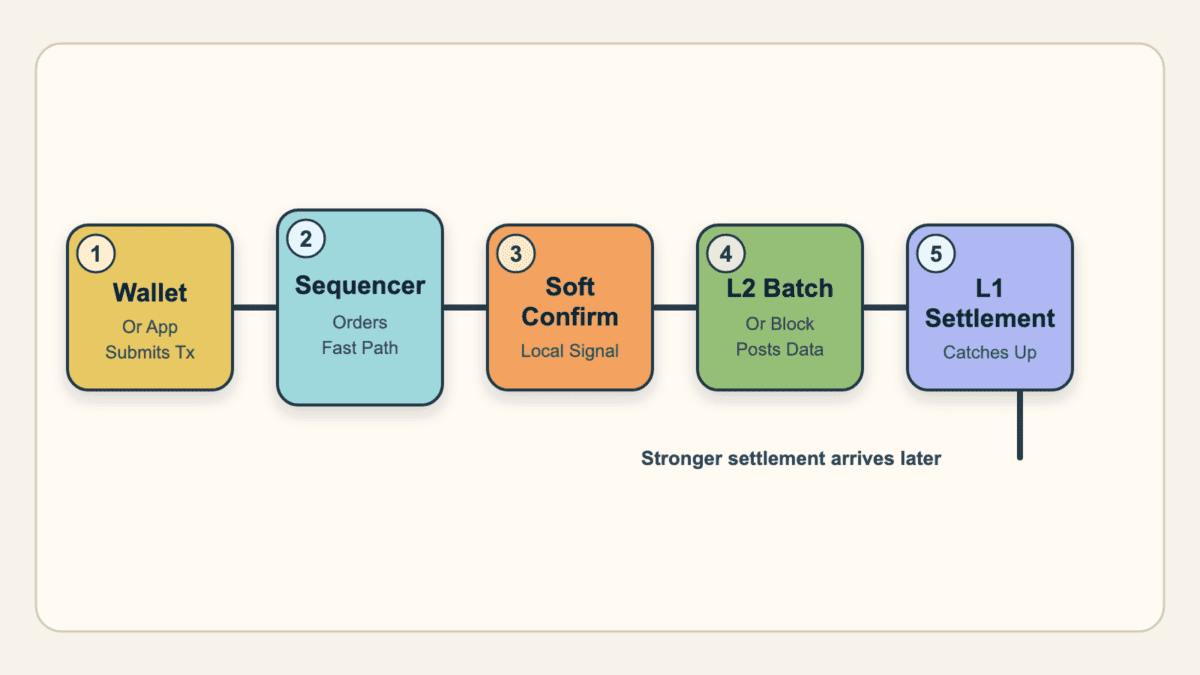
Different rollups implement this flow differently. Optimistic rollups, ZK rollups, app-specific rollups, and shared sequencing designs do not all use the same timing or fallback rules. But the core job stays familiar: the sequencer gives the rollup an ordered local lane before the base layer catches up.
Rollups use a sequencer because waiting for L1 for every user action would erase much of the L2 benefit. If every swap, mint, transfer, or app click had to wait for full base-chain processing, the rollup would feel expensive and slow.
The sequencer creates a local fast path. It can receive many transactions, order them quickly, and package them more efficiently than users sending every action directly to L1. The base chain still handles the stronger settlement role, but it does not need to process every user interaction at the same speed.
That local path also helps apps behave like normal software. A game, DEX, wallet, or mint page can show a result quickly instead of waiting for slower base-layer confirmation each time. Without that shortcut, many rollup apps would feel like paying mainnet prices to stand in a longer line.
This tradeoff is easier to see in two paths:
| Path | What Users Get |
|---|---|
| Fast sequencer path | Quick local ordering, low latency, and better app UX before final settlement. |
| Base-layer settlement path | Stronger security checks, data posting, proof or challenge mechanics, and slower finality. |
The tension is not hard to spot. Users want fast apps. Crypto systems also want neutral ordering, censorship resistance, and strong settlement. A sequencer tries to give the first part quickly, while the rollup design promises the second part over a longer path.
Sequencers are useful. The open risk is how much trust sits in the sequencer while users wait for the stronger layer underneath.
So the useful question is not whether a rollup uses a sequencer at all. Many do. The useful question is how much power that sequencer has, how transparent its rules are, and what happens when the fast path stops behaving normally.
A sequencer is not the same as a validator, batcher, prover, or bridge. Those roles often appear in the same rollup conversation, but they control different parts of the system.
Mixing them up leads to bad risk analysis. A sequencer may control ordering on the fast path, while a validator secures a base chain, a prover handles validity, and a bridge manages asset movement between layers.
The difference shows up during trouble. If a sequencer is slow, your L2 transaction may not land on time. If a bridge has a problem, your asset movement between chains can stall. If a prover or challenge process is not live, the settlement claim needs a different kind of scrutiny.
Use this table as the clean separation:
| Role | What Users Should Understand |
|---|---|
| Sequencer | Orders L2 transactions and shapes the fast user experience. |
| Batcher | Posts ordered transaction data or compressed batches toward the base chain. |
| Prover or challenger | Supports the rollup’s claim that state changes are valid. |
| Validator | Secures a base chain or separate network, not the same job as L2 sequencing. |
| Bridge | Moves assets or messages between layers and creates its own exit risk. |
Some projects combine roles operationally. A team may run the sequencer and the batcher, or one operator may handle several pieces during early stages. That does not make the words interchangeable.
For users, the clean question is: which role can affect my transaction right now? The sequencer affects ordering. The bridge affects movement between chains. The proof system and base layer affect stronger settlement. Each risk lives in a different place.
That separation also keeps marketing language honest. “Secured by Ethereum” can describe part of the settlement design while the normal ordering path still depends on a smaller operator set. Both claims can be true, and users need to know which layer each claim describes.
A sequencer can influence the fast transaction path, but it cannot simply reach into a self-custody wallet and take coins by magic. Sequencer risk is real without needing cartoon villain powers.
Your wallet keys still do their job. Good self-custody wallets can protect signing control, but they do not remove bridge, app-contract, upgrade, or sequencer-path risk. A transaction can be valid and still face ordering problems.
Use this fear check. If you sign a bad approval, the sequencer is not the main problem. If you sign a valid trade and the fast path delays or reorders it, the sequencer may be part of the problem. Different failures need different defenses.
Here is the useful split:
| Can Influence | Cannot Simply Do |
|---|---|
| Delay a transaction on the normal fast path. | Spend funds from your wallet without a valid signature. |
| Exclude or censor transactions until a fallback is used. | Override every rollup contract and bridge rule by itself. |
| Reorder transactions that are sensitive to timing. | Make final settlement irrelevant. |
| Create liveness problems if the operator or infrastructure fails. | Remove proof-system, data-availability, or upgrade risks. |
The danger is more subtle than theft. A sequencer can make a trade miss its window, delay a bridge action, change who wins a liquidation race, or leave users waiting during an outage. That is enough risk to care about.
So keep the fear accurate. A sequencer is an ordering control point. It is not the whole rollup, and it is not your private key.
The takeaway is simple: protect your keys, then inspect the system around the transaction. Wallet safety, contract safety, bridge safety, and sequencer design all answer different questions. Treating them as one blob is how users miss the risk that actually applies.
Centralized sequencer risk starts when one operator controls the normal ordering path. That can make a rollup fast and easier to operate, but it also creates a point of dependence for inclusion, uptime, ordering policy, and fee capture.
L2BEAT tracks sequencing as a separate risk area because ordering and inclusion can differ from final settlement security. As of June 22, 2026, its decentralized-sequencing table lists only three projects. That distinction is the heart of the user problem. A rollup can inherit some base-layer guarantees while still depending on one operator for the next few seconds or minutes.
The risks show up in ordinary transactions:
None of that proves a sequencer is malicious. Many centralized sequencers exist because launch teams want reliable performance before opening the operator set. But users should not confuse good uptime with decentralization. A fast gate is still a gate.
For traders, the risk is sharper because seconds can change execution. For long-term holders, the risk is more about bridge exits, network dependency, and whether the token or operator captures value from the activity.
Soft sequencer confirmations are fast acknowledgments from the L2 path. Final settlement is the stronger state that arrives later through the rollup’s base-chain process.
The gap changes how much confidence you should place in a screen that says “success.” Apps often show success before the heaviest security path is finished. That is normal for many rollups, and it is why large transfers, treasury moves, CEX deposits, liquidations, and bridge withdrawals deserve more patience than a small test swap.
Read the signals separately:
| Signal | What It Means |
|---|---|
| Wallet broadcast | Your wallet sent the transaction to the network path. |
| Sequencer acceptance | The L2 fast path has received and ordered it. |
| App confirmation | The app sees a local result and updates the interface. |
| Batch or data posting | The rollup has moved ordered data or commitments toward L1. |
| Final settlement | The stronger base-chain or rollup settlement path has caught up. |
Small actions often live happily on soft confirmations. Large actions should not. If a bridge or exchange waits for deeper confirmation, it is not always being difficult. It may be waiting for the part of the system with stronger guarantees.
That difference is also why “confirmed” can be a slippery word on L2s. Always ask what confirmed means in that app, bridge, exchange, or rollup.
If a sequencer censors or goes offline, normal L2 activity can slow, stall, or require a fallback route. The exact outcome depends on the rollup’s design, not a universal crypto rule.
Some rollups support direct L1 submission, delayed inboxes, force inclusion, or withdrawal paths that bypass the normal sequencer route. Those escape hatches can be valuable. They can also be slow, expensive, and awkward for ordinary users.
That is the part many risk summaries skip. A fallback can exist and still be a poor tool for a stressed beginner. It may require official contracts, L1 gas, waiting periods, careful documentation, and enough liquidity on the other side to make the exit useful.
The main scenarios are straightforward:
| Scenario | What To Check |
|---|---|
| Temporary outage | Whether transactions pause, queue, or recover automatically. |
| Censorship on the fast path | Whether force inclusion or L1 submission is available. |
| Bridge exit needed | Which official withdrawal route works without the sequencer. |
| Liquidity stress | Whether the asset still has depth when many users try to leave. |
Liquidity is the overlooked part. If everyone rushes for the same exit route, the problem can start looking like exit liquidity in slow motion. You may have a theoretical path out, but poor liquidity, long withdrawals, or app downtime can still hurt execution.
Force inclusion works more like an emergency ladder than a magic button. Useful, important, and not where you want to spend a casual afternoon.
Before moving serious funds, check whether the rollup explains the fallback in terms a normal user can follow. If the answer lives only in developer docs, size the position as if the escape route may be slower than your trade idea.
Sequencers affect MEV because ordering decides which transactions land first. That can change swap execution, liquidation outcomes, mint allocation, arbitrage paths, and bridge timing.
MEV is not only a public-mempool problem. On an L2, the sequencer or sequencing design can influence how priority works. Some systems may use first-come-first-served policies. Others may use auctions, protected routes, private order flow, or explicit priority lanes.
The examples are easier than the acronym:
This is where trader slang starts to overlap with infrastructure. In harsh markets, execution can feel like PVP trading because every delay hands someone else information or time.
The careful point is proof. Do not assume a specific sequencer extracts MEV just because ordering power exists. The stronger claim needs data. The safer claim is simpler: ordering is economically valuable, and valuable control points attract competition.
For normal users, the lesson is not to panic over every pending transaction. It is to avoid pretending order has no value. Tight slippage, small test trades, patient bridge timing, and clean app routes matter more when the ordering path is concentrated.
Centralized, decentralized, shared, and based sequencers are different answers to the same ordering problem. They do not solve the same risk in the same way.
A centralized sequencer keeps coordination simple. A decentralized sequencer spreads ordering across multiple participants. A shared sequencer serves more than one rollup. A based sequencer leans on the base layer’s proposer or validator path.
Use the models this way:
| Model | Plain-English Tradeoff |
|---|---|
| Centralized sequencer | Fast coordination, but one operator controls the normal ordering path. |
| Decentralized sequencer | Less single-operator control, but more coordination and incentive complexity. |
| Shared sequencer | One ordering layer can serve several rollups, but it becomes shared infrastructure. |
| Based sequencer | Ordering aligns more closely with L1, but latency and preconfirmation design get harder. |
A shared sequencer is not automatically safer for every user. It can improve cross-rollup coordination, but it may also concentrate dependency in a new place. A decentralized sequencer can reduce one operator’s power, but the operator set may still be permissioned.
Based sequencing needs its own caution. It is a technical rollup design term, not the same as based crypto slang, and not the same as Coinbase’s Base chain. Yes, the naming is doing nobody any favors.
The user check stays the same across models. Ask who can order transactions, who can join that role, what happens during failure, and what the design gives up for speed. A fancier label does not cancel the need for those answers.
Sequencer economics affect investors because rollups collect fees from users, pay costs to publish data or settle to the base layer, and may keep or redirect the difference. That flow can affect operators, protocol treasuries, tokenholders, and ETH value-accrual debates.
The simple version starts with fees. Users pay the L2 to transact. The rollup pays for data posting, blobs, settlement, proving, infrastructure, and operations. If revenue exceeds costs, the surplus may sit with the sequencer operator, a foundation, a DAO, a token model, or a broader fee-sharing design.
That fee path is why sequencer talk often appears in ETH and L2 investment debates. The technical role can become an economic role. If ordering, batching, and data costs create a surplus, someone may capture it. The important word is “may.”
Before assuming a token benefits, check the actual path:
ETH investors care because L2 growth can increase activity while moving some user fees away from L1 execution. Blob costs, data availability choices, and rollup settlement design all affect the debate. But that is not a price forecast. It is a fee-flow question.
For L2 token investors, the question is even more direct. A token can trade on the story of sequencing before it captures any sequencing value. The market loves infrastructure narratives. It loves invoices less.
So read token claims closely. Governance over a rollup is not the same as direct fee rights. A future shared-sequencing plan is not live revenue. And a busy L2 can be great infrastructure while still leaving public tokenholders with a weaker claim than the chart implies.
Before using an L2 with a centralized sequencer, check the live architecture rather than the roadmap. A network can settle to Ethereum later while still relying on one operator for ordering today.
Run the checks before you bridge serious funds, trade volatile assets, provide liquidity, or rely on the chain for treasury movement. Small tests are cheap tuition. Large blind transfers are the expensive course.
Use current sources, not only roadmap posts. A rollup may plan a decentralized sequencer, better proofs, or smoother force inclusion later. That does not help a transaction you send today if the current operator, bridge, or withdrawal path is still the bottleneck.
Use this checklist:
You do not need to avoid every centralized sequencer. That would rule out plenty of useful networks. Size your exposure around the actual control points.
If the only answer is “decentralization is on the roadmap,” the work is still future tense. Useful, maybe. Live, no.
The same check applies to apps built on that L2. A DEX, game, or lending market can look polished while depending on the same ordering path underneath. Match the amount at risk to the weakest live part of the route, not the best sentence in the roadmap.
Sequencer terms get messy because rollups borrow words from several parts of blockchain design. A few clean definitions prevent most confusion.
Use this short map when the vocabulary starts stacking up:
Ask which layer a claim belongs to. “Secured by Ethereum” may describe settlement. It does not automatically describe ordering, liquidity, bridge UX, upgrade keys, or the current sequencer operator.
That habit cuts through most L2 marketing. It also makes the next outage less surprising.
These concepts are most useful when read together. A rollup can have strong data availability and still rely on one sequencer for normal ordering. A bridge can work while liquidity is thin. A soft confirmation can feel finished while final settlement is still catching up.
When the terms blur, return to the user action. Are you swapping, bridging, minting, withdrawing, or investing in a token? The relevant sequencer concept depends on the risk in front of you.
A sequencer in crypto is the rollup component that receives transactions, orders them, and helps send ordered data or commitments toward a base chain. It creates the fast L2 path before stronger settlement arrives later.
No. A sequencer orders L2 transactions on the fast path, while a validator usually secures a base chain or another network. Some systems combine operations, but the roles are different. Ordering, validation, proving, batching, and bridging each carry separate risks.
Yes, a sequencer can censor or delay a transaction on the normal L2 path if it controls ordering. Some rollups provide force inclusion or direct L1 submission as a fallback, but those routes vary by network and may be slower or more expensive.
A sequencer cannot simply spend funds from your wallet without a valid signature. The stronger concern is delay, exclusion, reordering, outage risk, bridge friction, or app-level exposure. Wallet custody protects keys, but it does not remove every rollup risk.
If an L2 sequencer goes offline, normal transactions may stop confirming or queue until the service recovers. A fallback path may exist, but it depends on the rollup. Check official withdrawal routes, force-inclusion mechanics, and past incident handling before moving large funds.
A shared sequencer is an ordering layer used by more than one rollup. It can help coordinate activity across rollups and reduce isolated single-operator control, but it also creates a shared dependency. It is not automatically better for every app or user.
Start with the sequencer because it shows where the L2 is fastest and where it is most dependent. You do not need to become a rollup engineer. You do need enough context to avoid trusting a slogan with real funds.
Before you use a new L2 in size, take these steps:
Then decide what the chain is suitable for. A centralized sequencer may be fine for a small app action and wrong for a large treasury move. A decentralized roadmap may be promising and still not live.
Fast chains are useful. Just make sure you know who is driving the fast lane.
That does not mean every L2 needs to pass the same test. A tiny test mint, a stablecoin transfer, and a bridge withdrawal during market stress are different actions. The sequencer check should scale with the amount, urgency, liquidity, and fallback route.
If the chain cannot answer basic questions about the current sequencer, withdrawal path, and outage plan, wait or reduce the amount. A good rollup should make the fast path easy to use and the slow path possible to understand.