Physical Address
304 North Cardinal St.
Dorchester Center, MA 02124
Physical Address
304 North Cardinal St.
Dorchester Center, MA 02124


Understand sequencing rights before trusting an L2.
Sequencing rights are the power to decide the order in which crypto transactions enter a block, rollup batch, or settlement window. In plain English, they decide what goes first.
The phrase shows up around Layer 2 rollups, sequencers, MEV, and Ethereum-aligned scaling debates. It sounds dry until a swap lands after someone else’s trade, a bridge exit waits, or a fast L2 confirmation turns out to be less final than the app made it feel.
Sequencing rights in crypto let an actor or mechanism choose which valid transactions get ordered first for a chain, rollup, appchain, or specific time slot. They do not grant wallet custody, validator voting power, or general governance control.
Picture three transactions arriving at nearly the same time. One user swaps before a price move, one bot tries to arbitrage the same pool, and one borrower is close to liquidation. The ordering role decides which transaction gets the first seat in the queue.
That order can change real outcomes:
The control is narrow, but it is not small. Sequencing rights cannot sign from your wallet. They can still affect whether your transaction is included quickly, where it lands in the queue, and how much trust you should place in the first confirmation.
That is why the phrase shows up in rollup debates. A rollup can inherit security from a parent chain later while one actor, committee, or mechanism still controls the near-term transaction path.
For a normal user, the risk is usually timing, not theft. A transaction can be valid and correctly signed while still landing later than expected.
Sequencing rights affect crypto traders because transaction order can change execution. A valid transaction can still produce a worse result if it lands after another swap, liquidation, arbitrage route, or congested bridge action.
Picture a DEX swap with loose slippage. You submit first, but another transaction lands before yours and moves the pool price. Your trade still executes, yet the result is worse. The wallet shows success. Your PnL shows the bruise.
The trader risks are usually practical, not philosophical:
Weak liquidity is where sequencing rights meet exit liquidity. When the pool is thin, ordering and timing can decide whether you leave near the quoted price or become someone else’s exit.
That does not mean every sequencer is abusing users. The grounded point is simpler: transaction order has economic value. Any system that grants ordering power should explain how that power is assigned, limited, monitored, and challenged when something goes wrong.
For traders, the lesson is blunt. Low fees and fast UX are nice, but they do not remove execution risk. Check liquidity, slippage, bridge timing, and finality before a trade is large enough to hurt.
Sequencing rights work on Layer 2 rollups by assigning the early ordering job to one operator, a set of operators, or a protocol mechanism before stronger parent-chain settlement catches up. This is the fast lane that makes many rollups feel usable.
The usual flow starts when your wallet submits a transaction to an L2 app. The rollup sequencer or ordering mechanism receives it, places it into an ordered stream, and lets the L2 execute transactions in that order. Later, data, batches, proofs, or commitments move toward a parent chain such as Ethereum.
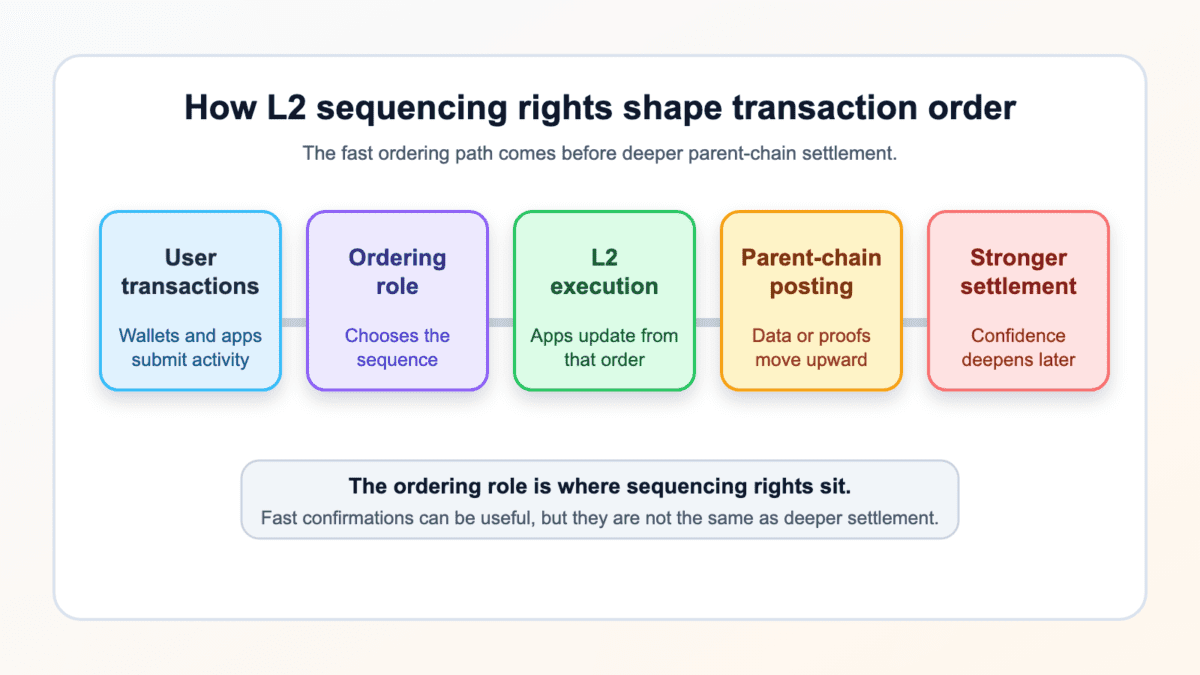
The flow is easier to follow in steps:
Different rollups fill those steps differently. An optimistic rollup may rely on challenge mechanics after data is posted. A ZK rollup may post validity proofs. Some systems separate sequencing, batching, proving, and settlement across different actors.
So avoid one giant label like “the rollup is decentralized.” Ask which part is decentralized. Sequencing rights are one layer. Data availability, proofs, bridge contracts, upgrade controls, and settlement rules all need their own checks.
Sequencing rights explain the gap between a fast L2 confirmation and stronger finality. A soft confirmation means the ordering path accepted your transaction. Finality means the settlement path has stronger backing.
Arbitrum’s sequencer documentation separates feed-based soft finality from parent-chain finality, which is the split users need here. The same page lists a 24-hour delayBlocks constant for force inclusion and says the Censorship Timeout delayBuffer can range from 30 minutes to 48 hours.
That’s the warning. Fallback paths can be real and still slow. Fast feedback helps, but it still depends on the sequencing path staying honest and available.
Use the stages separately:
| Stage | What It Means For The User |
|---|---|
| Wallet broadcast | Your wallet sent the transaction toward the network path. |
| Soft confirmation | The sequencer or ordering role accepted and ordered it. |
| L2 execution | The app sees a local result and updates the interface. |
| Batch or proof posting | Ordered data or commitments move toward the parent chain. |
| Stronger finality | The parent-chain or rollup settlement path has caught up. |
For small app actions, a soft confirmation may be enough. For large swaps, bridge exits, treasury moves, or exchange deposits, waiting for stronger confirmation can be worth the delay.
Three cases deserve extra patience:
The word “confirmed” is the trap. A wallet, bridge, exchange, and block explorer may use it differently. Before moving serious funds, check which confirmation level the tool is showing and which level the receiver requires.
Match the confirmation level to the size and reversibility of the action. A small app interaction can favor speed. A large transfer should favor certainty.
Centralized sequencing rights place the normal ordering path under one operator or a tightly controlled group. Decentralized sequencing rights spread that role across multiple participants or a more open mechanism.
Neither model deserves a cartoon label. A centralized sequencer can be fast, stable, and simple to run. It can also become a single point for uptime, censorship, ordering policy, and fee capture. A decentralized model can reduce that control point, but it adds coordination, incentives, latency, governance, and slashing questions.
For users, the split shows up in the normal transaction lane: who controls it, who watches it, and what recourse exists when it stalls.
The user-facing split looks like this:
| Model | User-Facing Tradeoff |
|---|---|
| Centralized sequencer | Fast coordination, but one operator controls the normal ordering route. |
| Permissioned sequencer set | More redundancy, but entry may still be controlled by governance or a foundation. |
| Permissionless sequencer set | Better openness, but users need to check stake, slashing, and operator concentration. |
| Shared sequencer | Several rollups can use one ordering layer, but shared infrastructure becomes a dependency. |
| Based sequencing | Ordering aligns more closely with the base layer, but fast preconfirmations get harder. |
The table leaves out one common problem: roadmaps can sound decentralized before the live system is. If the claim affects your decision, look for the current operator set, public rules, mainnet status, and a documented fallback path.
Then ask what can happen today if the ordering path fails, censors, delays, or becomes economically conflicted.
Based sequencing rights use the base layer more directly in rollup ordering. On Ethereum-aligned rollups, that can mean L1 proposers, validators, or delegated gateways play a privileged role in deciding transaction order.
The word “based” creates an easy confusion. It can be slang for approval or conviction, but based sequencing is infrastructure language. Here, based points toward the base layer, not a compliment from Crypto Twitter.
The appeal is clear. If rollup ordering leans on Ethereum’s proposer path, the rollup may depend less on a separate centralized sequencer. It can also support an ETH-aligned story around fee flow, censorship resistance, and settlement credibility.
The hard parts arrive quickly:
Based sequencing is a design direction with tradeoffs, not a magic stamp. If a project uses the term, ask what is live, who can participate, how preconfirmations work, and what happens when the base-layer path is slow or congested.
Strong based-sequencing claims should get specific. They should explain who receives sequencing rights for each slot, how users get fast assurances, and how the rollup keeps ordering credible without making the user experience painfully slow.
Shared sequencing rights let one ordering layer serve more than one rollup. Instead of each rollup running its own isolated sequencer, several rollups can rely on a shared network to order transactions.
The attraction is cross-rollup coordination. If rollups share an ordering layer, apps may be able to coordinate transactions across chains with less timing uncertainty. That can help cross-rollup swaps, intents, appchains, and modular designs that need transactions to line up cleanly.
A simple example helps. One user wants to swap on Rollup A, then use the result on Rollup B. If both rollups depend on unrelated ordering paths, timing can get messy. A shared sequencer can give both systems a common order for related activity.
But shared does not mean merged. A shared sequencer does not automatically create one state machine, one bridge, one liquidity pool, or one security model. Execution, data availability, proofs, bridges, and settlement can still differ by rollup.
The new risk is common dependence:
Shared sequencing can help when the tradeoff is clear. The claim gets weaker when it becomes a blanket decentralization label. Ask what the shared layer actually controls, what each rollup still controls, and what fallback exists if the shared path stalls.
Sequencing rights and MEV risk are linked because the order of transactions can become money. Whoever influences order may influence arbitrage, sandwiching, liquidations, mints, and other time-sensitive outcomes.
The beginner example is a DEX swap. You submit a swap with too much slippage. Another actor sees or anticipates the trade, lands a related transaction before it, and your execution gets worse. That is not always caused by the sequencer, but sequencing design affects how such races are handled.
Ordering risk can show up in several ways:
This is why busy DeFi can feel like crypto PVP. The market is not only users trading against prices. It is also users, bots, routes, and ordering rules competing for position.
Keep the claim narrow. Sequencing rights create a valuable control point, but that does not prove a specific operator is extracting MEV or censoring users. That stronger claim needs evidence.
So trade as if order is part of execution: use tighter slippage, avoid low-liquidity routes for size, understand whether an app uses protection or private order flow, and avoid assuming that “fast” means “fair.”
You evaluate sequencing rights before using an L2 by checking who orders transactions now, what happens during failure, and whether the escape path is actually usable. Start with the live system, not the roadmap.
Wallet safety and sequencing risk are separate. Good self-custody practices help protect signing keys, but they do not decide whether a sequencer includes your transaction quickly or whether a bridge waits for deeper finality.
Use this checklist before bridging, trading, depositing, or investing:
The forced-inclusion question deserves extra care. A fallback can exist on paper and still be painful for normal users. It may require L1 gas, special interfaces, longer waits, or enough confidence to act while everyone else is grumpy.
Investors should also separate infrastructure quality from token value. A rollup may have a sensible sequencing design without routing meaningful economics to a public token. Sequencer revenue, governance power, and token accrual are three different claims.
So keep the review practical. Test small, confirm exits, check finality rules, and read live status pages before size turns a learning moment into a tuition bill.
Sequencing rights sit near several rollup and trading terms. Knowing the boundaries helps you avoid mixing up ordering, settlement, custody, and trade execution.
Start with the role itself. A sequencer is the actor or system that orders rollup transactions. A rollup is the L2 design that executes activity away from the base layer and settles back to it. Those two ideas explain why sequencing rights sit between fast UX and deeper settlement.
Then separate speed from certainty. A soft confirmation is a fast acceptance signal from the sequencing path. Finality is the stronger confidence that arrives later. A preconfirmation is a fast promise about inclusion or ordering before that heavier settlement work finishes.
Fallback terms belong in the same map. Forced inclusion is a route for bypassing a stalled or censoring sequencer. Data availability means others can access enough data to verify or reconstruct rollup state. Both terms decide whether a rollup has a real safety path or only a nice diagram.
Two boundaries help most. Based in crypto explains the slang meaning, which is separate from based sequencing. Crypto wallets help with the signing-key side, which is separate from transaction-ordering risk.
These terms overlap, but they are not synonyms. A sequencer can order transactions without holding your wallet keys. A rollup can settle to Ethereum while still having a centralized fast path. A soft confirmation can feel complete before finality has arrived.
Keep the boundary simple. Sequencing rights answer “who orders first?” Other terms answer different questions: who verifies, who stores data, who settles, who can exit, and who takes the economic upside.
Sequencing rights in crypto are the power to decide the order in which valid transactions are included in a block, rollup batch, or settlement window. In rollups, this usually means who controls the fast L2 ordering path before deeper parent-chain settlement.
Sequencing rights are related to block production, but they are not always the same. On some systems, the block producer also orders transactions. On many rollups, the sequencer orders L2 activity before batches, proofs, or data commitments move toward the parent chain.
Sequencing rights alone should not let someone spend funds from your wallet without a valid signature. The real risks are delay, censorship, reordering, MEV exposure, outage problems, and confusing soft confirmations. Custody risk still depends on wallets, contracts, bridges, upgrades, and signatures.
Sequencing rights matter on Layer 2 because the sequencer often controls the fast transaction path users see first. That can affect swaps, mints, liquidations, bridge actions, uptime, censorship resistance, and the gap between a quick L2 confirmation and stronger settlement.
Based sequencing rights are sequencing rights that lean more directly on the base layer, such as Ethereum proposers, validators, or delegated gateways. The goal is stronger base-layer alignment, but users still need to check preconfirmation design, latency, MEV handling, and live implementation status.
Sequencing rights relate to MEV because transaction order can create value. If ordering decides which swap, arbitrage, liquidation, or mint lands first, then the sequencing design can affect who captures that value and how fair the user experience feels.
For sequencing rights, start by checking the live ordering path before you trust a rollup with size. The roadmap can wait. Your transaction uses today’s system.
The point is to match the risk check to the action. A small test swap needs less certainty than a bridge exit, treasury transfer, or crowded mint. A token investment needs a different check again, because sequencer value does not always flow to the token.
Work through five practical checks:
Then test the network like a user, not a press release. Send a small transaction, check the explorer, confirm withdrawal timing, and make sure you understand what “confirmed” means in that specific app.
If the network is new to you, make the first transaction boring. Use a small transfer, a clear receipt, a known withdrawal route, and a calm check that the bridge or exchange sees the same state you do.
Sequencing rights cover only one part of the rollup story: what goes first. In crypto, that small phrase can carry a surprising amount of money, trust, and occasionally comedy-free pain.