Physical Address
304 North Cardinal St.
Dorchester Center, MA 02124
Physical Address
304 North Cardinal St.
Dorchester Center, MA 02124


Settlement assurance explained for crypto users.
Settlement assurance is the confidence that a crypto transaction is final enough to rely on before you trade, bridge, credit, or release value.
The phrase is about transaction settlement on crypto rails. It is not about legal settlements, exchange disputes, or compensation claims. The useful question is simpler: what can still go wrong if you act on this transfer right now?
That answer changes by chain, wallet, exchange, bridge, asset, and amount. A wallet can show a transfer. An exchange can still wait. A bridge can finish one side and keep the other side pending. That gap is where settlement assurance earns its keep.
Settlement assurance means confidence that a crypto transaction can be treated as final enough for the next action. That next action might be trading, releasing goods, crediting a deposit, bridging again, or marking treasury funds as received.
The phrase is broader than settlement finality. Finality describes how a chain protects history from being rewritten. Settlement assurance also includes what a wallet, exchange, bridge, custodian, or merchant does with that chain signal.
That is why the same transfer can carry several labels at once. A USDC deposit can be visible on-chain, included in a block, and still unavailable for trading inside an exchange account. Nothing mystical is happening. Different systems are answering different questions.
Four labels cause most of the confusion:
| Status Label | What It Actually Tells You |
|---|---|
| Confirmed | The transaction has appeared in a block or reached a basic chain threshold. |
| Final | The transaction is much harder to reverse under the chain’s normal rules. |
| Credited | A service has updated your internal balance after its own checks. |
| Usable | You can trade, withdraw, bridge, spend, or account for the funds. |
Use those labels as layers, not synonyms. Confirmed is often the first useful chain signal. Final is stronger chain confidence. Credited is a service decision. Usable is the state most people actually care about.
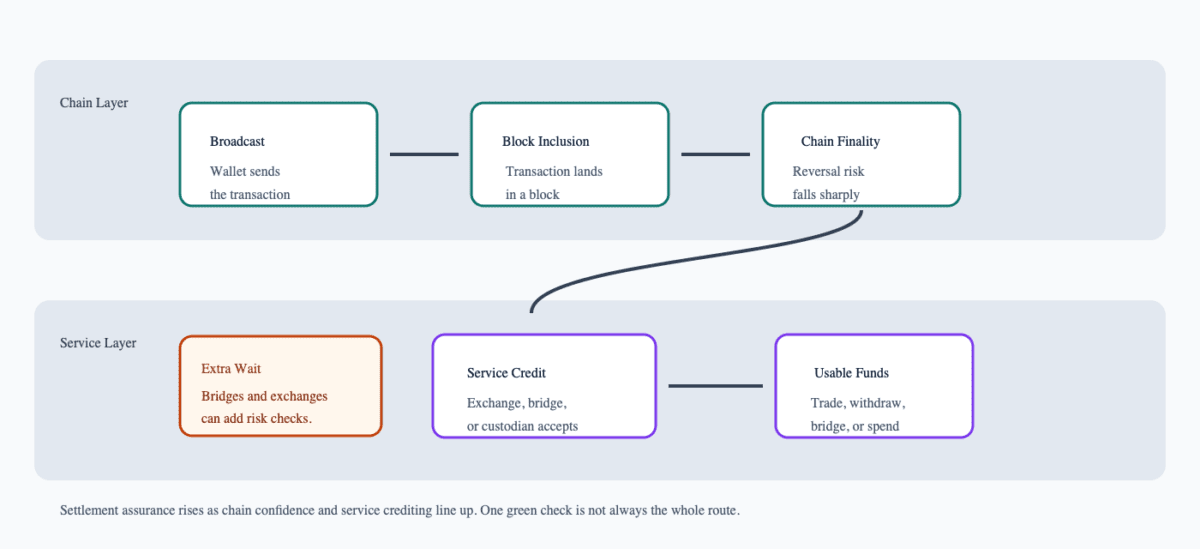
_A simplified settlement assurance flow. Bridges and exchanges can add waiting steps after a chain looks settled._
The clean habit is to ask what job the label is doing. If you only need to know whether your own wallet sent a small test, a confirmation may be enough. If someone will ship goods, release collateral, or let you withdraw funds, the threshold should be higher.
Settlement assurance is not the same as speed because speed tells you how quickly something appears, while assurance tells you how safely you can act on it. Those are related, but they are not identical.
Crypto speed claims often compress several signals into one number. A chart may compare block time, TPS, time to finality, exchange deposit time, or bridge completion. Each one measures a different part of the route.
Split the speed claim by what it actually proves:
| Signal | What It Proves, And What It Does Not Prove |
|---|---|
| Block Time | Shows how often blocks are produced, but not whether a transaction is final. |
| TPS | Shows throughput under a definition, but not whether your transfer is safe to use. |
| First Confirmation | Shows inclusion, but recent chain history can still be weaker than older history. |
| Hard Finality | Shows stronger chain settlement, but not exchange crediting or bridge completion. |
| Exchange Crediting | Shows the venue accepted the deposit, but withdrawal holds may still apply. |
| Bridge Completion | Shows a route finished its required steps, but liquidity and token-version risks can remain. |
Fast chains can create a better user experience. They can also reduce waiting for low-risk actions. But “fast” becomes slippery when the next action carries real value or cannot be reversed.
A chain might include transactions quickly while services still wait for more confidence. A bridge might display a fast source-chain step while the destination route needs proofs, liquidity, or a claim. An exchange might wait after on-chain inclusion because its risk team would rather annoy you than credit a deposit that later changes.
So compare speed claims by asking what state became faster. Did the transaction enter a block? Did the chain finalize it? Did the exchange make it tradable? Did the bridge finish both sides? The answer decides whether speed supports settlement assurance or just makes the loading screen look friendlier.
Blockchains create settlement assurance by making accepted history harder to replace. They do that through consensus rules, miner or validator incentives, confirmation depth, finality votes, penalties, and network participation.
The mechanism changes by chain. Some systems build confidence gradually as more blocks sit on top of your transaction. Some systems add validator votes and penalties. Others aim for finality once enough validators agree on a block or checkpoint.
For a concise taxonomy, QuickNode separates probabilistic and deterministic finality as different models rather than speed tiers. Its June 2026 update puts Bitcoin’s common six-confirmation security at about 60 minutes and Ethereum proof-of-stake finality at about 12 to 13 minutes. That distinction is useful because users should ask how confidence is earned, not only how many seconds passed.
Probabilistic finality means confidence rises over time. Bitcoin-style proof-of-work chains are the classic example. A transaction enters a block, then later blocks build on top of it.
Each additional block usually makes reversal harder because an attacker would need to replace more accepted work. That does not make the first confirmation useless. It means the first confirmation is an early signal, while deeper confirmations carry stronger assurance.
This is why confirmation counts became a common habit. They are simple to display and easy to understand. The catch is that one confirmation count does not travel cleanly across every chain, asset, or service policy.
Economic finality means reversal becomes expensive or punitive under the chain’s rules. Proof-of-stake systems can use validator votes, stake weight, and penalties to make finalized history costly to attack.
In this model, settlement assurance comes from more than elapsed time. It comes from validators having money at risk, rules for agreement, and consequences for trying to rewrite finalized history.
That still does not turn finality into magic. Bugs, client failures, poor validator participation, governance choices, and service policies can still affect the user experience. Economic finality answers the chain-history question first.
Deterministic finality means the protocol treats a block or transaction as final once a defined agreement threshold is reached. Many BFT-style systems aim for this cleaner user promise.
That can be helpful for payments, apps, and exchange crediting because the finality signal is less dependent on waiting for many later blocks. But the guarantee still depends on validator assumptions, network liveness, software quality, and what the service receiving funds chooses to trust.
So deterministic finality can improve settlement assurance. It does not remove the need to check the route, the asset, the service rule, or the next action.
Soft finality and preconfirmations give users earlier confidence before the strongest settlement path finishes. They can make apps feel instant, especially on L2s, sequencer-based systems, and routes that front liquidity.
The user benefit is obvious. You see faster feedback and can often keep moving for low-risk actions. The risk is that the early signal may rely on a sequencer, operator, liquidity provider, or service policy rather than the final settlement layer.
That does not make soft finality bad. It makes the label important. If a transfer is only soft-final, use it only where the failure cost is small. Large bridges, irreversible releases, and accounting records need stronger confidence.
Settlement assurance can differ because wallets, exchanges, and bridges have different jobs. A wallet reports chain activity. An exchange decides when to credit an internal account. A bridge decides when one chain’s event is safe enough to trigger another chain’s action.
Wallets are usually closest to the chain. They may show pending, confirmed, failed, or final based on the wallet’s view and connected infrastructure. A careful crypto wallets setup can help you track history, separate accounts, and avoid signing while you are only checking status.
Exchanges add their own ledger. A transaction can reach the exchange address before the exchange lets you trade, withdraw, or transfer the balance. The venue may still be checking confirmations, memo or tag matching, account risk, withdrawal policy, maintenance queues, fraud controls, or suspicious activity.
Say you send USDC to an exchange. The transfer may be visible on the destination chain first. The exchange can still show pending until its required chain confidence and internal checks clear. The account balance may then become credited, while withdrawals remain held for a separate rule.
Bridges add another clock. A source-chain transaction can look complete, but the bridge may wait for finality, a proof, relayer execution, liquidity, or a destination-chain transaction. A fast bridge may front liquidity. A canonical bridge may wait longer. The clean route depends on size, timing, and the asset you need on the other side.
Before you act on incoming funds, run a short check:
A wallet green check can be real and still incomplete for the service using the funds. If the next action is expensive, wait for the specific system that must accept the risk.
Settlement assurance across L2s and stablecoins needs extra care because the user often sees speed before the full settlement path is done. That does not mean the transfer failed. It means multiple systems are involved.
On many L2s, a sequencer can order transactions quickly. That can make a swap, payment, or self-transfer feel done in seconds. But a bridge withdrawal, message, or cross-chain route may still depend on data posting, proofs, challenge windows, validity checks, or base-layer finality.
The difference is easiest to see with two examples. If you send a small amount between your own wallets on the same L2, the sequencer-level status may be enough for normal use. If you bridge funds out, deposit to an exchange, or use the transfer as collateral elsewhere, another settlement clock may appear.
Stablecoins add their own layer. Stablecoin settlement is not only about the chain confirming a token transfer. Users may also care about issuer support on that chain, redemption paths, off-ramp timing, liquidity depth, token contract versions, and receiving-service rules.
A USDC or USDT transfer can be settled on-chain while a business, exchange, or payment processor still waits before treating it as final money. That wait can come from operational policy, liquidity, account review, or the need to match the token contract and network correctly.
The risky assumption is that all L2s and all stablecoins behave the same. They do not. Some routes give fast app-level confidence. Some give faster withdrawal paths. Some depend on a slower base-layer settlement path. Some stablecoin versions have better exchange support than others.
For users, the check is concrete. Ask whether the funds are only visible, usable inside one app, withdrawable to another venue, or redeemable through the path you actually need. Settlement assurance is strongest when those answers line up.
Settlement assurance deserves the most attention when acting early can cost more than waiting. The bigger the transfer, the more irreversible the next step, or the faster the market, the more confidence you need.
Large exchange deposits are the obvious case. If funds are delayed, the trade you planned may change before the balance becomes usable. That can affect entries, exits, collateral top-ups, and withdrawals. A clean transfer can still arrive too late for the original plan.
OTC and peer-to-peer transfers raise a different risk. One party may want to release funds, goods, or another asset after seeing a transaction. The safer move is to wait for the agreed settlement threshold, especially when the counterparty is unknown or the transfer is hard to unwind.
Several situations deserve extra caution:
Market rotation adds a timing problem. If funds arrive after a sector has already moved, the planned crypto rotation may be stale. Settlement did its job, but the setup changed while the funds were waiting.
That gets sharper in adversarial short-window markets. In PVP trading, late usable funds can put you behind faster traders, bots, and early holders. The delay does not create the bad trade by itself. It just removes the clean entry you thought you had.
Investors should care for a quieter reason. Settlement assurance helps separate infrastructure confidence from investment confidence. A finalized transaction can prove the transfer happened. It does not prove the token, route, counterparty, or timing was good.
Check enough settlement assurance by matching the transaction state to the action you plan to take. There is no universal confirmation number that fits every chain, bridge, exchange, and transfer size.
Start with consequence. If the next action is small, reversible, and only affects your own wallet, you can usually accept a lower threshold. If the next action releases goods, changes collateral, funds a trade, credits a customer, or moves treasury funds, wait for stronger proof.
Use this checklist before acting on funds:
Then compare the chain signal with the service signal. An explorer may show confirmations while an exchange still shows pending. A bridge may show the source side complete while the destination side waits. A custodian may credit internally before withdrawals are available.
Do not let a delayed transfer turn into an automatic chase. If funds clear after the trade has moved, the old plan may be gone. Late entries in thin markets can turn into exit liquidity risk when earlier buyers finally find someone eager enough to take the other side.
The best threshold is boring and specific. Name the value, chain, receiver, next action, and failure cost. Then wait until the status supports that exact action, not just a comforting green mark.
Settlement assurance in crypto is the confidence that a transaction is final enough to rely on for a specific action. That action might be trading, bridging, crediting, withdrawing, spending, or releasing goods.
It combines chain-level confidence with service-level acceptance. A transaction can be confirmed on-chain before an exchange, bridge, or custodian treats it as usable.
No, settlement assurance is broader than transaction finality. Transaction finality describes how hard it is for chain history to change after a transaction is included.
Settlement assurance also asks whether the receiver has credited the funds, whether a bridge has completed the route, and whether the balance is actually usable for the next step.
The number of confirmations needed for settlement assurance depends on the chain, transfer size, receiver, asset, and next action. One universal number would be neat, and also wrong.
Follow the receiving service’s rule when one exists. For large transfers, bridges, merchant releases, and time-sensitive trades, wait for stronger confirmation or finality than you would for a small self-transfer.
A transaction with strong settlement assurance should be very hard to reverse under normal conditions, but no label removes every possible failure. The remaining risk depends on the chain model, service policy, and extreme events.
Also separate reversal from other problems. A transaction can settle permanently and still involve a bad trade, wrong token contract, frozen service account, or bridge route that has more steps.
Settlement assurance does not work the same on every L2 or stablecoin route. An L2 can show fast sequencer confirmation while a bridge, withdrawal, or base-layer settlement path still has more work.
Stablecoins add token version, issuer, redemption, liquidity, and receiving-service rules. For serious transfers, check the exact chain, token contract, route, and account status before acting.
A faster blockchain can improve user experience, but faster does not automatically mean better settlement assurance. Speed may describe block production, first confirmation, app response, or finality.
Better assurance depends on what can still go wrong after that speed signal. Consensus design, validator or miner incentives, reorg resistance, bridge policy, exchange crediting, liquidity, and the next action all matter.
Start with the transaction hash and the receiver’s status page. The chain can tell you whether the transfer landed. The receiver tells you whether the funds are credited, withdrawable, tradable, or still waiting.
If the status page uses vague language, translate it into actions. Can you trade? Can you withdraw? Can you bridge again? If any answer is no, the funds are still in a waiting state.
Use these actions before relying on important funds:
Write down the action before you decide the threshold. A small self-transfer may only need enough confidence to confirm the wallet path. A customer credit, bridge withdrawal, collateral top-up, or treasury movement needs the receiving system to show a stronger status.
Keep the process boring. If the amount is small and reversible, a lighter threshold may fit. If the transfer funds a trade, bridge, delivery, withdrawal, or collateral move, wait until the exact system you need has accepted the funds.
The point is to slow one bad instinct: treating the first green check as the whole story. Sometimes it is. Often it is just the first door opening.