Physical Address
304 North Cardinal St.
Dorchester Center, MA 02124
Physical Address
304 North Cardinal St.
Dorchester Center, MA 02124


Understand stop hunts before the next wick gets expensive.
A stop hunt is a crypto price move into clustered stop-loss zones that can trigger forced exits, volatility, and quick reversals.
It feels personal because the candle often taps a trader’s stop, reverses, and leaves the chart looking annoyingly deliberate. The useful explanation is usually less dramatic: many traders place stops near the same visible levels, so those areas can attract price even when nobody knows your exact order. Crypto adds extra noise, because spot stop orders, perpetual futures, liquidation levels, thin altcoin books, and exchange-specific wicks all get mixed into the same phrase.
A stop hunt in crypto is a move into a likely cluster of stop-loss orders. It often happens around a level many traders can see, such as a swing high, swing low, round number, range edge, support zone, or resistance zone.
The phrase sounds like a villain story. Sometimes manipulation may be involved. But the basic market logic does not require someone seeing your exact stop. If enough traders use similar chart levels, the stop zone becomes predictable from the outside.
Picture a token chopping below a clean range high. Short sellers may place stop-loss buys above that high. Breakout traders may place buy orders there too. If price pushes through the high, those orders can fire together, create a burst of buying, and then fail if demand dries up.
That is why a stop hunt can feel unfair without proving a secret actor targeted you. The better clue is not the first wick. It is what happens after the wick.
Use this plain split:
The emotional trap is calling every painful stop a stop hunt. Sometimes the stop was too tight. Sometimes the market was thin. Sometimes the chart level was obvious enough to invite a crowd.
A stop hunt works by pushing price into an area where many stop-loss orders are likely to activate. Once those stops trigger, the resulting orders can add short-term pressure and make the move faster.
A stop-loss order usually has a trigger price. When market price reaches that trigger, the stop becomes an active order. If it becomes a market order, it seeks the next available liquidity. If the order book is thin, the final fill can be worse than the trigger. Conditional stops do not need to sit visibly in the public order book before activation, but traders can still infer likely stop zones because humans keep placing orders around the same clean levels.
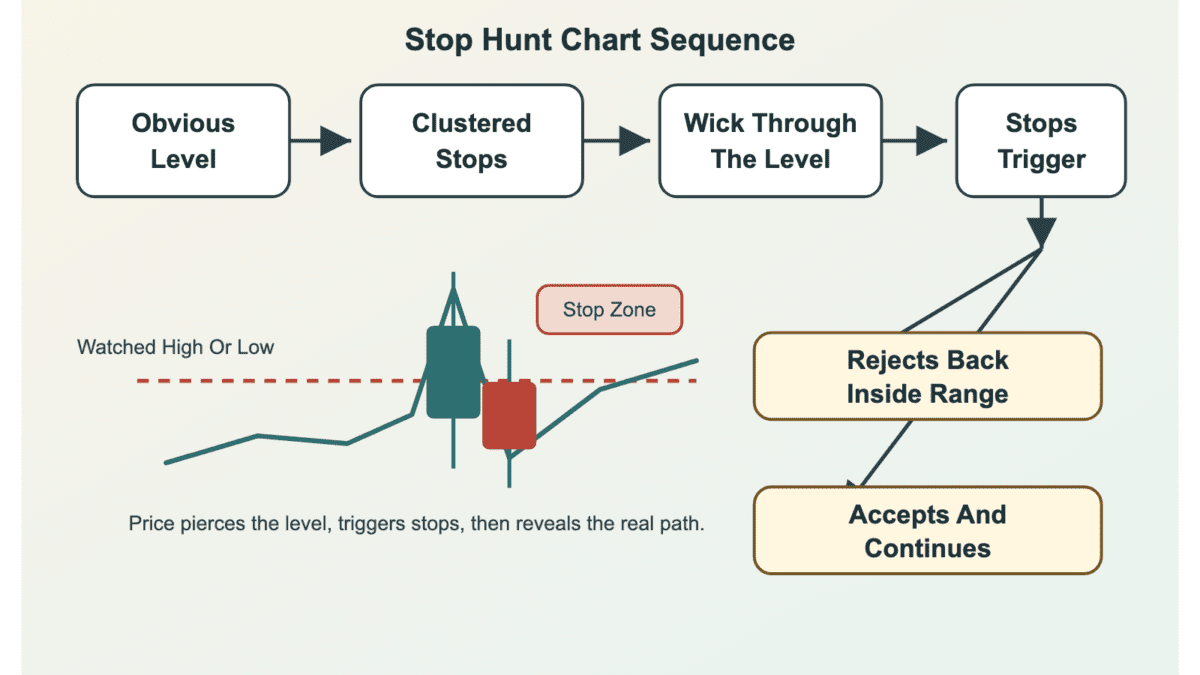
The sequence is easier to read step by step:
| Step | What Happens |
|---|---|
| Visible Level | A prior high, prior low, support line, or round number becomes obvious. |
| Stops Cluster | Traders place protective stops just beyond that level. |
| Price Tests The Zone | Price moves into the area where those stops likely sit. |
| Stops Trigger | Stop orders activate and can become market orders. |
| Pressure Builds | Fast fills, slippage, and panic orders can extend the wick. |
| Reaction Decides | Price either rejects back into range or accepts the break and continues. |
The reaction decides whether the stop hunt label has value. A wick below support that instantly reclaims the level tells a different story from a candle that closes below support and keeps grinding lower.
This is where many beginners get clipped twice. First, the stop fires. Then they re-enter because “it was only a hunt,” while price accepts the new level and continues against them. The label should slow your thinking, not speed up revenge trading.
Stop hunt, liquidity sweep, stop run, scam wick, fakeout, and liquidation cascade overlap in trading chat. The useful difference is what each term emphasizes.
A stop hunt emphasizes stop-loss orders. A liquidity sweep emphasizes price taking an obvious high or low. A liquidation cascade emphasizes forced margin closures, which can feed more forced closures. Those can happen near the same level, but they are not the same plumbing.
Here is the clean version:
| Term | What It Emphasizes |
|---|---|
| Stop Hunt | Price moves into likely stop-loss clusters. |
| Liquidity Sweep | Price pierces an obvious high or low to access liquidity. |
| Liquidity Grab | A looser phrase for taking nearby clustered orders. |
| Stop Run | A fast move through stops, often with momentum. |
| Fakeout | A breakout or breakdown fails after drawing traders in. |
| Scam Wick | Trader slang for a suspicious or exchange-specific wick. |
| Liquidation Cascade | Forced margin closures add pressure and trigger more liquidations. |
These terms are not courtroom language. Traders use them loosely, especially when the candle just cost them money. Still, the distinction helps your risk plan.
Triggered stops can create fills for other traders. One trader’s forced exit or late chase can become the other side of someone else’s trade, especially when the book is thin. Liquidations need extra care here: a stop-loss is an order you choose, while a liquidation is a forced closure when a leveraged position no longer has enough margin. A stop hunt can run into liquidation levels, but calling every liquidation wave a stop hunt blurs the most important risk.
A stop hunt on a crypto chart usually looks like a sharp wick through an obvious level, followed by either a reclaim back into range or acceptance beyond the broken level. The wick gets attention, but the close and follow-through do the real talking.
The common version is simple. Price approaches a clean support level, dips below it, triggers long stops, then reclaims the level. The opposite happens above resistance, where price breaks a high, triggers short stops and breakout buys, then drops back below.
Use a checklist before naming the move:
A rejected sweep above a high can resemble a top signal only when the market also shows rejection and follow-through. A reclaim below a low can resemble a bottom signal only after demand returns.
False positives happen when traders label normal volatility as a stop hunt after the loss is already booked. That label may protect the ego, but it does not improve the next trade.
A real breakout can start with a wick. A normal trend continuation can stop you out and never look back. A thin altcoin can print a strange candle because there was not enough depth, not because a mastermind needed your $47 stop. So ask what changed after the wick: rejection means price failed to hold beyond the level, while acceptance means price held the break, retested the area, or continued with fresh orders. That difference decides whether the stop hunt idea is useful or just cope with a chart attached.
A crypto stop hunt can feel sharper because crypto trades around the clock, across fragmented venues, with spot books, perpetual futures, and thin altcoin liquidity often reacting at once. A level that looks small on a chart can become noisy when leverage and low depth sit nearby.
Perpetual futures make the problem louder. Traders watch funding rates, open interest, liquidation estimates, mark price, and index price. Those signals can point to crowded positioning, but they are not the same as hidden stop-loss orders. Public liquidation maps also change the mood because they estimate where forced closures may happen, while stop-loss orders may sit privately with a venue.
Several crypto-specific pressure points make the move feel harsher:
Short-term crypto trading can feel adversarial because one trader’s forced exit can become another trader’s entry. That feeling gets stronger in the crypto trenches, where thin liquidity, bots, memes, and panic can all meet in one candle.
The boring risk takeaway is the useful one. Check the venue, depth, leverage context, and timeframe before blaming intent.
Whales usually do not need to see your exact stop to know where stop hunts are likely. Clean highs, clean lows, round numbers, and popular support zones already reveal where many traders may place stops. Large traders can also see visible order-book liquidity, which can show where depth is thin or where a market order may move price. In crypto perps, public liquidation estimates add another clue about crowded leverage.
Exchanges are different. A centralized venue may process conditional stop orders internally, depending on how its order system works. That does not prove a venue abused that information. Naming a specific exchange as manipulative needs strong evidence, not one angry screenshot and a candle with bad manners. Market manipulation can exist, and MITRE AADAPT includes stop hunting in its digital-asset market manipulation taxonomy. That supports careful language around the tactic, but it does not prove any specific wick was illegal or intentional.
Use this sanity check when a wick looks suspicious:
The useful distinction is exact stop versus likely zone. Your exact stop may not be visible to a whale. The obvious zone around your stop may be visible to everyone with a chart.
Stop-market and stop-limit orders fail in different ways during a stop hunt. One prioritizes getting out after the trigger. The other prioritizes the minimum acceptable price.
A stop-market order can exit quickly, but it can slip if the wick is fast or the book is thin. A stop-limit order can protect the limit price, but it may not fill if price jumps through the limit and never trades back. The best choice depends on what would hurt more: a worse fill or no exit at all.
That trade-off is worth seeing plainly:
| Order Type | Tradeoff In A Fast Wick |
|---|---|
| Stop-Market | Higher chance of exit, but the fill may be worse than the trigger. |
| Stop-Limit | Better price control, but the order may not execute. |
| Alert Plus Manual Exit | More control, but slower and easier to miss under pressure. |
| Wider Stop | Less likely to sit at the obvious level, but risks more unless size drops. |
None of these choices is automatically safer. The right one depends on liquidity, position size, leverage, and how bad non-execution would be. A stop-limit can look tidy in the order form and still fail at the exact moment you needed it.
Perp traders need extra caution. A stop-limit that fails to fill can leave a leveraged position open while price keeps moving. A stop-market can fill badly, but a missed exit near liquidation can be worse. Pick the failure mode you can actually survive.
You reduce stop hunt risk by improving stop placement, position size, order choice, and confirmation. Removing stops is not a beginner defense. It usually just hides risk until the position gets loud.
Start with invalidation. A stop should sit where the trade idea is wrong, not merely where the loss feels comfortable. If that invalidation level is far away, reduce the position size instead of pretending the same size still carries the same risk.
The main controls are practical:
Going full port is what turns a normal stop-out into a disaster. A stop hunt hurts less when the position is sized so one wick cannot dominate the account.
Wider stops do not magically reduce risk. They only reduce the chance of getting clipped near an obvious level. If position size stays the same, the total amount at risk increases. Use a simple example: if a trade risks $100 with a stop 2% away, moving the stop to 4% away means the position should be smaller if the risk budget is still $100.
This is where many stop-hunt fixes go wrong. Traders hear “place wider stops” and keep the same size. Then the next invalidation costs twice as much. The stop moved, but the risk plan stayed asleep.
Better stop placement should answer three questions:
If those answers are fuzzy, the stop hunt is not the main problem. The setup is.
Beginners should be careful after a stop hunt because the first reaction can be a trap in either direction. A rejected wick may offer useful context, but it is not a mechanical entry signal.
The tempting trade is to fade the wick. Price sweeps below a low, reclaims, and everyone suddenly feels like a market-structure expert. Sometimes that works. Sometimes price sweeps again, or accepts the lower level after a small bounce. The better question is whether price has rejected the level with enough evidence to define a new trade. If the answer is fuzzy, waiting is not cowardice. It is just refusing to pay tuition twice.
Use a slower checklist before acting:
Doing nothing is a position. It has no slippage, no liquidation price, and no need for a heroic Discord explanation.
If you do trade after a stop hunt, keep the idea narrow. You are not betting that “they hunted stops.” You are betting that price rejected or accepted a specific level, with a defined exit if that read fails.
That distinction keeps the trade from turning into a story. Stories get flexible under pressure. Levels, invalidation, and size are harder to argue with when the next candle is not flattering.
Related stop hunt terms help you understand what traders are actually arguing about after a wick. They are not perfect definitions, but they keep the conversation cleaner.
A liquidity sweep is the chart event of taking an obvious high or low. A stop hunt is more specific because it focuses on stop-loss orders near that level, while a stop run is the fast version where price pushes through stops with momentum. A fakeout is a failed breakout or breakdown. A scam wick is trader slang for a suspicious wick, often on one venue, so use that phrase carefully because suspicion is not proof.
A liquidation cascade is different again. It happens when leveraged positions are forced closed, and those closures add pressure to the move. A stop hunt can hit the same area as a liquidation cluster, but the mechanisms differ.
Two adjacent terms are especially useful:
The clean habit is to name the event first. Did price take a level? Did it trigger stops? Did it force liquidations? Did it reclaim or continue? Answer those, and the slang becomes useful instead of decorative.
A stop hunt in crypto is a move into a likely cluster of stop-loss orders, usually near a visible high, low, support zone, resistance zone, or round number. It can trigger stops, create a sharp wick, and then either reverse or continue.
A stop hunt is not exactly the same as a liquidity sweep. A liquidity sweep describes price taking an obvious high or low. A stop hunt focuses on stop-loss orders near that level. The same wick can sometimes fit both terms.
Whales usually do not need to see your exact stop loss during a stop hunt. They can infer likely stop zones from obvious chart levels, order-book depth, and public liquidation estimates. That is different from proving they saw your specific order.
Yes, a stop hunt can happen in spot crypto when stop-loss orders cluster near obvious levels and trigger during a fast move. Spot does not have forced liquidation like perps, but stop-market orders can still slip in thin liquidity.
No, most beginners should not stop using stop losses because of stop hunts. A better fix is smarter placement, smaller position size, lower leverage, and clearer invalidation. No-stop trading can turn one wrong idea into a much larger loss.
A stop hunt can be part of market manipulation when there is intent and evidence, but the label alone does not prove illegality. In crypto, many suspected stop hunts are better explained as clustered liquidity, thin books, leverage, or normal volatility.