Physical Address
304 North Cardinal St.
Dorchester Center, MA 02124
Physical Address
304 North Cardinal St.
Dorchester Center, MA 02124


A plain-English guide to Sybil attacks, wallet flags, airdrop farming, and fake crypto activity.
Sybil in crypto means one actor pretending to be many independent users, wallets, accounts, identities, or nodes.
That one idea shows up in several places. A Sybil attack can target a network. Sybil farming can target rewards. Sybil filtering can remove wallets from an airdrop. Sybil resistance makes fake independence harder, pricier, or easier to spot.
Crypto often uses wallet counts, node counts, votes, claims, and activity as trust signals. Cheap fake independence makes those signals noisy fast.
Sybil means fake independence. In crypto, the fake identities might be wallets, accounts, validators, nodes, social profiles, or app users. One person or group controls them behind the scenes.
Control is the key. A network may see many addresses, but not many humans. A DAO may see many votes, but those votes may come from the same operator.
Two simple examples show the shape:
That does not make every multi-wallet user dishonest. People split wallets for privacy, taxes, testing, DeFi risk, or basic hygiene. A Sybil label appears when a system believes those wallets are being used to fake separate participation.
That is why “many wallets” is not the same claim as “many users.” A project can have 100,000 addresses and still have a smaller real user base if many addresses share the same controller. The reverse can also happen when one careful user keeps separate wallets for different risks.
You will see Sybil used in a few normal crypto sentences:
So Sybil is more than a security-classroom word. It can be a wallet-eligibility label, a governance risk, an analytics problem, and a market-signal warning.
Sybil distorts crypto signals because the industry often treats activity as evidence. More wallets can look like more users. More claims can look like demand. More votes can look like community support.
But if a farm controls those wallets, the signal changes. A token launch can look popular before real retention exists. A testnet can look active because wallets are repeating cheap tasks. A DAO vote can look broad while one actor quietly pushes the outcome.
Sybil activity can distort signals that traders and users often watch:
AI agents add a new wrinkle. Wallet creation is already cheap. Automation can make repeated behavior look more human over time. That does not make every AI wallet malicious, but it raises the cost of trusting raw wallet counts.
For investors, the question is signal quality. The risk usually breaks three ways:
Governance has a similar problem. If a vote is wallet-weighted or reputation-weighted, duplicate identities can make support look broader than it is. If a vote is token-weighted, capital concentration becomes the bigger issue. Either way, the voting design shapes the Sybil risk.
None of this gives a clean answer. Sybil risk is one reason user numbers should never carry the whole thesis.
Sybil terms overlap, but they do different jobs. The split tells you whether the issue is network security, reward abuse, wallet screening, or system design.
Use this quick split before you read a dashboard, forum post, or airdrop rule.
| Term | Plain Meaning And Where It Shows Up |
|---|---|
| Sybil Attack | One actor uses many fake identities to influence a network, vote, route, reputation system, or app. |
| Sybil Farming | One actor uses many wallets or accounts to multiply rewards, usually in airdrops or points campaigns. |
| Sybil Filtering | A project screens wallets or accounts and removes those it believes share hidden control. |
| Sybil Resistance | A system design that makes fake identities harder, costlier, or less useful. |
These terms can describe the same campaign from different angles:
The reward angle is where airdrop farming fits. Farming is not always malicious, but Sybil farming crosses the line when the goal is to make one actor look like many eligible users.
That distinction helps when a dashboard label looks scary. “Sybil filtered” usually means the wallet failed a project’s eligibility logic. It does not automatically explain which signal triggered the result, whether the review was manual, or whether an appeal can change it.
It also stops lazy blame. A project can over-filter and exclude real users. A farm can exploit loose rules and drain a reward pool. A critic can call activity Sybil because it looks unnatural, even before any formal filter exists.
The shared theme is hidden control. A Sybil attack is not automatically a wallet-farming campaign, and a Sybil filter is not proof of fraud.
A Sybil attack turns cheap identities into influence. The attacker creates many accounts, nodes, wallets, or profiles, then uses them to shape what a system sees.
In a peer-to-peer network, fake nodes may surround a target, hide information, delay messages, or make one viewpoint look more common than it is. In governance, fake accounts may vote as if they were independent members. In reputation systems, fake identities can review, endorse, report, or bury content.
The attack can be direct or indirect:
Blockchains reduce some Sybil risks by tying influence to scarce resources. Bitcoin-style Proof of Work ties consensus power to hash power. Proof of Stake ties validator influence to bonded capital. Those designs make extra names less useful at the base layer.
But scarce-resource consensus does not solve every identity problem around the chain. Apps, airdrops, forums, testnets, DAOs, bridge rewards, and points campaigns still need their own checks.
That is why not every Sybil issue is a majority-control attack. Many are smaller and more boring. A fake wallet cluster can distort rewards without touching consensus. A fake account set can pollute governance discussion without controlling validators.
This is why node count needs context. A network can report many nodes, but users still need to know whether they are independently operated, geographically spread, and economically separate. Counting machines is easier than proving independence.
The split is simple:
Good defenses usually combine costs, reputation, history, and appeals. Bad defenses assume that counting accounts is the same as counting people. That shortcut is where the trouble starts.
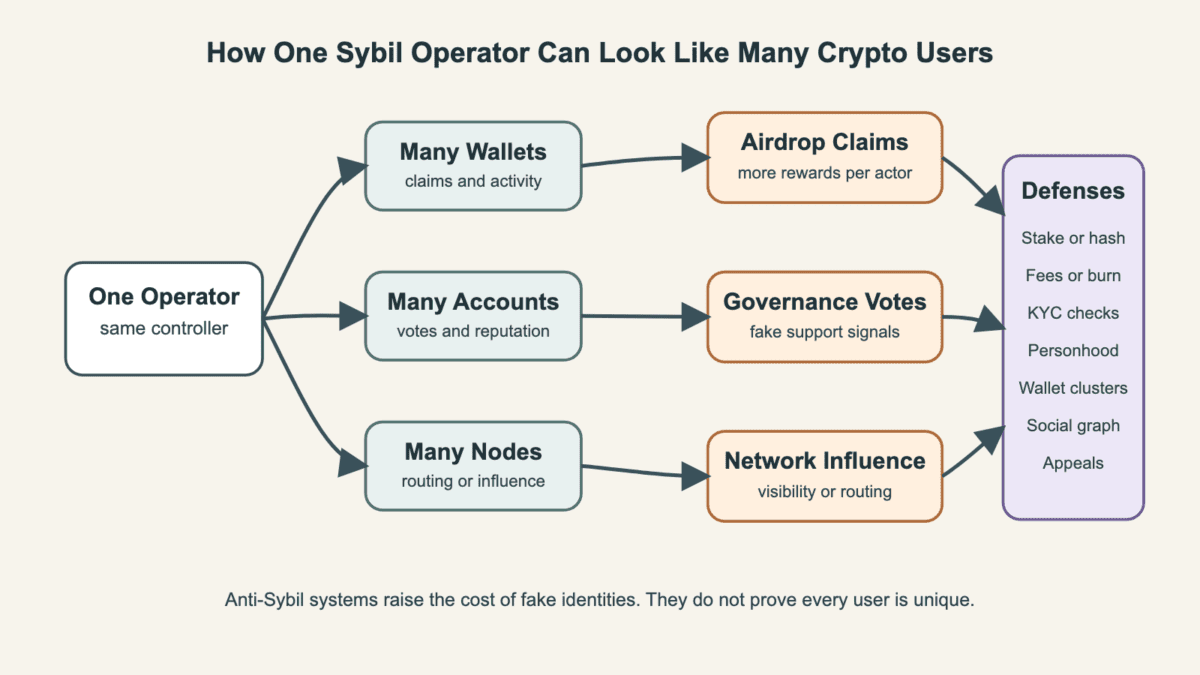
Sybil in airdrops usually means many wallets behave as if one operator controls them. Projects then decide whether those wallets deserve rewards, partial rewards, or no allocation.
Filters may look at shared funding sources, identical timing, repeated routes, bridge patterns, shallow wallet history, tiny looped transactions, synchronized claims, or activity that wakes up only when rewards are expected. None of those signs proves intent by itself.
Projects often combine many small signals instead of relying on one smoking gun. A single shared funding source may be harmless. A shared funding source plus identical routes, tiny repeated actions, and synchronized claims looks different.
Common signals include:
Here is a common pattern:
> Ten wallets receive funds from the same source, perform the same low-value actions in the same order, bridge through the same path, then claim at nearly the same time. That cluster can look Sybil even if every transaction is technically valid.
Airdrop hunting can feel like a lottery ticket. Users spend time and fees for uncertain future rewards, while farms try to make that uncertainty profitable at scale.
A 2025 arXiv paper on airdrop Sybil detection evaluated 193,701 addresses, including 23,240 confirmed Sybil addresses. That is not a claim that models are perfect. It is a reminder that detection often works from patterns, not certainty at scale.
Projects face a rough tradeoff:
That creates a product-design problem. If the rules are too public, farmers adapt faster. If the rules are too hidden, real users cannot understand the result. Projects end up balancing fairness, secrecy, and support volume.
So a “Sybil wallet” label is best read as a risk score or project judgment, not a courtroom verdict. The difference is painful when real money, eligibility, and reputation are attached.
Crypto projects try to stop Sybil behavior by making fake identities expensive, risky, less useful, or easier to cluster. No method solves the problem by itself.
The hard part: crypto also values open access and privacy. A system can demand stronger identity, but that may exclude users, expose private data, or centralize power in whoever controls the identity layer.
The main anti-Sybil tools all come with tradeoffs.
| Defense | Main Tradeoff |
|---|---|
| Proof of Work | Raises the cost of consensus influence, but consumes real compute and energy. |
| Proof of Stake | Uses bonded capital, but wealth can still concentrate. |
| Fees Or Proof Of Burn | Makes spam cost money, but can price out smaller users. |
| Wallet History | Rewards deeper activity, but can create false positives and a market for aged wallets. |
| Social Graphs | Uses relationships or reputation, but can exclude private users and still be gamed. |
| KYC | Reduces duplicate accounts, but adds privacy, access, and jurisdiction friction. |
| Proof Of Personhood | Tries to prove uniqueness, but raises trust, hardware, and appeal questions. |
| Analytics Clustering | Finds linked wallets, but remains probabilistic and hard to explain. |
Public identity can help with accountability, but it is not a clean answer. A doxxed identity may reduce some duplicate-account abuse while creating personal safety and privacy costs.
Pseudonymity has its own tradeoff. Crypto has long allowed anon devs and private users to build reputations without exposing legal names. Anti-Sybil design should not pretend every private user is suspicious.
Zero-knowledge identity and proof-of-personhood systems try to solve the same tension. They can let a user prove uniqueness without revealing every personal detail. But users still need to ask who issues the proof, who can revoke it, how appeals work, and what happens if the system is wrong.
The strongest anti-Sybil setup is usually layered. It raises cost, checks behavior, protects privacy where possible, and gives real users a way to appeal.
Yes, a real wallet can be falsely flagged as Sybil because detection is probabilistic. Filters infer control from patterns, and those patterns can mislead.
False positives often start with normal behavior that looks too tidy from outside:
> If your wallet is flagged as Sybil, use only the official appeal route. Keep transaction records, screenshots, and account details that prove normal use. Never share a seed phrase, private key, or remote-access screen with anyone offering to “fix” the wallet.
Buying an aged wallet is a bad workaround. It creates private-key risk, account-history risk, and filter risk at the same time. The seller may still control the key. The wallet may already be watched. The history may not match your future behavior.
False positives hurt because users usually discover them late. By then, the snapshot has passed, the dashboard is live, and support channels are overloaded. Seed-phrase scams get more dangerous when frustrated users are looking for quick help.
The response should stay narrow:
The safe path is boring. Read the eligibility rules, keep clean records, avoid spammy loops, and appeal through official channels when a project provides them.
Read Sybil-sensitive metrics as questions, not proof. Wallet counts, active users, claims, votes, and volume can all be inflated when rewards or attention are on the table.
That does not mean every hot project is fake. It means metrics need context. A project with real demand should show some activity after incentives fade, not only during a points race or claim window.
Use these checks before trusting the numbers:
Fake adoption can become a conviction play for the wrong reason: the chart and user count seem to confirm each other. That confidence can break when rewards end, farms sell, or filters remove wallets from the visible supply story.
Volume needs the same skepticism. Repeated loops between related wallets can look active while adding little real demand. Large claim counts can look broad while still being concentrated behind a few operators.
Do not ask whether Sybil can be detected perfectly. It cannot. Ask whether the project has enough transparency, cost, retention, and user behavior to make the headline metrics believable.
Start with the simplest check: what is the system trying to count? Wallets, humans, capital, nodes, reputation, or useful activity?
Each answer creates a different Sybil risk. Wallet counts are easy to inflate. Capital-weighted systems can favor rich actors. Identity systems can reduce duplicates while creating privacy and access problems.
Use these steps when Sybil risk shows up:
That is not paranoia. It is basic claim-filtering. Many wallets can be useful. Many wallets can also be theater with gas fees.
Use the same lens in the context in front of you:
The privacy angle needs care too. KYC may reduce duplicate accounts, but it also asks users to hand over sensitive identity data. No-KYC can preserve privacy, but it makes uniqueness harder to prove. Neither option is magic, which is very on-brand for crypto.
Sybil risk reminds you that crypto is full of numbers that look objective. Some are. Some need a harder look at who controls the keyboard.
No, Sybil is not the same as a bot. A bot is automation. Sybil is hidden duplicate identity or hidden shared control.
A Sybil actor may use bots to operate many wallets or accounts, but a human can also run a Sybil farm manually. A normal bot can be transparent, useful, and single-identity. The problem is fake independence.
Sybil filtered means a project removed or reduced a wallet, account, or cluster because it looked like part of duplicate-identity behavior.
You usually see the phrase around airdrops, points campaigns, or eligibility checks. It does not always prove fraud. It means the project’s filter or review process marked the activity as suspicious.
Your wallet may be marked as Sybil because its activity resembled a cluster controlled by one actor. Common signals include shared funding, repeated routes, synchronized timing, shallow history, or claim behavior that matches many other wallets.
That can still happen to real users. If an appeal exists, use the official portal and provide clear records. Do not send private keys, seed phrases, or wallet-control proof to strangers.
KYC can reduce some Sybil behavior by tying accounts to legal identities. It is strongest for duplicate-account control on centralized platforms or permissioned systems.
It does not solve every Sybil attack. It can create privacy risk, exclude users, and move trust to the identity provider. It also does little for base-layer systems that are designed to be open and permissionless.
Proof of Stake reduces some Sybil attacks by tying validator influence to bonded capital instead of account count. Creating many validator names does not help much if the same stake is split among them.
But Proof of Stake does not prevent every Sybil problem around apps, airdrops, governance forums, or wallet-based metrics. Those systems still need their own anti-Sybil checks.
Yes, AI agents can make Sybil attacks worse if they make it cheaper to create, manage, and vary many wallet or account behaviors.
That does not mean every AI wallet is malicious. It means systems that rely on cheap identity signals need stronger checks. As automation improves, “many accounts acted differently” becomes weaker proof of many independent people.