Physical Address
304 North Cardinal St.
Dorchester Center, MA 02124
Physical Address
304 North Cardinal St.
Dorchester Center, MA 02124


A plain-English guide to Sybil filters, airdrops, wallet clusters, and false positives.
A Sybil filter is a screening system that flags wallets, accounts, or nodes that look like one actor pretending to be many.
In crypto, most users meet a Sybil filter during an airdrop, points campaign, DePIN reward program, or token claim. A claim page may say a wallet was Sybil filtered, marked ineligible, reduced, or sent to review.
That does not mean the wallet owner hacked anything. It means the project found patterns that looked too coordinated, too duplicated, or too farmed for its eligibility rules.
The catch: Sybil filters are not psychic. They can protect real users from bot farms and still catch normal users with multiple wallets, shared networks, or messy claim setups.
A Sybil filter in crypto is a defense against fake identity at scale. It tries to stop one person, bot group, or wallet farm from looking like hundreds or thousands of separate users.
The name comes from a Sybil attack, where one actor creates many identities to gain influence. In blockchain networks, that can affect voting, node reputation, social graphs, or reward systems. In airdrops, it usually means many wallets were created or operated to collect more tokens than one real user should receive.
That gives you four related terms:
A simple example helps. A project opens an airdrop claim and checks wallet histories before final eligibility. Ten wallets funded from the same source, using the same bridge route, at nearly the same time, may be grouped as a wallet cluster. If they also claim the same way, the project may reduce those allocations or exclude them.
> The filter is scoring a pattern, not declaring that the human is fake.
So the useful question is not, “Did I get accused of being a bot?” Ask which pattern made the wallet look connected, duplicated, or low-quality under this project’s rules.
A Sybil filter protects airdrops from wallet-count inflation. If fake activity wins too much supply, real users get diluted before the token even starts trading.
Crypto reward systems often pay for actions that can be repeated. Swap on a testnet. Bridge once. Mint an NFT. Join a quest. Hold points. A real user may do these naturally.
A farm can script the same actions across many wallets. Then farming stops being a side hustle and becomes a distribution problem.
The damage usually shows up in a few places:
For a project, a weak Sybil filter can make traction look stronger than it is. Wallet counts rise. Discord activity jumps. Testnet usage looks healthy. Then the token launches, and a large share of recipients have no reason to stay. They came for the claim, not the product.
For users, bad filtering cuts both ways. No filter lets farms outcompete real users. A harsh filter can exclude honest wallets with no clear appeal path. Both outcomes damage trust, which is harder to rebuild than a clean dashboard screenshot.
That leaves two launch questions:
For investors, Sybil filtering changes how a launch should be read. A huge airdrop is less impressive if the recipient list is mostly farmed. But a brutal eligibility sweep can create anger, support tickets, and public claims that real users were ignored.
The cleanest airdrops usually show three things: clear eligibility logic, enough anti-abuse work to protect real users, and a review path for edge cases. Without those, the launch can become wallet theater with a token attached.
A Sybil filter spots wallet clusters by looking for repeated patterns across wallets. It does not need one magic signal. It usually weighs many clues together.
On-chain data gives the clearest trail. Wallets can share funders, bridge through the same route, interact with the same contracts in the same order, claim at similar times, or consolidate rewards after the drop.
Common signal buckets look like this:
| Signal | Why It Can Matter |
|---|---|
| Shared Funding Source | Many wallets funded from one address can look centrally operated. |
| Repeated Transaction Order | Identical action paths can suggest scripts or copied farming checklists. |
| Synchronized Timing | Wallets acting within the same narrow windows may be coordinated. |
| Fresh Wallet Age | New wallets with thin history can look built only for a claim. |
| Tiny Balances | Small leftover balances may show low-effort wallet churn. |
| Similar Bridge Routes | The same bridge path across many wallets can strengthen a cluster signal. |
| Claim Consolidation | Rewards moving back to one wallet can reveal shared control. |
| Device or IP Clues | Shared technical signals can matter when available. |
Off-chain signals can add another layer when a project has access to them. That may include IP ranges, device patterns, account metadata, referral abuse, or network-quality signals in DePIN-style rewards.
A 2025 paper, Detecting Sybil Addresses in Blockchain Airdrops, describes detection methods that use transaction graphs, timing patterns, and subgraph features to find likely Sybil addresses. Its experiments used a dataset of 193,701 addresses.
> The table is not a guilt checklist. One signal can have a normal explanation.
A household can share an IP. A trader can use several wallets. A bridge route can be popular because it is cheap. Tiny leftovers, or wallet dust, can also appear after routine transactions.
The issue is pattern density. The more signals line up across many wallets, the more likely a project is to group them into one coordinated cluster. A sensible filter leaves room for uncertainty. A sloppy filter turns weak clues into hard verdicts, then wonders why support channels catch fire.
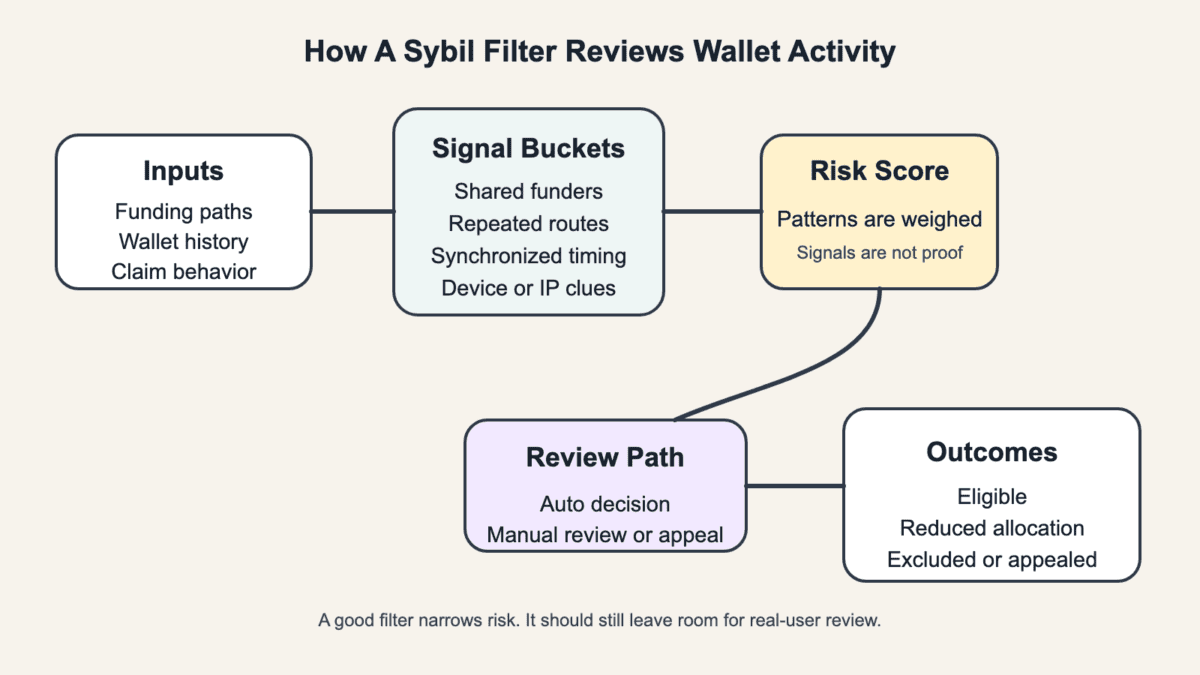
_A Sybil filter can narrow suspicious patterns, but good review paths still matter for real users._
A Sybil filter can misread real wallets when normal privacy, security, or operational habits resemble coordinated farming. Multiple wallets alone are not the problem.
Many crypto users separate wallets for good reasons. One wallet may hold cold storage. Another signs risky dApps. A third handles testnets or small trades. A fourth lives on a specific chain. That setup can be safer than using one address for everything.
Here is the cleaner split:
| Normal Pattern | Suspicious Pattern |
|---|---|
| Separate hot and cold wallets with different jobs. | Many fresh wallets doing the same claim tasks. |
| Chain-specific wallets used over time. | Wallets created shortly before an eligibility snapshot. |
| Shared household network with varied activity. | Many wallets acting from the same setup in tight timing. |
| Testnet activity mixed with real use. | Faucet-only activity copied across many addresses. |
| Different apps, amounts, and behavior. | Same route, same contracts, same sequence, same exit. |
Trouble starts when the wallets behave like copies. A project may see many fresh wallets funded from one source, performing the same tasks in the same order, then claiming and consolidating funds. That looks less like wallet hygiene and more like Sybil farming.
Project rules vary. Some publish broad criteria. Others reveal little because full disclosure can help farms adapt. That secrecy can be understandable, but it also makes false positives harder to challenge.
> Be especially careful with “aged wallet” shortcuts. Buying an old wallet to look organic can hand you hidden approvals, unclear tax history, reused private keys, recovery risk, or a seller who still has control.
If you use multiple wallets, keep records for your own sanity. Save claim screenshots, note official criteria, and avoid making every wallet look like a copy of the last one. Clean habits help, even when no filter is perfect.
Sybil filter tradeoffs are hard because stronger identity checks can reduce abuse while making users less private. Crypto wants one-human-one-share fairness, but wallets do not prove humanity.
One wallet does not equal one person. A person can have many wallets. A farm can have many wallets. A company can run many accounts. A family can share a device or network.
So projects add more signals. Those can include wallet age, staking history, social reputation, attestations, KYC, proof of personhood, or manual appeals.
Each option has a cost:
Privacy is not a side issue here. Users may not want to be doxxed just to prove they are not farming a token allocation. At the same time, projects cannot leave rewards open to unlimited wallet creation and pretend the distribution is fair.
> False positives sit in the middle of that tension. A real user with shared IPs, VMs, VPNs, testnet-heavy behavior, or several fresh wallets can look suspicious.
A farm with better tooling can look cleaner than expected. That is annoying, but it is also the central problem.
The best setup is layered: wallet-cluster analysis, clear eligibility rules, limited identity checks where needed, and an appeal path for edge cases.
For investors, a Sybil filter is a distribution-quality signal, not a price prediction. It can affect trust, supply pressure, and whether the user base looks real.
A weak filter can inflate activity. It may make a project look busy before launch while much of the demand came from claim hunters. If those wallets sell quickly, the token can face early pressure from recipients with no attachment to the network.
A harsh filter creates a different problem. Real users may feel cheated if criteria are vague, appeals are missing, or support fails during the claim window.
Before trusting the launch story, check these points:
None of those checks gives a perfect answer. A well-filtered drop can still sell off. A messy drop can still recover if the product is useful. But a Sybil filter helps separate real demand from claim demand.
The phrase “community distribution” should not get a free pass. Ask whether the community looks like users, wallets, scripts, or a little of each. In crypto, “a little of each” is often the honest answer.
If a Sybil filter flags your wallet, slow down and use only official channels. Claim-window panic is exactly when fake appeals, wallet drainers, and random checker tools show up.
Start with the official claim page or the project’s verified announcement channels. Do not trust promoted links, replies, DMs, or “appeal checker” sites. A real appeal will not need your seed phrase. It should not ask you to sign strange approvals from a random domain.
Use this safer order:
Wallet safety becomes part of the Sybil filter problem here. A user trying to fix eligibility can lose funds by connecting to a fake support site. The filter may be frustrating. A drained wallet is worse.
> Do not assume an appeal will restore your allocation. Some projects review edge cases. Some do not.
Some projects disclose only broad categories because full rules would help farms. That is not satisfying, but it is common. For the next campaign, the safest approach is boring: use wallets consistently, avoid copied checklists across fresh addresses, keep claim records, and do not buy wallet history.
Related Sybil filter terms separate the original security idea from the airdrop-screening version users see today. The words overlap, but they do different jobs.
Sybil attack is the parent concept: one actor creates many identities to gain influence, rewards, voting power, reputation, or network control. Sybil resistance is the defense layer around that problem, from staking costs to identity checks and appeal reviews.
Farming in crypto explains the broader reward-seeking behavior behind many airdrop campaigns. Sybil farming is the airdrop-heavy version, where many wallets farm eligibility, points, quests, or claims as if they were separate users.
Wallet cluster means addresses linked by funding, timing, contracts, claims, devices, or later consolidation. Proof of personhood tries to prove a user is a unique human without making every wallet fully public.
Quadratic voting and DAO governance sit on the same fault line. If one person can cheaply split into many identities, a voting system that tries to measure broad support can bend toward whoever controls the largest identity set.
If you need the shorter slang sense, farm in crypto explains how the word gets used across rewards and trading. Without that context, “farm” can blur routine yield activity, reward hunting, and coordinated Sybil farming.
The same identity problem now shows up in DePIN, social crypto, and AI-agent wallets. Any system that rewards “unique” participation has to decide what unique means, who gets to prove it, and what happens when the proof is wrong.
The takeaway is simple: Sybil filters are not only about catching “bots.” They are about deciding when many crypto identities should count as many users, and when they are really one operator wearing too many hats.
Sybil filtered means a wallet, account, or node was flagged by a Sybil filter as likely fake, duplicate, farmed, or coordinated. In airdrops, it usually means the wallet was excluded, reduced, or sent to review.
The phrase does not prove you personally attacked a network. It means your activity matched patterns the project considered suspicious under its eligibility rules.
Yes, a Sybil filter can be wrong because it works from signals, not certainty. Shared networks, multiple wallets, VMs, VPNs, fresh wallets, or repeated testnet tasks can confuse a filter.
Good projects leave room for review or appeals. Still, no project is required to restore eligibility, and many do not disclose every rule because that would help farms adapt.
No, using multiple wallets is not automatically Sybil farming. Many users separate hot wallets, cold storage, test wallets, chain-specific wallets, and risky dApp wallets.
The risk rises when wallets act like copies. Shared funding, repeated routes, synchronized timing, thin history, and coordinated claims can make normal wallet separation look suspicious.
Projects detect wallets with a Sybil filter by comparing patterns across activity. They may look at funding paths, transaction order, wallet age, bridge routes, claim timing, reward consolidation, and off-chain signals when available.
No single signal proves guilt. Filters are strongest when many independent clues point to the same wallet cluster.
No, KYC does not stop every Sybil filter problem. It can reduce duplicate claims, but it creates privacy, data-security, access, and false-positive tradeoffs.
Some projects prefer lighter tools, such as wallet history, attestations, social reputation, proof of personhood, or appeals. Each one can help. None is perfect.
If your wallet is Sybil filtered, use only the official claim page and verified support channels. Save screenshots, read the criteria, check whether an appeal exists, and avoid random checker tools.
Never enter a seed phrase for an appeal. Do not sign approvals from unknown sites. A missed airdrop is painful. Losing the whole wallet is the kind of lesson crypto does not need to repeat.