Physical Address
304 North Cardinal St.
Dorchester Center, MA 02124
Physical Address
304 North Cardinal St.
Dorchester Center, MA 02124


A plain-English guide to Sybil attack risk in crypto.
A Sybil attack is when one actor pretends to be many independent participants to gain extra influence, rewards, or control.
In crypto, those fake participants can be nodes, validators, wallets, accounts, DAO voters, or airdrop claimants. The damage is not always dramatic at first. Sometimes the attack simply makes a project look busier, fairer, or more decentralized than it is.
That makes Sybil risk a wallet problem, a governance problem, and an investor problem at the same time.
A Sybil attack in crypto is identity abuse. One person, team, script, or coordinated group creates many identities that appear independent, then uses them to gain influence the system did not mean to give one actor.
The classic version happens at the network layer. An attacker spins up many nodes or accounts and tries to make the network believe they represent broad participation. If the fake identities gain enough weight, they may affect routing, peer discovery, voting, censorship resistance, or the information honest users see.
The crypto version usually shows up in two places:
The second meaning shows up constantly in DeFi and airdrop talk. The fake identities are not always nodes. They may be wallets claiming an airdrop, accounts joining a points campaign, addresses voting in a DAO, or users trying to look like a large community.
Owning more than one wallet is not automatically a Sybil attack. Plenty of users separate trading wallets, cold storage, test wallets, and public wallets for sane reasons. The line is crossed when those wallets are used to bypass one-person limits, fake adoption, capture rewards, or multiply voting power.
A simple example: one farmer funds 200 wallets, runs the same bridge route through each one, clicks the same contracts, and claims rewards meant for 200 separate users. The wallets look separate on the surface. The control and intent point back to one source.
That is the core trick: a Sybil attack turns cheap identity into fake independence.
A Sybil attack works by making identity cheaper than influence. The attacker creates many visible participants, makes them look separate, then pushes them toward a shared goal.
The target changes by system. On a peer-to-peer network, the fake identities may be nodes. In a validator set, the problem is voting or validation weight. In a DAO, it may be governance accounts. In an airdrop, it may be wallets that all pretend to be separate users.
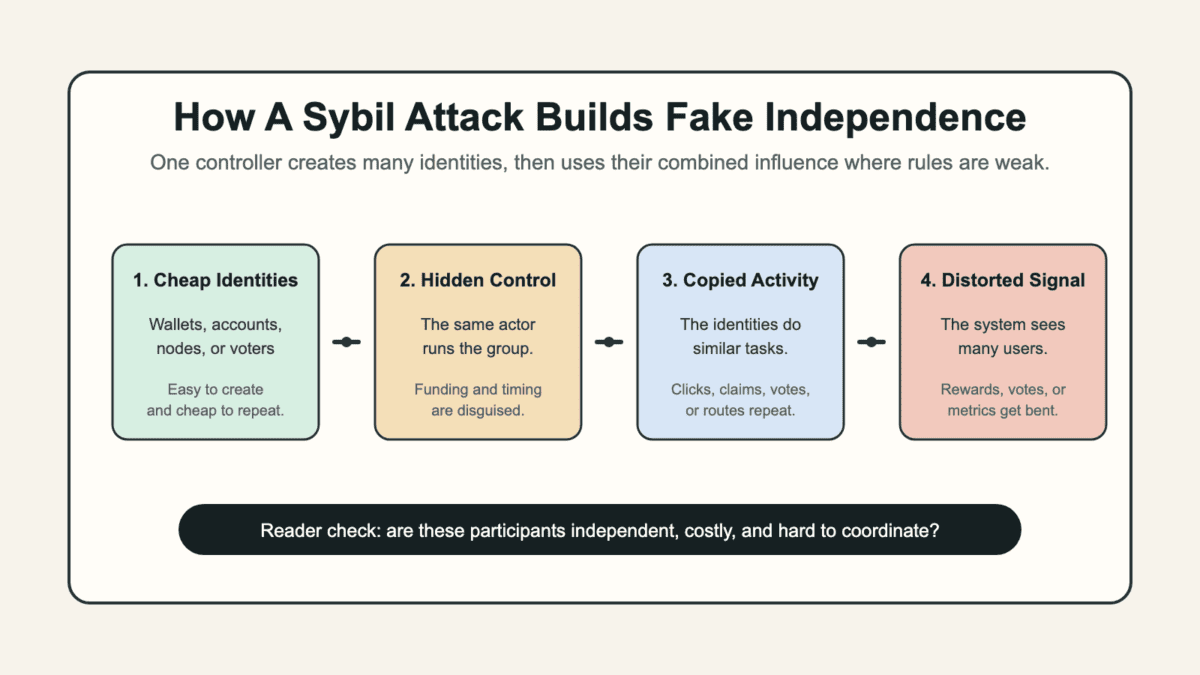
_A Sybil attack turns cheap identities into fake independence before using that influence where the rules are weak._
Most Sybil attacks follow the same rough loop:
The attack is easier when accounts are free, reputation is shallow, and activity checks reward volume over quality. If every new wallet gets points for doing the same simple action, a script can turn “engagement” into a spreadsheet exercise. Very glamorous. Very fake.
On blockchain networks, the usual defense is to make influence costly. Proof of work charges energy and hardware. Proof of stake charges collateral. Gas costs, staking bonds, reputation, and identity checks all try to make fake scale expensive enough that the attack stops being attractive.
But cost alone is not a cure. A rich attacker can still pay. A desperate airdrop farmer may still run hundreds of wallets. A project with weak rules may reward repetitive behavior because the dashboard looks good.
So the useful question is what those identities can control once they exist.
For crypto investors, a Sybil attack can make weak traction look strong. Wallet count is not user count. Transaction count is not necessarily demand. DAO votes are not always a broad community signal.
That gets dangerous around token launches and incentive campaigns. A project may show rising active wallets, a crowded points dashboard, or strong governance turnout. If much of that activity comes from one coordinated farm, the market may be pricing fake distribution as real adoption. The distortion can show up in several ways:
The sell-pressure link is especially important. If a Sybil-heavy airdrop sends tokens to farmers with no long-term interest, early trading can turn into an exit liquidity problem for later buyers. The farmers got paid. The next crowd gets the chart.
Sybil activity can also inflate the attention economy around a launch. More wallets, posts, claims, quests, and votes can make a project feel unavoidable. But attention built on fake identity tends to vanish once rewards stop.
Not every suspicious metric is fraud. New projects often attract mercenary users, curious traders, and normal multi-wallet behavior. For investors, the check is whether activity remains diverse, costly, and meaningful after the incentive disappears.
If the answer is no, the project may have bought a crowd instead of built one.
A Sybil attack shows up in airdrops when one actor uses many wallets to claim rewards meant for separate users. This is why airdrop teams spend so much time looking for clusters, repeated paths, and behavior that feels copied rather than organic.
The current pain point is not only the attacker. Normal users also worry about being tagged as Sybil by mistake. A person may use one wallet for DeFi, one for NFTs, one for testnets, and one for riskier contracts. That can be reasonable.
It becomes suspicious when the wallets move together like a rehearsed group. Anti-Sybil teams often look at patterns like these:
| Signal Projects May Check | Why It Can Look Suspicious |
|---|---|
| Same funding source | Many wallets may trace back to one controller. |
| Repeated contract path | The wallets may be following one farming script. |
| Synchronized timing | Actions may be automated or centrally coordinated. |
| Dust bridging | Small repeated transfers can show low-effort eligibility farming. |
| Aged-wallet buying | Old history may be used to bypass simple freshness checks. |
| VPN or device overlap | Accounts may look separate on-chain but connected off-chain. |
These checks are imperfect. A blunt filter can punish housemates, teams, power users, or people who copied the same public guide. Good filters look for combined patterns, not one awkward transaction.
This is where crypto farming becomes more than harmless grinding. Farming is normal when users test products, provide liquidity, or complete real tasks. Sybil farming is different because the goal is to multiply eligibility while hiding common control.
Wallet history can help or hurt. A wallet with varied activity, different funding paths, and real use over time looks less like a cloned account. Thin wallet patterns with identical routes, same-day funding, and no behavior outside the campaign look easier to flag.
The takeaway is simple: multiple wallets need a reason. If every wallet exists only to do the same reward-earning task, the project may read that as a farm. Sometimes correctly. Sometimes with all the subtlety of a vending machine.
A Sybil attack is about fake identity scale. It can overlap with bots, 51% attacks, eclipse attacks, and wash trading, but those terms describe different threat models.
The confusion is understandable. A bot can run many wallets. A Sybil node swarm can help isolate a target. Wash trading can use related accounts. But the label changes the defense.
| Term | How It Differs From A Sybil Attack |
|---|---|
| Bot activity | Automation. A bot may use one account or many fake identities. |
| 51% attack | Majority control of block production or validation power. |
| Eclipse attack | Isolating a node so it sees a distorted view of the network. |
| Wash trading | Fake market activity, often between related accounts. |
| Wallet spam | Unwanted wallet activity that may not seek influence or rewards. |
A Sybil attack can support some of these attacks, but it is not the same thing. The Sybil part is the one-actor-many-identities trick.
For example, a trading bot placing fast orders is not automatically Sybil behavior. If the same operator also creates thousands of accounts to fake volume, claim incentives, or vote many times, the identity problem enters the picture.
Likewise, a 51% attack is not just “many nodes.” It is control over enough mining or validation power to overpower honest block production. A network can have many fake nodes without those nodes having majority consensus weight.
That distinction changes what users should inspect. If the issue is bots, look for automation controls. If the issue is wash trading, look at related-party volume. If the issue is Sybil identity, look for common control hiding behind many faces.
Crypto networks defend against a Sybil attack by making fake influence costly, limited, or easier to detect. The goal is not to stop anyone from creating a wallet. The goal is to stop cheap identities from becoming cheap control.
As Ethereum.org explains, proof of work and proof of stake are consensus mechanisms that make attackers spend energy or lock collateral before they gain influence. That does not erase Sybil risk everywhere, but it makes raw identity count less useful. Each defense adds a different cost:
| Defense | Tradeoff |
|---|---|
| Proof of work | Raises hardware and energy cost, but favors scale and cheap power. |
| Proof of stake | Requires collateral, but concentrates influence where stake concentrates. |
| Gas or action costs | Makes farming expensive, but prices out smaller users too. |
| Reputation systems | Rewards history, but can punish new users or bought accounts. |
| KYC checks | Reduces fake accounts, but adds privacy and access problems. |
| Proof of humanity | Supports one-person-one-vote goals, but can create gatekeepers. |
| Behavior analytics | Finds clusters, but can create false positives. |
Identity-based defenses deserve extra caution. KYC, proof of humanity, and biometric checks can reduce fake accounts, but they also ask users to reveal more about themselves. In crypto, that can collide with privacy, safety, geography, and access. A fix that turns every wallet action into a passport checkpoint may solve one problem by creating another.
Zero-knowledge proofs and trust graphs try to soften that tradeoff. They can prove eligibility or reputation without exposing every detail. But they still depend on issuer choices, social assumptions, or verification systems that users may not trust. That is why doxxed identity sits near this debate. Public identity can increase accountability, but it also raises personal risk.
The best defense depends on the thing being protected:
No single defense wins everywhere. Good Sybil resistance usually layers costs, behavior checks, and clear rules so fake identities face friction without turning normal users into collateral damage.
You can spot Sybil attack risk by asking whether the visible activity looks independent, expensive, and durable. If the answer depends on a rewards program still running, be careful.
Start with wallet metrics. A high active-wallet count sounds good, but wallets are easy to create. Better signals include repeat use after incentives end, varied transaction types, different funding paths, and activity that fits the product instead of a quest checklist.
Then look at distribution. If a large share of rewards, votes, or allocations lands in similar wallets, the community may be less broad than it appears. A fair launch can still have whales. The warning sign is a crowd of tiny wallets behaving like one whale in a fake moustache.
Use these checks before trusting the numbers:
A project with transparent rules deserves more credit than one that announces vague bans after users spend time and gas. Clear criteria reduce drama, even when some edge cases remain.
For investors, the goal is not perfect certainty. It is avoiding blind trust in dashboards. If wallet growth, points, or votes collapse once incentives stop, the project may have measured reward hunters instead of users.
For airdrop users, the practical check is simpler. If you use multiple wallets, keep behavior explainable. Do not assume “many wallets” is clever by default. Sometimes it just creates a paper trail with extra gas fees.
Start with the rule that wallet count is not user count. A Sybil attack exploits the gap between visible accounts and real independent people.
Use that rule when looking at airdrops, DAOs, and young tokens. The number on a dashboard is only useful if the activity behind it is diverse, costly, and durable.
Also separate your own wallet behavior from project evaluation. As a user, you want activity that is explainable. As an investor, you want metrics that survive after the reward meter stops spinning.
These actions help you stay grounded:
If you are evaluating a project, look for real retention after the easy rewards end. If you are farming, avoid behavior that only exists to multiply eligibility. If you are voting, ask whether one-person-many-wallet activity can sway the outcome.
Clear rules protect honest users too, because nobody wants to learn the policy after the claim page says no.
Sybil risk is not a reason to distrust every crypto metric. It is a reason to ask what the metric actually counts. Sometimes it counts users. Sometimes it counts wallets. And sometimes it counts one motivated operator with a very busy afternoon.
A Sybil attack in crypto is when one actor uses many fake identities to gain extra influence, rewards, or control. Those identities can be wallets, nodes, accounts, validators, or DAO voters.
The key issue is hidden common control. One person may appear to be a broad group, which can distort airdrops, governance, network routing, or user-growth metrics.
No. A Sybil attack is about fake identities controlled by one actor. A 51% attack is about controlling most block production or validation power. They can overlap, but they are not the same. Many fake nodes do not automatically control consensus. A 51% attacker needs enough real mining power, stake, or validation weight to overpower honest participants.
Bitcoin can face Sybil-style risks at the network layer, such as fake peers trying to influence what a node sees. But Bitcoin’s proof-of-work design makes consensus influence costly because block production depends on mining power, not raw node count. So fake nodes alone do not let an attacker rewrite the chain or mint coins.
Airdrop projects ban Sybil wallets because rewards are usually meant for separate users, not one person running many accounts. If a farm captures a large allocation, real users get less and the token may face faster selling after launch. Projects look for clusters, repeated funding routes, synchronized actions, and low-effort activity to reduce that abuse.
No. Multiple wallets are normal in crypto. A user may separate cold storage, trading, testing, and public activity.
It becomes Sybil behavior when the wallets are used to bypass rules, fake independent demand, multiply airdrop eligibility, or gain voting power that should belong to separate participants. Intent and behavior patterns count more than wallet count alone.
KYC can reduce some Sybil attacks because it makes fake accounts harder to create. It does not solve every case. KYC adds privacy risk, excludes some users, and creates a gatekeeper. It also may not work well for wallet-level behavior if users can borrow identities, use companies, or shift activity to systems that do not require verification.