Physical Address
304 North Cardinal St.
Dorchester Center, MA 02124
Physical Address
304 North Cardinal St.
Dorchester Center, MA 02124


Atomic arbitrage explained without the bot-pitch fog.
In crypto, atomic arbitrage is an arbitrage trade where several legs are bundled into one blockchain transaction, so they execute together or revert together.
That all-or-nothing design is the point. A bot can try to buy from one DEX pool and sell into another in the same transaction, so it does not get stuck holding the first asset if the second swap fails. But “atomic” does not mean automatic profit, secret execution, legal approval, or safety.
Atomic arbitrage in crypto is an on-chain arbitrage pattern where a searcher tries to capture a price gap across venues or pools within one transaction. If every step succeeds, the transaction lands. If any required step fails, the transaction reverts.
The word “atomic” comes from computing and database logic. It means the operation is indivisible. You do not want half of the route to happen while the other half disappears into the void.
The split is easier to keep straight this way:
In a simple DEX example, Token X is cheaper in Pool A than Pool B. A bot buys Token X from Pool A, sells it into Pool B, checks the ending balance, and only accepts the transaction if the route clears its profit condition.
That makes atomic arbitrage different from a normal manual trade. A person might buy first, wait for the second trade, then discover the price moved. The bot tries to compress the full path into one on-chain action.
The clean definition still needs a warning. Atomic arbitrage protects against partial execution inside that route. It does not protect against a bad opportunity, a wrong simulation, a higher priority bid, a failed transaction fee, a broken contract, or a scammer selling “guaranteed” bot access.
So the next question is not only “can the trade revert?” It is also “who gets included first, who sees the route, what does it cost to try, and what happens if the edge vanishes?”
Atomic arbitrage works on a DEX by using smart contracts to join the buy leg, sell leg, and profit check into one transaction. The route usually runs through AMMs, which price swaps from liquidity pools rather than order books.
A DEX is a decentralized exchange. An AMM is a pricing system inside many DEXs. A liquidity pool is the pot of assets users trade against. If a large swap moves one pool’s price, another pool may briefly quote a different price for the same asset.
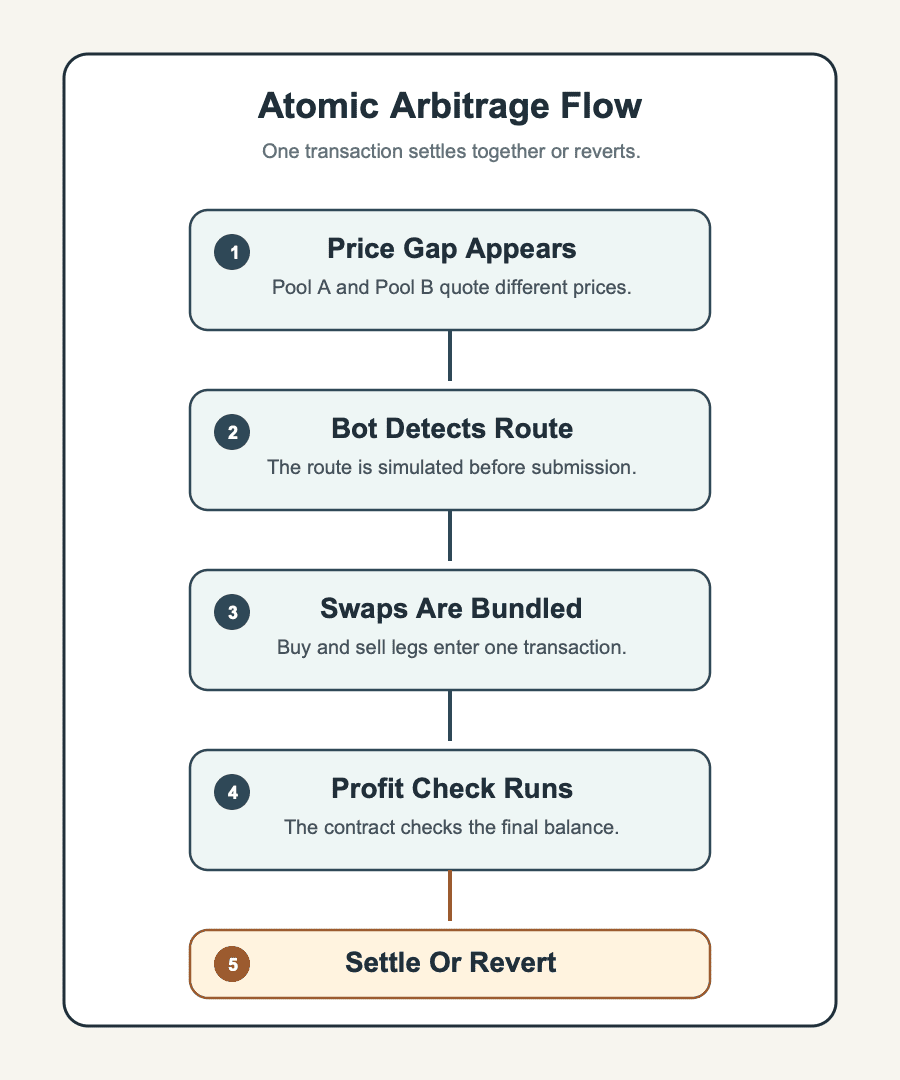
The lifecycle usually looks like this:
The profit check keeps the route from becoming a stranded trade. If the first swap would happen but the second swap no longer works, the transaction can revert before the bot accepts the bad ending.
Slippage and price impact are still central. Slippage is the difference between the expected swap result and the actual result. Price impact is how much the trade itself moves the pool’s price.
A route can look profitable before it hits the chain, then become stale before inclusion. Another searcher may land first. A priority fee may rise. The pool may shift because a normal user made a swap. The bot can be right about the idea and wrong about the moment.
That is why serious atomic arbitrage is less like spotting a coupon and more like bidding for a narrow window. The route, transaction, fee, and inclusion path all need to line up.
Atomic arbitrage gets confused with several nearby terms because they often appear in the same MEV conversations. The clean split is simple: atomic arbitrage is an execution pattern, while flash loans, non-atomic routes, and sandwich attacks describe different parts of the trade.
MEV means maximal extractable value. It describes value that can be gained from transaction ordering, inclusion, or exclusion. Atomic arbitrage is one MEV strategy, but not every MEV strategy is atomic arbitrage.
Here is the quick separation:
| Term | What It Means |
|---|---|
| Atomic arbitrage | Multiple trade legs execute in one transaction, or the whole route reverts. |
| Flash-loan arbitrage | A trade uses borrowed capital that must be repaid inside the same transaction. |
| Non-atomic arbitrage | Trade legs happen across separate transactions, venues, chains, or time windows. |
| CEX-DEX arbitrage | A trader compares prices between a centralized exchange and a decentralized exchange. |
| Cross-chain arbitrage | A trader tries to capture price gaps across chains or bridges, often with timing risk. |
| Sandwich attack | A bot places trades around a user’s swap to extract value from the user’s price impact. |
A flash loan can fund atomic arbitrage. It is not the same thing. The flash loan supplies temporary capital, while atomic execution controls whether the bundled route settles.
Non-atomic arbitrage has a different risk profile. If one leg happens on a DEX and another sits on a centralized exchange, the trader may hold inventory while waiting for the second leg. Prices can move, withdrawals can slow down, and the trade can become unbalanced.
The useful line between atomic and non-atomic arbitrage is practical: atomic routes reduce inventory risk by executing in one chain transaction, while cross-venue routes can leave traders exposed between legs.
Sandwich attacks are different again. They do not simply correct a price gap across pools. They exploit the ordering around another user’s transaction. That is why normal traders often hear atomic arbitrage, MEV, and sandwiches in the same breath, then walk away with a headache and three new tabs open.
Atomic arbitrage is not risk-free profit because the atomic part only protects against one narrow failure: one leg settling while another required leg does not. It does not guarantee that the route was real, cheap, private, or included before someone else.
That distinction becomes most dangerous when bot ads say “risk-free.” At the contract level, the transaction can revert if the route no longer meets its rules. In trading terms, the searcher may still burn fees, lose time, leak a route, or bid too much for inclusion.
> Atomic execution can stop a half-finished route. It cannot stop bad math, leaked routes, bad contracts, or a faster bidder.
The remaining risks are usually the real story:
The opportunity also has to beat costs. A price gap that looks wide on a chart may shrink once the route includes swap fees, network fees, priority bidding, failed attempts, and the cost of maintaining the infrastructure.
Then there is competition. The same gap can be visible to many searchers. If several bots chase it, the winner may be the one with faster state updates, better simulation, cheaper execution, or a stronger inclusion path.
Flash loans do not remove those problems. They can provide trade capital for a route, but they do not provide latency, privacy, code quality, fee budget, or a durable edge.
For beginners, the lesson is conceptual. Atomic arbitrage is a useful design pattern to understand. It is not a passive-income machine. If a pitch makes it sound like one, the pitch is doing more work than the bot.
Atomic arbitrage is mostly used by searchers, MEV teams, quant builders, protocol analysts, and advanced hobbyists. Some validators, builders, or routing services also sit near the activity because transaction inclusion is part of the game.
The competition is not just “who found the price gap.” Many people can find obvious gaps. The harder part is simulating the route correctly, building the transaction fast, bidding for inclusion, protecting the route, and avoiding negative expected value. This is where atomic arbitrage becomes player-versus-player trading rather quickly.
Serious participants usually compete on a stack like this:
The dull operational work counts more than the screenshot. A bot has to know the latest pool state, estimate the route, build the transaction, decide what to pay for priority, and record what happened after the attempt. If that feedback loop is weak, the bot may keep chasing routes that looked profitable only in stale data.
Public guides can explain the mechanics. They usually cannot hand you live profitable routes because those routes stop being useful once enough people copy them.
That is why “I found a bot script online” is a weak starting point. The public script may teach structure, but the durable edge tends to sit in data, speed, execution, and discipline. Boring, expensive things. Naturally, the sales page forgets to mention those.
Atomic arbitrage changes by chain because fees, latency, block production, private routing, and transaction inclusion differ. The core idea stays the same, but the environment changes.
Solana appears often in current atomic arbitrage searches because its fast trading environment attracts DEX routing, bot experiments, and MEV discussions. Jupiter, Raydium, Orca, Jito, gRPC feeds, and priority fees can show up in that context.
The simple comparison is:
| Environment | What Changes For Atomic Arbitrage |
|---|---|
| Solana | Fast slots, low base fees, DEX aggregators, Jito-style routing, and fierce latency competition. |
| Ethereum | Higher fee sensitivity, builder relationships, private RPCs, bundles, and deep MEV tooling. |
| L2 Rollups | Sequencer behavior, bridge timing, rollup-specific liquidity, and different failure costs. |
The table should not be read as a ranking. A cheap chain can still be crowded. A mature chain can still price out weak routes. An L2 can look simple until liquidity splits across venues and domains.
A recent arXiv paper on Polygon atomic arbitrage analyzed 23 million Polygon blocks, which is a useful reminder that this is not a tiny side topic hiding in one chain’s corner.
That does not make Solana a magic setting. It can lower some costs and speed up routing, but it also attracts heavy competition. The surrounding Solana market culture can turn every fast-trading edge into hype before most users understand the risk.
Ethereum and many L2s have a different shape. Builders, private RPCs, Flashbots-style routing, rollup sequencers, and gas markets can influence whether an atomic arbitrage transaction lands, gets delayed, or becomes too expensive. For normal users, the lesson holds across chains: faster rails do not remove routing, fee, and inclusion risk.
Atomic arbitrage affects normal crypto traders because it can shape DEX prices, routing quality, slippage, and transaction ordering. You may never run a bot, but bots can still be active around the pools you use.
The positive side is price alignment. If the same token trades at meaningfully different prices across pools, arbitrage can pull those prices closer together. That can make DEX markets less obviously broken. The tradeoff is MEV pressure, where bots competing around swaps can affect fees, ordering, and execution quality.
Liquidity providers feel another side of the same activity. Arbitrage can rebalance pools after a large swap, but it can also mean the pool trades against faster searchers while prices are stale. Most users do not need the formula for that problem. They do need to know why thin pools and jumpy tokens can produce rough fills.
For ordinary swaps, the practical checks are simple:
Slippage settings deserve special attention. Too tight, and your swap may fail. Too loose, and you may invite a worse fill. The right setting depends on pool depth, volatility, route complexity, and how urgently you need the trade.
Atomic arbitrage is not automatically bad for users. It can correct prices. But the same competitive environment can punish lazy routing, weak protection, and trades in pools where liquidity is mostly a mirage.
Risky atomic arbitrage bot claims usually sell certainty where the real market gives only a narrow, contested edge. The more effortless the pitch sounds, the more carefully you should inspect it.
A serious arbitrage setup needs code, monitoring, simulation, routing, fee control, wallet hygiene, and failure tracking. A scam setup needs a dashboard, urgency, and a user willing to connect a wallet too quickly.
Watch for these red flags before you pay, paste, sign, or connect:
The “no capital needed” line is especially slippery. A flash loan may supply trade capital for one route, but it does not cover everything else. You may still need fees, infrastructure, coding skill, private routing, and a strategy that survives competition.
Bot pitches can also turn users into someone else’s exit liquidity. The seller earns from subscriptions, deposits, copied contracts, or bad approvals while the buyer absorbs the risk.
Wallet safety is part of the same check. Keep long-term funds away from experimental bots, revoke stale approvals, and use separate crypto wallets when testing unfamiliar apps.
If a bot cannot explain what chain it uses, how routes are verified, where transactions can be checked, what permissions it needs, and how failed attempts are handled, stop. The mystery is not alpha. It is usually the product.
Related atomic arbitrage concepts help keep the term from becoming a bucket for every fast trade in crypto. MEV is the broader category for value tied to ordering, inclusion, or exclusion. DEX arbitrage is the venue pattern across decentralized exchange pools. Flash loans are a funding method, not a profit guarantee.
Non-atomic arbitrage adds timing and inventory risk between legs. Bundles, mempools, builders, validators, and sequencers shape whether a transaction gets included and who sees it first. Those ideas help explain why a route can be technically valid and still lose the race.
For competition context, PVP trading is the useful next concept because atomic arbitrage is often a race against other searchers, not a private coupon. For bot-pitch safety, exit liquidity helps explain how a “profit tool” can become a way to sell risk to late or hopeful buyers.
Start with atomic arbitrage as a concept before you make it a trading plan. The concept is valuable even if you never run a bot, because it explains how DEX prices, MEV, and transaction execution connect.
The best starting point is the plumbing. Learn how AMMs price swaps, how pool depth changes slippage, and how a transaction can revert when a condition fails. Then compare that with non-atomic arbitrage, where one leg can settle while another leg waits somewhere else.
Good next steps are practical and low-drama:
If you are studying the topic as a builder, focus on simulations, failure logs, fee modeling, and security before chasing live routes. If you are studying it as a trader, focus on slippage, routing, and wallet permissions.
Keep the experiment size boring. Use a separate wallet, expect failed attempts, and write down what each failure cost before scaling anything. A clean post-trade log will teach more than a dashboard promising daily returns.
Public strategies are best used as education. Once a profitable route becomes easy to copy, it usually becomes less profitable or more expensive to win.
That is the honest lesson behind atomic arbitrage. The transaction can be all-or-nothing. The business is not.
No. Atomic arbitrage is an execution pattern where trade legs settle together or revert, while flash loan arbitrage uses borrowed funds that must be repaid inside the same transaction. A flash loan can fund an atomic route, but it does not make the route profitable or safe by itself.
Beginners can study atomic arbitrage, but consistent profit is unlikely without strong technical skill, fast infrastructure, fee control, and a real edge. Most public bot scripts are better learning tools than income tools.
No. Atomic arbitrage reduces the risk of one leg settling without the other, but fees, failed attempts, stale prices, smart contract bugs, route copying, and competition remain. “Atomic” is not a shield around your wallet.
Atomic arbitrage is common in MEV because searchers can bundle multiple swaps, verify the ending balance, and compete for inclusion when pool prices diverge. The all-or-nothing format fits the fast, block-by-block nature of DEX price gaps.
Atomic arbitrage is not always bad for normal traders. It can help align prices across pools, but the MEV environment around it can also affect slippage, priority fees, and transaction ordering. Users still need sane slippage settings and careful routing.
Atomic arbitrage executes the required legs inside one transaction, so the route settles together or reverts. Non-atomic arbitrage uses separate transactions, venues, chains, or time windows, which can expose the trader to price movement and inventory risk between legs.