Physical Address
304 North Cardinal St.
Dorchester Center, MA 02124
Physical Address
304 North Cardinal St.
Dorchester Center, MA 02124


A plain-English guide to auto-compounder vaults, APY, and DeFi risk.
An auto-compounder is a DeFi vault or strategy that automatically harvests crypto rewards and reinvests them into the same earning position.
That can save time, gas, and a lot of repetitive clicking. It still does not make a risky pool safe. The vault does the chores, but it also gives you another smart contract, strategy, and withdrawal path to understand. So the real question is bigger than “What is auto compounding crypto?” It is also “What am I trusting, and what happens when I need to exit?”
An auto-compounder runs the reward-management loop for a DeFi position. Instead of asking you to claim rewards, sell or convert them, and redeposit the proceeds, the vault strategy handles that process on a schedule or when a keeper triggers it.
You will usually see auto-compounders around staking vaults, lending markets, liquidity pools, LP-token farms, and yield dashboards. The interface may call the product a vault, strategy, farm, optimizer, or aggregator. The label changes. The core job is the same: harvest, convert if needed, redeploy.
That distinction keeps users from mistaking automation for the yield source. A staking pool, lending market, or LP farm creates the return. The auto-compounder handles the chores after rewards appear.
The boundaries are useful because DeFi tools love sharing names like borrowed hoodies:
You often see the result indirectly. Instead of a separate reward balance waiting in the wallet, the vault share may represent a slightly larger claim after each compound cycle.
So an auto-compounder can make a good strategy easier to manage. It cannot make a weak pool good, fix a bad reward token, or protect you from a contract bug.
An auto-compounder works by wrapping your deposit in a vault, tracking your share, then running a harvest-swap-redeposit loop in the background. The yield still comes from the underlying staking, lending, or yield farming position, not from magic inside the vault.
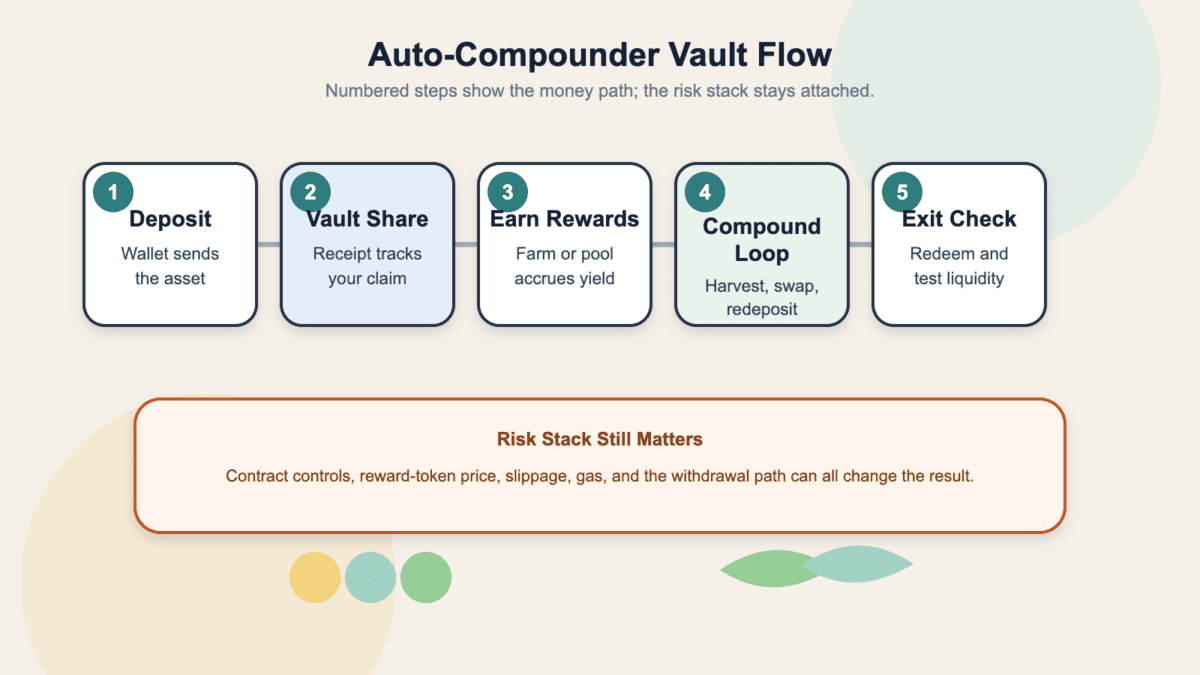
Depositing into an auto-compounder usually gives you a vault share, receipt token, or recorded balance. That token is not a separate reward. It represents your claim on the vault’s underlying assets.
If the strategy performs well, each share may represent more of the underlying position over time. If the underlying position loses value, the receipt token can still fall. A cleaner interface does not change the asset exposure.
Harvesting is the reward-claim step. The vault strategy collects tokens, fees, or incentives that the underlying protocol has made available.
Those rewards may never appear as a separate claimable balance in your wallet. You may only see your vault share represent a larger position after the next harvest and redeposit cycle.
Many vaults sell reward tokens into the asset needed for the strategy. For an LP vault, that may mean swapping rewards into both sides of a liquidity pair before adding more liquidity.
That step creates execution risk. Slippage, thin liquidity, bad routing, and high gas can all reduce the value actually compounded. A reward token can also fall before the vault sells it.
Withdrawing reverses the path. You redeem the vault share and receive the underlying asset, LP token, or whatever the strategy’s exit route allows.
Check this before deposit, not after panic starts making decisions. Some vault exits are simple. Others depend on pool liquidity, strategy unwinds, bridge conditions, or a delay before funds are available.
Auto-compounder, yield vault, and yield optimizer are related terms, but they are not perfect synonyms. The simple check is to ask what the product actually does with your deposit.
This table keeps the labels separate:
| Term | What It Usually Means |
|---|---|
| Auto-compounder | A strategy that harvests rewards and reinvests them into the position |
| Auto-compounding vault | A vault product built around that harvest-and-redeposit loop |
| Yield vault | A smart-contract vault that follows a yield strategy, which may or may not auto-compound |
| Yield optimizer | A tool that tries to improve yield through automation, routing, compounding, or strategy selection |
| Yield aggregator | A broader platform that surfaces or combines multiple yield opportunities |
| Auto-rebalancer | A tool that changes asset weights, ranges, or exposure rather than only compounding rewards |
| Trading bot | A program that opens or closes trades based on rules, signals, or market conditions |
Read the mechanics first and the label second. If the product harvests rewards and redeposits them, it is doing auto-compounding. If it routes, rebalances, or selects positions, more is happening.
The takeaway is simple. If a page says “optimizer,” do not assume it only compounds rewards. If it says “vault,” do not assume the strategy is low risk. Read the actual deposit asset, reward source, strategy rules, fees, and exit path.
This category is not background noise, either. Yield aggregators attract enough attention and capital across DeFi that users need to read the strategy behind the label. Size can make a vault easier to find. It does not make the strategy safer.
Auto-compounder APY can look better than farm APR because APY assumes rewards get reinvested. APR is a simpler annualized rate that does not include compounding.
A neutral Chainlink explainer compares auto-compounding with manual harvesting through harvest frequency, gas costs, and reward reinvestment. For users, the key point is that the biggest dashboard number is not automatically the best net return.
Use the labels carefully before trusting them:
| Dashboard Label | What To Check Before Believing It |
|---|---|
| Farm APR | Whether the rate comes from fees, incentives, or volatile reward tokens |
| Vault APY | How often the vault compounds and whether fees are deducted |
| Boosted APY | Whether the boost is temporary, token-based, or limited to certain users |
| Reward-token APR | Whether the reward token has real liquidity and selling pressure |
| Fee APR | Whether trading, lending, or protocol activity is creating the return |
| Historical APY window | Whether the number uses one day, one week, or a longer period |
The APY math also depends on costs. Performance fees, swap slippage, gas, and reward-token price moves can pull the result below the headline. If the vault compounds tiny rewards on an expensive chain, the shared gas benefit may help. If the same strategy sits on a low-fee chain, manual harvesting may be cheap enough.
Concentrated liquidity adds another twist. A farm APR may describe rewards earned only while liquidity stays inside an active price range. If the position spends time outside that range, the displayed APR can be a lousy guide. Before comparing vault APY with farm rewards, ask what capital is actually earning, when, and under which assumptions.
An auto-compounder can help when the compounding work is frequent, annoying, or too expensive to handle one wallet at a time. It is most useful when automation improves the net result after costs and risk.
That often happens when rewards accrue in small pieces or in tokens you do not want to manage manually. A vault can collect those rewards, handle the swap, and fold the value back into the position before the dust sits idle.
The benefit usually comes from operational cleanup:
That last point is underrated. A rules-based vault can reduce tinkering, which is useful when the alternative is clicking around DeFi because a chart looks bored. Less tinkering does not guarantee better returns, but it can stop small decisions from becoming a full-time hobby.
The gas side depends on the chain and the position size. Shared harvests can matter on expensive networks or in farms with frequent rewards. On cheaper networks, the same automation may save less than the vault fee takes back.
The benefit can shrink, though. On low-fee chains, manual compounding may be cheap. With tiny rewards, the extra strategy layer may not be worth it. And if you actually want to hold the reward token, an auto-compounder that sells it for the deposit asset may not match your goal.
Auto-compounder risks start with the underlying position, then add the vault layer on top. A vault can be efficient and still be one more contract, strategy, and control system to trust.
The risk stack is easier to see in two layers:
| Risk Layer | What Can Go Wrong |
|---|---|
| Vault contract | A bug, exploit, bad upgrade, or unsafe permission can affect deposits |
| Strategy contract | The harvest, swap, or redeposit logic can fail or execute poorly |
| Underlying protocol | The farm, pool, lending market, bridge, or staking system can break |
| Reward token | Rewards can fall in value before or after harvest |
| Swap route | Thin liquidity or slippage can reduce compounded value |
| Withdrawal path | Exits can depend on liquidity, delays, bridges, or strategy unwinds |
High APY can also attract late deposits into weak liquidity. If reward emissions are fading, token demand is thin, or insiders are leaving, new users can become exit liquidity while the dashboard still looks cheerful. The APY number does not know your cost basis. Very rude of it.
Stablecoin auto-compounders can look calmer because the deposit asset is meant to hold a stable value. That does not remove risk.
A stablecoin vault can still face depeg risk, pool imbalance, smart-contract failure, bridge exposure, oracle dependency, liquidity shortages, or a strategy that reaches for yield in places you would not choose manually. “Stable” describes the target price, not the whole vault.
Concentrated-liquidity vaults can automate positions inside a chosen price range. They can also make yield comparisons harder.
If price moves outside the active range, fees and rewards may change. If the vault rebalances too often, costs can rise. If it rebalances poorly, you can end up with exposure you did not expect. The compounding loop is only one part of the strategy.
Some vaults can update strategies, pause deposits, change harvest rules, or activate emergency controls. Those powers may be useful during an incident, but they also create governance and operator risk.
Look for clear docs, timelocks, multisig details, and public change history. An audit helps, but it is not a force field. It only says a review happened under certain conditions.
Auto-compounder vs manual compounding is not a contest with one universal winner. The better fit depends on gas, reward size, fee model, desired reward exposure, and how much control you want.
Start with the action you would take yourself. If you would claim the reward, swap it, and redeposit it on a similar schedule, an auto-compounder may simply do that work more efficiently. If you would hold the reward token, wait for better liquidity, or skip the swap, the vault may work against your plan.
This comparison keeps the tradeoff practical:
| Choice | Best Fit |
|---|---|
| Auto-compounder | You want less manual work and the vault’s costs are lower than your own compounding costs |
| Manual harvesting | You want full control over timing, reward tokens, swaps, and records |
| Holding rewards | You want exposure to the reward token instead of selling it back into the position |
| Doing nothing | Rewards are too small, costs are too high, or the strategy is not clear enough |
The table is only the first pass. The real comparison is net outcome after fees, gas, slippage, reward-token moves, and time spent managing the position.
Manual harvesting gives you more control. You decide when to claim, whether to sell rewards, and when to redeposit. That can help if reward tokens are volatile, tax records matter, or you want to avoid an extra contract layer.
Auto-compounding gives up some of that control for convenience. It can be better when rewards arrive often, gas is annoying, and the vault’s strategy is easy to understand. If the vault is vague, expensive, or built on a pool you would not use directly, automation is just a nicer wrapper around the same problem.
Check an auto-compounder by tracing the money before approving the transaction. You should know what asset enters, where it goes, what earns yield, what gets harvested, and how you exit.
Begin with the deposit asset and network. Then follow the route into the underlying pool, farm, lending market, or staking contract. If the vault page cannot make that route clear, the APY has not earned your attention yet.
Run through these checks before sizing a position:
The control checks matter as much as the yield checks. A vault that can upgrade strategy contracts, pause withdrawals, or route through a bridge may be doing reasonable things. You still need to know who can press those buttons and how visible those changes are.
Wallet setup belongs in this checklist because permissions are part of the position. A safer wallet workflow, spending limits where available, and a clean revoke habit can matter more than a prettier APY page. CryptoProcent’s wallet permissions guide is useful background before signing broad approvals.
If you cannot explain the yield source in one sentence, slow down. If you cannot explain the exit route, slow down twice. DeFi is generous with buttons and less generous with refunds.
An auto-compounder vault page should tell you what you deposit, what the strategy does, what the displayed yield assumes, and how withdrawals work. If it only shows a big APY and a deposit button, the page is asking for trust before it earns clarity.
Read the page like a transaction route. The top-line yield matters, but the boring labels usually tell you more about the position you are actually opening.
Start with the labels that affect the position:
Then compare the labels against the strategy description. A vault showing APY from a short window, a temporary boost, or a thin reward token needs a different level of caution than one showing steady fees from a simple pool.
Risk badges and audits can help, but they should not end the review. They do not tell you whether the reward token is liquid, whether the APY is temporary, or whether the strategy changed last week.
The best vault pages make the path boringly clear: deposit, strategy, harvest, swap, redeposit, withdraw. If the page hides those basics under marketing language, the vault is already making the user do detective work.
Auto-compounders fit best after you already understand the asset, pool, protocol, and reward source. They are an automation layer, not the foundation of the thesis.
That order matters. If the only reason you like the position is that the vault page shows a higher APY, you are starting with the weakest part of the case. The stronger starting point is wanting the underlying exposure anyway.
That makes them useful for specific situations:
A simple example is an LP position where you already want both assets and do not care to hold the reward token. The auto-compounder can turn routine harvesting into background maintenance. It still cannot protect you from impermanent loss, bad routing, or a reward program drying up.
Avoid auto-compounders when the APY is the only reason you are interested. Also avoid them when the strategy borrows against collateral in a way you do not understand, uses a bridge you would not trust, or depends on a reward token you would never hold outside the vault.
Start small, test the exit, and track whether the displayed yield matches the actual wallet result after costs. Position size should follow the risk you can actually explain. Automation should reduce routine work. It should not reduce attention.
Related terms help decode auto-compounder pages because vault interfaces compress a lot of DeFi into short labels. The most useful ones are the terms that explain yield source, share tracking, and exit risk.
Yield farming is the broader practice of using DeFi positions to earn fees, interest, incentives, or reward tokens. Farm rewards are the tokens or value streams the vault may harvest. A vault token or receipt token tracks your claim on the pooled position.
APY includes compounding assumptions. APR usually does not. TVL can show how much capital sits in a protocol, but it is not proof of safety. Impermanent loss affects LP positions when token prices move against the pool balance. Slippage affects swaps inside the compounding loop. Wallet approvals define what a smart contract can access.
Exit liquidity is the harsh market-side version of the same lesson. A high-yield vault still needs real buyers, liquid pools, and a workable withdrawal route. If those disappear, the compounding math becomes the least interesting part of the story.
An auto-compounder can be part of a yield optimizer, but the terms are not identical. A yield optimizer may compare, route, rebalance, or combine strategies, while an auto-compounder focuses on harvesting and reinvesting rewards.
Yes, you can lose money in an auto-compounder. Losses can come from asset prices, smart-contract bugs, underlying protocol failure, impermanent loss, stablecoin depegs, liquidation paths, slippage, or a strategy that performs worse than expected.
An auto-compounder is better when it saves more in time, gas, and missed reinvestment than it costs in fees and added risk. Manual compounding can be better when you want control over reward timing, token exposure, and records.
APR is a simple annualized rate before compounding. APY includes the effect of reinvesting rewards, so an auto-compounder vault may show APY because the strategy claims and redeposits rewards automatically.
Yes, some auto-compounders work with stablecoin strategies. That does not make them risk-free. Stablecoin vaults can still face depeg risk, smart-contract risk, pool imbalance, bridge risk, oracle issues, and weak liquidity.
Auto-compounders may create tax or recordkeeping questions because the strategy can harvest, swap, and redeposit rewards. Treatment depends on jurisdiction, so users should track transactions and get local tax guidance when the amounts matter.
Start with the underlying strategy, not the APY. If you would not use the pool, farm, lending market, or staking route directly, an auto-compounder should not make it suddenly attractive.
Use the next steps as a filter, not a ceremony. Each one should make the position clearer before more capital goes in.
Use this short sequence before deposit:
A small test deposit is not just a confidence ritual. It checks the approval, deposit, receipt-token tracking, and withdrawal path while the mistake is still small.
After the test, compare the vault result with the dashboard promise. Look at the actual tokens received, the fees paid, and whether the vault share moved the way the page implied.
Then set a review rhythm. Auto-compounders still need checks for fee changes, strategy updates, paused withdrawals, stale harvests, and reward emissions that fade faster than expected.
If any check fails, keep the position small or skip it. A confusing strategy, unclear exit route, or broad wallet approval is not a minor UX flaw when real funds are inside the vault.
For larger deposits, write down the reason for using the auto-compounder before you sign. The reason should be more specific than “higher APY.” Better reasons include lower manual gas costs, cleaner reward handling, or a vault strategy you already understand well enough to monitor.
An auto-compounder is a useful DeFi tool when the strategy is understandable and the automation earns its keep. When the only clear feature is a large APY, let the vault compound without you.