Physical Address
304 North Cardinal St.
Dorchester Center, MA 02124
Physical Address
304 North Cardinal St.
Dorchester Center, MA 02124


Backrunning explained for DEX traders.
Backrunning is a crypto trading tactic where a searcher places a transaction right after another transaction to profit from the state change it creates.
In a DEX trade, that change might be a pool price move, a liquidity update, a liquidation trigger, or an arbitrage gap. You usually see the effect later: slippage, a worse fill, a failed swap, or a route that felt strangely expensive.
Context decides whether backrunning is harmless arbitrage or the closing leg of a sandwich attack. That distinction stops feeling academic when your wallet balance takes the scenic route.
Backrunning in crypto means placing a transaction immediately after another transaction because the first one changes market conditions. The backrunner is usually a searcher, bot, validator-adjacent actor, or trading system looking for MEV.
MEV is value extracted from transaction ordering. Backrunning is one way that value appears. The searcher does not try to beat the target trade into the block. It wants that trade to land first, then reacts to the new pool state.
Take a simple AMM example. A trader buys a token from a low-liquidity pool. That buy pushes the pool price above the price on another venue. A searcher sees the gap and swaps right after the target trade, then sells or buys to capture the difference.
That can be standalone arbitrage. It can also be the final move in a sandwich attack. In a sandwich, a bot buys before the target transaction, lets the user trade at a worse price, then sells after the user. That last sell is the backrun.
So the term needs context. Backrunning can mean “selling after a whale buys,” but that is only one version. The broader idea is transaction ordering after a state change.
For a trader, the difference shows up in the fill. A price-correcting backrun happens after your trade already moved the pool. A sandwich pattern changes the conditions around your trade, so you can end up with worse execution.
That is why backrunning belongs in the same conversation as slippage, price impact, and routing. The label alone does not prove a hostile attack. The transaction pattern does.
A DEX backrun starts with a transaction that changes a pool, route, or contract state. The searcher wants its transaction to land right after the target, close to the same block or slot, before the opportunity disappears.
On Ethereum-style chains, the visible pending transaction may sit in a public mempool. On other networks, the path can involve private routing, direct validator paths, bundles, or fast infrastructure.
The details change, but the contest stays the same: who sees useful order flow, simulates it, and wins placement.
The basic flow usually looks like this:
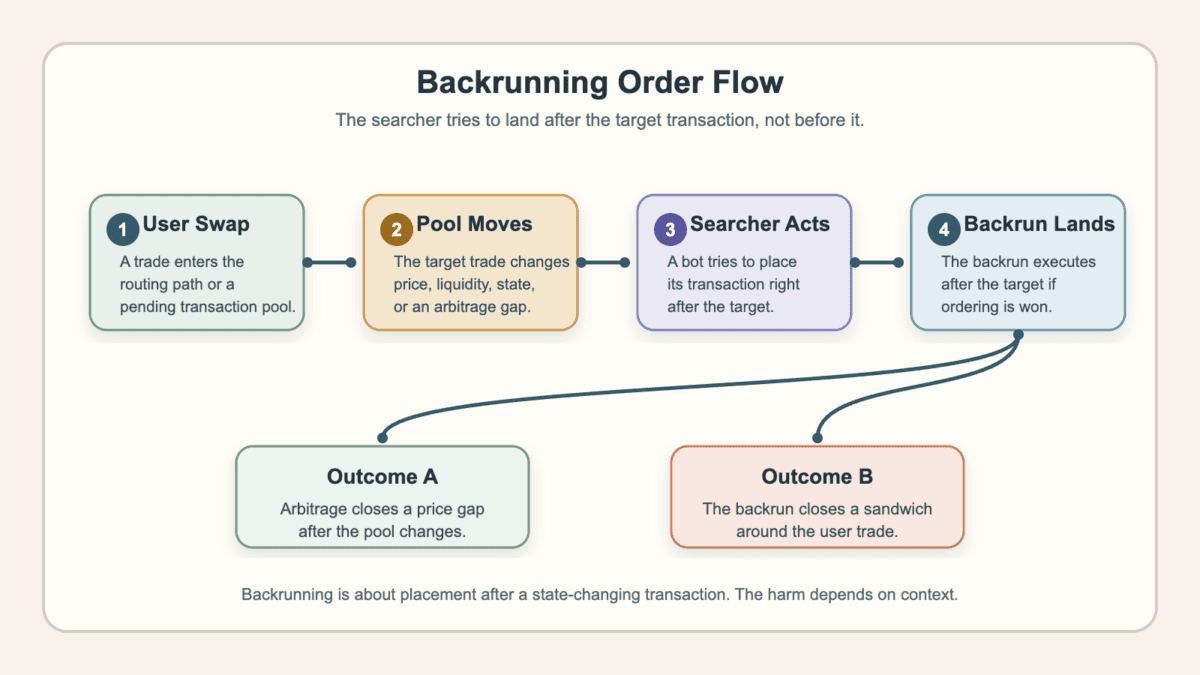
A wallet preview can look fine and still settle worse than expected. The preview is a snapshot. The settled trade happens after ordering, pool updates, and competing transactions change the state.
Searchers do not need to “hack” your wallet to backrun a DEX trade. They need visibility, speed, simulation, and a path into block construction. Less dramatic than a movie heist. Still enough.
Backrunning differs from front-running by timing. Front-running lands before the target transaction. Backrunning lands after it. A sandwich attack uses both around the target.
That timing split helps separate MEV from ordinary DEX friction. A bad fill can come from backrunning, but it can also come from slippage tolerance, price impact, a bad route, token tax, or thin liquidity.
Not every ugly chart candle is a bot conspiracy. Some are just bad plumbing.
| Thing | What The Trader Usually Sees |
|---|---|
| Front-running | A bot trades before the target, moving the price first. |
| Backrunning | A bot trades after the target, reacting to the new state. |
| Sandwich attack | A bot trades before and after the target, often worsening the user’s fill. |
| Price impact | The user’s own trade moves the pool because the order is large for available liquidity. |
| Slippage tolerance | The wallet allows execution within a price range, sometimes too wide. |
| Normal DEX fee | A visible protocol or pool fee charged by the route. |
The backrun leg is why sandwich attacks create confusion. Users hear “backrunning attack” and assume every backrun is hostile. The harmful part is usually the full sandwich pattern, where the user is boxed in by bot trades.
Standalone backrunning can still feel unfair because the searcher captures value after your trade. But if your trade already moved the pool and settled at the quoted route, the backrunner may be arbitraging the new price rather than worsening your fill directly.
The diagnosis changes the fix. A sandwich problem points toward tighter slippage, better routing, or protected flow. A price-impact problem points toward smaller trade size, deeper pools, or a different venue.
Backrunning affects crypto traders by turning transaction ordering into a cost, a missed surplus, or a confusing post-trade result. Even when the backrun does not directly take value from the target trade, it can expose weak execution.
The pain shows up in ordinary ways. A swap fills near the edge of your slippage range. A memecoin buy gets a worse entry than the preview suggested. A sell fails, then the retry clears at a worse price.
Sometimes the route looks cheap until the pool moves and the final received amount disappoints.
Thin markets make this worse. If a pool is shallow, one trade can push price far enough to invite arbitrage. If a token is mostly hype and late buyers, execution can feel like exit liquidity even when the visible fee looks small.
Backrunning also creates a blame problem. Users often blame the wallet because the wallet is the interface they saw. Sometimes the real issue is pool depth, routing quality, high slippage, a token transfer fee, or a volatile market moving while the transaction waits.
Wallets and aggregators still have work to do. Good routing, clear previews, warning labels, and MEV-aware options can reduce user damage. But the trade still settles inside a market where bots watch for state changes.
For small swaps in deep pools, backrunning may be invisible or irrelevant. For large trades, fresh pools, volatile memecoins, and low-liquidity exits, it can shape the whole experience. If your order changes the market, someone else may try to trade the new state.
Backrunning can be neutral or useful when it corrects a price difference after a trade or helps a market return to fairer pricing. That sounds less spicy than “MEV bot attack,” but it is part of how many on-chain markets work.
AMM pools do not know outside prices by themselves. If a large trade pushes one pool away from the broader market, arbitrage can pull it back. A backrunner may buy where the pool is cheap, sell where it is rich, and narrow the gap.
Liquidations can follow similar logic in lending markets. A state change creates an opportunity. Searchers compete to act on it. The result can remove bad debt or restore balance, even if the competition around it feels rough.
Some protected designs try to share value from post-trade arbitrage with users or route order flow through solvers. They do not make MEV vanish. They shift who competes, who sees the order, and how any surplus gets handled.
The neutral version has limits:
Flashbots reported in 2025 that spam bots across multiple rollups were consuming more than 50% of gas. That is the less visible cost. Useful arbitrage can still get messy when everyone races for it at once.
So the fair answer is narrower than “backrunning is good” or “backrunning is theft.” Some backruns restore prices. Sandwiching and spam-heavy competition can still harm users and networks.
Backrunning risk is highest when your transaction clearly changes a pool or exposes an easy after-trade opportunity. The more obvious the state change, the easier it is for searchers to model.
Large orders relative to pool depth are the cleanest signal. If your swap moves the AMM price, a backrunner can look for a second market where the price has not moved yet. The opportunity is cleaner when the token is volatile and the pool is thin.
Fresh pairs and memecoin-heavy markets add more risk. A new pool may have uneven liquidity, hidden token mechanics, concentrated holders, or buyers accepting wide slippage because they fear missing the move.
That is usually where execution gets loud, expensive, and weird.
Check these risk signals before a DEX swap:
| Risk Signal | What To Check Before Swapping |
|---|---|
| Trade is large for pool depth | Compare your order size with available liquidity and expected price impact. |
| Slippage setting is high | Lower it unless the trade truly needs room to settle. |
| Pair is new or thin | Check liquidity age, holder spread, and whether exits look realistic. |
| Token has transfer taxes | Confirm the received amount after token mechanics, not just route price. |
| Route is direct and public | Compare an aggregator quote and protected routing options. |
| Market is moving fast | Wait, split size, or use a limit order if the venue supports it. |
The table is not a guarantee. It is a pre-swap sanity check. If three rows look bad at once, your trade is not just “early.” It is walking into a crowded room wearing a price-impact sign.
Backrunning also appears around liquidity actions. Adding liquidity to a mispriced pool can create a quick arbitrage path. Removing liquidity during volatility can expose stale pricing. The same principle applies: if your transaction changes the state, someone may be ready for the next slot.
You reduce backrunning and sandwich risk by making your trade less attractive, less exposed, or less easy to reorder against. There is no magic setting. There are tradeoffs.
Start with the boring controls. They work more often than heroic bot lore. Lower slippage where possible. Avoid oversized trades in shallow pools. Compare routes. Split a trade when the saved price impact beats the extra gas or fees.
Then look at routing. Aggregators can compare pools and sometimes route around weak liquidity. MEV-protected routing or private RPCs can keep pending transactions away from some public mempool watchers.
Intent-based systems can let solvers compete on execution instead of exposing your raw order to every bot watching the route.
Each option changes a different part of the risk:
| Option | Tradeoff |
|---|---|
| Tighter slippage | Reduces sandwich room, but may cause more failed swaps. |
| Smaller chunks | Lowers price impact, but adds fees and timing risk. |
| Limit orders | Controls execution price, but may not fill. |
| Aggregator routing | Improves route search, but quotes can still move. |
| Private RPC | Hides from some public watchers, but adds relay trust. |
| MEV protection | Can reduce exposure, but does not fix bad liquidity. |
| CEX routing | Avoids public DEX ordering, but adds custody and venue trust. |
Wallet choices also count. Some wallets expose routing, slippage, approval, and RPC settings more clearly than others. A basic review of wallet settings can help you separate execution controls from security controls before a rushed trade.
Private routing deserves a careful note. A private RPC can reduce public visibility, but it does not erase all backrunning. The relay, builder, validator, solver, or venue path may still see useful information. The risk is not gone. It has moved.
A centralized exchange can avoid public DEX mempool exposure because your order does not go straight into an AMM route. But you accept account risk, custody risk, withdrawal limits, spreads, and the exchange’s own execution model. It is a tradeoff, not a cheat code.
The best protection is usually layered. Use deeper liquidity, saner slippage, better routing, smaller size, and private flow when the trust tradeoff makes sense. If the token itself is a circus tent with a contract address, no RPC setting will make it a blue chip.
Retail traders can profit from backrunning in theory, but the practical edge is hard to capture. The competition is fast, capitalized, and deeply technical.
A serious backrunning setup needs low-latency data, transaction simulation, private routing, bundle access, capital, gas controls, and failure monitoring. On Solana, the route may involve validator relationships, bundle paths, and infrastructure that normal users do not rent for a weekend.
The beginner mistake is thinking a “backrunning bot” is a downloadable money printer. In reality, it is a PvP trading game against searchers who already know the map, the routes, and the usual beginner mistakes. The cute dashboard is not the edge.
Failed transactions are part of the cost. So are priority fees, infrastructure bills, private relay failures, stale simulations, and getting copied by faster systems. A strategy can be directionally right and still lose because it lands one slot too late.
The scam risk is blunt, so use hard rules:
Backrunning can be a useful topic for developers learning AMMs, mempools, bundles, and simulation. As a casual profit plan, it usually becomes tuition. Sometimes expensive tuition, no certificate included.
Backrunning works differently across Ethereum, Solana, and L2s because transaction visibility and ordering paths differ. The user-facing risk still comes from the same ingredients: visible intent, ordering power, latency, and liquidity.
Ethereum examples often use mempool and builder language. A pending swap may be visible before inclusion. Searchers simulate the after-state, submit bundles or priority-fee transactions, and compete for a position after the target transaction.
Solana examples need different wording. Solana does not mirror Ethereum’s public mempool model in a simple one-to-one way. Order flow can move through RPCs, leader forwarding, Jito-style bundle paths, private arrangements, and latency-sensitive infrastructure.
The same user question remains: who can see or infer the trade, and who can influence ordering?
L2s add another wrinkle. Cheaper blockspace can make it easier to spam attempts when a backrun opportunity appears. Sequencer design, private routing, and batch timing all shape how the trade lands. A tiny fee does not make MEV vanish. It can make the race cheaper.
That is why chain-specific advice often sounds inconsistent. One trader says to use a private RPC. Another talks about bundles. Another says to split orders. They may all be responding to different ordering systems.
The practical takeaway is simpler than the infrastructure map. Before a DEX trade, check pool depth, slippage, route quality, and whether your transaction is likely to be visible before settlement. The chain changes the path. It does not remove the game.
Backrunning gets easier to understand once you separate execution risk from token-launch risk. A bad fill is one problem. A toxic market is another. Sometimes they arrive together, because crypto enjoys multitasking in the worst possible moments.
If you trade fresh memecoin pools, learn what trading in the trenches means before you blame every loss on MEV. Those markets often combine thin liquidity, fast buyers, wide slippage, social pressure, and messy exits.
Hard rug risk is the darker cousin. Backrunning can hurt execution, but a hard rug check asks whether the token can be drained, frozen, taxed, or abandoned by design. A clean route cannot save a broken token.
The useful habit is to stack the checks. Ask whether the trade is exposed to MEV. Then ask whether the pool is deep enough. Then ask whether the token itself deserves the trade. Skipping any one of those steps turns the swap button into a vibes-based consent form.
No. Backrunning lands after a target transaction, while front-running lands before it. A front-run tries to move first. A backrun reacts to the changed state after the target lands.
No. Backrunning can be ordinary arbitrage that restores prices after a trade. It becomes more harmful when it is part of sandwiching, spam, misleading execution, or a setup that captures value users could reasonably have kept.
Yes. Backrunning can happen on Solana, but the ordering path is different from Ethereum. Solana risk often involves RPC paths, leader forwarding, bundles, latency, validator relationships, and liquidity conditions rather than a simple public mempool story.
A private RPC can reduce some backrunning and sandwich exposure, but it does not remove all risk. It changes who sees the transaction, how it is routed, and which relay, builder, validator, or solver path you must trust.
A centralized exchange usually removes public DEX mempool exposure for that trade. It does not remove execution risk entirely. You add custody, account, withdrawal, fee, spread, and venue risk.
It is possible, but normal traders should assume it is difficult. Backrunning bots compete on speed, private order flow, simulation, capital, infrastructure, and inclusion paths. Fake bot offers are common enough to treat as hostile until proven otherwise.
Start with the trade, not the theory. Backrunning risk becomes easier to manage when you check the route before you sign and avoid settings that turn a normal swap into open season.
Use this order before a DEX trade:
Those steps will not stop every searcher. They will stop many self-inflicted losses that look like searcher genius after the fact.
Before a larger trade, run one extra check: ask what would happen if your transaction became visible to a fast bot. If the answer is “the pool moves a lot,” reduce size, wait for deeper liquidity, or use a route that gives you clearer execution controls.
After a bad swap, do not stop at the word MEV. Check the final route, received amount, pool depth, slippage setting, token mechanics, and whether a sandwich pattern appears around your transaction. The right post-mortem can improve the next trade.
Backrunning is not a reason to fear every DEX trade. It is a reason to respect ordering, liquidity, and route quality. If your transaction changes the market, someone may be waiting after it. Trade like you know that.