Physical Address
304 North Cardinal St.
Dorchester Center, MA 02124
Physical Address
304 North Cardinal St.
Dorchester Center, MA 02124


A plain guide to the blockspace market, gas fees, blobs, L2s, ETH value, and Bitcoin security.
The blockspace market is the way crypto networks price and allocate limited block capacity when users compete to get transactions included.
You feel it when a wallet fee quote jumps, a swap takes too long, or an L2 stays cheap while Ethereum mainnet looks expensive. The phrase sounds academic. The useful idea is simple: blockchains have limited room, and users bid for it.
The hard part is reading the signal. High fees can show real demand, spam, MEV, panic, or a crowded token launch. Low fees can mean better scaling, weak demand, or activity moving into a different lane. Same chart, several traps.
The blockspace market in crypto is the auction-like process that decides who gets into limited blockchain capacity, what they pay, and who earns the fee. It is market language, not a literal shop where one company sells storage shelves.
Blockspace is the scarce room inside a block. On a simple chain, that room might hold transactions. On a smart-contract chain, it can also include computation, contract calls, and data. When more users want inclusion than the next blocks can comfortably hold, price and priority start doing the sorting.
The market has three basic pieces:
A stadium-seat analogy works for about ten seconds. A block has only so many good seats. If everyone arrives during the same volatile market minute, the seats do not magically double. Some users pay more, some wait, and some decide the show is not worth the ticket.
But crypto has a sharper edge than a normal seat auction. Delay can change a trade, ruin a liquidation defense, lose an NFT mint, or make a bridge exit worse. So the blockspace market is not only a fee chart. It is a priority system for scarce settlement.
That is also why people talk about chains “selling blockspace.” Public networks usually do not have one owner selling slots from a counter. The market emerges from protocol rules, wallet bids, block production, and users deciding whether the next block is worth the price.
The blockspace market is scarce because blockchains deliberately limit how much work each block can carry. That limit protects the network from overload, spam, and hardware demands that only large operators can handle.
If a chain made blocks huge overnight, fees might fall for a while. But every node would need to download, verify, and store more data. That can raise bandwidth, memory, storage, and validation costs. If fewer people can run nodes, the chain may become cheaper to use but easier to centralize.
Scarcity comes from several places at once:
That is why “just add more blockspace” is not a full answer. More capacity can improve user experience. It can also weaken fee signals, invite spam, or make validation heavier.
> More capacity is not free. Someone pays through higher node requirements, weaker scarcity, different security assumptions, or lower fee pressure.
Scarcity also keeps fees from becoming a pure annoyance tax. When capacity is limited, spam and low-value repetition must compete with real settlement demand. The filter is imperfect, especially when bots can afford to bid. But without some limit, the network has less protection against everyone pushing costs onto node operators.
So the scaling debate is really about placement. Some activity belongs on an L2. Some belongs on L1. Some is bot noise wearing a fake mustache and calling itself adoption.
The blockspace market sets transaction fees by matching user urgency against limited inclusion capacity. A wallet creates a transaction, the network sees it, and the fee tells block producers how attractive it is to include.
Ethereum is the cleanest beginner example. Ethereum’s official gas overview breaks fees into gas limits, base fees, and priority fees, and lists a standard ETH transfer at a 21,000-unit gas limit. The base fee moves with block demand and is burned. The priority fee is the extra tip a user can add when speed matters.
The path usually looks like this:
Bitcoin works differently, but the core scarcity is familiar. Transactions compete for limited block capacity, and miners prefer transactions that pay enough fees for the block space they consume. There is no Ethereum-style gas meter for smart-contract execution, but there is still a fee market for scarce inclusion.
Fees rise when demand presses against capacity. That pressure can come from real users, DeFi liquidations, arbitrage, token launches, inscriptions, wallet consolidation, or bots trying to land first. The fee is not a moral score. It is the market asking, “How badly do you need this in the next block?”
For users, the lesson is boring and useful. If delay is cheap, waiting can be rational. If delay changes the outcome, paying more may be a cost of execution.
The blockspace market gets confusing because several fee lanes sit close together. Gas, blobspace, calldata, and L2 fees can all affect what a user pays, but they do not price the same resource.
Use this table when the jargon starts blending:
| Term | What It Prices |
|---|---|
| Blockspace | Scarce room for transactions, computation, or data inside blocks. |
| Gas | Execution work needed to run transactions or smart-contract calls. |
| Blobspace | Temporary Ethereum data capacity used mostly by rollups. |
| Calldata | Data posted through the execution layer, often more permanently. |
| L2 User Fee | A blended quote covering L2 execution, data posting, app costs, and margin choices. |
The key point is separation. Ethereum mainnet execution gas can be quiet while blob demand moves. Blobspace can be cheap while a wallet still shows an annoying L2 quote. A rollup can batch many users into one posting cost, then present each user with a simpler fee.
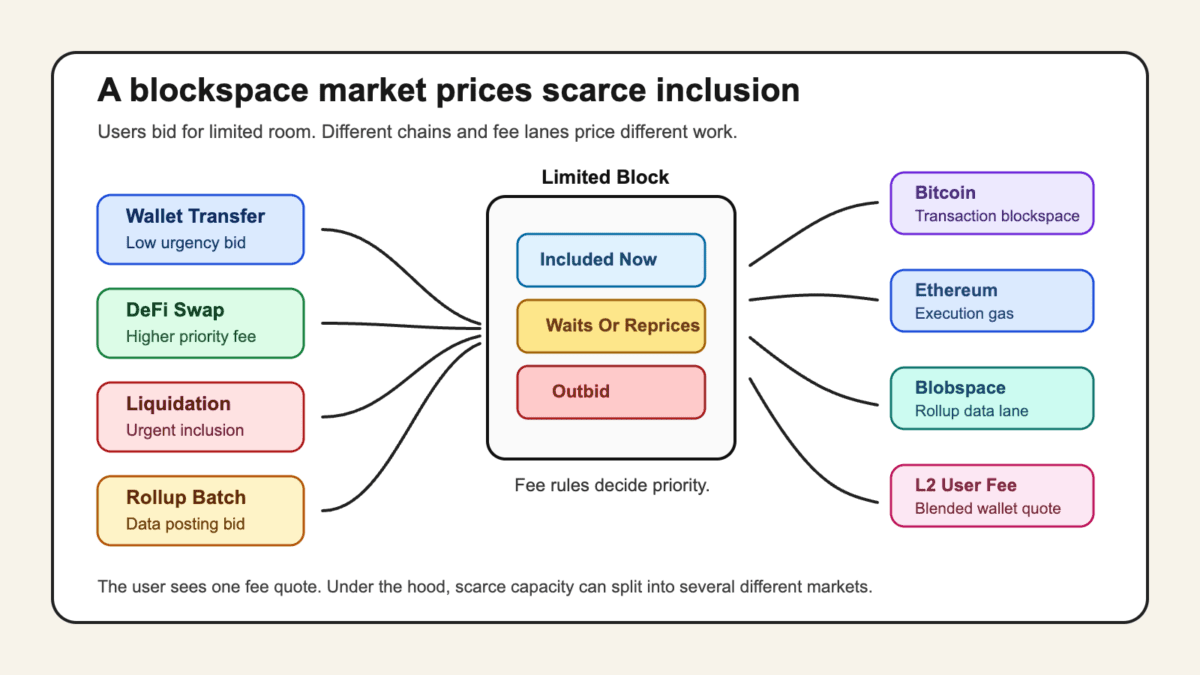
This is why one dashboard rarely tells the whole story. A gas chart, blob chart, rollup fee screen, and wallet quote may all be true at the same time. They are just answering different questions.
When you see a headline about “cheap Ethereum fees,” ask which lane it means. Execution gas? Blob fees? L2 user quotes? The answer changes the investment read and the practical user action.
Real blockspace market demand is demand that pays for scarce inclusion because the onchain action has value to someone. Full blocks alone do not prove that demand is durable, useful, or worth extrapolating into a token thesis.
Some demand is easy to understand. People send funds, swap assets, mint NFTs, rebalance DeFi positions, post rollup data, or defend loans from liquidation. Those actions can be expensive because the user or app has a reason to pay now.
Other demand is noisy. Bots may spam routes. MEV searchers may compete over ordering. Airdrop farmers may create repetitive activity. Meme cycles can fill blocks because the attention economy briefly turns every wallet into a tiny billboard with gas fees.
Useful checks separate signal from noise:
Willingness to pay is stronger than raw transaction count, but it still needs context. A chain can sell plenty of blockspace to arbitrage bots and still struggle to prove broad user demand. A high-fee day after a token launch is useful evidence, but it is not the same as months of repeat usage from wallets that keep coming back.
Watch what happens after the obvious catalyst ends. If fees collapse the moment incentives stop, demand was probably rented. If users keep paying because the chain settles trades, moves collateral, posts rollup data, or handles payments they cannot delay, the signal is harder to dismiss.
The fee market is a signal, not a personality test for a blockchain. Read it beside user retention, app quality, liquidity, and the kind of activity filling blocks.
The blockspace market affects traders because execution time can change the trade. During congestion, a slow transaction can miss a price, lose priority, fail, or land after the easy exit is already gone.
This shows up in swaps, liquidations, bridge exits, NFT mints, airdrops, arbitrage, and token launches. When volatility rises, wallets do not merely ask for “a fee.” They ask how much priority you want to buy in a crowded queue.
Crowded fee periods often overlap with narrative bursts and crypto rotation. Capital runs from one theme to another, onchain activity jumps, bots follow, and ordinary users suddenly wonder why a simple swap looks like a restaurant bill.
The trader version is practical:
The ugly edge is exit timing. When blocks are crowded and hype is peaking, late buyers can meet both high fees and weak exits. That is how a hot launch can turn into exit liquidity risk before the chart has time to look embarrassed.
Fees are not separate from trading risk. They are part of the price of getting into or out of the position.
The blockspace market touches ETH value through fee burn, validator income, L2 settlement, and the argument that ETH is needed for scarce settlement. But the signal is easy to oversimplify.
Under Ethereum’s fee design, the base fee can be burned while priority fees reward validators. That can make heavy L1 demand relevant to ETH supply dynamics. But “higher fees” is not automatically good. If fees price users out, activity may move elsewhere or avoid onchain settlement altogether.
The modern ETH debate has two sides:
Rollups make the picture less direct. An L2 can serve many users, batch activity, and post data back to Ethereum. That may create less L1 fee burn per user action than old mainnet activity, but it can also keep Ethereum at the center of more settlement and data-availability demand.
For ETH, ask what kind of demand Ethereum is serving, where that demand pays, and whether the fee system captures enough value without making the chain hostile to normal users.
ETH value debates get lazy when they turn fees into one number. Blockspace demand is a bundle of users, apps, rollups, validators, builders, and fee lanes. Pull one thread and the whole sweater argues back.
The blockspace market connects to Bitcoin security because miners earn revenue from block subsidies and transaction fees. As the subsidy declines over time, fee demand becomes a bigger part of the long-run security conversation.
Bitcoin blockspace is simpler than Ethereum execution gas, but the economic question is not small. Bitcoin blocks have limited room. Users who want transactions included pay fees. Miners choose profitable transactions, secure the chain, and receive the block reward plus those fees.
The long-term argument is straightforward:
That does not mean every high-fee period is healthy. Inscriptions, consolidations, exchange batching, market panic, or sudden demand can all affect fees. A fee spike may show willingness to pay, but it may not show stable day-to-day settlement demand.
Bitcoiners talk about blockspace because it is tied to what Bitcoin is good at: scarce, hard-to-change settlement. The debate is how much demand will pay for that settlement over time, and how ordinary users interact with L1 when fees rise.
For beginners, keep the comparison simple. Ethereum asks how execution, blobs, burn, validators, and L2s share value. Bitcoin asks whether scarce settlement fees can support miners as subsidy becomes less dominant.
More blockspace market capacity is not free because extra room changes security, decentralization, spam resistance, and fee signals. It can help users, but it can also move costs into places that are harder to see.
Raising capacity can lower fees during normal demand. It can give apps more room, reduce failed transactions, and make small onchain actions less ridiculous. That is the good part, and users are allowed to enjoy not paying premium prices for a basic transfer.
The tradeoffs start after the victory lap:
> More blockspace can save one transaction money while still raising costs for the network.
This is why scaling is usually layered. L2s, batching, better wallets, data-availability improvements, and app design can reduce user pain without asking every base-layer node to carry every possible action forever.
Capacity timing can distort the signal. Adding capacity before there is enough real demand can make fees look calm while spam, subsidized activity, or empty throughput fills the story. Waiting too long can make ordinary use expensive and push smaller users toward custodians or bridges they barely understand.
Ask where the extra room comes from. A rollup batch, a better data lane, or smarter wallet batching can reduce costs differently from a blunt base-layer size increase. Each choice shifts who pays, who validates, and what kind of blockspace demand remains visible.
More capacity can be good. The mistake is treating capacity as a dial with no wires attached.
L2s and blobs changed the blockspace market by moving many user actions away from direct L1 execution while keeping Ethereum involved in settlement and data availability. That made activity cheaper in some lanes, but harder to read at a glance.
A rollup can execute many user transactions off Ethereum L1, batch them, and post data or proofs back to Ethereum. The user sees an L2 fee. Under the hood, the rollup may be paying for data space, execution, sequencing, and settlement.
Blobspace sharpened that split. Instead of forcing rollup data through older calldata-heavy paths, blobs give rollups a specialized temporary data lane with its own fee market. Dencun and Pectra sit in this background, but users do not need upgrade trivia to understand the core point: blobs made the blockspace market more multi-lane.
That creates three common misunderstandings:
For ETH holders, this is the source of the low-fee anxiety. If activity moves to L2s and blobs stay cheap, direct L1 fee burn may look weaker than older bull-market periods. But if cheap L2 access brings more real app usage, Ethereum may still gain as settlement infrastructure.
For users, the practical answer is route awareness. The same action can cost very different amounts on L1, on an L2, or through a bridge. The cheapest route is not always the safest route, but ignoring the route is how small transactions get fee-punched.
The blockspace market can become tradable when future fee exposure is packaged into contracts, hedges, reservations, or derivatives. The basic idea is that some users and apps want protection from fee spikes before those spikes happen.
That demand is not hard to imagine. A rollup may want more predictable data-posting costs. A trading app may care about congestion during volatile periods. A builder may want to price ordering risk. A large onchain business may not enjoy discovering that its margins depend on everyone else staying calm.
This is emerging infrastructure, not a finished retail category. Product names, liquidity, contract design, settlement method, and counterparty risk can change quickly. Any claim about market size, funding, validator participation, or guaranteed hedging power needs verification before anyone treats it as settled.
The takeaway is conceptual. Once blockspace has recurring demand and volatile prices, markets will try to manage that volatility. That does not make every blockspace derivative useful. It only means fee risk is real enough that someone will try to sell protection.
That creates a different risk from a normal wallet fee. A user can usually decide transaction by transaction. A rollup, app, or trading venue may need a steadier cost base. If it cannot predict data posting or congestion costs, it may raise user fees, absorb losses, throttle activity, or redesign how it batches transactions.
Retail users do not need to trade blockspace futures to understand the point. If fee volatility affects builders, it can affect app costs, L2 pricing, MEV markets, and the wallet quote you see during busy periods.
When blockspace market fees spike, pause before you simply hit the fastest wallet preset. A high fee can be rational, but only if the transaction is urgent enough to justify buying priority.
Start with the action itself. A liquidation defense, urgent bridge exit, or time-sensitive trade may deserve higher priority. A small transfer, casual mint, or low-value swap can often wait. The chain is not offended when you refuse to overpay.
Use a quick checklist before signing:
Wallet choice can matter when congestion hits. Good fee controls, clear route displays, and network support help you decide whether to pay, wait, or use another path. CryptoProcent’s wallets coverage is useful when that decision depends on wallet UX rather than pure protocol theory.
High fees also expose tiny leftover balances. If a balance costs more to move than it is worth, it becomes a practical dust balance problem. The asset may still exist, but spending it can be economically silly.
The final check is psychological. If a fee spike is making you rush, ask whether the fee is buying execution or just buying relief from panic.
Related blockspace market terms help separate one fee lane from another. The vocabulary is annoying, but each term points to a different part of the system.
Blockspace is the broad capacity inside blocks. Gas measures execution work on smart-contract chains such as Ethereum. Blobspace is temporary data capacity used mostly by rollups. Calldata is transaction data posted through the execution layer. Data availability means other parties can access enough data to verify or reconstruct state.
These next pages help when one part of the fee stack needs a closer look:
Two advanced terms also appear often near blockspace debates. MEV is value extracted from transaction ordering, inclusion, or exclusion. PBS refers to proposer-builder separation, a design area around who builds blocks and who proposes them.
Those terms are not mandatory for every beginner. But they explain why the blockspace market is more than a wallet fee slider. Once ordering has value, the fight is not only “who pays enough?” It is also “who gets placed where?”
That is why blockspace debates can sound oddly intense. Fees touch user cost, token value, app design, validator incentives, miner revenue, MEV, and decentralization. One small word has too many roommates.
The blockspace market in crypto is the system that prices limited blockchain capacity when users, apps, and bots compete to get transactions or data included. It is usually driven by fee rules, bids, priority, and the choices of validators, miners, builders, or sequencers.
No, blobspace is one specialized lane inside the broader blockspace market. On Ethereum, blobspace prices temporary data capacity used mainly by rollups. Normal execution gas, calldata, Bitcoin transaction fees, and L2 user fees can all move differently.
High blockspace market demand can be good when real users and apps are willing to pay for scarce settlement. But it can also reflect spam, MEV, hype, or panic. The quality of demand matters more than a full-block screenshot.
The blockspace market matters for Bitcoin security because transaction fees can support miner revenue alongside the block subsidy. As subsidy rewards decline over time, durable fee demand becomes more important to the long-run security-budget debate.
Low Ethereum gas does not automatically mean the blockspace market is weak. Activity may have moved to L2s, blobspace may be cheap, execution demand may be quiet, or users may simply be waiting. You need to know which fee lane fell.
When blockspace market fees are high, check urgency first. Pay more only if delay changes the outcome. Otherwise compare L2 routes, wait for calmer conditions, avoid tiny uneconomic transactions, and review wallet fee settings before signing.