Physical Address
304 North Cardinal St.
Dorchester Center, MA 02124
Physical Address
304 North Cardinal St.
Dorchester Center, MA 02124


BullX explained without the referral fog.
BullX is a web and Telegram-connected DEX trading terminal for fast token discovery, charting, and on-chain buys or sells.
You will also see BullX Neo used as the main product name. Both names point to a speed-focused trading screen for meme-coin and DEX traders who want charts, token filters, wallet controls, and execution settings in one place.
BullX works more like a speed tool for risky on-chain markets than a normal exchange or profit bot. Fees, wallet setup, and link hygiene belong beside the buttons.
BullX is a trading terminal built for people who want to find, inspect, and trade on-chain tokens quickly. It brings together charting, token discovery, wallet controls, and order settings so a trader can move from research to execution without bouncing between several tools.
That hybrid setup is why BullX often gets called a BullX bot, especially when people enter through Telegram. But it is better understood as a web terminal with Telegram-connected onboarding and trade controls. A basic command bot feels like a chat window. BullX feels closer to a charting and execution desk for meme-coin markets.
The confusion comes from the workflow. A user might open BullX in a browser, connect through Telegram, fund a wallet, scan a new Solana token, set slippage, and press buy. The trade then goes on-chain through liquidity sources such as launchpads or DEX pools.
BullX Neo is the current name many users see in product pages, tutorials, and search results. In casual crypto chatter, people often shorten both names to BullX. In this guide, BullX refers to that shared BullX and BullX Neo trading-terminal workflow.
The boundary is simple. BullX can help you see and send a trade. It cannot make a thin token liquid, stop a malicious developer, or turn a bad entry into a good one. Fast tools still obey market gravity. Annoying, but useful to remember.
BullX works by moving a trader through discovery, checks, settings, execution, and settlement. The screen can make that flow feel simple, but every step carries a cost or risk the buy button does not show.
A typical trade starts with token discovery. You might find a token from a launchpad feed, a chart, a trending list, a wallet tracker, or a link shared in a trading chat. Then you check liquidity, holders, price action, contract signals, and whether the pool looks tradable.
Before the order goes out, the settings need attention. Market buys and sells are the basic actions. Depending on the setup, users may also see limit orders, DCA controls, presets, and multi-wallet tools. Those features are useful only if the user understands what each setting changes.
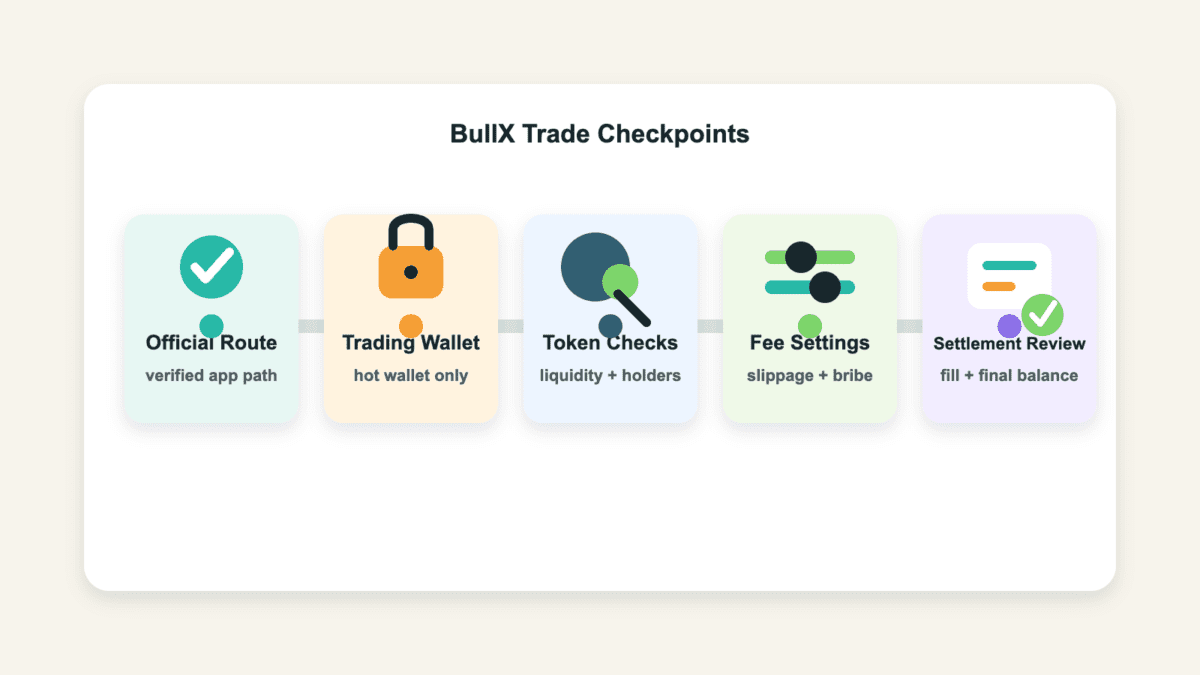
The main checks fit into a simple workflow:
| Step | What To Check |
|---|---|
| Open BullX | Use only the official app route or verified Telegram handoff. |
| Fund a wallet | Use a dedicated hot wallet, not your main wallet. |
| Find a token | Check liquidity, pool source, chart age, and holder behavior. |
| Set the trade | Review size, slippage, priority fee, bribe, and MEV mode. |
| Send the order | Remember the trade is on-chain and may fail or fill badly. |
| Review settlement | Check what left the wallet, what filled, and what fees were paid. |
The trade does not become safer because the workflow is faster. It becomes easier to repeat, and that is a different thing. A one-screen terminal can help a prepared trader. It can also help an impatient trader make five mistakes before lunch.
Traders use BullX for meme coins because the workflow rewards speed, visibility, and fast filtering. New token markets can move before a slow manual setup is even awake, so a terminal that combines charts and execution has obvious appeal.
BullX sits in the same trading culture people call the meme coin trenches. The trader is usually not researching a long-term hold. They are watching launches, social flow, wallet movement, liquidity changes, and exits.
The attraction is not just one-click buying. It is fewer handoffs between tools. A trader may otherwise watch Dexscreener, paste a token into a bot, check a wallet tracker, open a DEX, and adjust slippage elsewhere. BullX tries to compress that into one active workspace.
That helps with a few jobs:
BullX hype also spreads through trading chats and CT in crypto, where speed often gets framed as edge. Sometimes it is. Sometimes it is just a faster route to the same bad coin.
The useful limit is clear. BullX can make sense when speed and screen layout improve your process. It is not a substitute for liquidity checks, scam checks, or knowing when a meme coin has already become crowded.
BullX fees can hurt because a trade may pay more than one cost before the user notices. The visible price move is only one part of the result. The wallet balance tells the cleaner story.
BullX Neo Docs lists a 1% platform fee on every buy and sell, collected in SOL. That is only the first layer. Protocol fees, network fees, priority fees, bribes, slippage, and failed transaction costs can also affect the final result.
This is where small trades get punished. A 1% platform fee feels manageable on paper. But add a protocol fee, a priority fee, a bribe, and a bad fill, then the breakeven line moves. A trade that looks green on the chart can still leave less SOL in the wallet.
Here is the cost stack to check before trading:
| Cost | What To Check Before Trading |
|---|---|
| BullX platform fee | The base product fee on buys and sells. |
| Protocol fee | The pool or launchpad fee beneath the trade. |
| Network fee | The normal blockchain cost for sending the transaction. |
| Priority fee | Extra payment for faster confirmation during busy periods. |
| Bribe | Extra incentive tied to transaction routing or Jito-style priority. |
| MEV mode | Routing choice that may change bribe needs and execution behavior. |
| Slippage | The maximum price movement you accept before the trade fails. |
| Failed transaction | A failed attempt may still cost network or routing fees. |
An illustrative example makes the problem clearer. Say a trader tries a tiny meme-coin scalp with a small SOL amount. The token rises a little, but the trade pays product fees on entry and exit, plus protocol fees, plus a priority fee and bribe chosen from an aggressive preset. If the exit also fills with worse slippage, the wallet may shrink even though the chart looked friendly.
That example is not live pricing. It is the pattern behind many fee complaints. The smaller the trade, the more each fixed-feeling execution cost can distort the result. A 0.01 SOL priority or bribe choice can be noise for one trader and the whole edge for another.
So BullX trading fees should be checked before the buy, not after the angry refresh. If you cannot explain what your priority fee, bribe, MEV mode, and slippage setting do, lower the stakes first. Better yet, use a tiny test trade and read the settlement.
BullX safety depends on more than the app itself. You need to separate the product workflow, the token you trade, the wallet you fund, and the scam environment around Telegram and search links.
Product risk is about the tool. Meme-coin risk is about the asset and market you trade through it. Mixing those two creates bad conclusions.
BullX can execute a trade while the token itself is still dangerous. A fast buy button cannot prevent a hard rug, frozen liquidity, malicious token behavior, or a sell path that vanishes when everyone wants out.
The reverse is also true. A failed or expensive trade does not automatically prove platform wrongdoing. It may come from wide slippage, an overloaded network, a thin pool, a bad token route, or settings that made sense for a different trade size.
> A clean terminal can reduce friction. It cannot make a dirty market clean.
Fake BullX links are a real workflow risk because users often arrive through Telegram, X posts, search ads, or referral pages. That is a rough neighborhood for anyone moving fast.
The safest habit is boring: start from the official app or documentation route you have verified yourself. Do not click a random BullX Telegram bot link from a reply, sponsored result, Discord message, or copied access-code page. Referral spam is not onboarding. It is a sorting machine for distracted wallets.
Watch for fake safeguard flows, fake airdrops, fake support accounts, and prompts that rush you into signing or importing keys. If a link asks for more trust than the official route, close it. Missing a trade is cheaper than donating your hot wallet to a stranger with a logo.
BullX setup touches wallet security because trading terminals need a funded wallet path. That makes key handling, backups, and account protection part of the trading decision.
Use a dedicated hot wallet for active BullX trading. Do not connect or import a main wallet that holds long-term assets. If you need a refresher on custody types, CryptoProcent’s crypto wallets section is a better stop than learning from a drained balance.
Telegram security needs the same attention. Turn on two-factor authentication before you fund anything. Then back up private keys exactly as the official setup requires, store them offline, and assume support cannot recover a key you failed to save.
User complaints about missing funds, high fees, stuck trades, and scams are useful warning signals. They are not clean proof of what caused every loss.
Some losses around BullX can come from the market itself. A soft rug can drain confidence gradually through team selling, fading liquidity, or endless failed bounces. Other losses may come from fake links, compromised Telegram accounts, risky settings, or simple overtrading.
The sane move is caution. Complaints are reasons to reduce trust, test with small size, and avoid main wallets. They are not a complete investigation unless the facts are public, specific, and independently verified.
BullX compares with Photon, GMGN, Axiom, Jupiter, and Telegram bots by workflow. The better tool depends on what you are trying to do, how much control you need, and how well you understand the trade settings.
Some users want a chart-first terminal. Some want wallet analytics. Some only need a clean swap route. Others want Telegram commands because they care more about speed than screen space. None of those choices wins every trade type.
A practical comparison looks like this:
| Workflow | Best Fit And Main Tradeoff |
|---|---|
| BullX-style terminal | Fast charting and execution in one place, with more settings to manage. |
| Photon or Axiom-style terminal | Similar fast-trading intent, with different interface, fees, and routing choices. |
| GMGN-style analytics | Stronger wallet and token tracking, but copy-trading can create false confidence. |
| Jupiter or direct DEX swap | Cleaner for normal swaps, but slower for launch-trading workflows. |
| Telegram bot | Very fast and lightweight, but link hygiene and account security carry more weight. |
| Manual long-term spot buying | Simpler for investors, but not built for fast meme-coin entries. |
Use the comparison as a fit check, not a trophy ranking. If you need deep charting plus fast execution, BullX may fit. If you need a simple swap or a lower-stress setup, a terminal may be too much machinery.
Be careful with rankings that promise one universal winner. Meme-coin tools are often optimized for different trade sizes, habits, chains, and risk levels. The wrong tool can be expensive even when the product works as designed.
BullX is best for active on-chain traders who already understand liquidity, slippage, hot wallets, and launch volatility. It rewards users who can read a chart, inspect a pool, adjust fees, and walk away when the setup is bad.
That usually means BullX fits traders who value speed more than simplicity. They want faster token discovery, one-screen execution, wallet controls, and settings they can tune. They are also willing to accept that faster execution comes with more ways to misconfigure the trade.
BullX can make sense for users with these habits:
It can also work as a research terminal before it becomes an execution tool. Some users may benefit from watching charts, filters, and token flow first, then trading later after the settings feel less mysterious.
That research-first use is underrated. A beginner can learn how new tokens move, which pools look thin, and how fast spreads change without pressing buy. The point is to build pattern recognition before paying for every lesson with SOL.
Trade size also changes the fit. BullX makes more sense when the position is large enough that execution settings do not swallow the expected edge. If the whole plan depends on perfect fills and tiny fees, the setup is already fragile.
The best BullX user is not the most aggressive trader. It is the trader who can slow down inside a fast tool. That sounds boring until the market tests your thumbs.
Some users should avoid BullX because the workflow adds more risk than value. The clearest group is anyone who does not understand private keys, hot wallets, slippage, or on-chain settlement.
Tiny-account scalpers should also be careful. If the expected win is small, BullX fees, priority fees, bribes, failed transactions, and slippage can erase it. A fast entry does not help much when the cost stack eats the edge first.
BullX is a poor fit for users who match these patterns:
Late buyers should be especially careful. Fast terminals can still put you on the wrong side of exit liquidity when earlier traders need someone to buy their exit.
Another avoid signal is emotional trading. If a missed candle makes you raise slippage, increase bribes, and chase a worse entry, BullX will not protect you from yourself. It will simply make the next click easier.
The same goes for users who cannot read the post-trade result. If you do not know how to compare expected output, actual output, and fees after settlement, you will struggle to learn from each trade. The dashboard can feel clear while the wallet tells a different story.
If your main goal is a normal spot buy, use a simpler route. If your goal is learning meme-coin markets, watch first with tiny funds. BullX is not a training wheel. It is more like a sharper steering wheel.
BullX setup should start with verification, not funding. Often, the safest first trade is no trade until the access route, wallet, and fee controls are understood.
Start with the official app or official documentation path you verified yourself. Ignore access-code pages unless they lead back through a source you trust. Search results and social replies can look polished while still pointing at the wrong Telegram flow.
Before sending funds, run through this checklist:
The test amount should be money you can lose without changing the rest of your day. That sounds harsh, but it keeps the setup honest. If the first test fails, fills poorly, or costs more than expected, you bought information instead of a larger problem.
After the test trade, review what actually happened. Compare the expected amount, filled amount, fee lines, and final wallet balance. That habit will teach more than any access-code tutorial.
Then decide whether BullX is an execution tool for you or just a research screen. There is no shame in using it to watch tokens while sending trades somewhere simpler. A tool earns trust through repeated small checks, not through a loud launch page.
If BullX feels confusing at the setup stage, that is not a personal failure. It is useful signal. Step back, use a simpler swap tool, or watch the market without trading until the terms stop sounding like a cockpit checklist.
BullX is used for fast on-chain token discovery, charting, and trade execution. Most users discuss it around Solana meme coins, launchpad tokens, and active DEX trading workflows.
It is not a passive investing app. BullX is for traders who want to inspect tokens and send trades quickly, while managing fees, slippage, wallet risk, and route settings.
BullX and BullX Neo are often used interchangeably in search results, tutorials, and trading chats. BullX Neo usually refers to the newer product experience and official documentation.
For a beginner, the label is not the main issue. Both names point to the BullX trading-terminal workflow, which combines web access, Telegram onboarding, wallet controls, and on-chain execution.
BullX is not a centralized crypto exchange in the usual sense. It is a DEX trading terminal that helps users discover tokens, adjust trade settings, and send on-chain buys or sells.
That means BullX does not remove normal on-chain risks. You still need to understand wallet funding, token liquidity, slippage, execution fees, and what happens if a trade fills badly.
BullX fees can include the platform fee, the underlying protocol fee, blockchain network costs, priority fees, bribes, slippage, and sometimes costs from failed transaction attempts.
The exact cost depends on trade size, pool route, network conditions, and your settings. Small trades are more exposed because priority fees and bribes can take a large share of the expected profit.
BullX fees can eat profit when the trade size is small, settings are aggressive, or the token fills with poor slippage. A chart can show a gain while the wallet balance still falls after all costs.
Check the full path: entry fee, exit fee, protocol fee, priority fee, bribe, slippage, and failed attempts. If you cannot calculate the rough breakeven point, the trade may be too small or too fast for your current setup.
BullX can be used with Telegram only if you take account security seriously. Use the official route, enable Telegram two-factor authentication, avoid random bot links, and never fund from a main wallet.
Telegram adds convenience, but it also creates phishing risk. Fake bots, fake support accounts, and copied referral links can look close enough to fool a rushed trader.


