Physical Address
304 North Cardinal St.
Dorchester Center, MA 02124
Physical Address
304 North Cardinal St.
Dorchester Center, MA 02124


A practical guide to BullX Neo fees, safety, settings and trade fit.
BullX Neo is a hybrid web and Telegram on-chain trading terminal used for fast token discovery, charting, wallet tracking, and buy or sell execution, especially by active Solana memecoin traders.
If you found BullX Neo through an access-code page, Telegram link, or trading tutorial, do not start with the fastest button. Start with the plumbing: what the terminal touches, where costs appear, and how to keep a hot trading wallet from becoming an expensive shortcut.
BullX Neo is a fast on-chain trading terminal. It combines a web interface, Telegram-based access, charts, token discovery, wallet controls, and execution settings so traders can move from watching a token to sending a buy or sell order quickly.
That is why the label changes by context. Some people call BullX Neo a bot, a terminal, or a trading app depending on where they enter the workflow. A pure Telegram bot mostly feels like command-and-response trading. A normal DEX swap is usually one route, one trade ticket, and fewer discovery tools. BullX Neo sits between those worlds.
Before adding money, frame BullX Neo this way:
| BullX Neo Question | Plain Answer |
|---|---|
| Product type | Hybrid web and Telegram on-chain trading terminal. |
| Common access path | Official app route plus Telegram-based handoff or login. |
| Common use | Fast token discovery, charting, wallet tracking, and trade execution. |
| Main audience | Active memecoin and on-chain token traders. |
| Main risks | Fake links, hot-wallet exposure, high settings, thin tokens, and fees. |
| First thing to verify | Official route, wallet setup, fee settings, and transaction details. |
The boundary matters. BullX Neo can help you see and send a trade. It cannot make a thin token liquid, stop a malicious token team, or turn a rushed entry into a good one.
So do not stop at “is BullX Neo fast?” Ask what happens after the click. That second question saves more wallets.
BullX Neo works by moving a trader through official access, Telegram login, wallet setup, token discovery, trade settings, on-chain execution, and settlement review. The screen can make that flow feel simple, but each handoff can change cost, risk, or control.
That workflow is common in the memecoin trenches, where new tokens can appear, pump, fade, and disappear before slower tools finish loading. Speed helps only if the trader still checks the route, pool, settings, and final wallet balance.
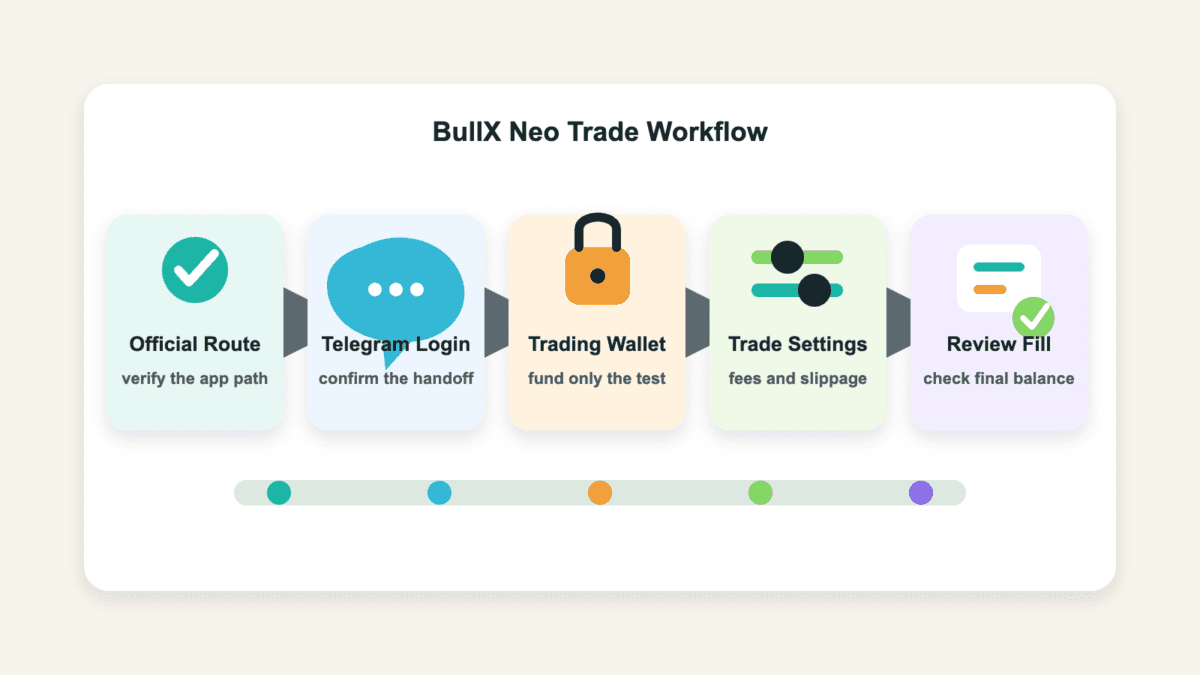
A basic BullX Neo flow usually looks like this:
| Step | What To Check |
|---|---|
| Open BullX Neo | Start from the official route you verified yourself. |
| Connect Telegram | Confirm the handoff is not from a random reply or referral page. |
| Set up a wallet | Use a separate trading wallet and back up keys safely. |
| Fund the wallet | Start small enough that a bad test does not matter. |
| Find a token | Check liquidity, holder behavior, pool source, and chart age. |
| Set the trade | Review size, slippage, priority fee, bribe, and MEV settings. |
| Submit on-chain | Remember that the trade can fail, fill badly, or cost more than expected. |
| Review the fill | Compare expected output, actual output, and final wallet balance. |
This is not the same as placing a spot order on a centralized exchange. You are working with on-chain liquidity, token contracts, network conditions, routing choices, and your own wallet setup.
That makes the review step part of the trade, not paperwork. If the wallet balance tells a different story from the chart, believe the wallet first.
BullX Neo versus BullX confusion comes from names, domains, older tutorials, Telegram flows, and access-code pages mixing in the same search results. A user may see bullx.io, neo.bullx.io, BullX Neo documentation, older BullX references, and referral posts that blur the difference.
Handle the naming cautiously: BullX Neo is the current product name users often see for the BullX-style hybrid terminal workflow. Older BullX references may still appear in tutorials, reviews, or user comments. That does not make every link official, and it does not make every migration claim reliable.
Use this rule before you connect anything:
> Verify the official BullX Neo path yourself. Do not scan random Telegram QR codes, trust a copied bot link, or import a wallet because an access-code page rushed you.
Access codes deserve extra suspicion. Some code pages are just referral funnels with light instructions wrapped around them. A referral can be legitimate and still be biased, because its job is to get you through the door.
If you are moving from an older BullX flow, slow down even more. Check the official route, confirm the account or wallet state, and test with a tiny amount before assuming an old tutorial still matches the live interface.
The split is simple. BullX Neo is the term to use for the current hybrid terminal you are researching. BullX is the broader name people may use casually. Neither name should override link hygiene.
BullX Neo fees can make tiny trades look broken because the chart move is only one part of the result. A wallet can end with less value even when the token price briefly moved your way.
The official BullX Neo Fees And Gas page breaks the cost stack into platform fees, protocol fees, priority fees, bribes, MEV mode, BDN routing, SWQoS, and slippage. It lists a 1% BullX platform fee on buys and sells. It also says protocol fees can range from 0.15% to 5% depending on the specific protocol and pool used, while other costs depend on route, network, and settings.
Small balances feel the stack first. A fee that seems minor on a larger trade can eat the whole edge on a tiny test. Add a priority fee, a bribe, a protocol fee, and a worse-than-expected fill, and the green candle starts looking less friendly.
Here is where BullX Neo trading costs can come from:
| Cost Source | What It Can Mean In Practice |
|---|---|
| Platform fee | BullX Neo’s own buy or sell fee. |
| Protocol or pool fee | Cost from the launchpad, DEX pool, or route beneath the trade. |
| Network fee | Base on-chain transaction cost. |
| Priority fee | Extra payment to improve confirmation chances during busy periods. |
| Bribe | Extra routing incentive that can help speed but raises cost. |
| MEV mode | Routing choice that may change protection, reliability, and added cost. |
| Slippage | Price movement you accept before the trade fails. |
| Failed transaction | An attempted trade may still consume network-related cost. |
| Tiny leftovers | Small balances can remain after trades and feel like dust balances. |
Now put that into a small-trade example. A trader buys a new token with a small SOL amount, pays the platform fee, accepts a launchpad or pool fee, adds a priority fee, and uses a bribe because the chart is moving. The token rises a little, but the exit also pays fees and fills with slippage.
The chart may show a win. The wallet may show a lesson.
BullX Neo can feel harsher to small accounts than to larger active traders because the same settings do not affect every trade size equally. If the expected win is only a few percent, the fee stack can eat it before the trader understands what happened.
Before raising a setting, ask one boring question: how much extra move do I need just to break even after all costs? If you cannot answer, the trade is probably too small, too rushed, or too poorly understood.
BullX Neo settings control execution speed, routing behavior, cost, and the price range you are willing to accept. They are not magic performance knobs. Raise the wrong one at the wrong time and you can simply pay more for a bad trade.
A priority fee is extra payment for faster transaction handling. A bribe is an added incentive tied to routing and inclusion. MEV mode changes how the transaction is routed or protected. Slippage sets how much price movement you accept between quote and execution.
No BullX Neo setting is always good or bad by itself. During a chaotic token launch, low settings may miss the move or fail. During a quiet swap, aggressive settings may overpay for speed you did not need.
Use this cheat sheet before changing BullX Neo settings:
| Setting | What To Check Before Raising It |
|---|---|
| Priority fee | Is the network or launch busy enough to justify paying more? |
| Bribe | Is faster inclusion worth the added cost for this trade size? |
| MEV mode | Do you understand the routing tradeoff and any added cost? |
| Slippage | Can the token move that far without turning the fill ugly? |
| Gas preset | Is the preset built for your balance, or for larger traders? |
| Route options | Do you know whether the trade is using a launchpad, pool, or router? |
Small traders should be especially careful with presets. A setting copied from a tutorial may be built for speed, not for your balance. A tiny position can lose its edge before the token price has enough room to move.
Aggressive slippage is the nastiest teacher. It can help a transaction fill, but it can also let the trade execute at a much worse price than expected. On a thin token, that is not a detail. It is the trade.
Give every BullX Neo setting a cost budget. Raise settings only when the specific token, route, liquidity, and trade size make the cost worth paying. Otherwise, speed becomes expensive decoration.
BullX Neo safety is not one question. You need to separate product access, Telegram account security, wallet handling, private keys, token risk, fake links, and user-reported complaints.
A trading terminal can work as designed while the token itself is dangerous. A scam token, frozen liquidity, bad contract control, or hard rug risk is not solved by using a faster interface.
The reverse is also true. A costly or failed trade does not automatically prove the platform stole funds. It may come from slippage, bad route choice, thin liquidity, fake links, a compromised Telegram account, or settings that made sense for a different trader.
These checks reduce the obvious BullX Neo safety risks:
Use a separate trading wallet because active terminals create more signing and key-handling moments. If you need to review custody basics first, start with CryptoProcent’s crypto wallets section before funding a terminal workflow.
User complaints about drained wallets, missing balances, support delays, or stuck trades are warning signals, not courtroom evidence. They still deserve respect. In crypto, waiting for perfect proof can be a fancy way to lose money twice.
A conservative setup is simple. Do not keep long-term holdings in a BullX Neo trading wallet. Telegram is not harmless just because it feels familiar. Do not turn every user report into confirmed fact. Build your setup so one bad click cannot reach your main stack.
BullX Neo fits active on-chain traders who already understand hot wallets, slippage, liquidity, launch volatility, and after-fee returns. It is built for speed, not for making beginner decisions safer.
The terminal may fit users who need charting, token discovery, manual execution controls, wallet tracking, and fast exits in one workflow. It is a stronger match for traders who can read a pool, inspect a token, adjust costs, and walk away when the setup looks bad.
BullX Neo may fit when these are true:
Slow down if these are true:
Fast tools can also place late traders in a rough position. When early buyers need someone to buy their exit, the terminal still works, but the late buyer becomes exit liquidity.
That is the fit test. BullX Neo can be useful when speed improves an existing process. It is a poor teacher when the trader is still learning what the buttons cost.
BullX Neo alternatives should be compared by workflow, not by referral-page confidence. Axiom, Photon, GMGN, Trojan, Banana Gun, Padre, and Jupiter can all appear in comparison searches, but they do not solve the same job in the same way.
Some traders want a chart-first terminal. Others want Telegram commands, wallet tracking, copy trading, safety scans, or a simpler DEX aggregator swap. The right comparison starts with what you actually need to do.
Use this table to compare tools without turning the page into a shopping list:
| If You Need | Compare These Factors |
|---|---|
| Fast manual terminal trading | Interface speed, fee visibility, logs, charts, and route controls. |
| Telegram-first trading | Account security, bot verification, command clarity, and withdrawal flow. |
| Token and wallet analytics | Holder data, smart-wallet labels, filters, and false-signal risk. |
| Simple swaps | Route transparency, quoted output, fees, and learning curve. |
| Copy trading | Delay, slippage, copied-wallet quality, and crowding risk. |
| Mobile workflow | App reliability, approval prompts, and how easy it is to review fills. |
| Safety scans | What the scan checks, what it misses, and how it handles new tokens. |
Jupiter or a direct DEX route may be calmer for normal swaps. Telegram-first bots may be faster for command-driven traders. Chart terminals may be better for people who need token feeds, wallet views, and execution controls near each other.
Do not crown a universal winner from a comparison page. Fee visibility, route logs, custody model, support transparency, and your own trade size will matter more than a ranking table. A tool can be excellent and still wrong for your first funded wallet.
Start with BullX Neo by verifying the access route and setting up risk limits before funding anything. First, clean up the route: remove easy ways to get tricked, overpay, or confuse a bad token with a bad terminal.
A clean first pass looks like this:
Keep the first test boring. If the test trade fails, fills badly, or costs more than expected, you learned something while the damage was small.
After the test, write down what happened in plain language. Note the token, route, size, slippage, priority fee, bribe, expected output, actual output, and final wallet balance. That short record makes the next trade less mysterious.
Then decide whether BullX Neo is your execution tool or only a research screen. Watching tokens, settings, and settlement behavior before trading is useful. It is also cheaper than learning every term with live SOL.
If the setup feels confusing, take that as a useful signal. Slow down, use a simpler swap route, or spend more time watching how new tokens behave before funding the workflow.
The best first session may end with no trade at all. If you leave knowing the official route, wallet setup, fee controls, and fill review process, you have already reduced the biggest beginner mistakes.
BullX Neo is better described as a hybrid on-chain trading terminal. People call it a bot because Telegram is part of the access and workflow, but the product is closer to a web trading screen with charts, wallet tools, and execution settings.
A terminal does not trade for you by default. You still choose the token, wallet, size, slippage, fee settings, and exit.
BullX Neo is the current product name many users see for the BullX-style trading-terminal workflow. Older BullX references, BullX Neo docs, Telegram onboarding, and access-code pages can all appear together, which creates confusion.
Do not rely on a random name match. Verify the official route before connecting Telegram, importing keys, or funding a wallet.
A BullX Neo trade can lose money after fees because the visible token move is not the full result. Platform fees, protocol fees, network fees, priority fees, bribes, MEV routing costs, slippage, and failed attempts can all affect the final wallet balance.
This is most painful on small trades. A tiny move in your favor may not cover the total cost of entering and exiting.
BullX Neo’s official fee page lists a 1% platform fee on buys and sells. That is not the only possible cost in a trade.
Protocol or pool fees, network fees, priority fees, bribes, MEV-related routing choices, and slippage can also affect the final result. Check the current fee page before trading, because product terms can change.
Priority fees on BullX Neo are extra payments meant to improve transaction handling during busy periods. Bribes are additional routing incentives that may help inclusion or speed, depending on the mode and route.
Both can be useful in crowded launches. Both can also make small trades uneconomical. Raise them only when the trade size and conditions justify the cost.
BullX Neo should be approached with standard hot-wallet caution. Use only verified official routes, secure Telegram, create a separate trading wallet, keep keys offline, and review every transaction before signing.
Do not connect a main holdings wallet to a fast trading workflow. Even if the product route is real, fake links, scam tokens, bad settings, and rushed approvals can still create losses.