Physical Address
304 North Cardinal St.
Dorchester Center, MA 02124
Physical Address
304 North Cardinal St.
Dorchester Center, MA 02124

Spot client concentration before staking ETH.
Client diversity is the practice of a blockchain network using multiple independently built software clients so one codebase cannot become a single failure point.
In crypto, a client is the software a node runs to follow network rules. Client diversity becomes important when one client gets too popular; the same bug can then hit too many nodes or validators at once. For Ethereum users, this is not developer trivia. It can affect finality, validator penalties, staking-provider trust, and confidence in ETH during stress.
Client diversity in crypto means a blockchain has several independent software clients in real use. Those clients follow the same protocol rules, but they are built by different teams, often in different programming languages.
A node is the machine or setup participating in the network. The client is the software that tells that node how to read blocks, validate data, talk to peers, and stay aligned with the chain. That split is easy to miss.
A blockchain can have thousands of nodes and still have weak client diversity if most of them run the same client. From far away, the chain looks decentralized. Up close, one codebase may be carrying too much weight. Keep the pieces separate before the topic gets technical.
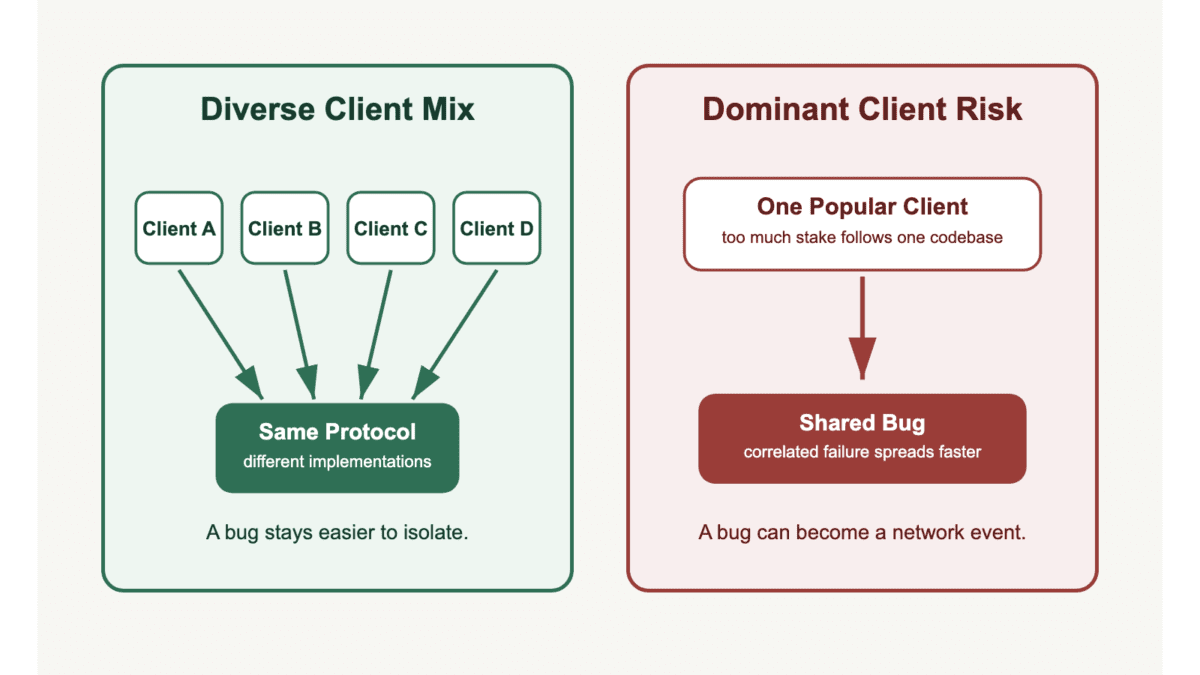
Healthy client diversity works like independent spell-checkers on the same document. They all know the rules, but one mistake in one program is less likely to appear in every program at the same time.
That is the protection. Independent implementations reduce correlated failure. A bug may still happen, but it is less likely to pull the whole network into the same bad state.
Client diversity is also different from general decentralization. A network can have many validators, node operators, countries, and cloud providers. Client diversity asks a narrower question: are too many of those participants trusting the same client software?
Ethereum needs client diversity because many nodes and validators must agree on the same chain. If too much of that activity runs through one client, one software bug can become a network-wide problem.
Ethereum.org explains that multiple independently maintained clients make Ethereum more resilient to bugs and attacks. On the same page, last updated in February 2026, Ethereum.org still described Geth as accounting for around 85% of all nodes. The key word is “adopted.” Alternatives on GitHub are not enough if most real users still run one dominant client.
For an ETH holder, the risk reaches beyond code. A severe client incident can shake trust in transaction finality, DeFi settlement, validator rewards, and staking withdrawals. The risk can show up in several places at once.
Ethereum culture also gives this topic its own shorthand. Debates about Geth, Lighthouse, minority clients, and validator risk can sound like inside baseball to newer users. If the language feels oddly tribal, that is partly normal ETH culture, and this ETH-native language often hides a serious infrastructure point underneath.
Client diversity also spreads responsibility. A network where one client team carries most of the load puts unusual pressure on that team. Bugs happen. Humans miss edge cases. Release timing gets messy. The stronger pattern is several teams finding and fixing different problems before one mistake becomes everyone’s problem.
Client diversity is a moving target because the risky client is whichever one becomes too dominant now. It is not always yesterday’s villain.
Ethereum’s older client-diversity debates often focused on Geth concentration. More recent community discussion has also looked at consensus-client concentration and other shifting pockets of risk. The lesson is to keep watching the mix, not to avoid one named client forever. The dominant-client label can shift through normal adoption patterns.
So current percentage claims deserve caution. Client-share dashboards can use different methods, some data can be stale, and consensus-client detection can be harder than it looks. For a beginner, threshold thinking works better: watch for any client above roughly one-third, and be very cautious around two-thirds.
The takeaway is simple. Client diversity is maintenance, not a trophy. A chain can improve its mix, relax, and then drift into a new concentration problem later.
Execution and consensus clients shape client diversity because Ethereum has two major software roles after The Merge. A validator setup normally needs both layers working together. The execution client handles transaction execution, state, and payloads. The consensus client handles proof-of-stake duties such as attestations, block proposals, fork choice, and finality.
That split can sound technical. The plain point is simpler: Ethereum client diversity needs at least two related client mixes, not one blended chart. A setup can be diverse on one layer and concentrated on the other.
| Client Layer | What It Does |
|---|---|
| Execution client | Processes transactions, tracks Ethereum state, and builds or verifies execution payloads. |
| Consensus client | Coordinates proof-of-stake consensus, validator duties, fork choice, attestations, and finality. |
The table separates the roles. It also shows why a staking provider should disclose both execution-client diversity and consensus-client diversity, not one vague “we run multiple clients” claim.
Execution clients are the Ethereum software that deals with transaction execution and state. Common examples include Geth, Nethermind, Besu, Erigon, and Reth. These clients should follow the same Ethereum protocol rules. They do not become “different Ethereums” just because their code is different.
Execution client diversity helps because a bug in transaction processing or state handling should not affect most of the network at once. If one execution client has a bad release or edge-case bug, other clients can keep checking the chain from separate code paths.
Consensus clients are the Ethereum software that handles validator coordination and finality. Examples include Lighthouse, Prysm, Teku, Nimbus, Lodestar, and Grandine. Consensus client diversity gets special attention because validators can be penalized when they follow the wrong chain or fail duties at scale.
This is why serious staking checks should ask for both layers. A provider that diversifies execution clients but concentrates consensus clients has not solved the whole problem. The inverse is also true.
Minority, majority, and supermajority clients describe how much network use one client has. The labels are useful because concentration changes the damage a bug can cause. A minority client has less share of the network. A majority client has enough share to become a serious coordination risk. A supermajority client controls such a large share that a critical bug can create ugly choices around finality, slashing, and recovery.
These labels are risk zones, not perfect live measurements. The main point is how fast a client bug can move from “bad day for some operators” to “network event.”
| Client Share | Plain-English Risk |
|---|---|
| Minority client | A bug hurts affected operators, but the rest of the network is more likely to keep agreeing. |
| Majority client | A bug can disrupt finality or pull too many validators into the same failure pattern. |
| Supermajority client | A bug can create severe invalid-finalization or slashing dilemmas if too much stake follows it. |
The useful markers are one-third and two-thirds. Above roughly one-third, a client failure can threaten finality. Around two-thirds, the failure can become much more dangerous because the faulty client may have enough weight to finalize the wrong view.
Here is the beginner version. If a small minority client fails, its users may need to patch, switch, or recover. Painful, but contained. If a dominant client fails, too much of the network may make the same mistake together. That difference is why “run a minority client” is not just public-good theater. It can reduce your exposure to the same correlated failure that everyone else is taking.
If you stake ETH, client diversity turns software choice into operational risk. A validator is not only holding an asset. It is performing duties, signing messages, proposing blocks, and staying online.
That does not mean every staker should make a dramatic client switch today. It means client choice belongs beside uptime, hardware, backups, monitoring, and recovery practice. A minority client you cannot maintain is not a badge of honor. It is a future support ticket with better branding. The best setup is usually boring in the right ways: supported, monitored, documented, and not blindly following the largest client just because the default button was easy.
Solo stakers control more of the stack, so they can directly improve client diversity. They choose an execution client, a consensus client, hardware, network setup, alerting, and update habits.
That control is useful, but it creates responsibility. Before switching to a minority client, check whether your staking tool supports it well, whether documentation is current, and whether you can recover from sync or database problems without guessing. Solo stakers should check a few points before changing anything important.
Running a minority client can help the network and reduce correlated risk. But do the change like production work, not like a weekend side quest with funds attached.
Pooled and liquid staking users do not usually choose clients directly. They choose a provider, protocol, or node-operator set, then inherit that operator’s client decisions.
That makes transparency the real question. A serious provider should be able to explain its execution-client mix, consensus-client mix, operator spread, slashing policy, and incident process. If those details are not disclosed, do not fill the blank with brand confidence. Keep three responsibilities separate when evaluating a provider.
Wallet safety is a separate layer. A wallet protects keys and transaction approval habits. It does not prove that a staking provider has good client diversity. Keep crypto wallets in the key-safety lane, then ask separate questions about the validator stack.
Liquid staking adds another wrapper. You may hold a transferable token while someone else handles validator operations. That can be useful, but it also makes client-mix transparency more important because the operational risk sits one step away from your wallet.
Client diversity cannot be perfectly enforced because the protocol cannot always know, prove, and police which software every validator is running. Any enforcement system would need measurement, identity, incentives, or reporting.
Each of those brings tradeoffs. Self-reporting can be gamed. Client fingerprints can harm privacy. On-chain rewards for “minority clients” need a trusted way to prove client identity. A cap on market share can create new governance fights over who gets blocked, counted, or punished. The clean-sounding answers can create messy side effects.
Enforcement can also create bad incentives. If rewards attach to a declared client label, operators may optimize for the label instead of safer operations. If a cap blocks a popular client too aggressively, honest operators may rush migrations and create downtime.
So Ethereum client diversity is partly social coordination. Client teams, staking providers, home stakers, dashboards, educators, and large operators all push the network away from dangerous concentration.
This is less satisfying than a hard rule. It is also more honest. In open networks, some safety problems are solved by protocol design, and some are solved by people refusing to let convenience become the only default.
Checking client diversity before staking means asking what software will actually run your ETH position. The answer should include both execution clients and consensus clients.
Start with dashboards such as clientdiversity.org, then read the caveats. Look for data dates, methodology notes, and whether figures are measured, inferred, or self-reported. Old percentages can be worse than no percentages because they feel precise while aging quietly. For solo staking, your checklist should focus on current client share and your ability to run the setup well.
For providers, the checklist is different. You are not asking which button to click. You are asking how much operational risk the provider expects you to trust.
| Question To Ask | Provider Risk Signal |
|---|---|
| Do you publish execution-client and consensus-client mix? | A single blended diversity claim can hide layer-specific concentration. |
| How many independent node operators run validators? | Operator spread reduces dependence on one team or infrastructure setup. |
| What is the slashing and incident policy? | Users need to know who absorbs losses and how incidents are handled. |
| How fresh is the client-mix data? | Stale data can make a concentrated setup look safer than it is. |
Provider reports, Rated.network-style analytics, and clientdiversity.org can all help. But none should replace judgment. Ask whether you would notice if this provider drifted into a dominant-client setup.
Client-diversity campaigns also spread through social channels. That can be helpful, but CT pressure can flatten nuance. If a claim about client risk is flying around Crypto Twitter, use a Crypto Twitter filter: find the data source, check the date, and separate useful warnings from engagement bait.
Client diversity applies outside Ethereum whenever a blockchain relies heavily on one software implementation. The exact risk changes by chain design, validator set, governance, hardware needs, and how mature alternative clients are.
Ethereum gets most of the client-diversity attention because it has several production clients and proof-of-stake finality rules that make concentration especially visible. But the broader problem is software monoculture. If one codebase dominates a network, one bug can travel farther than it should.
Solana is a useful comparison because alternative-client work such as Firedancer shows why independent implementations can be valuable on high-performance chains too. Use the same checks without turning the section into a tribal scorecard.
Compare the basics: credible alternative clients, real adoption of those clients, clear incident response, and enough operator skill to run them safely.
The answer will not be the same for every network. Some chains may have one reference client because the project is young. Others may have alternatives that look promising but still carry limited production use. Mature client diversity needs both code and adoption.
For users, the takeaway is portable. When a chain claims decentralization, ask what kind. Validator count, token distribution, geography, cloud use, governance, and client diversity all describe different risks. One number rarely tells the whole story.
Client diversity in crypto means a blockchain network uses multiple independent software clients instead of relying on one dominant implementation. It reduces the risk that one software bug affects too much of the network at once.
Ethereum validators and nodes need reliable agreement across execution and consensus layers. If one client dominates, a serious bug can affect finality, validator rewards, and user confidence.
A minority client is a client used by a smaller share of the network. Running one can help reduce concentration risk, but the client still needs good support, monitoring, and operator confidence.
Yes, a serious client bug can expose validators to penalties or slashing in some scenarios. The risk depends on the bug, the client layer, the amount of stake affected, and how operators respond.
Ethereum cannot easily force client diversity because proving which client every validator runs is hard. Enforcement could create privacy, measurement, oracle, incentive, and governance problems.
Client diversity can affect ETH holders even when they never run a node. Severe network incidents can shake trust in finality, DeFi settlement, staking operations, and market confidence. It gives no clean trading signal, but it is real infrastructure risk.
Start with one practical question: which client software is carrying the position or network activity you depend on? For a solo staker, that means checking your own execution and consensus clients. For a provider user, that means checking what the provider discloses.
Then move slowly. Client diversity is important, but rushed validator changes can create their own failures. A careful migration with backups, alerts, and current docs beats a heroic switch done half-awake. Use these next actions before staking or changing a setup.
For pooled or liquid staking, keep notes on what the provider actually publishes. A dated client-mix report is stronger than a vague decentralization claim. A clear incident policy is stronger than a polished dashboard with no owner behind it.
For solo staking, make one change at a time. Check the client mix, read the migration notes, confirm storage needs, and know how to roll back before funds are on the line. Client diversity helps most when operators can keep their setups boring under pressure.
The goal is fewer quiet single points of failure in the software that keeps the chain honest.


