Physical Address
304 North Cardinal St.
Dorchester Center, MA 02124
Physical Address
304 North Cardinal St.
Dorchester Center, MA 02124


A practical contract wallet guide for fees, recovery, exits, and smart wallet risk.
A contract wallet is a crypto wallet controlled by smart contract rules instead of only one private key. It can add recovery, spending limits, batching, multisig approvals, passkeys, or gas sponsorship, depending on how the wallet is built.
That sounds friendlier than a seed phrase taped inside a desk drawer. But a contract wallet also adds code, upgrade rules, app support limits, gas quirks, and recovery trust. Before you move serious funds, check what the wallet can do, where it can fail, and how you get out when the smooth app screen stops feeling smooth.
In crypto, a contract wallet uses smart contract logic to control what the account may do. The wallet can still hold tokens, NFTs, and other on-chain assets. The difference is that contract rules help decide which actions are allowed.
People use several names for the same general idea, which is why wallet copy gets messy. A smart contract wallet usually means a contract wallet. A smart wallet is the user-facing product name. A smart account is the account type many developers mean when they discuss programmable wallet behavior.
Use the terms this way when you see them in wallet copy:
The key point is control. A regular wallet usually signs from one private key. A contract wallet can check more conditions before acting. It may require another signer for large transfers, allow recovery through guardians, or let a game use a limited session key without giving that game full control of the wallet.
A contract wallet is not a legal contract. It is also not a wallet that stores smart contracts as files. It is a wallet whose own control logic lives on-chain. The wording is small, but the risk is not: the wallet is still handling real assets.
A contract wallet changes the control model, not the basic fact that crypto transactions can be irreversible. A regular self-custody wallet usually depends on an externally owned account, or EOA. If the private key signs, the account can act.
That simplicity has a clean appeal. It also makes the private key a single point of failure. Lose it, expose it, or sign the wrong approval, and there may be no friendly support desk waiting with a reset link.
| Wallet Type | What Changes For The User |
|---|---|
| Regular EOA Wallet | One private key usually controls the account. It is simple, widely supported, and unforgiving if the key is lost or stolen. |
| Hardware Wallet | The key stays on a separate device. It can be strong for storage, but everyday app use can still involve approvals and signing risk. |
| Multisig Wallet | Several signers can approve actions. It suits teams and treasuries, but setup and coordination can be slower. |
| Contract Wallet | Smart contract rules can add recovery, limits, batching, and permissions. Code, upgrades, gas, and compatibility now matter too. |
| Exchange Account | The exchange controls the wallet infrastructure. It may be easy to use, but it is not the same as self-custody. |
A contract wallet can add guardrails around the account. That makes it useful for recovery, team approvals, daily limits, or app-specific permissions. It also means the smart contract code and recovery design become part of the custody question.
Use case decides the better setup. A contract wallet may be better for active app use, team funds, or recovery-heavy setups. A hardware wallet may still be cleaner for long-term storage that rarely moves.
If you are choosing a wallet setup, start with the assets and actions you actually need. CryptoProcent’s wallet setup category can help compare custody, recovery, and everyday wallet use without chasing whatever a wallet app calls “smart” this week.
A contract wallet works by putting a rule-checking layer between the user and the final on-chain action. You still press a button, scan a prompt, or approve with a passkey. Behind that screen, the wallet asks whether the action fits its rules.
Those rules can be simple or complex. A small transfer might need one signer. A large transfer might need a second approval. A game move might use a session key that expires. A recovery action might need guardians or backup credentials.
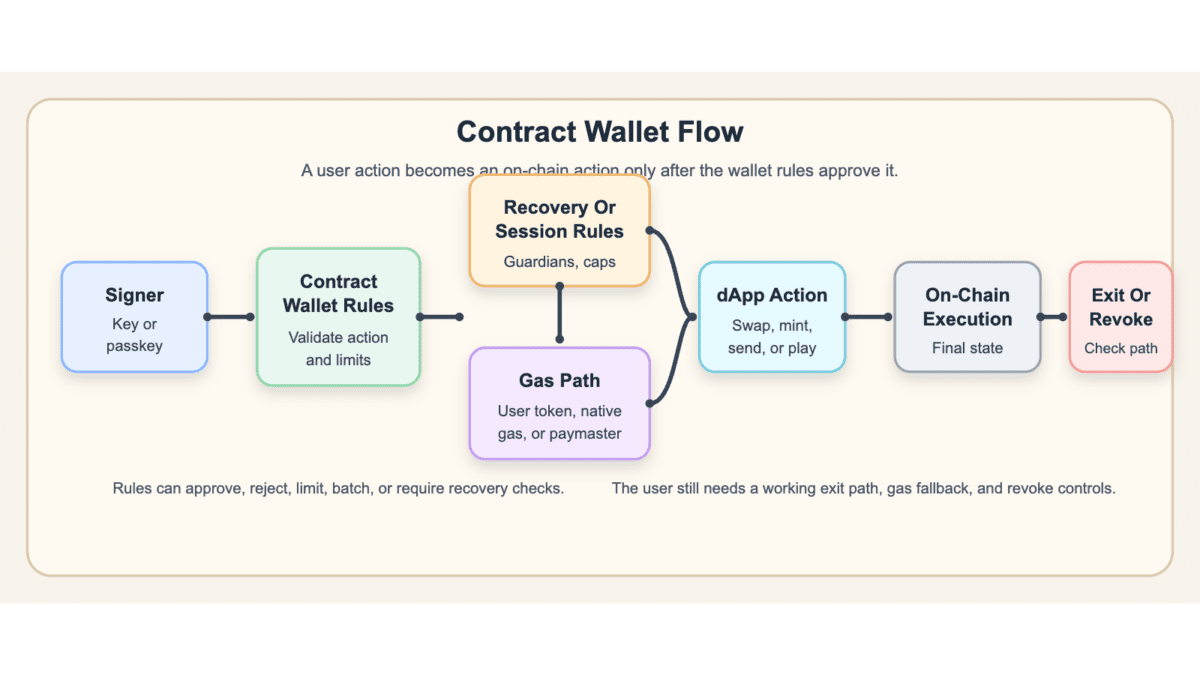
The plain-language flow looks like this:
On Ethereum, many smart-account flows come with ERC-4337 vocabulary. A UserOperation is a structured request from the user. A bundler packages those requests. The EntryPoint contract coordinates validation and execution. A paymaster can sponsor gas or approve a different fee path.
You do not need to memorize those terms before using a wallet. You do need to understand the dependency chain. If the bundler, paymaster, wallet UI, recovery service, chain support, or dApp integration fails, the experience can feel broken even while your assets remain on-chain.
Other chains can build smart-wallet behavior differently. So a contract wallet on an EVM chain, a Solana smart-wallet design, and an app-specific wallet may not share the same support, fees, or recovery path.
Contract wallets exist because normal wallets are too harsh for many users and too rigid for many apps. One lost seed phrase should not have to become a permanent financial obituary. That is the pitch, anyway.
The real value comes from programmable control. A wallet can make common actions easier while reducing some key-management pain. But every benefit depends on the actual wallet design, not the label on the landing page.
The useful features usually fall into a few buckets:
Gaming is a clean example. A player should not need to sign a full wallet prompt for every small move, item, or reward claim. A contract wallet can grant limited permissions for that app, which is why smart-wallet design often appears in GameFi wallets and app-heavy onboarding flows.
The catch is that “easier” can become “easier to click the wrong thing.” A contract wallet should make risky actions clearer, not merely faster. If the wallet hides approvals, gas rules, or recovery controls, it has moved the sharp edge behind nicer glass.
Contract wallet costs can surprise users because the wallet is doing more than a basic send. A simple EOA transfer may be one direct transaction. A contract wallet action may involve validation, contract execution, batching, paymaster checks, or extra calls.
That extra logic can cost more on expensive networks. On cheaper L2s, the difference may feel small. On Ethereum mainnet during busy periods, even small actions can become annoying fast. The chain does not care that the button said “easy.”
Check the fee path before assuming a contract wallet is cheap:
“Gasless” is the phrase that causes the most confusion. It usually means you do not need to hold the native gas token for that eligible action. It does not mean the network fee vanished. The app, wallet, sponsor, paymaster, or another fee path still covers it.
Tiny leftover balances are a special pain. You can have value in a contract wallet and still lack the native gas token needed to move it. That can turn into dust balances that are technically yours but not worth rescuing after fees.
So the rule is simple: test a send out before you fund the wallet properly. “Gasless” is useful when it works. It is not a lifetime fee waiver written in stone.
Contract wallet risk starts with code. If the wallet contract has a bug, bad upgrade path, weak validation rule, or unsafe integration, the polished app screen will not save you. Smart contracts are powerful because they execute rules. That also means bad rules can execute very efficiently.
Recovery is the second big tradeoff. A contract wallet can replace seed-phrase panic with guardians, backup keys, passkeys, device approvals, or recovery providers. That is useful only if you understand who can help, who can block you, and what happens if they disappear.
Common failure points include:
The real test is control under stress. If you lose your phone, forget a passkey, lose a hardware signer, or need to move funds while a wallet app is down, can you still recover or exit?
Funds can feel stuck for boring reasons, not just dramatic hacks. Maybe the wallet supports Base but your token sits on Ethereum. Maybe the token is present, but the app cannot route it. Maybe you have USDC but no ETH for gas. Maybe a bridge needs a wallet signature the smart account cannot produce through that interface.
There is also approval risk. A contract wallet does not make malicious spend approvals harmless. It may add limits or simulations, but users still need to review spenders, amounts, expiries, and revoke controls.
The practical fix is small and unglamorous. Set up recovery before you need it. Test the recovery path with a tiny balance. Then test a send, a swap, and a revoke. The wallet is only as safe as the path you can actually use under pressure.
A contract wallet makes sense when programmable rules solve a problem you really have. It is less convincing when the only reason is that the app says “smart” in a large font.
Active users usually benefit more than passive holders. If you swap often, manage approvals, use DeFi apps, play on-chain games, or handle team funds, contract-wallet features can reduce friction. If you buy and sit for years, extra contract logic may be unnecessary baggage.
Good fits usually look like this:
The weak fit is long-term cold storage. If funds rarely move, a simple hardware-wallet setup with strong backups may be easier to reason about. Less machinery means fewer moving parts.
There is no universal wallet hierarchy. Start with the failure you most want to avoid. A contract wallet can reduce seed-phrase and approval pain. It can also add contract, upgrade, support, and fee risks that a plain wallet does not have.
Check a contract wallet by proving the exit path before the balance matters. Do not trust a wallet because account abstraction sounds modern or because the signup flow felt smooth. Smooth entry is the easy part.
Start tiny. Send a small amount in, send a small amount out, and confirm that the wallet works with the apps and chains you actually use. If the first withdrawal is confusing, a bigger balance will not make it more relaxing.
Use this checklist before you move real funds:
This is also where position size matters. Moving a full balance before testing recovery, gas, and withdrawals is a full port move in spirit, even if the wallet app looks respectable.
Write down what you learn. Which chain worked? Which app failed? Which fee token was needed? Which recovery route did you test? A contract wallet is practical only when those answers are boring.
Contract wallets, account abstraction, and smart accounts belong together, but they are not identical. The contract wallet is what the user may create or fund. Account abstraction is the broader design work that lets wallets behave with more flexible rules.
Ethereum’s account abstraction roadmap connects this to smart contract wallets, EIP-4337, EIP-7702, recovery, gas changes, and batched transactions. It also says EIP-4337’s EntryPoint contract has facilitated the creation of over 26 million smart wallets. Useful context, but the beginner point stays simple: the account can enforce rules before execution.
Use this map to keep the terms clean:
| Contract Wallet Term | Plain Meaning |
|---|---|
| Contract Wallet | A wallet controlled by smart contract rules. |
| Smart Contract Wallet | Another name for a contract wallet. |
| Smart Wallet | The product-friendly name users often see. |
| Smart Account | The programmable account that validates actions. |
| Account Abstraction | The broader shift toward flexible account behavior. |
| UserOperation | A structured request used in ERC-4337 flows. |
| Bundler | A service that packages smart-account requests. |
| EntryPoint | The contract that coordinates validation and execution in ERC-4337. |
| Paymaster | A component that can sponsor or authorize gas payment. |
EIP-4337 is one route for smart accounts without changing Ethereum’s base transaction rules. EIP-7702 gives existing EOAs a path to use smart-wallet behavior. Builders need those details. For everyday users, the effect is easier recovery, better permissions, and more flexible fees when the wallet, chain, and app support them.
The support caveat is the key. A contract wallet feature is only useful where it is supported. If a dApp does not recognize the wallet, or a paymaster does not sponsor that action, the smart-account theory will not move your funds.
Contract wallet hype can spill into tokens, narratives, and “smart wallet” trades. That does not make the wallet concept a buy signal by itself. Infrastructure can be useful while a related token still has weak value capture.
Keep product value and token value separate. A contract wallet can gain users through a wallet app, SDK, paymaster, or chain integration while the token captures little of that activity. If the token only sells the account-abstraction story, you still need to see how demand reaches holders.
If a project claims exposure to contract wallets or account abstraction, check what the token actually does. Does it earn fees? Govern contracts? Secure infrastructure? Pay for usage? Or is it just attached to a good story?
Useful checks include:
Wallet creation counts also need context. Funded repeat use says more than promo signups, test wallets, or one-time incentive activity. The same goes for “gasless” adoption numbers if the sponsor disappears once the campaign ends.
A strong tech theme can still turn late buyers into exit liquidity. A contract wallet can be a good product design. A token tied to that narrative still needs its own proof.
Do not confuse “I understand the wallet” with “I should buy the token.” Those are different decisions. Crypto has a long tradition of turning useful ideas into extremely creative bags.
Contract wallet concepts can look interchangeable until you need support. Then the distinctions get expensive. Keep the nearby language clean before you fund, bridge, or approve anything.
Smart account usually means the programmable on-chain account. Smart wallet usually means the wallet product wrapped around it. Account abstraction is the design direction that lets wallets use flexible validation, recovery, gas rules, and batching.
Some terms point to specific features:
One warning: “smart wallet” can also mean a tracked profitable wallet in trading tools. That is wallet watching, not a contract wallet. If someone says they follow smart wallets, they may mean copy-trading signals, not programmable account logic.
A contract wallet and a smart wallet often refer to the same user-facing idea: a wallet controlled by programmable rules instead of only one private key. “Smart contract wallet” is the more literal phrase, while “smart wallet” is common product language. A smart account is the technical account behind many of these designs. Account abstraction is broader. It describes the design shift that makes smart accounts and smart-wallet features easier to build and use.
A contract wallet can be safer against some risks and weaker against others. It may reduce seed-phrase risk through guardians, passkeys, limits, or multisig approvals. But it also adds smart contract code, upgrade controls, recovery-service assumptions, and app compatibility risk. A regular wallet is simpler and more widely supported. A hardware wallet can still be better for long-term storage. The safer choice depends on what you are protecting against.
A contract wallet can work without showing the user a normal seed phrase, but something still controls access. That might be a passkey, device key, backup key, guardian setup, social recovery design, or provider-managed recovery flow. The important check is what happens if you lose your device or credential. If recovery depends on a provider, guardian, or admin rule, understand that dependency before moving meaningful funds.
Contract wallet gas fees can be high because the wallet may run extra smart contract logic before the final action. Validation, batching, paymaster checks, token approvals, and contract execution can all add cost. “Gasless” only means the user may not pay native gas directly for an eligible action. It does not mean network fees disappear. Sponsorship can fail, expire, or apply only to certain chains, apps, and transaction types.
Funds can feel stuck in a contract wallet when the exit path is unclear. Common causes include missing native gas, unsupported tokens, unsupported chains, dApp incompatibility, bridge issues, app outages, recovery problems, or balances too small to move economically. That does not always mean the assets are gone. It means the wallet path needed to move them is not working for the user. Always test a small send out before funding the account properly.
A contract wallet does not work the same way on every blockchain. Ethereum and EVM chains have smart-account and account-abstraction patterns, while other chains may implement smart-wallet behavior through different account, program, or app designs. Support also depends on the wallet, dApp, bridge, token, and signing flow. Before using one across chains, confirm the wallet supports the exact network and actions you need.