Physical Address
304 North Cardinal St.
Dorchester Center, MA 02124
Physical Address
304 North Cardinal St.
Dorchester Center, MA 02124


Avoid paying peak crypto fees blindly.
Congestion pricing is how a blockchain raises fees or priority costs when too many users want the same limited blockspace.
In crypto, the phrase is about transaction capacity, not city toll booths. You see congestion pricing when a wallet fee quote jumps, a Bitcoin transaction waits in the mempool, a Solana app asks for a priority fee, or an Ethereum swap costs more during a busy market.
The fee is annoying. No debate there. The useful question is simple: does paying more change the result, or should you wait, reroute, or cancel?
Congestion pricing in crypto means blockchains use fees to ration scarce transaction inclusion. When more users want into upcoming blocks than the network can handle smoothly, price sorts the queue.
That sorting can happen through gas, priority fees, mempool fee bidding, or wallet presets. The exact design changes by network, but the user experience feels familiar: faster inclusion costs more when everyone wants the same limited space.
The road-pricing analogy helps, but only briefly:
| Road Pricing Analogy | Blockchain Fee-Market Reality |
|---|---|
| A busy road charges more at peak times. | A busy chain prices scarce blockspace higher. |
| Drivers pay to enter a crowded zone. | Users pay to get transactions included. |
| Waiting can avoid the peak toll. | Waiting can avoid a fee spike. |
| Paying does not make the road wider. | Paying does not create infinite block capacity. |
The difference is urgency. A late road trip is annoying. A delayed crypto transaction can miss a swap price, fail during a mint, leave a withdrawal pending, or make a small transfer uneconomic.
The fee also changes by layer. A wallet may estimate a network fee, an exchange may charge a withdrawal fee, and an app may add route costs. Congestion pricing is the chain-level pressure underneath many of those quotes. It is not always the only cost on the screen.
Read congestion pricing as a queue signal. It tells you how crowded the chain is, how much priority costs, and whether your transaction deserves premium treatment.
Congestion pricing makes blockspace expensive because every block has limits. Those limits protect the network from overload, but they also force users, apps, and bots to compete when demand rises.
That demand can come from normal transfers, smart-contract calls, liquidations, NFT mints, hot token launches, inscriptions, airdrops, bridge exits, or bots racing for the same trade. When a hype wave turns into the attention economy, blockspace can fill before wallets catch up.
Several forces usually push the fee up at once:
Paying more can improve priority, but it does not remove the bottleneck. If a chain can only fit so much work into upcoming blocks, higher fees decide the order of the line. They do not erase the line.
That is also why cheap transactions can become slower or unreliable during bursts. A low-fee transaction may still be valid, but it can sit behind urgent trades, liquidations, or app activity willing to pay more.
Congestion pricing can feel unfair even when the mechanism works as designed. It prices urgency. If your transfer is not urgent, the best bid may be no bid for now.
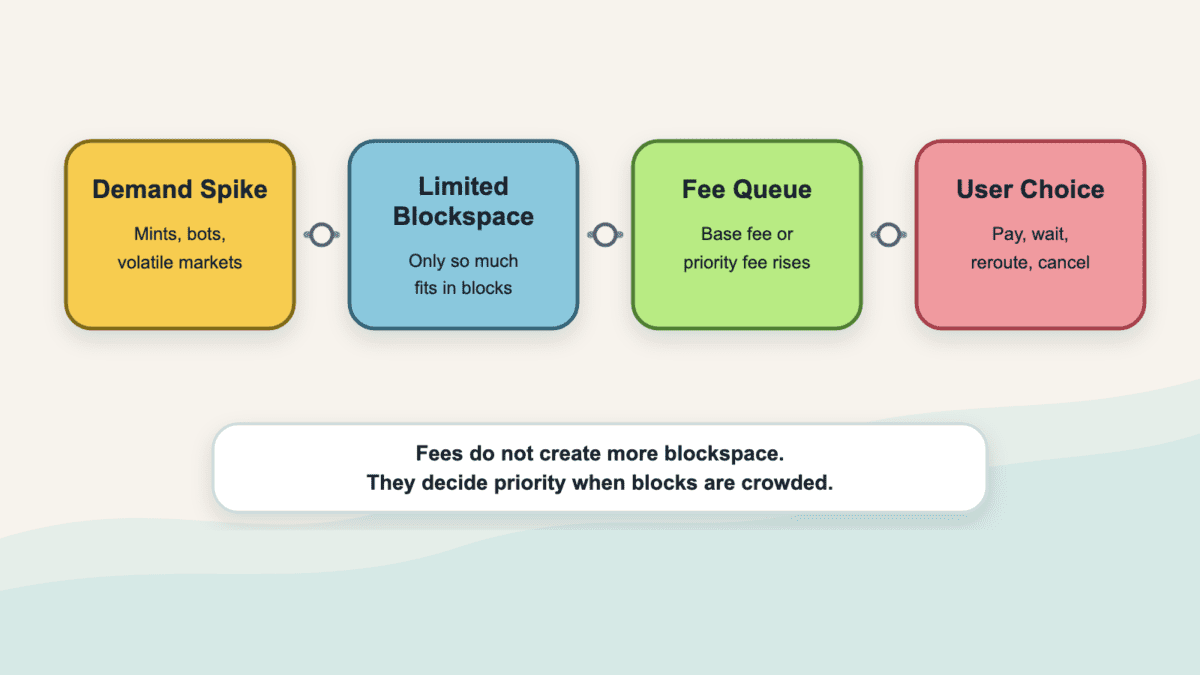
Congestion pricing works differently across networks, but the same idea keeps returning. A chain has limited capacity, users want inclusion, and fees decide who gets priority.
Ethereum is the clearest gas-fee example. Gas measures transaction work, with base fees, priority fees, and wallet fee estimates all shaping what users pay. Ethereum’s gas documentation says the base fee can rise or fall by a maximum of 12.5% per block when block size is above or below target, which gives congestion pricing a per-block adjustment rhythm rather than a random fee jump.
Wallets usually hide much of that machinery. They may show a slow, market, or fast option instead of asking you to build a fee bid manually. That helps safety, but it can make fee spikes feel mysterious.
Here is the practical version across common crypto routes:
| Network Or Layer | How Congestion Pricing Shows Up For The User |
|---|---|
| Ethereum | Gas estimates rise when blocks are crowded, and priority fees matter more when speed matters. |
| Bitcoin | Transactions compete through fees in the mempool, and low-fee sends can wait longer. |
| Solana | Base costs are usually low, but priority fees can help during crowded app or trading periods. |
| Layer 2s | Users may see a blended fee that includes L2 execution, data posting, bridge routing, or app costs. |
| Blob Fee Markets | Rollup data can have its own congestion lane, separate from normal Ethereum execution gas. |
Bitcoin does not use Ethereum-style gas. It still has congestion pricing because pending transactions compete for limited blockspace. A user who pays too little may wait, especially when many transactions are trying to confirm.
The size and shape of a Bitcoin transaction can also affect cost. Cleaning up many small inputs can cost more than sending one simple transaction, which is why fee timing matters for long-term holders.
Solana shows a different lesson. A chain can be fast and cheap on average while still needing priority fees during crowded moments. High throughput reduces many everyday costs, but it does not erase competition around hot apps, trading bursts, or infrastructure pressure.
Layer 2s add another layer of confusion. Your wallet may show one quote, while the route includes L2 execution, data posting back to Ethereum, bridge liquidity, and app charges. Low mainnet gas does not always make every L2 action cheap, and cheap L2 fees do not mean congestion pricing has vanished.
Blob fee markets add one more split. Rollups can post data through a separate data-cost lane, so a chart about normal Ethereum gas may miss what rollups are paying for data. For users, the visible question stays simple: which route gives the best cost for the job?
The takeaway: identify the fee lane before reacting. Gas, mempool fees, priority fees, blob fees, and platform charges all belong to different parts of the transaction path.
Congestion pricing hits hardest when the user sees one fee but does not know which layer created it. Wallets, networks, and exchanges can all show costs, but those costs are not the same thing.
A wallet estimate usually tries to predict what the network needs for confirmation. A crypto wallets comparison can help you compare custody and transaction settings, but each wallet still depends on network conditions and its own fee-estimation logic.
Keep the layers separate before you blame the wrong one:
> A high exchange withdrawal fee is not proof that the blockchain itself charged that exact amount.
Exchange fees can be fixed, batched, subsidized, marked up, or changed by policy. They may move during congestion, but they do not always mirror the network fee tick for tick.
Small transfers are where congestion pricing feels cruel. If you are moving a tiny balance, cleaning up old UTXOs, or sending a low-value token, the fee can make the transaction irrational even when it is technically possible.
That is why dust is not just clutter in a wallet. During high-fee periods, tiny balances can become too expensive to move without planning.
Before sending, compare the fee with the value and urgency of the transfer. A five-dollar equivalent fee on a ten-dollar movement is not a rounding error. It is the trade.
The same logic applies to withdrawals from an exchange. If the platform fee is high and the transfer is not urgent, waiting or choosing a different supported network may be cheaper. Just make sure the receiving wallet supports that network before you send.
Congestion pricing changes trading because execution has a cost beyond the asset price. During crowded markets, the fee can decide whether a swap, mint, liquidation defense, or arbitrage attempt still makes sense.
For traders, the danger is fee drag plus timing risk. You can pay more, land late, suffer slippage, and still watch a transaction fail. In bot-heavy markets, priority becomes a cost battle.
The trader checks are simple and unforgiving:
Investors read congestion pricing differently. High fees can show users are willing to pay for scarce settlement. On some networks, fee revenue, validator income, or burn mechanics can become part of the token story.
The trap is reading a spike without asking who paid. A bot war, one hot mint, or a liquidation rush can produce impressive fees without proving steady user demand. Durable demand is harder. It shows up when users keep paying because the chain gives them settlement they need.
But high fees are not automatically bullish. If ordinary users get priced out, activity can move to cheaper routes, Layer 2s, or competing chains. That movement can feed crypto rotation as capital looks for cheaper, faster, or more profitable activity.
For traders, congestion pricing is part of execution cost. For investors, it is part of network quality. The same fee chart can mean demand, friction, spam, or a temporary crowd. The context decides the read.
The balanced read is plain, which is often good. Fee spikes are a signal, not a trade thesis. Check who is paying, why they are paying, and whether the demand lasts after the hot event cools down.
Checking congestion pricing before sending means comparing urgency, value, and route before you click confirm. The transaction may be possible, but still not worth doing at that fee.
Start with the wallet quote, then question it. Wallets can estimate fees well, but they cannot know whether your transaction is urgent, whether the exchange has its own withdrawal policy, or whether waiting would be cheaper.
Use this quick pre-send checklist:
For Bitcoin, that may mean checking mempool pressure before moving small UTXOs. For Ethereum, it may mean waiting for calmer gas conditions or using a suitable Layer 2. For Solana, it may mean paying a priority fee only when timing actually changes the outcome.
For exchange withdrawals, read the withdrawal screen as its own fee quote. The platform may charge a flat fee, limit supported networks, or batch withdrawals in a way that does not match your wallet’s onchain estimate.
For swaps and mints, include slippage and failure risk. A transaction that looks cheap at first can become expensive if it fails once, reprices, and lands after the market moves.
The right habit is matching the fee to the job. Urgent liquidation defense and a casual wallet cleanup do not deserve the same bid.
Common congestion pricing mistakes usually come from treating every fee quote as the same kind of cost. The chain, wallet, app, and exchange can each shape what you see.
The second mistake is reacting emotionally. A high fee can be annoying without being suspicious. A low fee can be attractive without being safe. Understand the tradeoff before the transaction leaves your wallet.
Watch for these avoidable errors:
Advanced fee settings deserve caution. If you do not understand max fees, priority fees, replacement rules, or confirmation risk, a wallet preset may beat manual tinkering.
Another mistake is confusing speed with certainty. Paying more can improve priority, but it cannot guarantee a profitable fill, a good bridge route, or a flawless app experience during heavy load.
Users also overlearn from one bad fee quote. A painful withdrawal does not prove the whole chain is unusable. A cheap transaction does not prove the chain will stay cheap when everyone rushes into the same app.
A slower move is usually cheaper: pause, check the fee lane, and ask whether the transaction still improves your position after cost. If the answer is no, congestion pricing already gave you the signal.
Related concepts help because congestion pricing rarely appears alone. It shows up beside wallet settings, small balances, crowded trades, hype cycles, and capital moving across chains.
Use these concepts as a quick map:
Tiny balances explain why a fee spike can turn a spendable-looking wallet into dead weight. Bot-heavy markets explain why priority fees become part of the fight, not a separate nuisance.
Attention-driven demand explains why mints, launches, and narratives can crowd blocks suddenly. Rotation adds the investor layer: if one chain becomes expensive during peak demand, users and capital may test cheaper routes.
Congestion pricing is the fee signal. These related ideas show why that signal can change wallet behavior, trading behavior, and capital flows so quickly.
Congestion pricing in crypto is the way a blockchain charges more, or makes priority fees more important, when demand for limited blockspace rises. It helps sort which transactions land sooner when the network is crowded.
The fee can show up as gas, a priority fee, a mempool fee bid, or a blended wallet quote. The label changes by network, but the core idea is scarce capacity.
Congestion pricing is not exactly the same as gas fees. Gas fees are one way congestion pricing appears, especially on Ethereum-style networks.
Bitcoin mempool fees, Solana priority fees, Layer 2 data costs, and exchange withdrawal fees can all affect what users see. The important step is identifying which fee lane moved before you react.
Crypto fees rise when congestion pricing kicks in because too many users want limited transaction capacity at once. More demand meets fixed near-term blockspace, so the price of faster inclusion rises.
That demand can come from market volatility, token launches, bots, liquidations, mints, airdrops, or simple wallet activity. Paying more can improve priority, but it cannot make unlimited blockspace appear.
Yes, congestion pricing can make a small crypto transfer not worth it. If the network fee is close to the value being moved, the transfer may be technically valid but economically silly.
This is common with tiny balances, old Bitcoin UTXOs, low-value token transfers, and wallet cleanup. Waiting for calmer conditions can beat paying premium pricing for a low-value move.
High congestion pricing can be good or bad for a blockchain token, depending on why fees are high. It can show real demand, fee revenue, validator income, or burn pressure.
But persistent high costs can also push users to cheaper chains, Layer 2s, or custodial shortcuts. A fee spike is useful evidence, not a complete investment thesis.
You can avoid overpaying during congestion pricing by checking fees before sending, matching speed to urgency, and comparing the fee with the value of the transaction.
For non-urgent transfers, waiting often works. For urgent trades, include fees, slippage, and failed-transaction risk in the cost. If the fee kills the edge, the trade may already be gone.
Start by reading congestion pricing as a signal before you fight it. A high fee tells you the network, app, or route is crowded. Your job is to decide whether your transaction deserves that crowded lane.
Use these actions before the next send:
Then slow down for one extra screen. If the fee, route, or platform charge looks wrong, cancel and recheck before you spend money proving a point.
That extra pause is not hesitation for its own sake. It is the moment where you separate a chain-level fee from a wallet estimate, an app route, or an exchange withdrawal charge.
For trades, add the fee to slippage and failure risk before you count the edge. For wallet cleanup, wait for calmer conditions unless the move is urgent. For exchange withdrawals, compare the platform fee with the onchain route before blaming the network.
For small transfers, be stricter. A transaction can clear perfectly and still waste funds if the fee eats the balance. That is congestion pricing doing its job, even if the answer is irritating.
For investing, separate the fee signal from the story around it. High fees can show demand, but they can also show stress. Low fees can show better capacity, but they can also show weaker usage.
Crypto rewards speed sometimes. It punishes expensive autopilot far more often.


