Physical Address
304 North Cardinal St.
Dorchester Center, MA 02124
Physical Address
304 North Cardinal St.
Dorchester Center, MA 02124


Check confirmation risk before acting on crypto transfers.
Confirmation risk is the chance of acting on a crypto transaction before it has settled enough for that action.
It shows up when a wallet says pending, a block explorer shows activity, and an exchange still refuses to credit the funds. This guide is about transaction confirmation risk, not chart confirmation, news confirmation, or confirmation bias.
The question is not just “did the transaction appear?” It is “can I safely trade, ship, bridge, withdraw, or stop worrying yet?”
Confirmation risk in crypto is the risk that a transaction looks real enough to notice but is not yet safe enough to rely on. The risk is sharpest when your next action is hard to undo.
The wallet screen is only the first clue. The real exposure begins when you release goods, enter a trade, approve a bridge mint, or mark funds as received before the transaction has enough settlement behind it.
The main states are easy to mix up:
These states can describe the same transfer at different moments. A wallet may only need to show you that the transaction was broadcast. A business, exchange, or bridge needs stronger confidence before it treats the transfer as money it can safely use.
A small wallet test transfer may need less caution than a merchant shipping goods, an exchange crediting a deposit, or a bridge minting wrapped assets. Same transaction. Different risk.
That last split is where people get into trouble. A wallet can show one confirmation while an exchange still shows pending. A bridge can wait longer than your wallet. A merchant may accept small payments quickly and still wait for larger orders.
Confirmation risk is not a claim that crypto transactions are flimsy. It is a reminder that settlement is a process, not a screenshot.
Confirmation risk starts before settlement because a transaction can be visible before it becomes durable enough for your next step. Wallets, explorers, and venues can all label that journey differently.
When you send crypto, your wallet broadcasts a signed transaction to the network. Nodes may pass it around. Miners or validators may include it in a block. Later blocks, finality rules, and venue policies decide how safe the result is for different actions. Use this ladder to place what you are seeing:
| Status | What It Means For Action |
|---|---|
| Broadcast | Your wallet created and sent the transaction, but the network may not have accepted it widely. |
| Pending | The transaction is visible somewhere, yet it is not in a settled block. |
| First Confirmation | The transaction is included in a block, but it is still near the chain tip. |
| Deeper Confirmations | More blocks have built after it, reducing normal reorg risk. |
| Venue Accepted | An exchange, bridge, wallet app, or merchant has applied its own policy. |
| Finalized | The chain or app has reached its stronger settlement threshold. |
These labels are helpful, but they are not universal. One wallet may say “confirmed” after block inclusion. Another app may wait for a safer state. An exchange may show pending until both on-chain and internal checks clear.
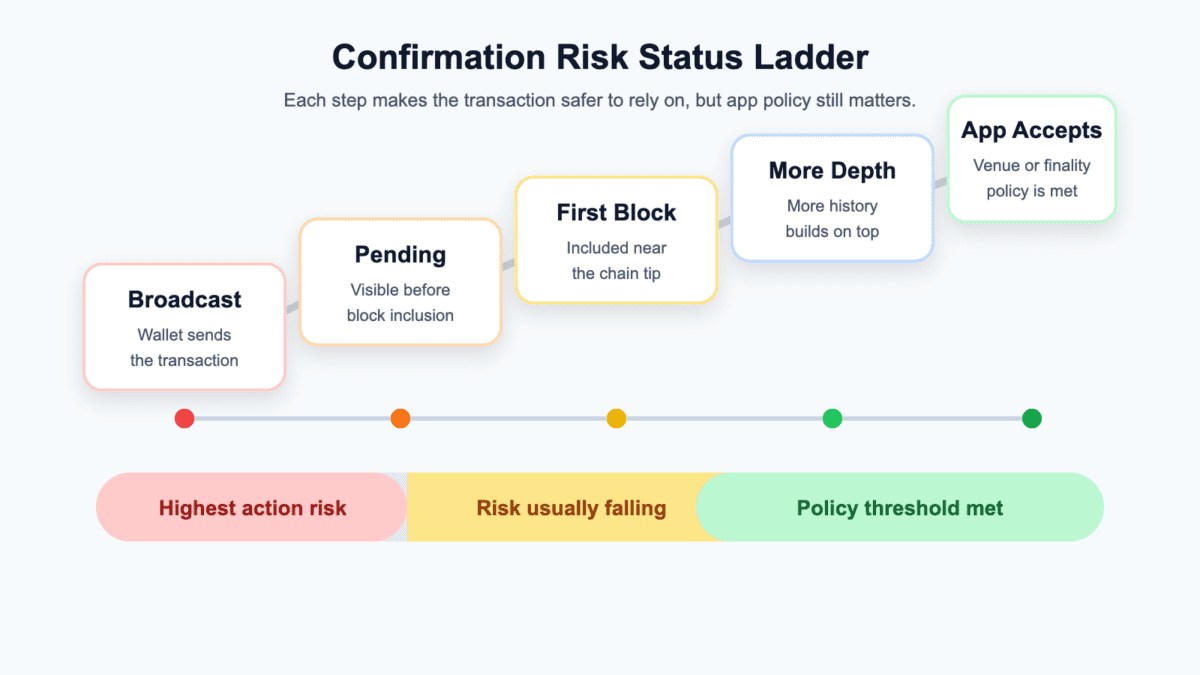
So start with the next action. If you are only checking whether a test transfer left your wallet, pending may be enough information. If you are releasing goods, minting on a bridge, or trading a volatile move, pending is not the same as safe.
Confirmation risk happens because blockchains settle transactions in stages. Before a transaction is deep enough, it can be delayed, replaced, dropped from some mempools, or affected by a short chain reorganization.
Bitcoin is the cleanest beginner example. Bitcoin.org’s block chain guide describes the block chain as an ordered public ledger used to protect against double spending and changes to older transaction records. Each new accepted block adds more weight to the history that includes a transaction, but the first visible moment still is not settlement.
Users feel the risk in a few places:
A zero confirmation transaction has been broadcast but is not yet included in a block. That can work for tiny, low-risk situations where both sides accept the risk. It is dangerous for irreversible delivery, high-value transfers, and hostile counterparties.
Replace-by-fee, or RBF, adds another wrinkle. An RBF transaction lets the sender replace an unconfirmed transaction with another version that pays a higher fee. That can be a normal way to rescue a slow transaction.
But RBF also makes zero-confirmation acceptance weaker. If a counterparty accepts an unconfirmed payment, the sender may still replace it before settlement. Only one valid transaction can land in the accepted chain.
A reorg happens when the network follows a different valid chain tip and recent blocks lose their place. The old block becomes stale, and transactions in it may need to be included again elsewhere.
Most everyday reorg risk is about shallow history, not movie-villain control of the network. Still, the effect is real. If your transaction was only in the latest block, a reorg can change what a wallet, explorer, or venue sees.
This is why confirmations are a confidence ladder. They are not magic. They simply make normal replacement less likely as more accepted history builds on top.
More confirmations usually reduce confirmation risk, but the right number depends on the chain, amount, venue, and action. A universal answer would be neat. Crypto declined the invitation.
For Bitcoin-style chains, each additional block built after the transaction usually lowers normal reorg and double-spend risk. For proof-of-stake chains, apps may care about finalized checkpoints or other stronger states. For exchanges and bridges, policy can be stricter than the wallet display. Use confirmations as one input, not the whole answer:
| Action | What To Verify Before Acting |
|---|---|
| Small Wallet Transfer | Correct address, correct network, visible TXID, and at least the first expected confirmation. |
| Exchange Deposit | Required confirmation count, deposit status, memo or tag rules, and whether trading or withdrawal is enabled. |
| Merchant Delivery | Payment value, customer trust, reversibility of delivery, and whether the transaction is still shallow. |
| Bridge Mint | Source-chain settlement, bridge policy, destination asset, and whether the route fronts liquidity. |
| Treasury Movement | Chain finality, internal approvals, destination controls, records, and whether a test transfer cleared first. |
The action sets the tolerance. A $10 test transfer between your own wallets is mostly a status check. A large sale, bridge mint, or treasury movement creates a loss path if you act before settlement.
Bitcoin confirmations also get discussed more than most because Bitcoin made the confirmation-count habit famous. That habit is useful, but it does not transfer cleanly to every chain. Different systems use different settlement models, and apps sometimes add their own risk buffer. If a platform publishes a requirement, follow that requirement instead of guessing.
Confirmation risk changes by context because each participant takes a different kind of risk. Your wallet wants to show status. An exchange wants to avoid crediting a deposit that may not settle. A bridge wants to avoid minting against a source transaction that can still change.
The consequence changes with the job. A wallet display can be early because it is only informing you. An exchange credit is different because once the venue lets you trade, withdraw, or use funds, the venue may carry loss if the deposit does not settle as expected.
Wallets are usually closest to the chain. They show broadcast, pending, confirmed, failed, or dropped states based on the wallet’s view and its connected nodes or services. Good wallet controls help when you need fee bumping, coin control, status checks, or cleaner address management.
Those controls help you react. They do not override settlement. Fee bumping can help with some unconfirmed transactions, coin control can reduce awkward dust problems, and better records can make support easier. None of that makes a shallow transaction final.
The other common settings split like this:
For exchanges, the visible label can hide several queues: block confirmations, memo or tag matching, account risk, compliance review, and withdrawal availability.
For bridges, the route may wait for source-chain confidence before it releases or mints value somewhere else. For merchants, the question is blunt: can you get the product or service back if the payment changes?
This is why the same transfer can be “fine” in one place and risky in another. The chain state is only one layer. The next action decides how much certainty you need.
Confirmation risk on Bitcoin, Ethereum, and faster chains differs because “confirmed” does not mean the same thing everywhere. Block time, consensus design, finality rules, app labels, and venue policies all shape the wait.
The label travels badly across chains. Bitcoin-style confirmation language is useful, but it can mislead when the system uses checkpoints, sequencers, app-level safety labels, or a bridge route with its own delay.
The same status word can hide different systems:
| Chain Or Context | What Confirmation Risk Usually Depends On |
|---|---|
| Bitcoin | Block inclusion, depth, fee pressure, RBF status, and reorg tolerance. |
| Ethereum | Inclusion, safe or finalized state, app policy, and smart contract execution. |
| Layer 2 Networks | Sequencer status, L2 confirmation, L1 settlement path, and bridge exit rules. |
| Faster L1s | Local finality model, validator set, app labels, and venue acceptance rules. |
| Exchange Accounts | On-chain confirmations plus internal crediting, risk, and withdrawal policy. |
Bitcoin-style chains usually make users think in block depth. More blocks after your transaction generally mean more accepted history sits above it. That helps explain why Bitcoin confirmations became the default mental model for many users.
Ethereum-style systems can add different language. An app may care about inclusion, a safe state, or a finalized state. Layer 2 networks can add another step because the local transaction may confirm quickly while bridge exits, proofs, or settlement paths still depend on another chain.
Fast can mean quick inclusion, app acceptance, economic finality, or venue credit. Those are not identical.
So avoid pasting Bitcoin confirmation logic onto every chain. Ask what the chain calls settled, what the app calls done, and what the venue requires before funds become usable.
Confirmation risk is about settlement safety. Market timing risk is about losing the trade window while settlement catches up.
The two often feel like the same problem because they hit at once. You send funds to an exchange, the transaction waits, price moves, and the clean plan turns into a refresh-button workout.
A transaction can settle correctly and still arrive too late for the trade you had in mind. That does not make the confirmation process wrong. It means the market moved while your funds were still becoming usable.
Keep the split clear:
That last one is the quiet killer. A delayed deposit can tempt users to size up, chase a candle, switch venues, or skip normal checks because the first plan already feels ruined.
This is common around volatile Bitcoin moments. During a BTC ATH move, deposit delays can mean you arrive after the headline candle, not before it. The transaction may settle correctly and still miss the price you wanted.
Hype markets add another danger. If funds clear late, traders can chase weaker liquidity, wider spreads, or crowded exits. That can turn a late deposit into exit liquidity risk when earlier holders are already selling into attention.
None of this is a trading signal. It is a timing check. If a deposit clears after the move, you still need a fresh reason to act.
The old reason may have expired while the transaction was waiting. Recheck the setup, liquidity, order book, funding pressure, and your own risk limit before turning a slow deposit into a rushed trade.
When confirmation risk leaves a transaction pending, slow down and identify the state before sending more funds or trusting anyone in your inbox. Most bad second moves happen while the first transaction is still explainable.
Start with the basics. Confirm the TXID, network, destination address, amount, fee, memo or tag, and wallet status.
Then compare a reputable explorer with your wallet or venue display. Wallets can lag, explorers can disagree at the edges, and exchanges can apply their own policies. Use this checklist before escalating:
Fee economics can make small outputs ugly. If a tiny Bitcoin-style output costs more to move than it is worth, the issue starts to overlap with dust balances and coin control rather than normal confirmation waiting.
RBF and CPFP are not universal rescue buttons. RBF must be supported and enabled by the original transaction or wallet flow. CPFP depends on spending a child output with enough fee to encourage miners to include both transactions.
If the transaction is an exchange deposit, use the venue’s official support channel from inside your account or bookmarked site. Do not use search ads, social DMs, or random “accelerator” links.
Nobody legitimate needs your recovery phrase to unstick a transaction. That sentence has saved more money than several bull-market strategies.
Check confirmation risk before you act by matching the transaction state to the action you want to take. A transaction can be safe enough for watching and unsafe for delivery.
Start with the consequence. If the next action is reversible, small, or only affects your own wallet, your tolerance can be higher.
If the next action ships goods, releases a trade, mints a bridged asset, or moves treasury funds, demand more certainty. Run the check in this order:
| Check | What You Are Looking For |
|---|---|
| Next Action | Trade, withdraw, ship, bridge, record, or wait. |
| Amount At Risk | Larger values need more settlement confidence. |
| Reversibility | Irreversible delivery deserves a longer wait. |
| Chain Model | Confirmations, finality, L2 settlement, or venue policy. |
| Transaction State | Pending, first confirmation, deeper confirmations, failed, or dropped. |
| Counterparty | Trusted self-transfer, exchange, merchant, bridge, or unknown buyer. |
| Records | TXID, destination, memo, receipt, timestamp, and support history. |
The recordkeeping part is boring until something breaks. Keep the TXID and platform receipts together. If a transfer later needs support, you want evidence, not a memory of a green checkmark.
Avoid legal or tax conclusions from wallet labels alone. A pending transaction, dropped transaction, failed withdrawal, and credited exchange balance can have different recordkeeping meanings.
If the amount is material, save the trail and get proper advice from someone qualified. For everyday use, the rule is simple: do not make the next action riskier than the transaction state can support.
Confirmation risk sits beside several terms that often appear in wallet screens, support tickets, and angry group chats. Knowing the nearby language helps you avoid the wrong fix.
Here are the terms worth separating:
| Term | How It Connects To Confirmation Risk |
|---|---|
| Mempool | Where many unconfirmed transactions wait before block inclusion, depending on node view. |
| TXID | The transaction identifier you use to check status on an explorer. |
| Zero Confirmation | A broadcast transaction with no block inclusion yet. |
| RBF | A replacement method for some unconfirmed transactions that can raise the fee. |
| CPFP | A fee-bump method where a child transaction helps pull a parent transaction into a block. |
| Reorg | A change in recent accepted chain history that can affect shallow transactions. |
| Stale Block | A valid block that loses to another chain branch. |
| Double Spend | A conflict where the same funds are attempted in more than one transaction. |
| Finality | A stronger settlement condition used differently by different chains and apps. |
The important pattern is that these terms describe different stages or failure modes. A mempool delay is not the same as a reorg. RBF is not automatically fraud. Finality is not always the same as a wallet saying confirmed.
Two nearby topics help when confirmation risk turns into account or trading pressure:
When in doubt, turn the label into a next step. Can you wait, fee bump, contact official support, or safely act? If the answer is unclear, the confirmation risk is still open.
Confirmation risk in crypto is the chance that a transaction appears visible before it is settled enough for the action you want to take. It usually matters when you plan to trade, ship goods, bridge funds, credit a customer, or rely on a newly visible deposit.
The core idea is simple: seen is not always settled. Check the transaction state, confirmation depth, chain finality model, and venue policy before acting.
One confirmation may be enough for some low-value or reversible actions, but it is not a universal safety line. The right wait depends on the chain, amount, counterparty, venue policy, and what happens if the transaction changes.
For larger or irreversible actions, wait for deeper confirmations or the platform’s required threshold. If an exchange or bridge publishes a policy, follow that policy.
Confirmation risk can affect a recently confirmed transaction if the transaction sits in shallow chain history and a reorg changes which block is accepted. That is why one confirmation is stronger than zero confirmations, but weaker than deeper settlement.
Deep reversals are uncommon on major networks, but shallow changes are the reason confirmations exist. The bigger the next action, the more certainty you should want.
More confirmations usually reduce confirmation risk, but there is no one number for every crypto transaction. Bitcoin-style chains, Ethereum-style finality, L2s, bridges, and exchanges can all use different settlement logic.
Ask what you are trying to do. A small self-transfer, exchange deposit, merchant delivery, bridge mint, and treasury movement do not need the same risk threshold.
RBF is not the same as confirmation risk. It is a replacement method that can let an unconfirmed transaction be resent with a higher fee. It can be useful when a transaction is stuck.
RBF can look like double-spend risk to someone accepting zero confirmations because a different version may settle instead. That is why counterparties should avoid treating unconfirmed payments as final.
Confirmation risk still matters after an exchange shows pending because the exchange may not have credited the deposit yet. The venue may be waiting for more confirmations, internal processing, compliance checks, or withdrawal-risk controls.
Do not assume the chain failed because the account balance is not usable. Check the TXID, deposit page, memo or tag, network, and official support status before taking another action.
When confirmation risk matters, start with the action you are about to take. The right wait depends less on your anxiety level and more on what can go wrong next.
If you control both wallets, the next step may be simple: verify the TXID, confirm the address, and wait for the expected state. If another party is involved, the risk changes because you may be releasing value, credit, goods, or access before the transfer is settled enough.
Use this short sequence:
This sequence also protects you from the worst follow-up mistakes. It slows down blind resends, fake support links, wrong-network guesses, and pressure to “just try again” while the first transaction still has a normal explanation.
If the next action is low value and reversible, you may be able to move sooner. If the next action is expensive, irreversible, or cross-chain, let the confirmations do their job.
Crypto moves fast enough already. You do not need to add a preventable mistake while the transaction is still catching up.