Physical Address
304 North Cardinal St.
Dorchester Center, MA 02124
Physical Address
304 North Cardinal St.
Dorchester Center, MA 02124


Fast bridges move crypto quickly, but the route matters.
A fast bridge is a cross-chain route that moves or credits crypto faster than a canonical bridge, usually by using liquidity, solvers, relayers, or messaging.
That speed helps when your funds sit on one chain and the opportunity, wallet, or app you need sits on another.
But a fast bridge also adds route assumptions. The faster path may depend on liquidity depth, a solver filling the order, a relayer delivering a message, or settlement catching up later.
A fast bridge in crypto is a bridge route that gets value to the destination chain quickly, often before slower official settlement is complete. It is not just a bridge website with a fast interface. The speed comes from how the route handles liquidity, messages, fills, and settlement.
The wording can confuse people because FastBridge is also used as a product name by some projects. Here, fast bridge means the broader route category. When a project uses FastBridge as a brand, check that product’s own route, token support, and risk model.
A normal bridge may wait for the chain’s official message path. A fast bridge may use one of these shortcuts:
That does not make the route fake. It means the bridge has changed the timing. You may receive destination-chain funds quickly while someone else waits for reimbursement, finality, or slower settlement behind the scenes.
Speed helps when the route is clear, the asset form is right, and liquidity is deep enough for the size. It gets risky when the user cannot tell who fills the destination side, what token lands, or what happens if the route stalls.
Fast bridges exist because multi-chain crypto turns simple money movement into a small errand pile. Your USDC may sit on Base, your ETH may sit on Arbitrum, and the app you want may only accept funds on Ethereum, Optimism, Solana, or another chain.
That fragmentation is annoying before fees even appear. You may need the right gas token, token version, approval, bridge transaction, wait, and then another swap. The screen says “bridge.” Your evening says “admin work with price risk.”
Speed becomes valuable in a few common situations:
That last case connects fast bridges to market rotation. When capital moves from one chain or sector to another, waiting hours or days can change the trade. The route becomes part of execution, not just background infrastructure.
But speed still has a bill. A fast bridge may charge more, route through thinner liquidity, or deliver a wrapped token instead of the native asset you expected. The faster route solves the waiting problem, but the user still has to inspect how the route makes that speed possible before signing.
A fast bridge and a canonical bridge can both move value across chains, but they do different jobs. A canonical bridge usually follows the official route recognized by a chain, rollup, or token system.
A fast bridge often gives you a quicker destination-side result. It does that by using liquidity or coordination before the official path catches up.
The canonical route can be slower because it respects the chain’s normal settlement and challenge design. For OP Stack chains, Optimism documentation separates normal transaction finality from the Standard Bridge’s withdrawal delay. It notes that Standard Bridge withdrawals of ETH and ERC-20 tokens to Ethereum require a minimum 7-day wait.
The same source says OP Stack transactions themselves are typically finalized around 20-30 minutes after submission. That contrast is what fast bridge users are buying: faster liquidity access, not a new definition of finality. The delay protects the withdrawal claim process. A fast bridge may reduce your wait by having another party front funds or coordinate a faster path.
| Route Type | What The User Should Know |
|---|---|
| Canonical Bridge | Usually follows the chain’s recognized route and standard token mapping, but can be slower or require a claim step. |
| Direct Fast Bridge | May front destination liquidity quickly, while settlement or reimbursement happens later. |
| Bridge Aggregator | Compares routes in one interface, but the chosen route still has its own contracts, fees, limits, and failure path. |
| Centralized Exchange Route | Can be predictable when deposits and withdrawals are supported, but adds custody, KYC, account limits, and platform policy risk. |
This table is not a ranking. A canonical bridge can be the better route for a large transfer where token form and settlement clarity matter more than speed. A fast bridge can be better for a smaller urgent move when the quote is clear and liquidity is deep.
Do not assume “official” always means best or “fast” always means reckless. Each route changes what you trust. Canonical bridges lean on the chain’s standard path. Fast bridges lean more on liquidity, route operators, solvers, messaging, or market depth.
A fast bridge works by separating what you receive from how final settlement finishes. The destination side may be filled quickly, while a slower bridge, solver repayment, message, or liquidity rebalance completes afterward.
The clean button hides a route. Underneath, the system has to decide what asset leaves, what asset arrives, who fronts liquidity, and how everyone gets squared up later. A fast fill still needs someone or some pool willing to provide the destination-side asset.
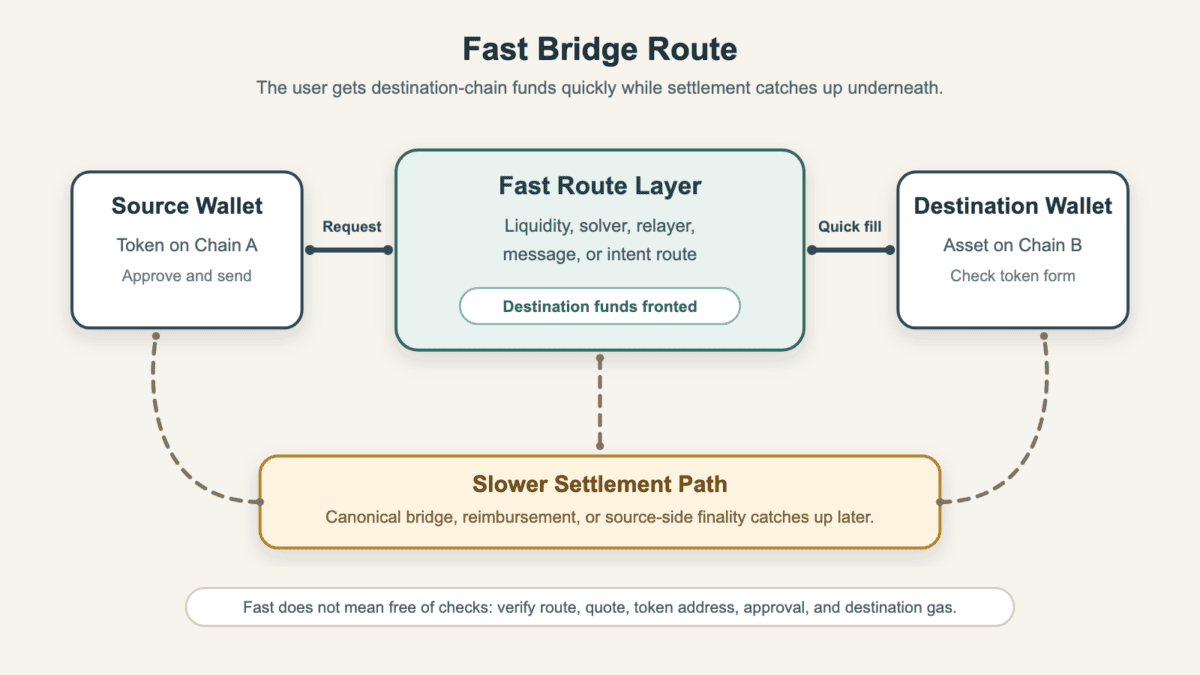
A liquidity-backed fast bridge uses inventory on the destination chain to pay the user quickly. The route then waits for settlement, rebalances liquidity, or collects repayment later.
This pattern can feel instant when liquidity is deep. It can get worse when the route is busy, the asset is thin, or the destination pool is running low. The quote may change because the pool is not a bottomless vending machine. Crypto keeps refusing to become tidy.
A solver or intent route starts with the outcome the user wants. The user may say, in effect, “I want this asset on that chain,” and solvers compete or coordinate to make it happen.
You see a destination result, not every internal step. That can reduce manual work, but the route still needs to show enough detail to trust the fill. Check the final token, received amount, fees, expiry time, and refund path.
A message-based route uses cross-chain communication to prove or coordinate an action between chains. A relayer or messaging layer may carry information that the destination side needs before releasing or minting assets.
This can be efficient, but the message path still has assumptions. Ask who verifies the message, what happens if the relayer stalls, and whether the route has pause controls or upgrade keys that can change behavior.
A bridge plus swap route moves value across chains and changes the asset along the way. You may start with ETH on Base and receive SOL, USDC, or a wrapped asset on Solana or another destination.
This is convenient when it works. It is also where users often misunderstand what landed. The ticker can look familiar while the contract address, wrapper, liquidity, or app support is different. Always check the destination token address, not just the logo.
A fast bridge costs more than the line labeled “bridge fee.” The real cost is the final amount and asset you receive after source gas, destination gas, spread, slippage, solver fees, route liquidity, and any extra swap.
This is why two routes with the same headline fee can land very different results. One may use deep stablecoin liquidity. Another may add a swap through a thinner pool. A third may be cheaper until a failed transaction burns gas and leaves you with nothing but character development.
| Cost Line | What To Check Before Signing |
|---|---|
| Bridge Fee | The explicit fee shown by the route or bridge interface. |
| Source-Chain Gas | The gas paid to approve and send from the starting chain. |
| Destination-Chain Gas | Whether the route leaves enough gas to use the received funds. |
| Spread And Slippage | The gap between quoted and final output if the route includes a swap. |
| Solver Or Liquidity Fee | Any premium paid for a faster fill or route provider. |
| Failed Transaction Cost | Gas lost if the approval, bridge, or swap fails. |
Also watch for dust balances after the transfer. A bridge can leave tiny gas-token leftovers or unusable fragments across chains. They may not matter on one small transfer, but they distort the real cost when you bridge often.
The quote is still useful. Just read it as a preview, not a promise from a stone tablet. Check the expiry time, minimum received amount, asset form, destination chain, and whether the route can change before you confirm.
Fast bridge risk is not one scary blob. It breaks into specific checks: URL, contract approval, token address, route liquidity, destination chain, route controls, quote expiry, test-transfer size, and support path.
Start with the boring checks because boring saves money. Use official links, confirm the domain, and avoid routes sent by random social posts or direct messages. If a bridge needs an approval, read the spender and amount before signing.
Run through this checklist before you move real size:
Wallet support does not remove route risk. Hardware wallets and other crypto wallets help protect signing keys, but they do not audit the bridge, guarantee liquidity, or prove the destination token is the one you wanted.
Pause controls and upgrade keys deserve attention too. Some routes can be paused during incidents. Some contracts can be upgraded by a team, multisig, or governance process. If the route is confusing, the token form is unclear, or support paths are vague, slow down. The confirm button is not a trust fall. It is a contract interaction with your money attached.
A fast bridge is not the best route when speed creates more uncertainty than it solves. Large transfers, low-liquidity assets, unclear token versions, tax-sensitive bridge plus swap flows, and unsupported chains all deserve a slower look.
The wrong fast route can turn a simple transfer into a recovery problem. You might receive a wrapped token that the destination app does not accept, arrive without gas, or route through a swap that changes the asset more than expected.
Slow down when these signals appear:
A canonical bridge may be better when settlement clarity matters more than speed. An exchange route may be cleaner when the exchange supports both deposit and withdrawal chains. But that adds custody and account policy risk.
The point is not to avoid fast bridges. The point is to choose the route that matches the job. Moving a small amount of USDC for gas is not the same as moving a large position you cannot afford to chase through support tickets.
Fast bridge examples make the tradeoff easier to see. The route can look similar on screen while the important checks change by asset, chain, and destination use. A bridge can be fine for a tiny gas refill and still be awkward for a larger position.
Use these examples as route-reading practice, not bridge recommendations:
For each case, check the fee, final amount, destination token, route, approval, and whether you need gas after arrival. That work is less exciting than speed.
It is also cheaper than discovering the wrong wrapped asset after the fact, especially on routes that cross EVM and non-EVM chains.
The shared lesson is simple: name the starting asset, destination asset, chain, route, approval, and final amount. If you cannot name those five things, the route is not ready for real size. The route may be simple, but only after the hard parts are visible.
Related fast bridge terms help users read bridge screens without guessing. The key is not memorizing jargon. It is knowing what each term changes before you sign.
Use this mini glossary as a route-reading aid:
| Term | What It Changes For The User |
|---|---|
| Canonical Bridge | The recognized route or token mapping for a chain, often slower but clearer. |
| Relayer | A party or service that helps move messages or transaction information between chains. |
| Solver | A route participant that fills the user’s requested outcome, often for a fee or spread. |
| Intent | A user-defined result, such as receiving a token on a destination chain, rather than a manual step list. |
| Wrapped Token | A token representation that depends on backing, custody, or bridge logic elsewhere. |
| Native Token | The asset issued or recognized directly on that chain. |
| Finality | The point where a transaction is hard or impossible to reverse under the chain’s assumptions. |
| Slippage | The difference between expected output and final output, usually from price movement or thin liquidity. |
| Bridge Aggregator | A tool that compares or routes across bridges, swaps, and chains. |
These two follow-ups help when a route preview still feels abstract:
The terms overlap in real routes. A bridge aggregator may use an intent route. A fast bridge may rely on solvers. A wrapped token may appear after a bridge plus swap. That is why the route preview matters more than the label on the button.
When in doubt, translate each term into a user-facing check. Who verifies the move? Who provides liquidity? What token arrives? Can you exit it later? That beats nodding at jargon and hoping the wallet popup is feeling generous.
A fast bridge can be safe enough for a specific route, amount, and asset, but it is not safe by default. Check the official URL, token address, approval amount, liquidity, destination chain, route controls, and support path before signing.
For larger transfers, use a small test first. A successful test does not prove the route can handle a much larger amount, but it can catch wrong-chain, wrong-token, and wallet setup mistakes early.
FastBridge can be a product name, while a fast bridge is also a generic route category in crypto. Context decides which meaning applies.
If the term appears in a product page, read it as that product unless the page explains otherwise. If traders use the phrase casually, they usually mean a faster bridge route compared with a slow canonical bridge.
A fast bridge is faster because it may use destination liquidity, solvers, relayers, messaging, or intent routing instead of waiting for the official bridge path to finish before the user receives funds.
That speed shifts some assumptions. Someone may front liquidity, coordinate a message, or wait for reimbursement later. The user should check who fills the route and what happens if settlement stalls.
A fast bridge can lose, delay, misroute, or strand funds if the route, contract, approval, frontend, liquidity, or destination token is wrong. Bridge risk is real even when both chains keep working normally.
Most user mistakes happen before signing. Confirm the chain, token address, recipient, approval amount, quote expiry, and minimum received amount. Slow hands are underrated here.
A fast bridge is a route designed to move or credit assets quickly. A bridge aggregator is an interface that compares routes and may choose a fast bridge, canonical bridge, swap route, or mixed path.
The aggregator is not the risk model by itself. The selected route still matters. Read the route details before assuming the aggregator found the safest option.
Fast bridges can deliver native tokens, wrapped tokens, bridged tokens, or a swap output. The result depends on the route, asset support, destination chain, and liquidity source.
Check the destination token contract before using the funds. A familiar ticker can hide a different asset version, and some apps only support specific token contracts.
Start with a small transfer, a clear route, and a boring checklist. A fast bridge is useful when you understand what moves, what lands, and what assumptions make the speed possible.
Before using a fast bridge for meaningful size, take these actions:
For larger moves, ask two extra questions before you scale:
Then scale only when the first move behaves as expected. Even then, recheck liquidity and quote expiry for larger transfers. A $20 test route and a $20,000 route can behave differently when liquidity gets thin.
The fast route is a tool, not a personality test. Use it when speed solves a real problem and the route is clear enough to inspect. Skip it when the bridge asks you to trust too much for too little time saved. A slower route that lands the right asset can be the cheaper route in the end.