Physical Address
304 North Cardinal St.
Dorchester Center, MA 02124
Physical Address
304 North Cardinal St.
Dorchester Center, MA 02124


Learn why crypto trades can fill worse than expected.
Execution risk is the chance that a crypto trade, swap, or automated order completes at a worse price, size, speed, or route than expected.
A good trade idea can still become a bad fill. You might read the market correctly, click at the right moment, and still receive fewer tokens, pay a wider spread, miss the fill, or exit later than planned.
Crypto makes that gap easy to feel because venues, order books, AMM pools, gas, MEV, APIs, and wallet screens all sit between intention and outcome. After any trade, ask two questions: was the price view right, and did the order execute as expected?
Execution risk in crypto means the trade process itself can damage the result. It is the risk that buying, selling, swapping, closing, or automating an order does not finish as expected.
The risk usually appears in four places: price, size, speed, and route. Price is the final fill versus the quote. Size is whether the full amount fills. Speed is whether execution happens before the market changes. Route is the venue, pool, bridge, or path used to complete the action.
Those four levers show up in normal crypto habits:
That is why execution risk is wider than slippage. Slippage is a common symptom. Execution risk is the whole path from intention to result.
A beginner often sees only the app screen. An active trader sees the order book, the queue, the pool, the gas fee, the API response, and the final fill report. The second view is less cozy, but it explains the result.
Perfect execution is not the goal. Crypto does not hand that out with the welcome email. The goal is to know what can change before you click, sign, or let a bot act.
Execution risk is different from market risk because it lives between your decision and the completed trade. Market risk is being wrong about where price goes. Execution risk is getting a worse result while trying to act.
Imagine you decide to buy ETH after a clean setup. If ETH falls after your order fills, that is market risk. If the order fills far above the quote because liquidity was thin or the spread widened, that is execution risk.
The two can arrive together, which makes them easy to confuse:
| Risk Type | What Went Wrong |
|---|---|
| Market risk | The asset moved against your trade idea after you entered. |
| Execution risk | The trade filled worse, later, smaller, or through a bad route. |
| Liquidity risk | There was not enough depth to trade your size cleanly. |
| Venue risk | The platform, wallet, or route delayed, rejected, or changed the trade path. |
The split helps because each problem needs a different fix. A bad price prediction calls for better sizing, thesis checks, or no trade. A bad fill calls for better order type, smaller clips, deeper liquidity, or a different route.
You can also be right on direction and still lose value at entry. A Bitcoin trade can catch the move and still start with a worse average price because the order swept thin offers. That is not the chart betraying you. That is the market charging for urgency.
So review the fill, not only the candle. If the trade idea was fine but the execution was sloppy, the lesson sits in the order details.
Crypto execution risk starts with the quote because the displayed price is not always the final economic result. A quote, chart price, or app preview can change before the trade settles.
The quote is a snapshot. The final fill is an event. Between those two moments, liquidity can move, spreads can widen, gas can rise, a route can change, or a pool can get hit by another trade.
Stablecoin swaps make this clear. A USDC-to-USDT trade may look nearly flat because both tokens aim to stay near $1. But the received amount can still change through fees, route choice, spread, pool balance, or price impact.
Use this simple flow:
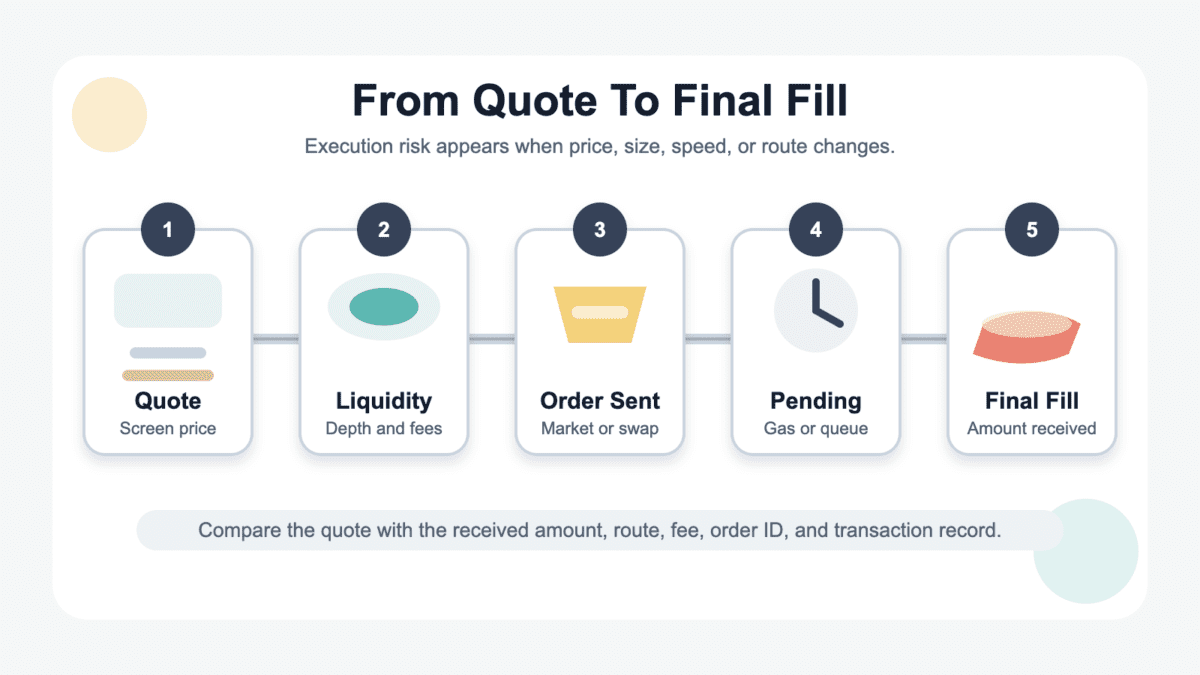
Thin books make the same problem louder. If there are not enough willing buyers or sellers at the quoted level, your trade walks into worse prices. That is where exit liquidity becomes more than a meme-market insult. It tells you who can take the other side when you need out.
The received amount matters more than the headline price. A swap preview, exchange quote, or convert screen can feel clean while the actual output is shaped by hidden spread, routing cost, and available depth.
Before acting, compare the quote with what you actually receive. Keep the fill report, transaction hash, order ID, and screenshots when the result looks wrong. Those records make support, accounting, and your own post-trade review less dramatic.
Order types change execution risk because every order chooses a trade-off. You can favor speed, price control, fill certainty, or protection after a trigger, but you cannot maximize all of them at once.
A market order is the fastest common choice. It asks the venue to fill now at the best available prices. That can work in deep markets, but it can also walk through the book when the order is large or the market moves fast.
A limit order sets a maximum buy price or minimum sell price. That protects the price, but it can leave you with no fill. In fast markets, no fill can be the cost of discipline.
These trade-offs are easier to compare in one place:
| Order Type | What It Protects, And What It Can Still Fail At |
|---|---|
| Market order | Protects speed and fill certainty, but can suffer slippage and price impact. |
| Limit order | Protects price, but may not fill or may fill only partly. |
| Stop order | Triggers after a price level, but the final fill can be worse than the stop. |
| Stop-limit order | Adds a price limit after the stop, but may not execute in a fast move. |
| DEX swap | Previews an output amount, but route, pool depth, gas, and slippage tolerance can change the result. |
Stops deserve extra care. A stop price is usually a trigger, not a guaranteed exit price. When the trigger fires, the resulting order still has to execute in the available market.
Stop-limit orders solve one problem and create another. They can prevent a terrible fill, but they can also leave the position open if the market gaps through the limit. That is not a bug. It is the trade-off.
So start with urgency. If you must exit now, you accept more price uncertainty. If price matters more than speed, you accept non-execution risk. The right order is the one whose failure mode you can live with.
Slippage, spread, and price impact drive execution risk because they turn a displayed price into a different final price. They are related, but they are not the same thing.
Spread is the gap between the best buyer and best seller. Slippage is the difference between expected and actual execution. Price impact is what your own trade does as it consumes available liquidity.
A recent MetaMask slippage guide separates order-book slippage from AMM slippage and frames 0.5% to 1% slippage tolerance as a common balance between avoiding failed swaps and limiting execution cost. The split fits crypto well. Centralized exchanges match against orders. DEXs often price against pool balances and routes.
The size of your trade relative to depth matters more than your confidence. A small order in a deep BTC market may barely move. The same dollar amount in a thin token can drag through several price levels.
Watch for these signals before you trade:
This is why low-liquidity meme markets feel so hostile. In the meme coin trenches, the chart can look tradable until your own order becomes part of the problem.
Slippage tolerance is not a magic shield. A tighter setting can make a DEX swap fail. A wider setting can allow a worse fill if the market moves or another actor exploits the window. The setting should reflect liquidity, urgency, and trade size, not hope.
If the quote gets worse as you increase size, split the trade, wait for better depth, or skip it. The market is already telling you the exit may be expensive.
DEX swaps add execution risk because the trade must move through wallets, routes, pools, gas markets, and on-chain ordering. The interface can look calm while the transaction is still exposed.
An AMM swap does not fill against a normal order book. It trades against pool liquidity. If your trade is large relative to the pool, the price changes as the swap moves through the curve.
Routing adds another layer. A wallet or aggregator may route through several pools to reach the best quoted output. That route can change as liquidity shifts, especially during volatile moments.
Then the transaction waits. While it is pending, gas prices can move, the pool can change, or another transaction can land first. In adversarial markets, PVP trading is more than slang. It describes conditions where traders and bots compete directly against your execution.
MEV can cause a bad DEX fill. A sandwich attack can place a transaction before and after yours, pushing your received amount worse while staying inside your slippage tolerance. Front-running can also change the state you expected.
But ugly swaps do not all come from MEV. Low liquidity, high price impact, route changes, token taxes, front-end fees, and normal volatility can all look similar from the user’s seat.
A wider slippage setting deserves caution:
Failed swaps add one more sting. If a transaction reverts, the trade may not happen, but the chain can still charge gas for the attempted execution. That feels unfair. It is also part of how on-chain computation gets priced.
For DEX trades, check the received amount, route, pool depth, slippage tolerance, gas, and token contract warnings before signing. The final click is not only a trade. It lets the transaction try.
Execution risk gets sharper with futures, leverage, and stops because a small fill gap can hit the whole account. Leverage can turn execution details into liquidation details very quickly.
A stop-loss is the classic trap. Many users read the stop price as an exit guarantee. It is usually a trigger. After that trigger, the venue still needs liquidity to fill the order.
Fast markets make that difference painful. If price gaps through the trigger, a stop-market order can fill below the stop on a long position. A stop-limit order may avoid the bad fill but leave the position open.
Leverage adds pressure from several directions:
Stops still have a job. They need sizing, order-type awareness, and backup planning because a stop can reduce one risk while adding another.
Position size is the first control. A trade that depends on a perfect exit is usually too tight for crypto’s mood. Alerts, backup access, and order review help, but they do not replace room for error.
Spot traders can feel this too. A failed exit in a fast altcoin can leave you holding a position you expected to close. With leverage, the same gap can force the trade closed, and the market will not ask politely.
Execution risk for bots, copy trading, and API orders starts when users confuse a fast signal with a reliable fill. Speed can help, but it does not remove liquidity, spread, venue rules, gas, or queue position.
A bot may detect a setup faster than a human. Then it still has to submit an order, survive API latency, clear throttles, hit available depth, and record the fill. A profitable signal can become a poor trade after execution costs.
Backtests often hide the problem. They may assume the strategy enters at the candle price, the midpoint, or a clean quoted price. Real orders face spread, slippage, partial fills, fees, failed transactions, and missed orders.
Copy trading adds another wrinkle. The leader may enter first. Followers arrive later, often into changed liquidity. A small leader account can fill cleanly while follower volume worsens the average result.
Automation should track execution quality, not only signal quality:
API traders should also model ugly states. What happens when an exchange rejects an order? What happens when gas spikes? What happens when only half the order fills?
If the answer is “the bot tries again forever,” the strategy may be less clever than it looks. Execution controls are part of the strategy, not a cleanup task after launch.
You reduce execution risk by checking the trade path before you act. The point is not to remove every possible failure. The point is to avoid the obvious ones before they charge rent.
Start with the outcome you need. Do you need a fast fill, a specific price, a full size, or a clean route? Once that answer is clear, the order type and venue choice become easier.
Use this pre-trade checklist before you buy, sell, swap, close, or automate:
Wallet workflow matters for DEX execution. Good crypto wallets make it easier to review transactions, switch networks carefully, verify addresses, and keep signing habits cleaner.
They do not make a thin pool deep. They do not make MEV vanish. But they can reduce preventable mistakes around transaction review, account access, and records.
Records are boring until you need them. Keep the quote, final fill, order ID, transaction hash, venue, time, and screenshots when something looks off. That helps support requests and your own review. It is not tax advice, but it is good operational hygiene.
If the setup only works with perfect execution, resize it or skip it. A plan that cannot survive normal slippage, spread, delay, or partial fills is not a plan. It is a wish with a submit button.
Related execution risk terms help you name the exact failure instead of calling every bad trade “slippage.” Better language leads to better fixes, especially after a trade goes wrong and every chart looks guilty.
Exit liquidity describes who is available to take the other side when you need to sell or close. If the answer is “almost nobody,” your quote may not survive contact with size.
Slippage is the gap between expected and actual execution. It is one form of execution risk, not the whole category.
Price impact is the part of the move caused by your own order consuming liquidity. It can be small in deep markets and brutal in thin ones.
MEV describes value extracted by transaction ordering or block-building choices. It can affect DEX swaps, but low liquidity and route quality can create similar pain.
Bagholder risk is the end state when a failed or late exit leaves you stuck in a position. The bagholder label sounds like slang, but the execution lesson is plain: an exit plan only counts if it can actually execute.
Jeets sit on the other side of that exit problem. The term describes traders who sell quickly, often under pressure. In thin markets, a fast exit can be rational and still create a worse fill for everyone behind it.
PVP trading, trenches, and wallet workflow also connect back to execution risk, but they do different jobs. PVP names adversarial conditions. Trenches describe low-liquidity meme-coin environments. Wallet workflow covers transaction review and signing habits. Keep the terms separate so each fix matches the failure.
These terms overlap, but they do not replace each other. If a trade goes wrong, name the layer first: quote, depth, order type, route, pending time, venue access, or final fill. That makes the next fix less emotional and more useful.
No. Slippage is one common form of execution risk, but execution risk is broader. It also includes missed fills, partial fills, failed swaps, rejected orders, route changes, gas costs, pending time, and stop orders that trigger but fill worse than expected.
A limit order can reduce price slippage, but it cannot remove execution risk. The order may not fill, may fill only partly, or may miss the move entirely. It protects price at the cost of fill certainty.
A stop-loss can fill below the stop price because the stop is usually a trigger, not a guaranteed exit price. After the trigger, the order still needs available liquidity. In fast or thin markets, the fill can land worse than the stop.
No. MEV can cause bad execution risk on a DEX, especially through sandwich attacks or front-running. But low liquidity, price impact, route changes, token fees, gas delays, and volatility can also make a swap settle worse than expected.
There is no universal safe number. Acceptable slippage depends on asset liquidity, trade size, volatility, urgency, venue, and route. A deep BTC order may tolerate less slippage than a thin meme-coin swap that moves with every trade.
A crypto swap can fail but still cost gas because the chain charges for the attempted computation. The transaction may revert because price moved beyond your tolerance, liquidity changed, or the route failed. The trade is blocked, but network work still happened.
Start by checking whether your next trade needs speed or price control. That choice decides the execution risk you are accepting before the order ever reaches the market.
If speed matters, market orders and DEX swaps can cost more because they chase the available liquidity. If price matters, limits or tighter settings give you more control, but the trade may not complete.
Then size the trade against real liquidity. The question is not “do I like the asset?” It is “can this market handle my order without punishing me?”
Before you act, take these steps:
After the trade, compare the plan with the record. Look at the quoted price, final fill, received amount, route, gas, fees, and any partial-fill notes. If the gap was avoidable, adjust the next order type, size, venue, or slippage setting.
For long-term investors, this still matters. A one-time spread may look small, but repeated sloppy entries and exits can quietly reduce returns. For active traders, the same habit decides whether a setup survives contact with the actual book.
Execution risk is not a reason to freeze. It is a reason to slow the click by a few seconds and make the market plumbing visible before it invoices you.