Physical Address
304 North Cardinal St.
Dorchester Center, MA 02124
Physical Address
304 North Cardinal St.
Dorchester Center, MA 02124


A clear guide to the execution layer, Ethereum clients, rollups, gas fees, and user risk.
The execution layer is the part of a blockchain that checks transactions, runs smart contracts, meters compute, and updates shared state.
You see it whenever a wallet sends a transfer, a DEX swap executes, an NFT mint fails, or a rollup says it processes transactions away from Ethereum. The term can sound like architecture jargon, but it points to the place where crypto actions become results.
That result still needs other layers around it. Consensus, settlement, data availability, wallets, bridges, sequencers, and client software all change the safety picture. The execution layer explains the transaction outcome, but it does not answer every trust question by itself.
The execution layer in crypto is the part of a blockchain stack where transactions are evaluated and applied. It checks whether a transaction is valid, runs the needed smart contract logic, charges gas or compute, and changes balances or contract state when the action succeeds.
Think of it as the workbench, not the final judge. The execution layer processes the transaction. Other parts of the system decide which history is accepted, where proofs settle, and whether outside parties can verify the data behind the result.
The phrase appears in a few related contexts:
That is why the same term can show up in a staking guide, an L2 pitch, and a wallet error message. The core idea stays the same: execution is where inputs become state changes.
The next question is not only “what is the execution layer?” It is also “what else is this system relying on?” A chain can execute quickly while still depending on a sequencer, bridge contract, data layer, or settlement path that deserves its own check.
The execution layer works by taking a signed transaction, checking it against the current state, running the relevant code, and writing the result. If the transaction breaks a rule, runs out of gas, or hits a contract condition that fails, the call can revert.
Start with a basic token swap. You sign a transaction in a wallet. That transaction includes the sender, nonce, target contract, call data, gas settings, and signature. It then enters a mempool, builder path, or sequencer queue, depending on the network.
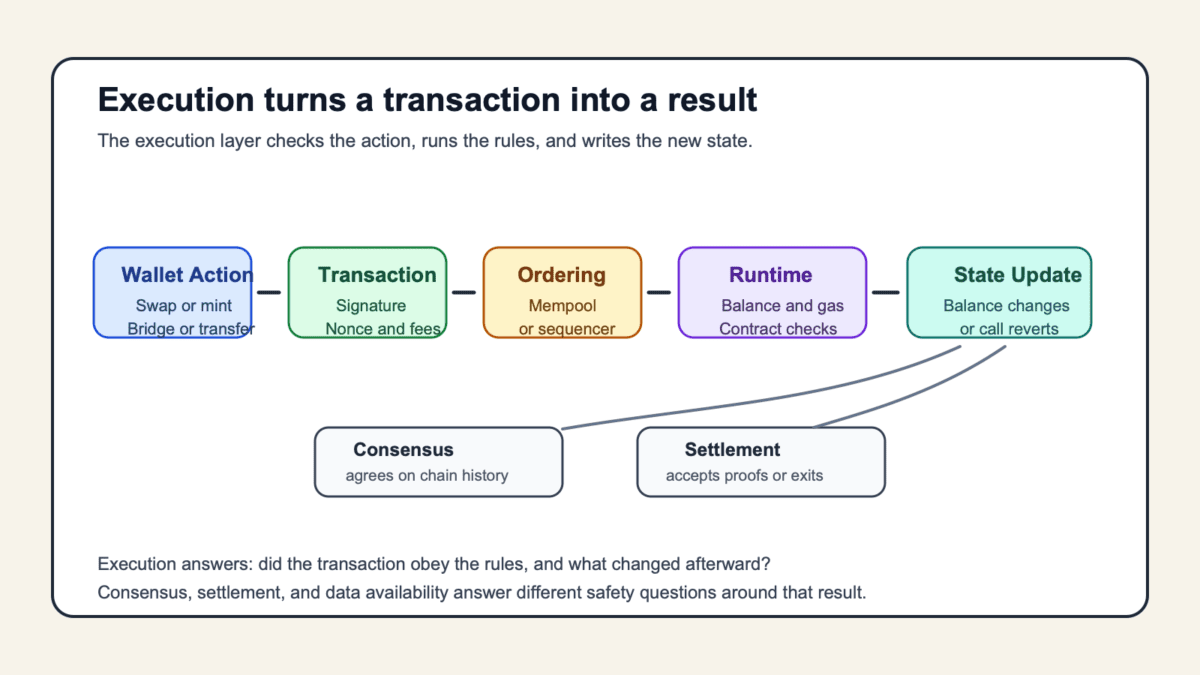
The transaction path usually looks like this:
The runtime detail depends on the chain. Ethereum uses the EVM. Some chains use different virtual machines. Some rollups use EVM-compatible execution so familiar contracts and wallets can work with fewer changes.
Execution is deterministic when the rules are sound. Every honest node running the same input against the same state should reach the same output. If one node says your swap worked and another says it failed, the system has a much larger problem than a bad wallet pop-up.
For users, the main lesson is simple. A transaction is not final just because the button was clicked. It has to be ordered, executed, accepted by the relevant chain, and surfaced correctly by the wallet or app.
The execution layer is one job in a larger blockchain stack. Consensus, settlement, and data availability answer different questions around the same transaction result.
This distinction keeps “fast chain” from doing too much work. Fast execution can make swaps feel better, but it does not prove that withdrawals are safe, data is easy to verify, or chain history is broadly agreed.
| Layer | Job And User Check |
|---|---|
| Execution Layer | Runs transactions and updates state. Check what runtime, gas model, and contract assumptions your action uses. |
| Consensus Layer | Agrees on valid chain history. Check who validates blocks and how finality or reorg risk is handled. |
| Settlement Layer | Accepts proofs, commitments, withdrawals, or dispute outcomes. Check where exits settle and what delay or governance exists. |
| Data Availability | Makes transaction data available for verification. Check whether others can inspect the data needed to rebuild state. |
A monolithic chain may bundle these jobs tightly. A modular design separates them so one chain or network handles execution while another supports settlement or data availability.
That separation can be useful. It can also hide risk behind cleaner branding. If an L2 says it has cheap execution, ask what chain settles withdrawals, who orders transactions, and where the data is published.
Consensus without valid execution would agree on nonsense. Execution without usable data would ask users to trust a summary. Settlement without a clear exit path can turn a cheap bridge into a locked-door experience.
So do not grade a chain by throughput alone. Check which layer is doing which job, then ask what happens when the operator is slow, the bridge pauses, the sequencer stalls, or the data path gets messy.
The execution layer is a protocol function. An execution client is software that implements that function for a network. The layer is the job. The client is one program that does the job.
On Ethereum, a node now pairs execution and consensus software. Ethereum.org reports that Geth runs at roughly 50% of Ethereum’s execution-client share, which helps explain why stakers watch client diversity when they pick software.
That split explains why stakers hear several names at once. Geth, Nethermind, Besu, Reth, and Erigon are execution clients. Lighthouse, Prysm, Teku, Nimbus, and Lodestar are consensus clients. Validator software handles duties such as proposing and attesting.
The terms can blur in setup guides, so keep the roles separate:
Client diversity is not cosmetic. If too many operators run the same client and that client has a serious bug, the network can face correlated failure. That does not mean every normal user must run a node. It does mean client software is part of real network reliability, not trivia for infrastructure people.
Updates create the same reliability risk. Protocol upgrades can require compatible client versions. A staker who ignores execution client updates can end up with missed duties, sync problems, or a node that stops following the chain correctly.
For a non-staker, the takeaway is narrower. When a wallet, RPC provider, exchange, or staking service has execution-side trouble, your app experience can break even if the chain design is sound. The plumbing still has to run.
Rollups often use execution layers by processing transactions away from a base chain while relying on another layer for settlement, data publication, or security. So, is an L2 an execution layer? Often, yes, but the full design decides user risk.
In a rollup, users submit transactions to an L2. A sequencer may order them quickly, execute them in the rollup environment, and produce a batch. The rollup then posts data, commitments, proofs, or state roots to another chain such as Ethereum.
The user sees lower fees and faster confirmation. Under the hood, several trust questions remain:
Optimistic rollups assume batches are valid unless challenged during a window. ZK rollups use validity proofs to show that state transitions followed the rules. Both models can be useful, but neither removes every operational risk.
The bridge is often where users feel the tradeoff. A rollup can execute quickly, yet withdrawals may depend on proof timing, bridge contracts, governance controls, or liquidity providers. Cheap execution does not automatically mean fast exits.
This is where modular-chain marketing can get slippery. A project may advertise parallel execution, high throughput, or a new virtual machine. Those claims answer only part of the question. You still need to know where settlement happens, who orders activity, and whether the data can be checked.
A good rollup explanation should leave you with a map, not a slogan. Execution tells you where transactions run. Settlement, data availability, and bridge design tell you what users can prove when something goes wrong.
The execution layer changes fees because computation and state updates consume scarce resources. More complex transactions usually need more gas or compute than simple transfers.
But gas fees are not only an execution-layer story. Demand for blockspace, priority fees, data posting costs, wallet routing, bridge paths, and network support all shape the final quote a user sees.
You feel execution design in a few places:
Wallets make this visible because they force a network choice. A token can exist on Ethereum mainnet, an L2, a sidechain, or an app-specific chain. If you pick the wrong network, cheap execution becomes an expensive support ticket. CryptoProcent’s wallet network support coverage is useful when you need to think through routing and compatibility checks.
Exchange networks create the same problem with a different costume. An exchange may list a token and allow withdrawals through specific networks only. If your wallet expects one execution environment and the exchange sends through another, the transaction can get confusing fast.
Low fees are still valuable. Nobody enjoys paying a mainnet fee large enough to make a small swap look theatrical. But cheap execution is only one variable. Liquidity, bridge safety, network support, app reliability, and exit paths decide whether the cheap route is actually usable.
Execution layer failures usually come from bad code, bad assumptions, overloaded resources, or weak operators around the execution path. The base concept is neutral. The implementation can still hurt users.
Smart contract bugs are the obvious risk. If a contract lets the wrong account move funds, calculates balances incorrectly, or mishandles permissions, the execution layer may faithfully run bad logic. The chain did what the code allowed. The user still loses.
Client bugs are another concern. Execution clients must interpret protocol rules the same way. A serious client bug can cause node disagreement, missed blocks, stalled services, or emergency updates.
> A faster execution layer can still have weak bridges, centralized ordering, thin liquidity, or contracts that fail under pressure.
Congestion can also show up at execution. If too many users compete for the same compute or state access, fees rise and transactions fail more often. Gas griefing, spam, and MEV games can make the experience worse during volatile moments.
Rollups add operator risk. A sequencer outage can delay transactions. A bridge upgrade can change the trust model. A forced-inclusion path may exist on paper but remain awkward for normal users. This is where a speed claim starts to look less shiny.
Market risk can attach itself to the same story. A token narrative built around a faster execution layer can pull late buyers into thin liquidity. That is when the technical pitch starts to rhyme with exit liquidity risk. The technology may be real, while the trade is still ugly.
The clean way to read execution risk is to separate layers. Contract bugs are not the same as consensus failure. Sequencer downtime is not the same as an invalid runtime. Bridge governance is not the same as gas pricing. Each risk needs its own check.
You can check an execution layer by mapping where transactions run, where results settle, who orders activity, and how users exit. That gives you a practical risk map before you trust the app, bridge, chain, or token story.
Start with the basic user path. If you swap on a rollup, ask where the transaction executes and how the result reaches the base chain. If you bridge funds, ask which contract controls withdrawals. If you buy a token narrative, ask whether real usage exists beyond a fast demo.
Use this checklist before the shiny throughput chart takes over:
Investor narratives around execution layers often move in waves. A new runtime, L2 design, or modular stack can become a market meta before most buyers understand the actual assumptions.
Capital can then chase one chain category, cool off, and move elsewhere. That kind of crypto rotation is not proof that the execution design is good or bad. It is a market behavior you should separate from the technical claim.
For live use, start small. Send a test transaction, confirm the network in your wallet, and read the bridge route before moving meaningful funds. For investing, look past speed and ask whether users, developers, liquidity, and exits are strong enough to justify the attention.
The goal is not to become a protocol engineer overnight. It is to avoid mistaking one impressive layer for the whole safety stack.
Execution layer concepts help translate what wallets, rollups, node guides, and protocol pages are saying. Keep these definitions compact, then return to the actual transaction path.
Here are the terms that come up most often:
These terms are easy to overcomplicate. The useful split is cleaner: execution changes state, consensus agrees on history, settlement accepts outcomes, and data availability lets others verify the work.
Once you have that split, most architecture pages become less intimidating. They may still be dense. At least the nouns stop colliding with each other.
The execution layer in blockchain is the part of the system that processes transactions, runs smart contract logic, meters compute, and applies state changes.
An L2 is often an execution layer because it processes transactions away from a base chain. You still need to check where it settles, where data is published, and who controls ordering.
The execution layer is broader than the EVM. The EVM is one runtime used to execute smart contracts, while the execution layer includes transaction processing, gas metering, and state updates.
An execution client is software that implements a network’s execution rules. On Ethereum, examples include Geth, Nethermind, Besu, Reth, and Erigon.
Yes, the execution layer affects gas fees because transactions consume compute and state resources. Fees also depend on demand, priority bidding, data costs, routing, and network support.
No, a faster execution layer only tells you part of the story. Settlement, bridge design, sequencer control, data availability, liquidity, and wallet support still shape risk.
Start with the next transaction you actually plan to make. Identify the network, check where the action executes, and confirm the wallet is showing the route you expect.
Then trace the risk around that action:
If you are looking at an investment, do the same exercise without touching the buy button. Ask where users execute transactions, who orders them, where data goes, and whether liquidity remains when attention fades.
For apps and bridges, keep the test painfully small before you trust the route. One tiny transfer can reveal a bad wallet network choice, a confusing explorer, a slow bridge, or a withdrawal path that does not match the marketing page.
For token research, separate usage from the story. A chain can have smart execution design and still have thin liquidity, weak app demand, or a token that already priced in the good news. The execution layer is a technical surface. The market can still be ridiculous around it.
The execution layer is where crypto promises meet actual state changes. Understand that part first, then check the rest of the stack with fewer mystery acronyms in the way.