Physical Address
304 North Cardinal St.
Dorchester Center, MA 02124
Physical Address
304 North Cardinal St.
Dorchester Center, MA 02124


Catch exchange outflow traps before a bullish headline costs you.
Exchange outflow is crypto leaving exchange-controlled wallets for outside wallets, often signaling custody moves, reduced sell pressure, or routine transfers.
Traders watch exchange outflow because exchange wallets sit close to the market. Coins leaving Binance, Coinbase, Kraken, OKX, or another tracked venue can hint that holders are moving assets away from instant selling.
But the signal is not magic. One dramatic withdrawal bar can mean accumulation, staking, cold storage, custody reshuffling, panic after exchange stress, or ordinary wallet routing dressed up as a market signal.
Exchange outflow in crypto means assets are moving from exchange-labeled wallets to external wallets. The destination may belong to a retail user, a fund, a custodian, an OTC desk, a staking service, a DeFi user, or even a route to another exchange.
Picture a simple BTC example. You buy Bitcoin on Coinbase, then withdraw it to a hardware wallet. On an exchange-flow dashboard, that transfer can count as Bitcoin exchange outflow because the coin left a wallet tagged as exchange controlled.
The destination decides much of the interpretation:
At first, that can sound bullish. If fewer coins sit on exchanges, fewer coins may be ready for immediate sale. Many BTC holders like that story because it supports the long-term holding narrative.
The catch is intent. The chain shows movement, not motive. A withdrawal does not tell you whether the owner plans to hold, stake, lend, custody, route funds, settle an OTC deal, or move coins because they distrust the venue.
So exchange outflow is a movement signal first. It shows supply moved away from tracked exchange wallets. The market meaning comes only after you compare it with inflow, netflow, reserves, price, volume, asset type, and the reason that may have pushed wallets to move.
Exchange outflow, exchange inflow, exchange netflow, and exchange reserves answer related questions, but they are not the same metric. Mixing them together is how a normal chart becomes a weak trade thesis with cleaner lighting.
Start with direction. Outflow means crypto left exchange-labeled wallets. Inflow means crypto entered them. Netflow compares both sides during the same period. Exchange reserves show the total balance sitting in tracked exchange wallets over time.
Use this map before reading any crypto exchange-flow chart:
| Term | What It Tells You |
|---|---|
| Exchange Outflow | Crypto moved out of exchange-labeled wallets during a chosen period. |
| Exchange Inflow | Crypto moved into exchange-labeled wallets during a chosen period. |
| Exchange Netflow | Inflow minus outflow, or a similar balance-change method depending on the provider. |
| Exchange Reserves | The total amount of an asset held in tracked exchange wallets. |
| Exchange Balance | Another name often used for exchange reserves or tracked exchange-held supply. |
That split keeps the read honest because each metric answers a different market question. Raw exchange outflow asks, “How much left?” Netflow asks, “Did more leave than enter?” Reserves ask, “How much is still sitting near exchange venues?”
Dashboard methods can also differ. Some providers count transfers into and out of labeled addresses. Others focus on balance changes across exchange wallets. Exchange labels can update later, so two dashboards may show different numbers for the same asset and window.
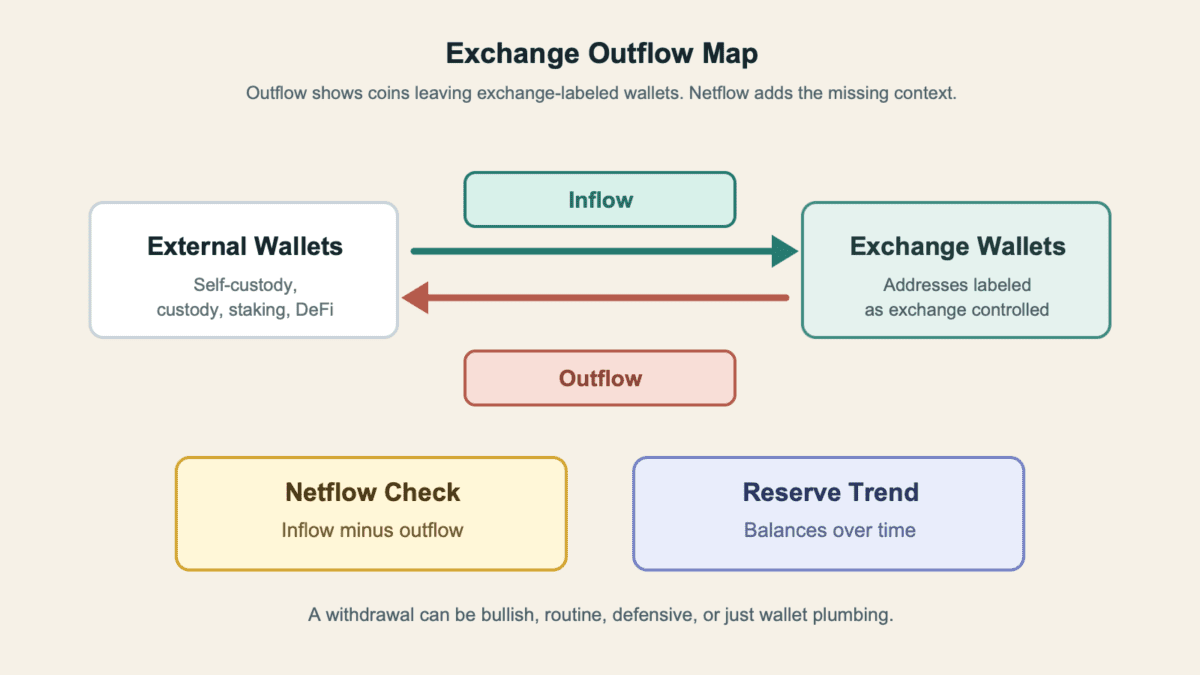
Exchange netflow usually beats raw exchange outflow because it includes the deposit side. A large withdrawal can look bullish until you notice a larger inflow arrived during the same window.
Negative exchange netflow means more of the tracked asset left exchange wallets than entered. Positive netflow means more entered than left. That sign gives a cleaner first read than a single outflow number, though it still needs confirmation.
The cleaner workflow is simple. Check outflow, check inflow, then check netflow and reserves before attaching a market story. If reserves keep falling across several periods while netflow stays negative, the signal has more weight than one withdrawal spike.
Exchange outflows happen for many reasons, and several have nothing to do with an imminent price move. The same transfer path can reflect calm self-custody, institutional settlement, DeFi activity, or fear after an exchange scare.
The most ordinary reason is wallet custody. Many users buy on a centralized exchange and then move coins to their own wallet because they do not want to keep long-term holdings on a venue account. That is where crypto wallets become part of the flow story, not just a security preference.
Other exchange outflows come from professional market structure. A desk may settle an OTC deal. A fund may move coins to a custodian. An exchange may shift inventory between hot wallets, cold wallets, and operational addresses.
Common reasons include:
ETH deserves special care. ETH exchange outflow can mean self-custody, but it can also mean staking, liquid staking, DeFi collateral, treasury movement, or validator-related routing. That makes the signal less clean than “coins went cold.”
Risk response is another important case. If users withdraw after an exchange hack, lawsuit, liquidity rumor, or withdrawal freeze, the outflow may show fear. That can be defensive behavior, not accumulation.
Keep the claim modest. Exchange outflow tells you where coins moved, not why they moved. The reason comes from venue concentration, asset type, news context, reserve trend, and whether deposits elsewhere offset the move.
Exchange outflow can look bullish when it supports a broader accumulation picture. The strongest version is not one huge withdrawal. It is sustained negative exchange netflow, falling exchange reserves, rising spot demand, and price action that confirms buyers are absorbing supply.
For Bitcoin, a persistent Bitcoin exchange outflow can suggest holders are moving coins away from trading venues. If that pattern appears across several major exchanges while spot demand improves, it can support a possible bottom signal or a longer accumulation read.
The signal improves when the market context agrees:
That checklist keeps the signal honest. Reduced exchange supply can help, but buyers still need to show up. A market can have lower exchange balances and still fall if demand fades, crowded positioning unwinds, or macro news knocks risk assets around.
Check the denominator next. A large BTC exchange outflow from a major venue may be meaningful if it is large relative to that venue’s exchange balance and appears in the reserve trend. The same headline can be weaker when it is tiny compared with daily spot volume.
Check breadth too. Outflow from Coinbase alone tells a narrower story than outflow across Coinbase, Binance, Kraken, and OKX-style venues. A broad pattern reduces the chance that you are only seeing one custodian, one treasury wallet, or one exchange’s housekeeping.
The phrase “supply shock” should earn its keep. Falling reserves can tighten available sellable supply, especially in BTC. But a true market squeeze also needs demand, liquidity pressure, and fewer offsetting inflows. Otherwise, the headline is mostly fuel for bullish accounts.
Exchange outflow misleads traders when a chart gets treated as a trade setup before the context is checked. A big withdrawal bar is not a trading plan. It is a prompt to ask better questions.
One-exchange events are the classic trap. If most of the outflow comes from one venue, it may reflect internal wallet maintenance, a custody move, a large customer withdrawal, or exchange-specific stress. That is weaker than broad outflow across several venues.
One-day spikes are another problem. A single large movement can disappear inside the next netflow update if fresh deposits arrive elsewhere. It can also be revised after providers improve wallet labels.
Data quality can distort the read:
Panic withdrawals need their own warning label. If users pull coins after a hack, legal action, withdrawal rumor, or solvency concern, outflow can show fear. That may reduce exchange balances, but it does not automatically create bullish demand.
Stablecoins can also flip the usual story. If USDT or USDC leaves spot exchanges, that can mean dry powder moved away from trading venues. It may reflect custody, chain migration, or rotation, but it is not the same as BTC leaving for cold storage.
Altcoins add another wrinkle. A token may show exchange outflow on one centralized venue while most real liquidity sits on a DEX, another chain, or a market maker’s route. In that case, the exchange chart captures only part of the market.
Derivatives markets can muddy the read as well. A trader may move assets for collateral, margin, hedging, or risk management while the spot market tells a different story. That is why funding, open interest, and liquidation pressure belong beside flow data.
The weak version of the signal is easy to spot. It usually says “huge outflow” without showing inflow, netflow, reserves, venue mix, price reaction, or volume. Buying that kind of headline can turn you into someone else’s exit liquidity.
So ask what the chart does not show. If the missing context is doing most of the work, the signal is not ready to guide a trade.
Exchange outflow data is most useful when you read it as a sequence, not as one screenshot. Choose the asset, choose the window, compare both flow directions, then test the market reaction.
Start with the provider method. On June 20, 2026, CoinMarketCap showed 947 active exchanges in its live market snapshot, a useful reminder that exchange outflow coverage depends on which venues and wallet labels a dashboard tracks.
A repeatable process helps:
That order prevents the easiest mistake: seeing coins leave and assuming sellers vanished. Sellers can still hold coins elsewhere, use OTC routes, return assets later, or sell through another venue.
Timeframe also changes the message. An hourly outflow may be noise. A multi-week reserve decline across major venues carries more weight, especially when spot demand and volume agree.
The denominator check belongs here too. Compare the outflow with daily spot volume, exchange reserves, and the asset’s usual flow range. A number that looks huge in a social post may be ordinary when set beside the asset’s normal exchange activity.
Match asset coverage too. Some dashboards cover spot exchanges, while others mix broader exchange labels. Some split spot and derivatives. Some update labels faster than others. If you compare CoinGlass, CryptoQuant, Glassnode, Santiment, Arkham, and CoinMarketCap-style views, match the definitions before comparing the numbers.
Then look for concentration. If one exchange explains the entire move, ask whether there was a venue-specific event. If several major venues show the same pattern, the signal becomes harder to dismiss.
The final check is price response. If exchange outflow rises while price breaks down on weak demand, the market is telling you the withdrawal did not save the chart. If outflow rises while price holds support, volume improves, and reserves keep falling, the signal deserves more attention.
Use live dashboards carefully. Screenshots age fast, labels can revise, and a daily candle can change before the period closes. If you are making a trade, reopen the source instead of relying on the post that found you.
Exchange outflow examples change by asset type because users move BTC, ETH, stablecoins, and small-cap tokens for different reasons. Treating every withdrawal as the same signal is how useful data turns muddy.
Use asset type as your first filter:
| Asset Type | What Exchange Outflow May Mean |
|---|---|
| Bitcoin | Cold storage, long-term holding, institutional custody, OTC settlement, or lower immediate sellable supply. |
| Ethereum | Self-custody, staking, liquid staking, DeFi collateral, treasury movement, or custody routing. |
| Stablecoins | Buying power leaving exchanges, capital moving to another chain, or sector rotation. |
| Major Altcoins | Whale positioning, exchange-specific liquidity movement, market-maker routing, or custody changes. |
| Meme Coins And Small Caps | Noisy CEX data because DEX liquidity and wallet clustering can dominate the market. |
BTC exchange outflow gets the cleanest bullish treatment because Bitcoin has a strong cold-storage culture and deep on-chain monitoring. Even then, the signal still needs netflow and reserve confirmation.
Large Bitcoin withdrawals can also reflect institutional custody. Coins may move from an exchange address to a custodian or cold-storage setup after a purchase, ETF-related activity, or OTC settlement. That can reduce exchange-held balances without proving a new wave of public buying.
ETH exchange outflow is more flexible. ETH can leave an exchange and move into staking, liquid staking tokens, DeFi collateral, cold storage, or a custodian. That means the outflow may reduce exchange-held supply without pointing to the same long-term holding behavior as BTC.
For ETH, the follow-up question is usually destination-based. Did the coins move toward staking infrastructure, a DeFi protocol, a custody address, or a fresh wallet? The answer changes the read more than the withdrawal label alone.
Stablecoin outflow can be the opposite of bullish for crypto prices. If stablecoins leave exchanges, immediate buying power may be moving away from spot venues. Sometimes that reflects crypto rotation into another chain, sector, or venue. Sometimes it just means capital is stepping back.
Altcoins need the most caution. A large outflow from one exchange can be important if that venue holds most of the asset’s liquidity. For a small token with active DEX markets, CEX outflow can miss the real trading arena.
That is why asset type should come before interpretation. A BTC reserve decline, an ETH staking move, and a stablecoin withdrawal can all look like exchange outflow. They do not all tell the same story.
Exchange outflow means different things for holders and traders. Holders usually care about custody and risk. Traders care about whether flows support a market setup.
For holders, withdrawing coins can reduce exchange counterparty risk. But it replaces venue risk with wallet-security risk. Lose a seed phrase, approve a malicious contract, or send to the wrong network, and the chain will not undo it.
Before moving funds, check the basics:
For traders, exchange outflow belongs beside other evidence. Negative netflow may support a long setup, but it should not create one by itself. Price structure, volume, liquidity, perp positioning, and news still decide whether the signal is worth acting on.
Ask different questions by role. A holder asks, “Where should this asset live, and can I protect it there?” A trader asks, “Does this flow confirm the setup I already see?” Mixing those questions can lead to bad custody moves and bad trades.
Portfolio size changes the risk. A small test withdrawal is a learning step. Moving a large balance in one transaction because a social feed got loud is operational risk dressed up as urgency.
Your position size should not grow just because a dashboard color changed. Use exchange outflow as a confirmation layer. If your setup already has support, volume, and clean risk, outflow can add context. If the setup is weak, the flow chart should not rescue it.
Exchange outflow connects to several trading and custody ideas, but the useful links are the ones that sharpen the next check. The main cluster is flow direction, market timing, wallet safety, and crowd behavior around headlines.
A top signal is the mirror image to many bullish outflow stories. Heavy deposits, rising reserves, and weak price reaction can suggest supply is moving closer to sale instead of away from it.
Exchange outflow can also test a conviction play. A real thesis should already have reasons beyond one wallet chart. Outflow can confirm or challenge those reasons, but it should not replace them.
Exit liquidity is the risk concept behind bad flow headlines. If a crowd buys only because a withdrawal screenshot looks bullish, smarter sellers may get the liquidity they wanted.
Wallet custody sits on the practical side. Many outflows are boring by design: users buy coins, move them away from exchanges, and stop touching them. Boring can be good. It just should not be mistaken for a guaranteed market move.
The concept to keep is simple. Exchange outflow can support a market read, but it works best as one input in a larger check. It is not a crystal ball with a wallet label, regardless of how confidently the chart is posted.
Exchange outflow means crypto moved out of exchange-labeled wallets into external wallets. It can point to self-custody, custody transfers, staking, DeFi use, OTC settlement, or reduced immediate sellable supply.
Exchange outflow can be bullish for Bitcoin when it is sustained, broad across exchanges, paired with falling reserves, and confirmed by stronger spot demand. One BTC withdrawal headline is not enough.
Exchange outflow counts assets leaving exchange wallets. Exchange netflow compares inflow and outflow during the same period, often using inflow minus outflow.
Exchange outflow can mean investors are scared when withdrawals follow exchange stress, legal trouble, hacks, liquidity rumors, or withdrawal concerns. In that case, the signal may show risk aversion, not accumulation.
ETH exchange outflow does not always mean the same thing as BTC exchange outflow. ETH can leave exchanges for staking, liquid staking, DeFi collateral, treasury use, custody, or self-custody.
You should not trade based on exchange outflow alone. Check netflow, reserves, price action, spot volume, liquidity, funding, open interest, stablecoin flows, and the news catalyst first.
Start with the definition, then slow the trade down. Exchange outflow means coins left exchange wallets. It does not mean price must rise.
Use this quick workflow when a chart or post catches your eye:
Then decide what kind of question you are answering. A custody question asks where the coins should live and whether you can protect the wallet. A trading question asks what would invalidate the setup and how much risk belongs on the trade.
Mixing those questions is where a useful chart starts doing unpaid theater. Good exchange outflow analysis slows the reaction down before money moves.
If you are a holder, focus on safe wallet handling before copying anyone’s withdrawal behavior. A correct self-custody move starts with small tests, recovery discipline, and the right network.
If you are a trader, write down what would prove the outflow signal wrong before entering. Maybe price loses support. Maybe inflows offset the withdrawal. Maybe reserves stop falling. That line keeps a useful signal from becoming a story you keep defending.
If you are just learning, compare several recent examples without trading them. Pick one BTC chart, one ETH chart, and one stablecoin chart. Note how each asset reacts differently when coins leave exchange wallets.
If you are a trader, use exchange outflow as supporting evidence. The signal is useful when it joins a cleaner setup. It is dangerous when it becomes the setup.