Physical Address
304 North Cardinal St.
Dorchester Center, MA 02124
Physical Address
304 North Cardinal St.
Dorchester Center, MA 02124


The shared L2 ordering layer, without the fog machine.
A shared sequencer is a transaction-ordering layer used by multiple rollups instead of each rollup relying only on its own sequencer.
That sounds like infrastructure plumbing, because it is. But this pipe sits close to the money. Ordering affects speed, censorship risk, outages, MEV, cross-rollup coordination, and who may earn fees from activity across L2s.
A shared sequencer does not merge every rollup into one chain. Each rollup can still keep its own execution rules, bridge design, data path, liquidity, and settlement process. The useful question is narrower: what improves when several rollups use one ordering layer, and what new dependency appears?
A shared sequencer in crypto is a common ordering layer for more than one rollup. A normal rollup sequencer receives transactions for one rollup, puts them in order, and helps the rollup create a fast local experience before deeper settlement arrives.
The shared version extends that ordering role across several rollups. Think of it as one clock used by multiple L2s. The clock can help related transactions line up, but it does not execute every app, hold every asset, or turn several chains into one balance sheet.
That boundary keeps the term useful. Shared sequencing is about transaction order. It is not a wallet, exchange, bridge, token category, or magic interoperability sticker.
Otherwise, one neat label starts absorbing the whole rollup stack.
Keep the definition clean:
So the word “shared” is doing a specific job. Several rollups can rely on a common ordering service without sharing one execution engine, liquidity pool, security model, or emergency exit.
That is the user-facing value. The shared sequencer may improve timing across rollups, but the assets, apps, bridges, and rules around those transactions still need their own checks.
A shared sequencer changes rollup control by moving part of the ordering job away from one rollup-specific path. That path makes apps feel quick, but it can concentrate control over inclusion, timing, liveness, fee policy, and MEV handling.
Start with the ordinary rollup flow. You submit a transaction to an L2. The rollup sequencer receives it, places it in order, and gives the app a quick result. Later, data, proofs, commitments, or settlement steps move through the rollup’s deeper path.
That first step is powerful. If the sequencer stalls, the app may stop feeling instant. If the sequencer excludes a transaction, the user may need a slower fallback. If ordering decides who wins a liquidation or arbitrage route, the sequencer sits close to economic value.
Now add fragmentation. Rollup A has its own ordering path. Rollup B has another. Rollup C has a third. A user may want to swap on one L2, bridge or message to another, then complete a trade somewhere else. Independent clocks make that harder.
A shared sequencer tries to give several rollups one ordering reference. That can help with timing-sensitive actions that touch more than one rollup.
Useful examples are easy to picture:
The appeal is coordination. The risk is dependency. If one shared layer serves many rollups, its failure can affect more than one network at once.
Shared sequencer, normal sequencer, decentralized sequencer, and based sequencing describe different ways to answer the same question: who orders rollup transactions before final settlement catches up?
A normal per-rollup sequencer serves one rollup. A decentralized sequencer spreads that job across multiple participants for one rollup or design. A shared sequencer serves more than one rollup. Based sequencing leans on the base layer’s proposer or validator path.
The comparison helps before the acronyms start breeding.
| Model | Plain-English Tradeoff |
|---|---|
| Per-rollup sequencer | Fast and simple for one rollup, but the operator can become the main ordering gate. |
| Decentralized sequencer | Spreads ordering control, but adds coordination, incentives, and launch complexity. |
| Shared sequencer | One ordering layer can serve several rollups, but it becomes shared infrastructure. |
| Based sequencing | Ordering leans toward the base layer, but latency and preconfirmation design get harder. |
| Shared mempool | Transactions may sit in a common pool, but that is not the same as shared final ordering. |
Based sequencing needs a small naming warning. It is technical rollup language, not Coinbase’s Base chain and not the same as based crypto slang. It describes where ordering authority comes from, not whether an app is culturally “based” or deployed on Base. Protocol naming remains an endurance sport.
Shared mempool language needs the same care. A common mempool can expose or route transactions before ordering, but the mempool does not automatically decide final order. That final ordering rule is where censorship risk, priority fees, MEV policy, and fallback design become concrete. If a project uses one of these labels, ask which transactions are ordered, who can participate, what users can verify, and what happens if the normal path fails.
A shared sequencer works by taking transactions from multiple rollups and producing a common order before each rollup handles its own execution and settlement path. The common order is the shared part. The rest of the rollup stack does not vanish.
Picture two users. One submits a trade on Rollup A. Another submits a related action on Rollup B. Instead of both rollups relying only on separate clocks, the shared sequencing layer can place those transactions into one ordered sequence.
The basic flow looks like this:
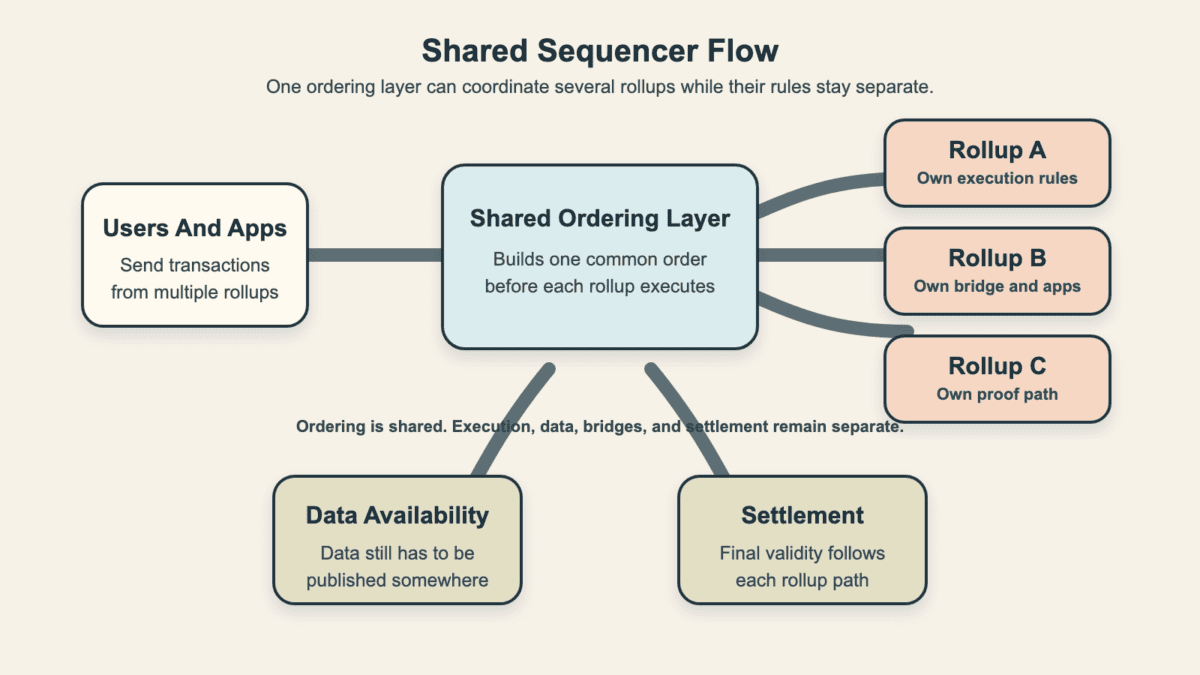
Ordering decides sequence. Execution applies transactions to state. A shared sequencer can say which transaction comes first, but Rollup A and Rollup B still process transactions according to their own execution rules.
That distinction prevents a big misunderstanding. A shared sequencer does not automatically make an app on one rollup read balances from another rollup as if both lived in one database. It can help coordinate related actions, but the rollups still need messaging, bridging, liquidity, or app logic to make cross-rollup activity useful.
Shared ordering does not remove the data problem. Rollups still need transaction data, state commitments, or proofs to be available through their chosen data and settlement design.
If a rollup uses Ethereum blobs, a separate data availability layer, or another publication route, that choice remains separate from the shared sequencer. Users still need to know where data lives and how it can be checked.
Each rollup keeps its own contracts, upgrade controls, bridge assumptions, fees, and failure behavior. Shared sequencing can coordinate the order, but it does not standardize every rule underneath.
The best shared-sequencer explanations separate ordering from execution, data availability, settlement, bridge logic, and liquidity. Boring is useful here. It keeps one shiny term from covering five different risks.
A shared sequencer can improve L2 use by giving several rollups a common ordering layer. That can make cross-rollup coordination easier, reduce duplicated infrastructure, and improve some timing-sensitive actions.
The strongest user benefit is not abstract architecture. It is better coordination when activity touches more than one rollup. A shared order can help apps reason about which action came first across connected L2s.
That can be useful for intents, cross-rollup swaps, app chains, bridge-like routes, and systems that need predictable timing. But every upside has a condition attached.
| Possible Improvement | What Must Also Be True |
|---|---|
| Better cross-rollup timing | The rollups and apps must actually use the shared order. |
| Less duplicated infrastructure | The shared layer must be reliable enough for several rollups. |
| Stronger censorship resistance | The operator set must be diverse, public, and meaningfully accountable. |
| Faster coordination | Wallets, bridges, and apps must support the flow users expect. |
| Better MEV design | Fair ordering, privacy, auction, or solver rules must be explicit. |
The pattern is the same across the table. Shared sequencing creates an opening for better UX. It does not deliver the whole result by naming itself.
For a normal L2 user, the practical upside may show up as fewer failed timing assumptions, smoother cross-rollup routes, or more predictable inclusion. For a builder, it may reduce the burden of creating a rollup-specific sequencer from scratch.
For a trader, the benefit depends on execution details. A common order can help related trades coordinate across venues. It can also make the ordering market more competitive. The word “shared” does not decide who wins.
A shared sequencer does not fix every rollup risk. It improves the ordering layer only when the design works as promised, and it leaves many other boundaries untouched.
A shared sequencer does not automatically merge liquidity. It does not replace every bridge. It does not remove smart-contract risk, wallet-signing risk, data availability risk, governance risk, or settlement delay. It also does not make every rollup use the same security assumptions.
Use this boundary check before trusting interoperability claims.
| Claim | Reality Check |
|---|---|
| One shared order makes one chain | Rollups can share ordering while keeping separate execution and settlement. |
| Bridges disappear | Asset movement, messages, proofs, and liquidity still need their own systems. |
| MEV goes away | Fair ordering requires specific rules, not just shared infrastructure. |
| Wallet risk is solved | Users still need safe signing habits and custody tools. |
| Every token captures value | Fee rights, governance, and tokenholder value are separate questions. |
Wallets are a good example of the boundary. A shared sequencer can affect when your transaction lands, but it does not protect you from signing a bad approval. Good crypto wallets can help with custody, but they do not remove rollup ordering risk.
Bridge claims need the same discipline. Shared sequencing can support faster or safer coordination for some cross-rollup actions. It still needs bridge contracts, message verification, liquidity, and settlement logic. If any of those parts fail, the shared order alone will not rescue the route.
The clean split is simple. Shared sequencing helps with who goes first. Bridges help assets or messages move. Data availability helps others check data. Settlement gives final validity. Liquidity decides whether your exit price is friendly or hostile.
Shared sequencer MEV risk comes from the same place as its benefit: a common order across several rollups can make timing more valuable. More coordination can mean better routes, but it can also create a larger field for searchers and bots.
Take a simple example. A token trades at different prices on Rollup A and Rollup B. A searcher wants to buy on one side and sell on the other. If the shared sequencer can coordinate related actions, the opportunity may become easier to execute.
That does not mean the user gets a better price by default. A recent arXiv paper modeled atomic execution across two Constant Product Market Maker liquidity pools and four possible swap-outcome states, then warned that atomic execution alone is not enough to guarantee better arbitrage profit extraction in shared sequencer designs. The caution is useful because it punctures the easy marketing line.
Fair ordering depends on design choices. The important details include:
In rough markets, this can feel like PVP trading because bots, searchers, wallets, solvers, and venues all compete around timing. Shared sequencing can change the battlefield. It does not make the battlefield polite.
The warning is not that shared sequencers are bad. The warning is that “shared” and “fair” are different words. The system still needs clear rules for priority, privacy, auctions, and revenue.
For users, the practical defense stays boring: use reasonable slippage, avoid large trades on thin routes, test new bridges in small size, and avoid assuming a new sequencing design protects every transaction. If your trade depends on perfect timing, the order layer is part of the trade.
Shared sequencer fees attract investors because ordering can become a business model. If several rollups use one ordering layer, there may be fees from users, rollups, searchers, operators, or apps that need guaranteed timing.
The hard part is finding who captures that value. Users may pay fees to an L2. Rollups may pay for ordering service. Searchers may bid for valuable order flow. Operators may earn rewards. A foundation, DAO, company, or token model may sit somewhere in the middle.
Those flows can become a market story before they become clear cash flow. That is where crypto meta risk enters. A real infrastructure trend can still produce sloppy token claims.
Ask these questions before treating shared sequencing as an investment catalyst:
The gap between protocol revenue and tokenholder value can be wide. A shared sequencer might be useful infrastructure while its public token, if one exists, captures little. Or it might route fees to operators without giving ordinary holders a direct claim.
Late buyers can become exit liquidity when the narrative moves faster than the rights. That is not a prediction. It is a reminder to read the fee path before the chart tells you a bedtime story.
For ETH holders, shared sequencing may change where ordering value, data costs, and rollup fees flow. That is a mechanism question before it is a price opinion.
Who runs a shared sequencer determines how much trust sits inside the shared ordering layer. A shared layer can reduce isolated rollup dependence, but it can also become a common failure point if the operator set is weak.
Operator design can vary. Some systems may start with a permissioned set. Some may use staking, slashing, committees, rotating leaders, or governance-controlled membership. Some may describe a permissionless path that is not fully live yet.
That makes the current operator set more important than the roadmap. A serious claim should explain who can order transactions today, how leaders are chosen, what users can verify, and what penalties exist for failure or misbehavior.
Run this checklist before trusting a shared sequencer:
Failure does not need to be dramatic. The shared sequencer can slow down, censor certain transactions, suffer operator coordination problems, publish data late, expose weak client diversity, or route users toward clumsy fallback paths.
The shared part cuts both ways. If the design is strong, many rollups may benefit. If the design is weak, many rollups may inherit the same problem.
You check a shared sequencer claim by separating live infrastructure from roadmap language. The most useful evidence is usually dull: active integrations, operator lists, fallback rules, public MEV policy, and clear data publication paths.
Start with the rollups. Which ones actually use the shared sequencer in production? A demo, testnet, integration announcement, or investor memo does not carry the same weight as live ordering for real user transactions.
Then inspect control. A shared sequencer can sound decentralized while still relying on selected operators, upgrade keys, or permissioned participation. That may be fine for an early system, but users should price it honestly.
Use this checklist before bridging, trading, building, or buying the narrative:
The strongest answers are concrete. They name live rollups, operator rules, failure behavior, and user-facing fallback routes. The weakest answers hide inside “coming soon,” “aligned incentives,” or “next-generation interoperability” language.
Also check the user surface. If the shared sequencer works only for builders while wallets and bridges still feel fragmented, normal users may not see much benefit yet.
Shared sequencer related terms overlap, but they are not synonyms. Most confusion starts when ordering, execution, data availability, bridges, and settlement get shoved into one rollup bucket.
A normal sequencer orders transactions for one rollup. A shared sequencer orders transactions for multiple rollups. A decentralized sequencer spreads ordering control across multiple participants. Based sequencing leans more directly on the base layer for ordering.
Data availability asks whether transaction data can be accessed and checked. Settlement is where final validity, dispute resolution, or proof acceptance happens.
Bridge language creates another trap. A bridge moves assets or messages between chains or layers. Shared sequencing can help timing, but it does not replace bridge contracts, liquidity paths, or proofs.
If you need the slang side of the naming mess, based in crypto is the separate CT-language detour. If the question is where rollup data gets published, blobspace explains one Ethereum-specific data lane that is separate from sequencing.
Sequencing rights are the broader economic idea. They describe who gets to order transactions and possibly capture value from that order.
Shared mempool is nearby but different. A shared mempool can mean transactions are visible or routed through a common pool before ordering. A shared sequencer is the system that produces the order. Same neighborhood, different door.
When vocabulary gets noisy, return to the user action. The relevant term is the one that can change your inclusion, timing, finality, custody, liquidity, or fee exposure.
A shared sequencer in crypto is a transaction-ordering layer used by multiple rollups. It can help those rollups coordinate activity, while each rollup keeps its own execution rules, bridge design, data path, and settlement process.
No. A normal sequencer usually orders transactions for one rollup. A shared sequencer orders transactions for several rollups. That may improve coordination, but it can create a common dependency.
Not by itself. A shared sequencer can be centralized, permissioned, partially decentralized, or more open. Check the operator set, governance, staking rules, fallback paths, and live integrations before trusting the label.
A shared sequencer cannot stop MEV by default. It can change how MEV appears across rollups, but fair ordering depends on rules such as encrypted mempools, auctions, solver design, rebates, or governance controls.
No. A shared sequencer can help coordinate timing across rollups, but bridges still handle assets, messages, liquidity, proofs, and user exits. It does not erase bridge risk by itself.
If a shared sequencer goes down, affected rollups may slow, pause, queue transactions, or switch to fallback routes. Check whether users can force inclusion, withdraw, or keep using a rollup-specific path during failure.
Start with shared sequencer claims by checking what is live, who runs it, and what happens when it fails. Do that before you bridge serious funds, route a large trade, build on the system, or buy into the infrastructure story.
Use a short routine:
Then match the risk to the action. A small test swap can tolerate more uncertainty than a large bridge move. A token thesis needs more proof than a clean diagram.
Shared ordering can be useful. It can make rollups coordinate better and reduce some isolated control points. But the useful version is the one you can verify, not the one that sounds best in a pitch deck.
For users, that means testing the route before relying on it. Send a small transaction, then check whether settlement or withdrawal behaves the way the interface implies.
For investors, start with rights and cash flow instead of slogans. If the shared sequencer earns fees, find who receives them, whether any token has a claim, and whether that claim is live or only future-tense marketing.
If those answers are vague, reduce the amount at risk.


