Physical Address
304 North Cardinal St.
Dorchester Center, MA 02124
Physical Address
304 North Cardinal St.
Dorchester Center, MA 02124


Shared security, restaking, and token risk explained.
Shared security is a blockchain design where one network, validator set, or staked asset pool helps secure other chains or services.
You will usually hear it around rollups, Polkadot parachains, Cosmos provider security, EigenLayer restaking, AVSs, and data availability layers. The phrase sounds like a safety blanket. In use, it means security assumptions are being reused or exported.
That can help a smaller chain or service avoid building trust from zero. It can also connect risks that users expected to be separate. Before you stake, buy, bridge, or hold a liquid restaking token, ask three things: what is being shared, who operates it, and who can lose money?
Shared security in crypto means a smaller chain or service can rely on a larger security base instead of building every protection layer alone. That base may be a blockchain, a validator set, a pool of staked assets, or operators who accept extra duties.
The term does not mean shared private keys, shared wallet passwords, or generic wallet security. If someone says a project has shared security, they are talking about architecture and economic protection, not whether your seed phrase is safely stored.
You can spot the idea by asking three plain questions:
Ethereum rollups may rely on Ethereum for settlement or data paths. Polkadot parachains connect to Relay Chain security. Cosmos chains can use provider security models. EigenLayer lets restaked assets help secure AVSs. These ideas share a theme, but each route moves risk differently.
For a beginner, the mistake is assuming the biggest named chain protects everything equally. A rollup using Ethereum is not the same as a restaking service using operators, and neither is the same as a parachain slot or a Cosmos provider-security setup.
Turn the phrase into a map. A shared security claim is useful only when you can name the provider, the consumer, the collateral, the operator set, and the punishment path. Otherwise, it is marketing with a technical accent.
Shared security works by connecting a security provider to a consumer chain or service through validators, operators, collateral, rewards, and penalties. The consumer starts with a stronger trust base. The provider takes on extra duties, economic exposure, or both.
The provider can be a base layer like Ethereum, a shared validator system like Polkadot, a provider chain in Cosmos, or a restaking market like EigenLayer. The consumer can be a rollup, appchain, parachain, data service, oracle, bridge service, or AVS.
Here is the basic checklist behind the model:
| Part Of The Model | What Users Should Check |
|---|---|
| Security Provider | Which chain, validator set, or asset pool backs the service. |
| Consumer Service | What chain, app, AVS, or data layer is borrowing that security. |
| Collateral | Which asset can be staked, locked, allocated, or punished. |
| Operator Or Validator Set | Who runs the software and how concentrated that group is. |
| Punishment Path | What behavior can cause slashing, jailing, ejection, or loss. |
| Reward Source | Who pays rewards and whether they come from fees, incentives, or tokens. |
| Exit Path | How users withdraw, unbond, sell, or move the position. |
The table is tidy. Real routes rarely stay that neat. One dashboard can hide staking contracts, operator delegation, LRT wrappers, bridge routes, governance controls, and withdrawal queues.
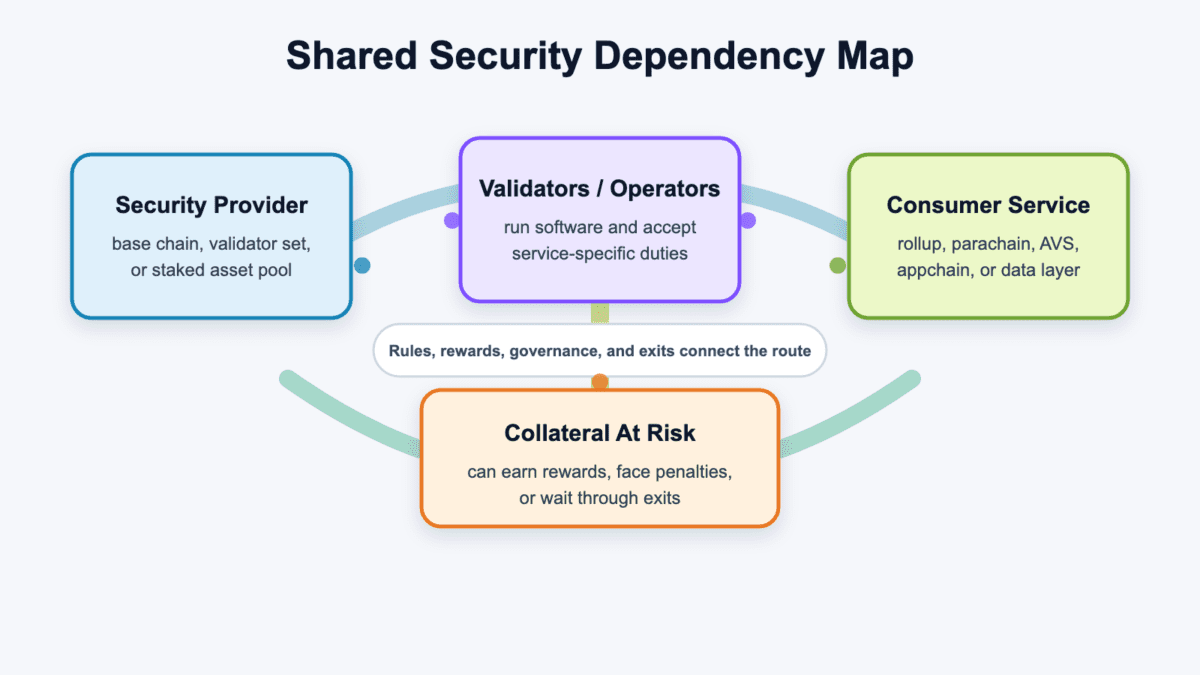
Borrowing security does not remove risk. It moves trust into another layer, then asks users to understand that layer. That can be useful when the provider is strong and the rules are clear. It gets dangerous when the words are cleaner than the contracts.
Main shared security models differ by what gets shared and who can be punished. Some share settlement guarantees. Some share validator work. Some share staked collateral. Some share data availability assumptions.
That is why the phrase can confuse users. A rollup, parachain, provider-secured Cosmos chain, and restaking AVS can all use shared security language while exposing holders to different risks.
| Model | What Shared Security Means There |
|---|---|
| Ethereum Rollups | A rollup runs transactions elsewhere, then uses Ethereum-linked settlement, proofs, or data paths to anchor trust. Users still need to check sequencer, bridge, and withdrawal assumptions. |
| Polkadot Parachains | A parachain uses the Relay Chain validator set and pays for access through mechanisms such as coretime. DOT staking, validation, and chain access all shape the security story. |
| Cosmos Provider Security | A consumer chain can receive security from a provider chain such as Cosmos Hub. Partial Set Security can make participation more selective, so validator costs and reward flow matter. |
| EigenLayer Restaking And AVSs | Restaked assets and operators can secure extra services. Rewards may rise, but slashing and operator exposure can become more complex. |
| Data Availability Layers | A rollup or chain may rely on another layer to publish or retrieve data. If data is unavailable, verification and exits can become harder. |
Bridges are the clean contrast. A bridge moves assets or messages between systems. It does not automatically mean both systems share the same security budget or punishment rules.
That distinction keeps marketing from blurring the risk. A project can connect to a famous chain without inheriting every part of that chain’s safety. The actual protection depends on settlement, validation, data, collateral, exits, and governance.
Shared security and restaking overlap, but they are not the same thing. Restaking is one way to create shared security by letting already-staked or liquid-staked assets back extra services.
EigenLayer is the common Ethereum example. A user can restake eligible assets or delegate through a route. Operators perform work for AVSs. The AVS defines tasks, rewards, and possible penalties. Liquid staking tokens and liquid restaking tokens can add another layer on top.
Restaking adds several moving parts at once:
That is why restaking rewards can feel close to farming rewards. The user sees extra yield, points, or campaign incentives. Underneath, the route may include a much longer list of failure points.
The simple split is this: shared security is the umbrella, and restaking is one branch. If an app, article, or token pitch treats the two as exact synonyms, slow down. The plumbing may still be solid, but the explanation is already cutting corners.
This also helps with LRTs. A liquid restaking token may look like one wallet asset, yet it can depend on ETH staking, an LST route, a restaking protocol, an operator, one or more AVSs, and secondary-market liquidity. That stack can work, but it deserves a stack-sized risk check.
Shared security can affect token value, but it does not create automatic upside. A base asset may become more useful if more systems need its security, fees, collateral, or staking market. The token still needs a clear path to value capture.
For ETH, the shared security story usually appears through rollups, settlement, data, restaking, LSTs, LRTs, and EigenLayer-style services. More demand for ETH-backed security can support the thesis, but the holder still has to separate ETH exposure from LRT exposure, governance-token exposure, and restaking reward exposure.
For ATOM and DOT, the question is value flow, not ecosystem loyalty. Do provider-security rewards reach stakers? Do consumer chains create recurring demand? Does coretime or chain access create durable DOT use? Do validator costs make participation practical?
| Token Exposure | Question To Ask |
|---|---|
| ETH | Is demand tied to settlement, restaking collateral, fees, or short-term incentives? |
| LST Or LRT | What extra route, operator, redemption, bridge, or depeg risk sits under the token? |
| ATOM | Do consumer-chain rewards and provider-security economics reach stakers in a meaningful way? |
| DOT | Does shared validation, staking, and coretime demand create clear recurring use? |
| Consumer-Chain Token | Does the token capture fees, governance power, or only market attention? |
Shared security can also become a market narrative before the economics are proven. That does not make the trade fake. It means price can move on a story faster than fees, rewards, and usage can validate it.
If shared security is part of your conviction play, write down the value path in one sentence. “More chains use this asset for security, so more demand reaches holders through X” is a thesis. “Shared security is hot” is a group chat with a gas fee.
Shared security risks start when one security source supports several chains or services. The model can make smaller systems safer, but it can also connect slashing, liquidity, smart contract, operator, and governance problems.
Slashing is the clearest risk for stakers and LRT holders. EigenLayer’s slashing overview frames AVS slashing around three gates: the operator is registered to that Operator Set, the strategy is included, and the applicable safety or time delays have passed.
That flexibility can be useful. It also means “Ethereum is secure” is not enough information. You need to know which operator accepted which AVS duties, how much stake was allocated, and what process governs a penalty.
| Risk | What To Check |
|---|---|
| Slashing Risk | Which behavior can punish collateral and whether the user is directly exposed. |
| Smart Contract Risk | Which staking, restaking, bridge, LRT, or middleware contracts hold the route. |
| Operator Concentration | Whether a few operators control most work, keys, monitoring, or delegation. |
| Governance Or Multisig Risk | Who can change rules, pause contracts, upgrade systems, or approve penalties. |
| Liquidity Risk | Whether withdrawals, LRT markets, bridges, or unbonding queues can handle stress. |
| Cascading Risk | Whether one failure can spread through shared collateral, routes, or confidence. |
Cascading risk is easy to overstate, so keep it specific. One AVS failure does not automatically break every connected system. But shared collateral, crowded operator sets, common contracts, or thin LRT liquidity can turn one problem into several exits at once.
Market risk belongs in the same checklist. When restaking or modular infrastructure becomes crowded, late buyers can become exit liquidity for earlier holders. That is not a protocol bug. It is the usual crypto move: good technology, bad entry, painful receipt.
Evaluate a shared security claim by tracing the asset, the operator, the penalty, the reward, and the exit. If you cannot map those five items, you are still reading the pitch, not the risk.
Start with the asset. Are you holding ETH, an LST, an LRT, ATOM, DOT, a consumer-chain token, a governance token, or a reward token? Those are different claims. One may represent collateral. Another may represent a protocol. Another may be pure market exposure.
Also check whether the route can change after you enter. Simple staking can pick up AVS duties, reward tokens, bridge steps, withdrawal queues, or new operator assumptions.
Then check the operating route:
Custody is not glamorous, so it gets skipped until it becomes expensive. If your position involves LSTs, LRTs, reward tokens, or IBC-style movement, make sure your crypto wallets support the chains and token contracts involved.
The last check is position size. Shared security can be a strong design, but no design needs your full portfolio to admire it. A small test position teaches more than a large position you cannot explain under stress.
Shared security sits near several crypto ideas that sound similar but answer different questions. Keep each term attached to the question it actually answers.
Restaking asks whether existing staked assets can secure extra services. Liquid restaking asks whether that exposure can be wrapped into a transferable token. Pooled security asks whether many chains can draw from one shared validator or security source.
A market narrative asks whether attention is moving into a theme before the numbers catch up. A conviction play asks whether your thesis is clear enough to survive a bad week.
Exit-liquidity risk asks who may be selling into your entry when a theme gets crowded. That concept is especially useful when shared security tokens run before fees, rewards, or user demand can prove the case.
Wallet support is the practical end of the map. A position can look fine on paper and still become messy if rewards land on another chain, redemption takes time, or the token has thin liquidity where you need to exit.
The shared security label should help you ask better questions. It should not make you stop asking them.
No. Restaking is one shared security model, but shared security also includes rollups, Polkadot parachains, Cosmos provider security, and data availability designs.
The shared idea is that one security source helps another chain or service. Restaking does that through already-staked or liquid-staked assets, operators, AVSs, and extra reward or slashing rules.
Shared security can make a blockchain safer, but it does not make it automatically safe. The result depends on the provider, implementation, operators, contracts, governance, exits, and liquidity.
A chain can borrow a strong security source and still have a weak bridge, centralized sequencer, unclear upgrade control, or poor token economics. The label is a starting point, not a certificate.
Shared security can affect ETH when systems use Ethereum for settlement, restaking collateral, data-related routes, or economic security. That can support ETH demand, but it does not guarantee price upside.
The exposure changes by route. Holding ETH, staking ETH, holding an LST, using an LRT, and buying a restaking governance token are not the same position.
Shared security can affect ATOM when Cosmos-style provider security creates rewards, fees, demand, or duties for ATOM stakers and validators. The value path still has to be visible.
Check whether consumer chains pay meaningful rewards, whether validators can afford the extra work, and whether reward tokens have real liquidity. Architecture alone does not pay your bills.
Shared security can affect DOT through Polkadot staking, Relay Chain validation, parachain access, and coretime demand. DOT is tied to the security and access model, but value capture depends on usage.
Ask whether chains need the shared security enough to create recurring demand. Also check whether staking, governance, and chain-access mechanics are clear before treating DOT exposure as a simple infrastructure bet.
Yes, shared security can create cascading risk when many services depend on the same collateral, operators, contracts, liquidity routes, or governance controls. One failure can pressure several connected positions.
That does not mean every shared security model is fragile. It means users should map dependencies before chasing yield, buying the token, or assuming one strong base layer protects every layer above it.
Start with shared security by mapping exposure before chasing yield. The strongest models are the ones you can explain without opening six tabs and hoping the dashboard is telling the whole truth.
A good first pass does not need a spreadsheet. It needs names. Name the provider, consumer, asset, operator, reward source, and exit route. If one of those boxes is blank, the position is not ready for size.
Use these checks first:
After that, check whether your actual exposure matches the thesis. Holding ETH is different from holding an LRT. Holding DOT is different from holding a parachain token. Holding ATOM is different from holding a consumer-chain reward token.
Then decide what would prove you wrong. A slashing rule you cannot understand, an operator set you cannot inspect, a reward token with thin liquidity, or an exit route you cannot test should reduce your size. None of those checks require predicting the whole market. They require refusing to buy a black box with nice branding.
If the route still feels vague, keep learning and keep the position small. Shared security can be useful infrastructure. It is not a reason to outsource your risk sense.