Physical Address
304 North Cardinal St.
Dorchester Center, MA 02124
Physical Address
304 North Cardinal St.
Dorchester Center, MA 02124


A practical guide to settlement layers, finality, L2 exits, and bridge risk.
A settlement layer is the blockchain level where transaction results become final enough for other systems to trust and enforce.
You meet the term when an L2 says it settles on Ethereum, when Bitcoin is described as a payment settlement base, or when a token pitch claims a chain will become global settlement infrastructure. The label only earns its keep when the layer can prove a result, enforce it, and give users an exit route when the normal path gets messy.
A settlement layer in crypto is where a blockchain stack accepts transaction results, resolves disputes, and makes withdrawals or state changes enforceable. It is the place other systems point to when they need a stronger answer than “the app says it worked.”
Crypto often splits that work across layers. One system may run the app and update balances. Another may store data. Another may order transactions. The settlement layer is where the final commitment becomes enforceable through proofs, withdrawals, and dispute rules.
The term shows up in several settings:
In each case, the settlement layer is less about speed and more about enforceability. It may not give the fastest screen update, the cheapest transfer, or the cleanest wallet message. It gives other systems a rule-bound place to ask whether a result can be relied on.
The trap is using “settlement layer” as a prestige label. A chain can claim settlement status while still having weak bridge controls, thin liquidity, centralized operators, or unclear exits. The label starts the risk check. It does not finish it.
A settlement layer differs from an execution layer because execution runs the transaction, while settlement makes the accepted result enforceable elsewhere. Execution answers what happened inside the app. Settlement answers what another contract, bridge, chain, or user can rely on.
The difference shows up in timing. A swap can feel complete before the deeper safety path finishes. A rollup sequencer may show your trade quickly. Later, the rollup posts data, commitments, proofs, or withdrawal messages to the settlement layer.
The stack is clearer when each job answers a different question:
| Layer | User Question It Answers |
|---|---|
| Execution Layer | Did the app run my transaction and update balances? |
| Settlement Layer | Can another system rely on this result and enforce exits? |
| Data Availability | Can outsiders see enough data to verify the result? |
| Consensus Layer | Who agrees on the accepted chain history? |
A monolithic blockchain may bundle these jobs together. A modular design may split them across different networks or contracts. Neither model is automatically better for every user. If you bridge into an L2, you need to know where your transaction executes and where your withdrawal settles.
The split also explains why layer diagrams can mislead beginners. They make systems look tidy. Real funds move through contracts, operators, data paths, and waiting periods. A clean diagram may show one settlement box, while your actual withdrawal depends on a bridge contract, an operator path, posted data, and a claim transaction.
Use the terms as a map, not as comfort language. Execution tells you where the activity happened. Settlement tells you where the result becomes enforceable enough for the next system to trust it.
A settlement layer works for rollups by accepting the rollup’s posted results and enforcing the rules that let users challenge, prove, or withdraw from those results. The L2 handles fast activity. The settlement layer handles the stronger guarantee behind it.
Picture a user bridging ETH to an L2, making a trade, and later withdrawing back to Ethereum. The L2 may confirm the trade quickly because its sequencer ordered and executed the transaction. But the withdrawal path may still depend on batches, proofs, challenge windows, bridge contracts, and posted data.
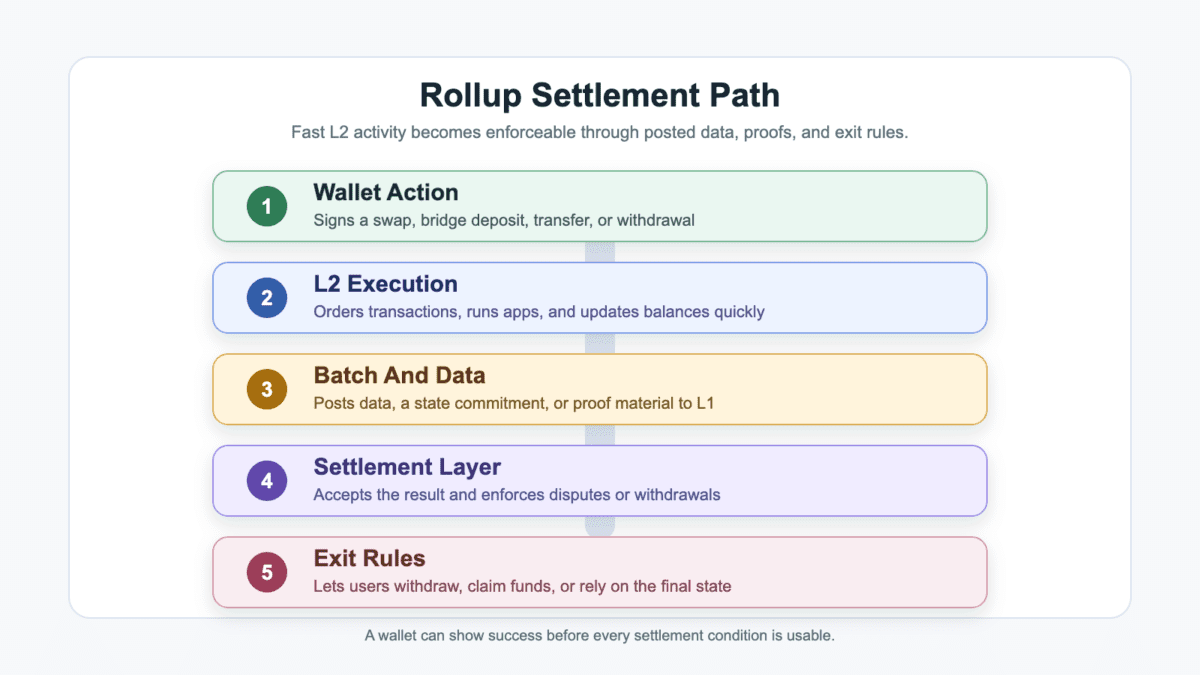
For Ethereum rollups, Ethereum.org frames L2s as separate chains that extend Ethereum and inherit Ethereum security guarantees. The same page, last updated June 4, 2026, notes that Ethereum had reached its current capacity with more than 1 million transactions per day. That inheritance is strongest when the rollup publishes the right data, uses sound proofs or dispute rules, and lets users exit through enforceable contracts.
The main rollup paths differ like this:
| Rollup Type | Settlement Path In Plain English |
|---|---|
| Optimistic Rollup | Assumes batches are valid unless someone challenges them through the dispute process. |
| ZK-Rollup | Uses validity proofs to show that state changes followed the rules. |
Both models can be useful. Neither makes the interface magic. A centralized sequencer can still delay inclusion. A bridge contract can still carry upgrade risk. A proof system can still be young or complex.
This is why “Layer 2 settlement” should make you ask follow-up questions. Where is transaction data posted? Who can force an exit? What happens if the sequencer is offline? Which contract releases funds? A cheaper transaction is nice. A clear exit path is better.
Settlement layer finality means a result is reliable enough for other systems to act on it. It is stronger than a wallet notification, but the exact meaning changes by network design.
Bitcoin finality is usually probabilistic. Confidence rises as more accepted blocks build on top of a transaction. Many proof-of-stake and rollup systems use different finality rules, including validator agreement, validity proofs, or challenge periods. The states can blur, so separate the user-facing label from the actual guarantee:
| Status | What It Means For Users |
|---|---|
| Wallet Confirmation | Your wallet or app sees the transaction in its current view. |
| L2 Acceptance | The rollup or sequencer has accepted the action inside the L2. |
| L1 Posting | Batch data, commitments, or proof material reached the base chain. |
| Settlement Finality | The result is hard enough to reverse under the system’s rules. |
| Withdrawal Finality | You can claim, release, or rely on funds outside the original system. |
Apps expose these stages differently. A bridge may show a source transaction complete while the destination claim still waits. An exchange may show a deposit on-chain before crediting it internally. Fees also affect settlement behavior, and tiny dust balances can become uneconomic to move when base costs are high.
So finality is not one universal stopwatch. Ask what became final, who accepts that finality, and whether your next action depends on a stronger stage.
Settlement layers carry different jobs across crypto systems. Bitcoin, Ethereum, and rollups all use the language, but the user-facing tradeoffs are not the same.
Bitcoin is the cleanest starting point. Its base chain is slower and more expensive than a normal app payment rail, but that is part of the settlement tradeoff. Ethereum shows the rollup version: apps can run on L2s while Ethereum Mainnet acts as the settlement anchor for posted data, commitments, proofs, and withdrawals. The user-facing differences look like this:
| Example | What The Settlement Layer Does |
|---|---|
| Bitcoin And Lightning | Anchors channel open and close activity on the Bitcoin base chain. |
| Ethereum And Rollups | Accepts rollup data, proofs, commitments, and withdrawal messages. |
| Modular Blockchain Stack | Lets execution, settlement, and data availability sit in different places. |
Modular systems add one more twist. A rollup might execute transactions in one environment, settle disputes or proofs somewhere else, and publish data through a separate data-availability layer. That can lower costs or improve capacity, but it moves trust assumptions into more places.
Stablecoins and tokenized assets make the idea less abstract. A transfer may be quick inside one app or venue, but the final record still depends on the chain and contracts underneath. Settlement is the boring part until it breaks. Then it becomes the only part anyone wants to discuss. Know what finality supports in each design: conservative base settlement, rollup settlement, shared security, or modular specialization with extra homework attached.
Settlement layer risks come from the assumptions around finality, not only from the base chain itself. A rollup can rely on a strong L1 and still expose users to sequencers, bridge contracts, upgrade keys, data gaps, and awkward exits.
The phrase “inherits security” needs detail. An L2 may inherit some security from its settlement layer if the data is available, proofs work, contracts are enforceable, and users can exit when operators misbehave. Remove one of those conditions and the claim gets thinner. Before moving meaningful funds, check the exact path your assets use:
Wallet behavior belongs on that list because users often lose funds at the signing step. Good wallet safety habits help you separate the real bridge, the right network, and the contract approval from a fake prompt that looks official enough at 1 a.m. Admin controls need the same plain reading. Upgrade keys and multisigs can protect users during emergencies, but they can also become failure points.
That does not make every bad settlement outcome a hard rug risk. Bugs, downtime, and immature proof systems can hurt users without deliberate theft. Still, the user result can look similar: funds are delayed, trapped, or routed through assumptions nobody read. Test small, verify the route, read the withdrawal terms, and avoid moving size through a system whose exit path you cannot explain.
Being a settlement layer can support token demand, but it does not guarantee token value. The argument depends on fees, security budgets, staking or mining economics, collateral use, and whether real activity pays the base layer.
This is where technical plumbing becomes market theater. A chain may genuinely settle important activity. Traders may still overpay for the token because the phrase “global settlement layer” sounds grand enough to wear a cape. The value-accrual debate usually revolves around a few channels:
Ethereum is the main example because rollups create a visible settlement-layer thesis for ETH. Supporters argue that L2 activity strengthens Ethereum’s role as a security and settlement base. Skeptics argue that cheap L2 fees and competition can weaken direct fee capture. Bitcoin has a different version, where settlement credibility supports the asset story but does not explain every BTC valuation argument.
Investors should separate infrastructure use from market demand. A token can sit under real settlement activity while buyers still become exit liquidity for a stretched narrative. Settlement-layer language can also become a market meta where many projects borrow the same pitch, so ask who pays fees, which asset captures value, what subsidies are hiding activity, and whether users need the token at all.
Settlement layer examples show up whenever fast activity depends on a slower or stronger final record. The term stops feeling abstract once you map it to wallets, bridges, payments, and app balances.
Start with Bitcoin and Lightning. You may send small payments through Lightning channels because it is faster for day-to-day use, while opening, closing, or resolving channel balances still points back to Bitcoin’s base chain. Ethereum rollup withdrawals are another common example: a swap can show quickly on an L2, while the exit route may still need proof generation, a challenge period, a claim transaction, or a bridge message. Here are the situations most users actually meet:
Stablecoins make the same point without a rollup chart. If you send a stablecoin across a supported network, the token transfer may settle on that network. But exchanges, wallets, and payment processors can still add their own crediting and withdrawal rules. Tokenized assets bring a similar issue because the token may move on-chain while the legal or issuer-side process involves separate records and rights.
The useful habit is simple: trace the dependency chain. What system shows the balance? What chain enforces the transfer? What contract controls exits? What party, if any, can pause the route? That map tells you more than the marketing noun on the homepage.
Use settlement layer knowledge by tracing where your action executes, where it settles, and how you can exit if the normal path fails. That gives you a practical map before you move funds or buy a token story.
Start with the transaction you plan to make. A small test transfer needs less confidence than a large bridge, collateral move, or treasury transfer. The risk threshold should match the damage if the route delays or fails. Run this checklist before the shiny bridge button wins:
For trading, add a narrative check. If a token pitch depends on becoming a settlement layer, ask whether the network already settles meaningful activity or just borrows the phrase. A label is not cash flow. It is a claim that needs evidence.
For bridging, read the exit path before the deposit path. Deposits are often the easy side. Withdrawals reveal the proof system, waiting period, liquidity route, and contract controls. The goal is not to become a protocol auditor. It is to avoid mistaking speed for finality, settlement for safety, and a market narrative for a guarantee.
A settlement layer is not always the same as a Layer 1. Many Layer 1 blockchains handle settlement, execution, consensus, and data in one system, but modular designs can split those jobs.
In practice, people often call a Layer 1 the settlement layer when rollups or payment channels rely on it for final records, proofs, or exits. The label depends on what role the chain plays.
Yes, Bitcoin can act as a settlement layer when its base chain provides the final record for transfers, channel openings, channel closings, or larger value movement.
That does not mean every Bitcoin payment must settle directly on-chain. Lightning and other layers can handle faster activity while the base chain remains the anchor for stronger settlement.
Yes, Ethereum can act as a settlement layer for rollups that post data, commitments, proofs, or withdrawal messages to Ethereum Mainnet.
The important caveat is that rollup safety still depends on design details. Sequencers, proof systems, data availability, bridge contracts, and upgrade powers can all change the user risk.
A settlement layer accepts and enforces final results. Data availability means the transaction data behind those results was published so others can verify the state.
Rollups usually need both. Settlement without usable data can leave outsiders unable to check the result, while data availability without enforcement does not release funds by itself.
Yes, settlement-related systems can delay withdrawals through congestion, proof timing, challenge periods, bridge pauses, sequencer problems, contract bugs, or governance controls.
The base chain may keep running while a specific bridge or rollup exit path has trouble. That is why users should check the exact route, not only the name of the settlement layer.
A settlement layer role can support ETH or BTC value arguments, but it does not guarantee higher prices. Value depends on demand, fees, security budgets, monetary design, liquidity, and market behavior.
For ETH, rollup settlement is part of the debate around fees, blobs, staking, and L2 demand. For BTC, base-layer settlement credibility is part of the monetary story. Neither removes investment risk.