Physical Address
304 North Cardinal St.
Dorchester Center, MA 02124
Physical Address
304 North Cardinal St.
Dorchester Center, MA 02124


A clear guide to crypto shill group risk.
A shill group is a crypto community where people push a token to create attention, demand, or buying pressure.
You will usually see the term around Telegram, Discord, X, Reddit, and meme-coin launch chats. Excitement is not the issue. Acting on group momentum before checking incentives, liquidity, and the pitch outside the room is the issue.
A shill group in crypto is a promotion-heavy space where a token gets pushed until it looks more popular than it may be. The push can come from founders, marketers, paid posters, bots, influencers, callers, or ordinary holders trying to protect their own bags.
The word “shill” covers a wide range in crypto. Sometimes it means casual bag-pushing, like a holder loudly posting about a coin they already own. Sometimes it means undisclosed paid promotion, where the speaker is not a neutral fan. And sometimes it points to coordinated hype meant to bring in late buyers.
That is why the setup matters more than the label. Watch who is allowed to speak, what happens to criticism, and whether the same claims keep arriving from accounts with the same incentive. A real discussion can handle questions. A shill group usually treats questions like obstacles.
Keep that range in mind. A shill group is not automatically a proven fraud. It is also not a research group just because people post charts. The same label can describe several setups:
The common thread is incentive. Someone wants attention to move toward a coin. If late buyers are the intended fuel, the risk starts to look like exit liquidity with a group chat around it.
Crypto shill groups usually work by turning one token pitch into repeated social pressure. A coin appears, the same talking points spread, urgency rises, and price movement is used as proof that the group was right.
The process often starts in Telegram or Discord, then leaks into X posts, Reddit-adjacent discussion, DEX scanner watchlists, and influencer replies. The chat does not need to control the whole market. It only needs enough attention to move a thin pool or make a weak story look alive.
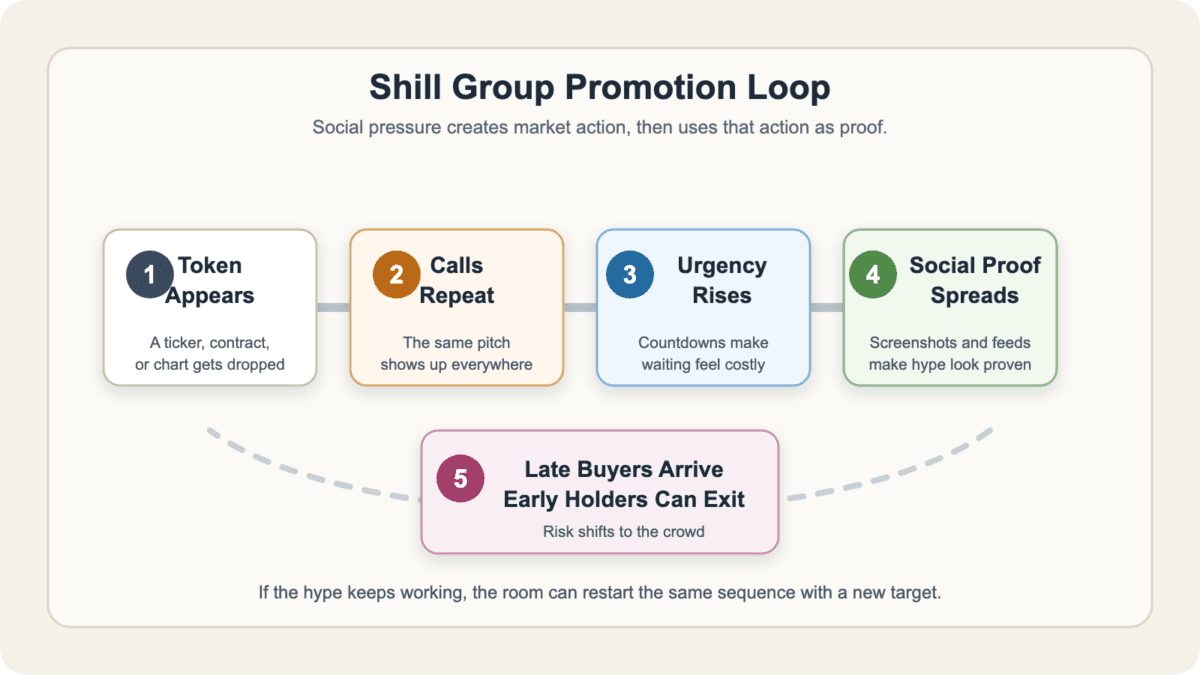
The timing gap is the part most members cannot see. Early holders may already be positioned before the public call lands. By the time the same ticker reaches newer members, the trade may depend on fresh demand more than fresh information.
The loop often follows a familiar path:
The hard part is the feedback. A small price move can make the pitch look correct, even when the pitch helped create the move. Then the room points to that move as proof. Neat loop. Terrible place to outsource judgment.
That is why the same shill group can feel useful and hostile at the same time. It may show where attention is moving, but it rarely shows who entered first, who paid for promotion, or who can sell without moving the chart.
Traders still use crypto shill groups because attention often appears there before it reaches slower research channels. In meme coins, the first clue can be a messy chat, a copied ticker, or a sudden burst of posts.
That does not make the group trustworthy. It can act like a noisy radar, showing what people are trying to push, which chain is hot, which ticker is spreading, or which caller has a crowd today.
The appeal usually comes from a few needs:
There is also a discovery gap. Stricter communities often remove referral links, Telegram invites, new-token spam, and low-effort promotion. That keeps public feeds cleaner, but it pushes some launch chatter into rougher rooms where moderation is weaker and incentives are harder to read.
So traders use the group as a watchlist, not as a verdict. The useful move is to record what keeps appearing, then leave the room and check the token somewhere quieter. If the idea only feels good while the chat is chanting, the chat is doing the heavy lifting.
This is where the crypto attention economy comes in. In fast markets, attention can become liquidity. But attention also fades, rotates, and gets manufactured. A shill group can show the spark. It cannot tell you whether anything real sits behind it.
Shill group red flags are signs that the room benefits more from your reaction than from accurate information. The strongest warnings combine social pressure with weak token evidence.
A single loud post is not enough. Look for patterns: no criticism allowed, copied talking points, sudden influencer swarms, private manager DMs, guaranteed returns, referral pressure, thin liquidity, new social accounts, or contract settings that make selling harder than buying.
Use the table as a first pass, then step away from the chat before acting.
| Red Flag | What To Check Next |
|---|---|
| Countdown buys or “last chance” calls | Whether the price already moved before the public call |
| Anonymous admins with VIP rooms | Who gets paid by fees, referrals, or early access |
| Copied posts across chats and X | Whether the same script is being pushed by related accounts |
| Fake payout screenshots | Whether trades can be verified on-chain without edited images |
| No criticism allowed | Whether basic questions about liquidity or supply get removed |
| Thin liquidity or odd contract controls | Whether a selling block, liquidity pull, or permission risk is possible |
| Slow team exits after heavy promotion | Whether trust is fading after attention has already been harvested |
The red flags hit harder when they cluster. A low-liquidity token with countdown language and private admin DMs deserves more caution than a noisy public chat around a liquid asset.
If the concern is abrupt contract failure or drained liquidity, compare the setup with a hard rug. If the risk is slower team selling, fading updates, or quiet abandonment after heavy promotion, the closer pattern is a soft rug.
Also watch the emotional design. If the group makes you feel late, stupid, or disloyal for asking basic questions, the room is training speed instead of understanding. That is exactly when slower checks help.
A shill group is different from a signal group or pump-and-dump group, though the middle can blur quickly. The difference comes down to purpose, incentives, and how directly the room pushes action.
A normal community can discuss a coin and still allow doubt. A shill group is built for attention. A signal group gives trade calls. A pump group tries to coordinate buying. An influencer network can mimic organic demand without sitting in one obvious room. The categories below name what the user is facing.
| Group Type | What It Means For The User |
|---|---|
| Normal crypto community | Discussion includes questions, criticism, and mixed views |
| Shill group | Promotion dominates and token attention is the main product |
| Signal group | Trade calls are offered, sometimes with fees or referrals |
| Pump-and-dump group | Buying is coordinated so insiders can sell into demand |
| Influencer swarm | Many accounts repeat the same coin narrative at once |
The blurry cases are the dangerous ones. A signal group can become a shill group when every call routes users toward a referral. A shill group can become a pump room when timing, buying pressure, and insider exits are coordinated.
Names are marketing too. A room can call itself education while pushing opaque referrals. A promotion chat can call itself a community while deleting basic doubts. A pump room can avoid the word “pump” and still train members to buy at the same time.
So do not stop at the label. Ask who benefits when you act, what information is missing, and whether dissent survives longer than five seconds. The more the room depends on speed, secrecy, or loyalty language, the less it behaves like a place for independent decisions.
A shill group can be useful only as weak attention data. It can help you notice a coin, phrase, caller, or meme early. It should not be the reason you buy.
The group is biased by design. People may be paid, overexposed, desperate, or simply stuck after buying too high. A loud holder can become a bagholder with a microphone, and that microphone can sound like conviction.
Usefulness also fades fast. A coin mentioned early can be a lead. The same coin mentioned after three countdowns, five screenshots, and a VIP upsell is a different trade. By then, the room may be selling you the feeling of being early after the early people already arrived.
If you use a shill group at all, separate discovery from decision:
Some calls will work. That does not prove the room is honest. A lucky call, delayed copy, or edited screenshot can still pull users into worse setups later.
Track the call like evidence. Note when it appeared, whether the chart had already moved, who posted it first, and what happened after criticism showed up. Keep every call in the unverified-lead pile until market and contract checks agree.
Before buying from a shill group, check whether the market, contract, and group incentives survive outside the chat. If the pitch only works while everyone is yelling, that is already useful information.
Start with the basics: find the token through official channels, confirm the contract address, and check liquidity, volume, holder concentration, token permissions, buy and sell taxes, mint controls, and whether the pool can be drained or changed.
Then check the human incentives:
The CFTC’s FY 2025 Agency Financial Report gives useful scale to the social-risk problem: approximately $5.8 billion in relationship investment scam losses were reported to the FBI in 2024. That does not prove every shill group is fraud, but it explains why random group chats, fake trading sites, and “winning trader” pitches deserve cold checks before you buy.
No checklist catches every scam. The goal is narrower and more useful: remove the easy mistakes before a fast room turns into a fast loss. If the group profits from your buy, click, referral signup, or VIP fee, your caution should rise.
Related crypto slang helps decode shill groups because the same rooms reuse trader terms as pressure tools. Some words describe real risks. Others make hesitation feel embarrassing.
Start with the terms that change what you check next:
Other nearby terms also help. Exit liquidity describes late demand that helps earlier holders sell. Hard rug points to abrupt contract, liquidity, or selling failures. Soft rug points to slower abandonment, quiet selling, or broken trust.
Use those labels to sort the risk. Exit-liquidity talk asks whether you are arriving after the insiders. Rug language asks whether the token design or team behavior can break the trade after promotion has done its job.
Trenches language is about fast meme-coin hunting in noisy launch environments. Top signal language points to excitement that may already be peaking. Both help only if they make you slower and sharper.
These terms are not badges. They are translation tools. If a chat calls every seller a jeet, every critic FUD, and every chart dip a top signal, the language is doing crowd control. Translate the slang back into risk before acting.
When a shill group mentions a coin, start by slowing the trade down. You do not need to win the first minute of a move to avoid the worst mistake.
Use a short routine before touching your wallet:
Use that routine for a cooling-off period, not homework theater. The point is to break the spell long enough to see whether the pitch still has legs without a hundred people yelling “send.”
Be especially careful with links handed to you inside the room. A fake site, copied contract address, or private “support” account can be a separate risk from the token itself. Find official channels from independent sources and assume DMs are sales until proven otherwise.
Next, check the parts the chat is least likely to discuss. Look at whether the pool is deep enough for your size, whether holders are concentrated, and whether selling works in both directions. A group that only shows green candles is skipping the exit.
Then decide whether the idea still makes sense without the room. If the pitch collapses when the countdown ends, the countdown was probably the product.
The best outcome is not always buying early. Sometimes it is passing quickly, avoiding a bad token approval, or learning which caller not to trust next time. In shill-group territory, a missed pump is cheaper than a trapped wallet.
No. A shill group is not always a scam, but it is always promotional. Some groups are messy marketing rooms, while others blur into paid promotion, pump coordination, or direct fraud.
Telegram crypto shill groups usually push a token through repeated calls, urgency, screenshots, admin messages, and social proof. The goal is to make attention feel like confirmation before users check the market.
A shill group is built around promotion. A signal group gives trade calls. They overlap when a signal room promotes coins with hidden incentives, referral pressure, or VIP access.
Joining a crypto shill group is not automatically illegal. Coordinated manipulation, fraud, undisclosed paid promotion, or helping others mislead buyers can create legal risk. Rules vary by jurisdiction.
A shill group can help surface early meme-coin chatter, but it cannot validate the trade. Use it as a lead, then check liquidity, contract risk, holders, and independent discussion.
Avoid becoming exit liquidity in a shill group by refusing rushed buys, checking who entered first, and confirming whether there is enough real liquidity for your exit. If the group needs speed, slow down.