Physical Address
304 North Cardinal St.
Dorchester Center, MA 02124
Physical Address
304 North Cardinal St.
Dorchester Center, MA 02124


A practical guide to flash loan attack mechanics, DeFi exposure, and safer incident checks.
A flash loan attack is a DeFi exploit that uses borrowed, same-transaction liquidity to amplify a weakness in a protocol.
The loan supplies speed and size. It gives an attacker enough temporary capital to bend a price, accounting rule, liquidation path, bridge assumption, or governance vote before the transaction ends.
A flash loan can support normal arbitrage or position management. In an attack, that same temporary capital becomes a public stress test the protocol fails.
A flash loan attack in crypto is a DeFi exploit where borrowed capital lets an attacker push a vulnerable protocol into a bad state, extract value, repay the loan, and keep the difference.
The flash loan gives scale. The target protocol supplies the weakness. That weakness might be a price feed that trusts one pool too much, a vault that updates shares in the wrong order, or a lending market that accepts a distorted collateral value.
OWASP Smart Contract Security describes flash-loan-facilitated attacks as same-transaction borrowing used to amplify an underlying vulnerability. Its SC04:2026 case studies list Bunni’s September 2025 incident as an $8.4 million loss tied to a withdrawal-rounding error amplified by flash loans. The pattern is simple: borrowed liquidity is a tool, not the root bug.
The attacker usually does not need a normal loan, credit history, or long holding period. In DeFi, a smart contract can borrow assets for one transaction if it repays them before that transaction closes. If repayment fails, the whole route reverts. Nothing sticks.
That atomic design is useful for legitimate finance tasks. It also creates a harsh test for protocols that assume markets move slowly, voting power is stable, or a single pool price is trustworthy.
So when you see a flash loan attack headline, ask two questions first:
That question beats panic. The attack may hit a pool, vault, bridge, token, or lending market. It may not touch your wallet directly at all.
A flash loan attack works by chaining several actions into one atomic transaction. Borrow, distort state, extract value, repay, and keep the profit if every step succeeds.
Atomic means all-or-nothing. The blockchain accepts the full transaction only if every included action works. If the attacker cannot repay the flash loan by the end, the transaction reverts and the temporary loan never exists as a settled debt.
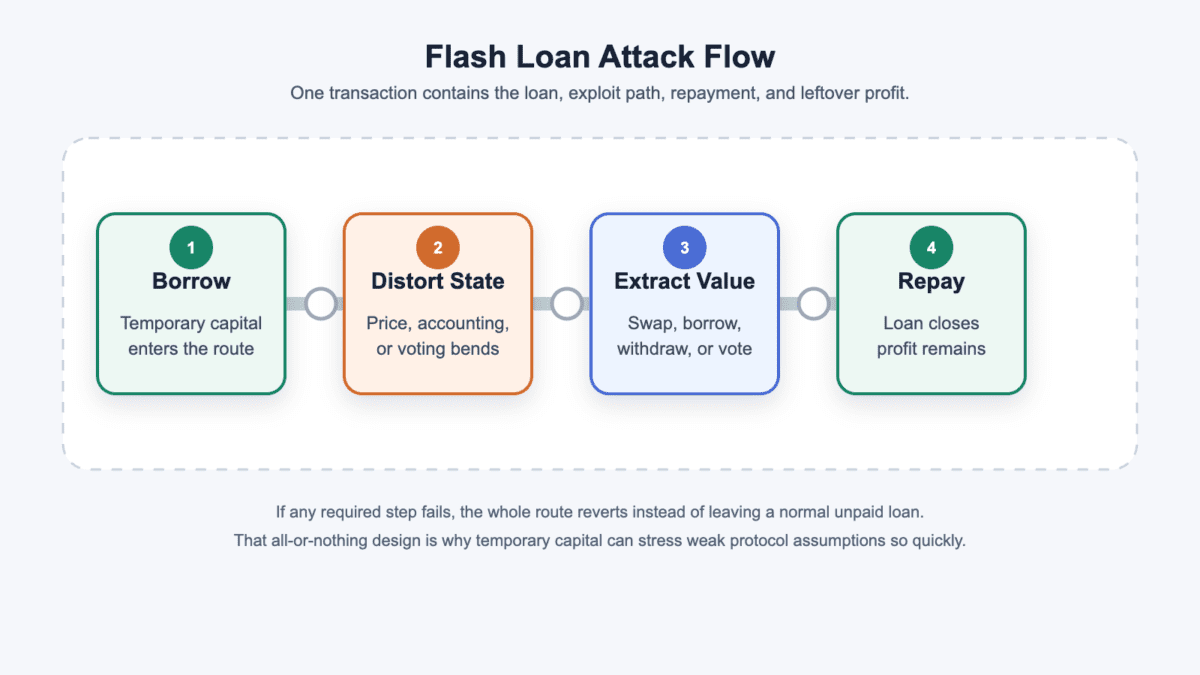
The sequence usually looks simple from a distance, even when the code path is ugly.
The attacker only needs the route to work once. They do not need to hold capital overnight or convince a lender that the strategy is sane. The smart contract checks repayment before final settlement. It does not judge whether the route is fair.
This is why flash loan exploits often feel faster than normal market abuse. A protocol may check the current block, current pool price, or current balance and conclude everything is valid. The missing question is whether that state can be manufactured for one transaction.
Good defenses force the protocol to look beyond a single instant. They use harder-to-manipulate pricing, delays, sanity checks, and accounting rules that survive extreme but valid transactions.
A flash loan attack is hostile, but flash loans themselves are not automatically bad. The same primitive can support arbitrage, collateral swaps, liquidations, refinancing-style moves, and other one-transaction DeFi operations.
The difference is consent and target. Normal arbitrage closes a price gap between venues. A flash loan attack abuses a protocol that misreads that temporary capital as real market depth, real collateral value, or real voting power.
Use this table to separate the common cases.
| Activity | What A User Should Understand |
|---|---|
| Normal flash loan | Borrowed assets must be repaid in the same transaction, so the loan is usually background infrastructure. |
| Flash loan arbitrage | A trader or bot closes a price gap across venues. It can be aggressive, but it is not automatically theft. |
| Collateral swap or deleveraging | A user may move debt or collateral without first holding all needed capital. Execution risk still exists. |
| MEV competition | Searchers may fight over ordering and routing. Most beginners are not competing on fair ground here. |
| Flash loan attack | Temporary capital exploits weak pricing, accounting, governance, liquidation, or contract sequencing. |
| Flash-loan bot pitch | Easy-profit scripts often sell hope, gas waste, or worse. The bot seller usually has the better trade. |
The takeaway is simple: flash loans do not automatically mean hacks. Large temporary liquidity changes what a protocol must be able to handle.
Arbitrage can make markets more efficient. It can also create slippage, gas wars, and ugly routing. But an attack crosses a different line by extracting value from a protocol assumption that should have been protected.
For most users, flash loans are worth understanding as risk infrastructure. If someone promises passive income from a copy-paste flash-loan bot, be especially cold-eyed. Serious routes are crowded by MEV searchers, private order flow, and developers with real infrastructure.
Common flash loan attack types differ by what gets distorted. The headline may say “flash loan exploit,” but the real failure usually sits in pricing, collateral logic, vault accounting, governance, bridge assumptions, or contract sequencing.
These categories overlap. A single incident can involve an oracle, a lending market, a vault, and a bridge-connected asset. Still, the labels help you understand what the attacker bent and who may be exposed.
Oracle manipulation happens when a protocol trusts a price that can be pushed around with temporary liquidity. An attacker can borrow a large amount, trade through a thin pool, move the apparent price, then use that fake price somewhere else.
A user might see strange collateral values, sudden liquidations, a pool imbalance, or a token trading far away from the price shown elsewhere. The risky assumption is simple: one instant price is not the same as a fair market price.
Liquidation abuse appears when a flash loan changes collateral values or debt ratios long enough to trigger profitable liquidations. The attacker may push a token price down, force unhealthy positions, buy discounted collateral, and repay the loan.
Borrowers can be hurt even if they did nothing new. LPs and lenders can also face bad debt if the market updates after the attack route has already drained value.
Vault attacks target how deposits, withdrawals, shares, fees, or rewards are counted. If a vault updates share price before checking edge cases, a large one-transaction deposit or withdrawal can skew the math.
Users may see a vault pause withdrawals, reprice shares, or announce that one pool was affected while other pools were not. The key detail is whether your funds sat in the same vault, strategy, or accounting path.
Governance flash loan attacks use temporary voting power to influence protocol decisions. If voting, proposal execution, or quorum checks are too fast, borrowed tokens can count like long-term commitment.
The damage may arrive through parameter changes, treasury movement, bad upgrades, or emergency controls. Timelocks and vote snapshots exist because voting power should not appear for one block and then walk off with the furniture.
Reentrancy means a contract is called again before it has finished updating its own records. Borrowed capital can make the repeated call larger, faster, and more damaging.
For users, this may show up as a drained pool, frozen contract, or post-mortem phrase like “checks-effects-interactions.” You do not need the code lesson. The risk is simpler: the contract let a caller act while the accounting was still half-updated.
Cross-protocol attacks exploit the way DeFi apps depend on each other. A bridge token, DEX pool, lending market, and vault can all touch the same price or balance assumption.
If the weak link sits upstream, the damage can spread. A token may depeg, a lending market may pause, or a vault may lose value because another protocol fed it bad state.
These types are not a checklist for becoming an attacker. They are a map for reading incident updates. Find the distorted input, then map your exposure to the affected contracts, pools, vaults, or tokens.
A flash loan attack can hit investors and traders when their position depends on the affected protocol, even if their wallet keys are safe and they never touched the exploit transaction.
Spot exposure is different from protocol exposure. Holding a token on an exchange is not the same as depositing it into a lending market, supplying it to a liquidity pool, bridging it, or using it inside a yield strategy.
The common exposure paths are worth separating.
Yield users need extra care because their funds often sit inside several layers. A farm can route deposits through a vault, pool, lending market, reward contract, or bridge. Understanding yield farms helps when an exploit headline names a strategy rather than a simple wallet balance.
Traders face a different problem. The protocol loss may be over, but the market reaction may still be unfolding. Liquidity can thin out, spreads can widen, and panic sellers can become exit liquidity for faster accounts leaving the trade.
Do not assume every token holder has the same exposure. A native ETH holder, an LP in an ETH pair, a borrower using a wrapped ETH token, and a vault depositor can all react to the same headline with different risks.
Your first move is position mapping. Identify where your funds are deposited, which contract holds them, which token represents them, and whether the incident touched that path.
After a suspected flash loan attack, check exposure before you transact. Moving fast can help in some incidents, but panic clicks and fake recovery links often create the second loss.
Start with official sources and on-chain facts. Do not trust a random support account, promoted post, or “claim portal” that appears five minutes after the exploit. Scammers love incident traffic because fear does half the sales work.
Use this triage list before withdrawing, swapping, revoking, or bridging.
Self-custody has a clear boundary here. A flash loan attack does not normally steal your seed phrase. But it can still hurt funds you deposited into a protocol, approvals you granted to risky contracts, LP positions you supplied, or tokens whose market confidence breaks.
That is where wallet hygiene still belongs. Separate active DeFi wallets from long-term storage, review approvals after incidents, and use trusted crypto wallets and tools instead of links from social replies.
If a centralized exchange lists the affected token, check its official notices too. Exchanges may pause deposits, withdrawals, or markets while they inspect token contracts, bridge backing, or chain status.
The goal is not to freeze forever. It is to avoid doing the attacker’s cleanup work for them. Verify the affected surface, then act where your actual exposure sits.
Protocols try to prevent a flash loan attack by making key assumptions harder to distort inside one transaction. No single badge, audit, oracle, or dashboard covers every failure mode.
The right defense depends on the weak spot. If the risk is a manipulable price, the answer is better pricing. If the risk is instant governance capture, the answer is time. If the risk is unsafe accounting, the answer is testing, limits, and checks that survive extreme transaction paths.
Here is the map.
| Weakness | Better Defense Category |
|---|---|
| One-pool spot price | Decentralized oracles, TWAPs, liquidity checks, and sanity bounds. |
| Same-block governance capture | Vote snapshots, timelocks, quorum design, and delayed execution. |
| Vault share manipulation | Invariant testing, precision checks, deposit limits, and safer update order. |
| Liquidation abuse | Collateral sanity checks, circuit breakers, and market-specific risk limits. |
| Reentrancy | Reentrancy guards, careful state updates, and stricter external-call patterns. |
| Cross-protocol dependency | Dependency reviews, bridge-risk limits, and monitoring across connected contracts. |
| Unknown exploit path | Audits, simulations, bug bounties, monitoring, and emergency pause controls. |
Oracles and TWAPs are often useful, but they are not magic shields. A TWAP can still be weak if the window is too short, the market is thin, or the protocol ignores liquidity conditions. A good oracle can still be wired badly.
Audits have the same limit. They reduce risk, but they do not prove a protocol can survive every economic attack, every integration, or every future upgrade. Flash loan attacks often live in the gap between code correctness and market behavior.
Layered defense is the stronger signal. Look for protocols that explain oracle design, governance delays, pause powers, monitoring, bug bounties, dependency risk, and post-incident process in plain terms.
If the answer is only “we were audited,” keep reading. Ask what the audit and later testing actually covered.
A flash loan attack is one crypto risk pattern, not a label for every hack, rug pull, bridge failure, or wallet scam. The categories can overlap, but the cause and user response often differ.
This comparison helps when incident language gets messy.
| Risk | How It Differs From A Flash Loan Attack |
|---|---|
| Smart contract exploit | A broad category. A flash loan attack is one way to exploit contract logic or assumptions. |
| Oracle attack | Often part of a flash loan attack, but can happen without a flash loan. |
| Bridge exploit | May involve cross-chain messages, validators, wrapped assets, or false backing. Flash loans may only be one tool. |
| Governance attack | Can use borrowed voting power, but can also come from token concentration or weak process design. |
| Wallet-drainer scam | Targets user signatures or approvals. A flash loan attack usually targets protocol logic. |
| Hard rug | A project-controlled exit where insiders drain or disable value, not a same-transaction DeFi exploit. |
| Soft rug | A slower decay through neglect, broken promises, or quiet extraction rather than one atomic attack route. |
The rug distinction changes what you check. A hard rug points you toward insider controls, liquidity locks, mint authority, and withdrawal blocks. A flash loan attack points you toward protocol assumptions, affected contracts, and transaction flow.
A soft rug is slower and messier. It may involve team silence, poor delivery, or gradual liquidity drain. Flash loan attacks are usually sharper. The exploit hits, markets react, and the post-mortem begins.
Some incidents combine categories. A bridge exploit can involve oracle weakness. A governance attack can use temporary capital. A wallet scam can surge after a real flash-loan headline because fake recovery links appear while users are rattled.
So do not stop at the headline label. Identify the failure mode, then match your response to your exposure. That is how you avoid solving the wrong problem.
Start by mapping where your crypto actually sits. A flash loan attack hurts users through protocol exposure, not because the phrase sounds scary.
If you use DeFi, keep a short checklist for any protocol where you deposit, borrow, farm, bridge, or provide liquidity. The point is not paranoia. It is knowing which questions to ask before a headline turns into a bad transaction.
The best checks happen before a crisis. If you wait until withdrawals are paused, your choices may be limited to watching official updates, avoiding fake links, and deciding whether a secondary-market exit is worth the slippage.
Use these actions as your baseline.
Keep your DeFi wallet boring where possible. Fewer approvals, smaller active balances, and clearer position notes make incident response easier. If an app needs unlimited approvals, a fresh wallet or a smaller test position can save a lot of later cleanup.
The core lesson is simple. The speed of the loan is secondary. The real danger is a protocol believing something fragile at exactly the wrong moment.
A flash loan attack in crypto is a DeFi exploit where an attacker borrows temporary liquidity, manipulates a vulnerable protocol condition, extracts value, repays the loan, and keeps the profit in one transaction.
A flash loan attack usually does not steal private keys or drain a wallet by itself. It can still hurt you if your funds are deposited in the affected protocol, you hold an exposed LP position, or you have risky approvals tied to the incident.
No. Flash loans can support arbitrage, collateral swaps, liquidations, and position management. They become a problem when temporary capital is used to exploit weak pricing, accounting, governance, or contract logic.
Flash loan attacks happen in one transaction because the borrowed assets must be repaid before the transaction finishes. If the route cannot repay the loan, the transaction reverts and the attack does not settle.
An oracle manipulation flash loan attack uses borrowed liquidity to distort a price input that another protocol trusts. The attacker then uses that bad price to borrow, liquidate, swap, or withdraw value unfairly.
First, verify official protocol updates and affected contracts. Then check whether your funds are in the named pool, vault, lending market, bridge, or token before you withdraw, revoke approvals, swap, or follow any recovery link.