Physical Address
304 North Cardinal St.
Dorchester Center, MA 02124
Physical Address
304 North Cardinal St.
Dorchester Center, MA 02124


Crypto float shows how much token supply can really trade.
Float in crypto is the amount or share of a token’s supply that can actually trade in public markets.
That sounds like a clean supply number, until locked supply shows up. A token can have a small public float, a much larger locked supply, and an FDV that makes the “cheap” market cap look less cute. Here, float means token supply and market structure, not banking float, floating-point math, or any project named Float.
Float in crypto means the public, tradeable part of a token supply. It can be stated as a token amount, such as 100 million tokens, or as a percentage, such as 10% of total supply.
That percentage is often the more useful number. If two tokens both trade at a $50 million market cap, the one with 80% of supply already public has a very different setup from the one with 8% public and the rest waiting behind vesting schedules.
You will usually see float used in two ways:
In day-to-day crypto talk, “float” often overlaps with circulating supply. But it is not always identical. Some analysts focus on tokens that are not only circulating, but also likely to trade.
So when someone says a token is low float, they usually mean only a small slice is available to the market. That can help a chart move quickly. It can also make the next supply event the real trade.
Float sits beside several supply metrics, and mixing them up is how new buyers get surprised. The common mistake is reading market cap as the whole valuation story while locked supply and FDV sit off to the side.
CoinMarketCap’s supply methodology treats circulating supply as an approximation of assets in public hands. Coin Metrics goes further with free-float supply by excluding some supply that is unlikely to trade in the short to medium term.
Here is how the terms split:
| Metric | What It Tells You |
|---|---|
| Float | The supply that can realistically trade now, or the tradeable share of supply. |
| Circulating supply | A provider’s estimate of tokens in public circulation. |
| Total supply | Tokens issued so far, usually excluding burned supply when applicable. |
| Max supply | The largest possible supply under the token’s rules, if there is a cap. |
| FDV | The price multiplied by total or max supply, depending on the provider. |
The table is not a ranking. It is a map. Float helps you understand today’s tradeable supply, while FDV helps you see the valuation implied by future or full supply.
Provider methodology still matters. One dashboard may count restricted tokens differently from another, so always check what the number includes before comparing projects.
Crypto float is usually calculated by dividing available or released supply by total or max supply. The formula is simple, but the denominator can change the story.
A basic version looks like this:
Say a token has 100 million tokens trading and 1 billion total tokens. Its current float is 10% of total supply.
If the token trades at $1, the current market cap is $100 million. The simple full-supply valuation is $1 billion. That does not mean the token must fall. It means the market is pricing a small public slice while future supply may still be coming.
Use the same denominator when comparing projects. A 15% float against total supply is not the same thing as 15% against max supply if emissions, burns, or uncapped issuance affect the number.
Also check whether the supply is liquid. Tokens sitting in a few wallets, thin order books, or shallow DEX pools may count as circulating, but they may not behave like healthy float.
Low float crypto can move sharply because fewer tradeable tokens can absorb less buying or selling pressure. When supply is thin, a strong narrative can push price faster than fundamentals can explain.
That cuts both ways. A small public float can make a new token look exciting during a listing, airdrop, or social-media push.
Then a modest sell wave can hit harder than expected because the market is not deep enough. Fast sellers, including jeeting traders, can pressure a thin float before slower buyers understand the supply picture.
Low float can also create ugly holder outcomes:
This is why low-float charts can look heroic one hour and tragic the next. The same structure that helps a pump travel can help a dump travel too.
It is especially common in the crypto trenches, where new launches, small caps, and thin liquidity meet fast narratives. Float is not the only signal there, but ignoring it is expensive research by wallet.
Low float, high FDV means a token has a small public trading supply but a much larger valuation if the full referenced supply were counted at today’s price. It is a clean way to spot hidden dilution risk.
The key contrast is market cap versus FDV. Market cap uses the supply trading now. FDV asks what the valuation would look like if all tokens, or the provider’s full-supply assumption, were counted at the same price.
Use a round-number example:
That token can look small by market cap and expensive by FDV at the same time. Both statements can be true. Awkward, but true.
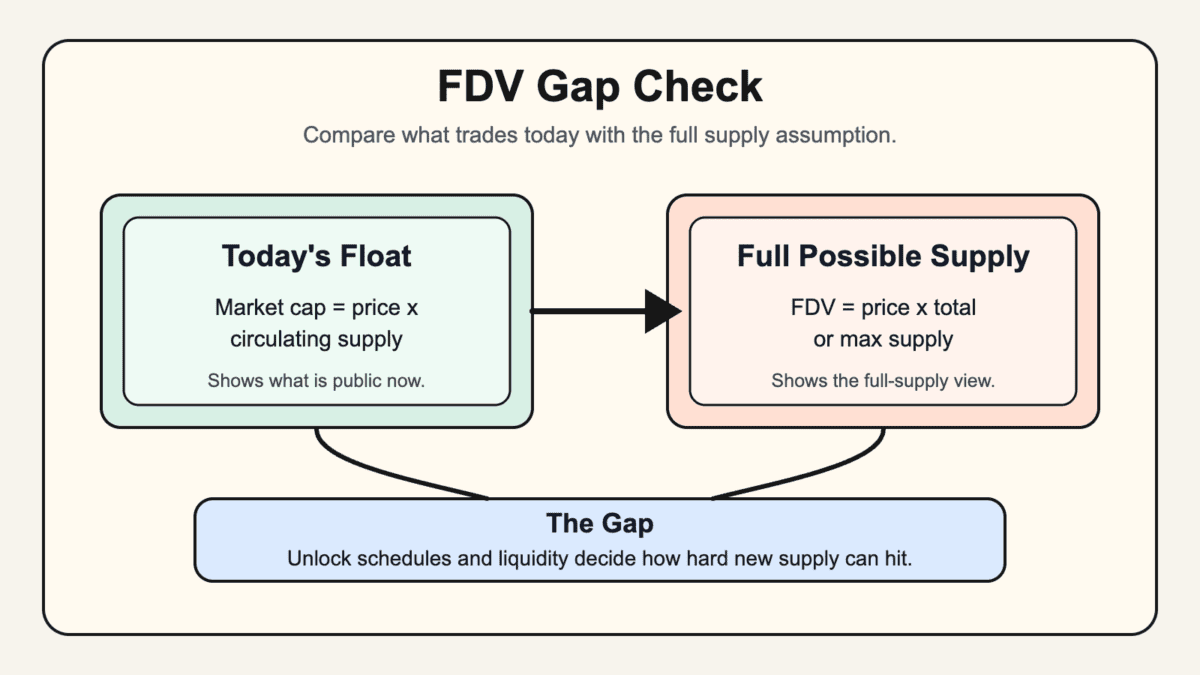
This setup often raises exit liquidity concerns because future token releases may need fresh buyers to absorb supply. If demand is real, unlocks can be digested. If demand is thin, public buyers can end up absorbing supply from everyone else.
Narratives can overpower that risk for a while. A strong narrative coin can attract enough attention to push through supply worries, at least temporarily. But temporary is doing work there.
Low float and high FDV do not prove bad intent, but they do force a tougher question: who owns the locked supply, when can it move, and who is expected to buy it?
Token unlocks change float by moving previously restricted tokens into the tradeable supply. That makes float a moving number, not a one-time snapshot from a token page.
An unlock is not automatically a dump. Price depends on demand, liquidity, holder behavior, market conditions, and whether the unlock was already expected. Still, unlocks can change the supply available to sell.
The main patterns are easy to separate:
| Unlock Pattern | What It Can Do To Float |
|---|---|
| Cliff unlock | Adds a large batch of tokens at one scheduled date. |
| Linear vesting | Adds tokens gradually over weeks, months, or years. |
| Emissions | Expands supply through rewards, mining, staking, or protocol distribution. |
| Staking withdrawal unlock | Lets previously locked staking supply become movable. |
| Treasury release | Moves foundation or project tokens into grants, spending, or liquidity. |
| Market-maker allocation | Adds tokens that may support liquidity but can still affect available supply. |
The calendar can be more useful than the headline float. A token with 12% float today and a major cliff next month is not the same as a token with 12% float and slow linear vesting over several years. In a study updated April 29, 2026, CoinGecko Research found that low-float tokens made up 21.3% of the top 300 crypto assets by market cap.
Some traders watch unlock dates for shorts, hedges, or spot exits. That behavior can become crowded. The cleaner check is simpler: ask how much supply is arriving, who receives it, and whether real demand can absorb it without turning the chart into a public lesson.
To check float before buying a token, compare today’s available supply with the future supply schedule, then test whether liquidity and demand can handle the difference. One number is not enough.
Start with the token’s supply page, whitepaper, tokenomics chart, vesting schedule, unlock calendar, and wallet distribution. If those pieces are unclear, that is already information.
Run the check in this order:
This is especially useful around new listings, presales, airdrops, and small-cap launches. The phrase low float can spread through social trading channels before many buyers know what it means. If a token comes from a chaotic launch market, slow down and check whether the chart is moving because demand is strong or because the float is tiny.
Do not force every project into one rule. A new protocol may need vesting to stop instant insider selling. But if the unlock schedule is aggressive, liquidity is thin, and demand is mostly hype, the float check is waving, not whispering.
Low float is not always bad. It can be normal early in a token’s life, especially when team and investor tokens are locked to prevent immediate selling.
The problem starts when low float meets high FDV, fast unlocks, weak liquidity, and no clear demand. At that point, the token is not just early. It is asking public buyers to price a future supply wall.
Low float can be acceptable when these conditions line up:
Do not confuse tokenomics risk with fraud. Malicious liquidity removal, slow-drain failure, and ordinary supply pressure are different problems. A low-float token can be neither fraud nor failure. It can simply be a risky launch structure.
Ask whether the float, FDV, unlock schedule, liquidity, and actual demand belong in the same room. That answer tells you more than a simple good-or-bad label.
Float can also point to project names, token tickers, tools, or company pages. The word can look confusing if you expected only a supply definition. Here, float is a tokenomics and market-structure term, not a review or recommendation of any Float-named asset.
If you are researching a specific project named Float, start with that project’s official site, contract address, exchange listings, docs, and risk disclosures. Then separate that project research from the broader float concept.
Keep the project name separate from the supply metric. On a token page, Float may be a name or ticker. In tokenomics, float describes how much supply can actually trade.
A token named Float can still have high or low float, just like any other token. Check its public supply, locked allocations, vesting schedule, liquidity, and holder concentration before treating the name as useful information.
Names are marketing. Float is supply math. Keep those two ideas separate, and the search-result confusion gets easier to handle.
Float connects to several nearby crypto terms, especially around launch trading, valuation, and risk. They help because float rarely causes price action by itself.
Use these concepts to separate supply risk from other market problems:
A real thesis should survive supply math, not ask you to ignore it.
Start with float checks before you decide whether a token’s market cap is cheap. Market cap alone can hide a large future supply story.
Use a short routine before you buy, average down, or chase a new listing:
Then write one plain sentence before buying: “I am comfortable with this future supply because…” If that sentence turns into fog, pause.
That sentence forces the trade into daylight. Maybe the project has real demand, slow vesting, and enough liquidity to absorb future supply. Or maybe the chart only looks cheap because most of the supply has not arrived yet.
The check also protects you from overcorrecting. A low-float token is not automatically doomed, and a high-float token is not automatically healthy. The point is to know which supply risk you are taking before price movement makes the decision for you.
Float does not tell you whether a token will win. It tells you how much supply the market is handling now, how much may arrive later, and whether the price already assumes everyone will be very polite about it.
Float in crypto is the amount or percentage of a token supply that is available to trade in public markets. It helps you see how much supply the current price is actually working with.
Float is close to circulating supply, but it is not always the same. Circulating supply is usually a data-provider estimate, while float may focus more tightly on tokens that can realistically trade.
A low-float crypto is a token with only a small share of its supply available to the public market. It can move sharply because less tradeable supply is available to absorb buying or selling.
Low float, high FDV means a token has a small public supply today but a large valuation if full supply is counted. It is a warning to check unlocks, allocations, and future dilution.
Token unlocks affect float by adding previously restricted tokens to the supply that can move or trade. The impact depends on the unlock size, holder behavior, liquidity, and demand.
Float can be a project name or token ticker, but in tokenomics it is a supply metric. In this article, float means the tradeable share of a token supply.