Physical Address
304 North Cardinal St.
Dorchester Center, MA 02124
Physical Address
304 North Cardinal St.
Dorchester Center, MA 02124


Learn how floor price defense works before trusting an NFT floor.
Floor price defense is an attempt to support the lowest visible NFT listing price by buying, delaying, or reducing sell pressure.
In NFT markets, that phrase usually appears when a project, founder, whale, or community wants the collection floor to look stronger. It can mean real support. It can also mean one funded wallet is cleaning up cheap listings while everyone watches the number blink.
The visible move is only the first clue. The real test is whether independent buyers, recent sales, and listing depth still support the floor after the support stops.
Floor price defense in NFTs means coordinated action to support the cheapest visible listings in a collection. The “floor” is the lowest active ask on a marketplace, so defense usually focuses on buying cheap listings, discouraging new listings, or creating confidence around that low end.
That floor is an asking price. It is not a guaranteed sale price. If the cheapest listed NFT is 1 ETH, that only tells you what the lowest seller is asking. It does not prove your NFT can sell for 1 ETH, or that many buyers are waiting there.
A current Cube Exchange explainer separates active listings from completed sales, venue differences, listing depth, and manipulation risk. Its 2026 example uses a 10,000-NFT collection with only 150 active listings, or 1.5% of supply, to show why a visible floor can rest on a very small slice of the market. That distinction drives the whole risk check.
Floor price defense tries to influence the visible number before the market confirms it. A team might sweep low listings. A founder might buy quietly. Holders might get rewards for not listing. A project might announce new utility right after a floor dip.
Those actions can reduce panic and support a thin market for a while. But they do not create a deep buyer base by themselves. A defended floor is only strong if real buyers keep taking listings after the obvious support event has passed.
So the clean definition is simple: floor price defense is market support around the lowest NFT listings, not proof that the collection has durable value.
Floor price defense works by changing what buyers see at the bottom of an NFT collection’s listings. It starts with cheap asks. Then a team, treasury, founder, whale, or holder group tries to remove, absorb, or discourage them.
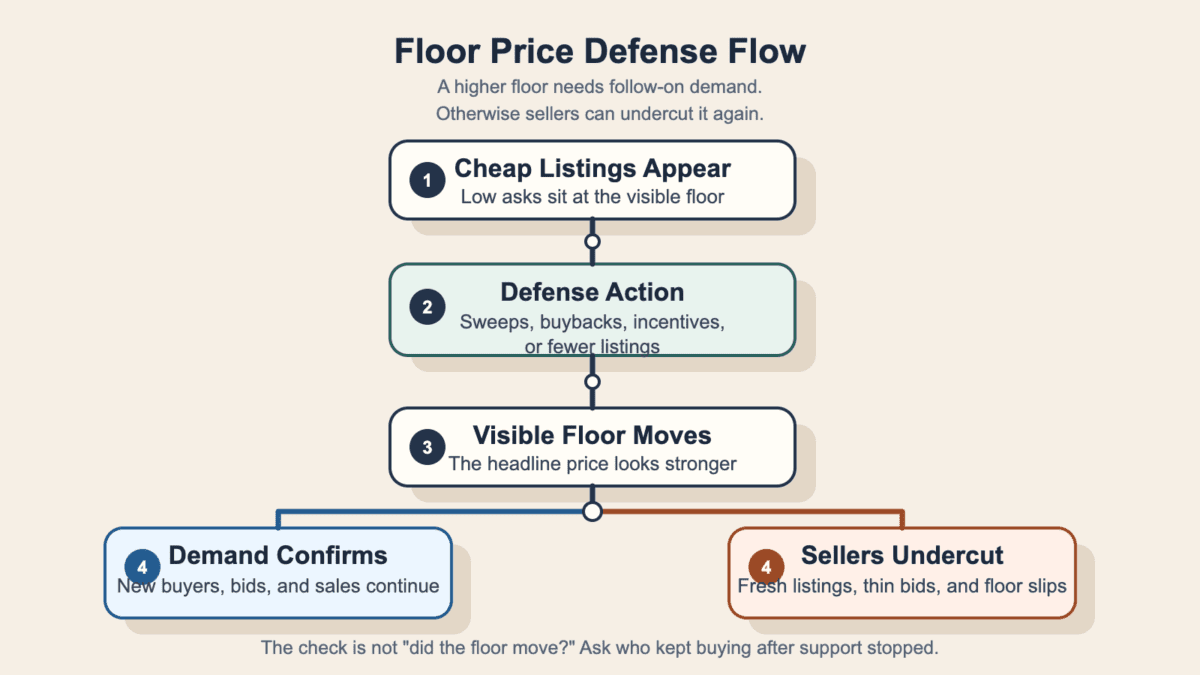
A floor sweep is the fastest version. Someone buys several NFTs listed near the floor, which removes cheap asks and can push the visible floor higher.
That looks strong on a marketplace chart. But a floor sweep can happen without broad demand. One wallet can do the buying, social posts can celebrate the move, and new sellers can undercut the new floor an hour later.
Treasury buybacks use project funds to buy NFTs from the collection. When rules, wallets, and funding sources are public, buybacks can show that a team is willing to absorb some sell pressure.
But a buyback still needs context. Ask where the funds come from, how much remains, who controls the wallet, and what happens to the NFTs after purchase. A treasury can defend a floor only while it has funds and a reason to keep spending.
Holder incentives reduce sell pressure instead of buying listings directly. A project might offer staking rewards, access, points, allowlists, or future benefits to holders who keep NFTs unlisted.
That can make the visible floor look tighter. It can also hide weak demand if holders are waiting for promised rewards rather than choosing to own the NFT freely. When incentives fade, the listings may come back.
NFT projects use floor price defense because the floor is a public confidence signal. Holders see it, traders share it, and outsiders often read it as a quick health check on whether a collection is alive or leaking value.
That creates pressure after a mint, a roadmap delay, a failed reveal, or a wider NFT selloff. If the floor falls fast, holders may panic list. If cheap listings disappear, the project can look steadier while the team buys time.
The motive is not always bad. Some teams genuinely want to reduce panic selling, support collectors, or smooth disorderly trading after a noisy launch. In a thin collection, a handful of low listings can make the whole project look broken even when many holders are not selling.
But floor price defense can also become cosmetic. A project can spend just enough to lift the visible number, then let social posts do the rest. That is where buyers need to separate support from theater.
These are the motives to separate:
The difference is disclosure and follow-through. Real support explains the rules, funding source, and limits. Weak support asks users to admire the floor without asking who paid for it.
Then the market has to confirm the story. If sales continue near the defended range, buyers broaden, and bids rise, the support may have calmed a real panic. If activity dries up after the sweep, the project bought a better screenshot, not a better market.
Floor price defense can lift the headline floor, while real NFT demand shows up in completed sales and broad buyer behavior. The first can be funded by one wallet. The second requires more people to keep buying.
That difference is clearest in thin collections. If one wallet sweeps five cheap listings, the visible floor can jump. If no new buyers appear, the move may only create exit liquidity for holders who want out at the higher number.
Use the floor as a starting point, then check whether the rest of the market agrees.
| Signal | What It Tells You |
|---|---|
| Recent completed sales | Whether buyers actually paid near the defended floor |
| Listing depth | How many NFTs sit close to the floor before price gaps appear |
| Unique buyers | Whether demand is broad or only one wallet cluster |
| Unique sellers | Whether sell pressure is concentrated or spreading |
| Collection offers | Whether buyers are bidding below the visible asks |
| Cross-marketplace floors | Whether one venue looks cleaner than the wider market |
The strongest defended floors usually have several signals moving together. Recent sales happen near the new range, bids rise with asks, and more than one buyer participates.
Weak defended floors look different. The floor moves, but bids stay low. Sales dry up. Sellers relist higher, then undercut each other again. The chart had a moment. The market did not agree.
Common floor price defense tactics try to change buy pressure, sell pressure, or confidence. None of them proves demand by itself, so each tactic needs a separate check.
The most visible tactic is the sweep. A founder, whale, or project wallet buys the cheapest listings and raises the displayed floor. That can be legitimate support, but it can also become a quick theater trick if the buyer stops and the floor slips.
Other tactics are quieter. Teams may use buyback budgets, holder rewards, delayed staking claims, utility announcements, marketplace campaigns, or private whale coordination. Some support is public. Some support is just wallet activity with a story attached.
Use this table before reacting to an update.
| Tactic | What To Check |
|---|---|
| Floor sweep | Did independent buyers follow after the sweep? |
| Treasury buyback | Is the wallet public, funded, and governed by clear rules? |
| Founder or whale buying | Is the buyer absorbing supply or creating a headline? |
| Holder rewards | Do rewards explain ownership, or only delay selling? |
| Utility announcement | Did sales and buyers rise, or only social noise? |
| Relisting bought NFTs | Does supply return above the floor in a controlled way? |
Roadmap support can also fade slowly. A project may promise utility, keep holders waiting, defend the floor in bursts, and then drift into a soft rug pattern without one dramatic collapse.
That is why the aftereffect counts more than the tactic. If support creates steady demand, the floor has a case. If support creates one nice screenshot, keep your hand away from the buy button.
Traders can check floor price defense by comparing the floor with sales, bids, listings, wallets, and marketplace spread. The goal is to test whether the defended floor can survive without the defending wallet.
Start with the simple mismatch. If the floor is 1 ETH but recent sales cleared at 0.65 ETH, sellers are asking more than buyers recently paid. If top collection offers sit far below the floor, the exit path is thinner than the headline suggests.
Then check the depth around the floor. Count how many listings sit within 5 to 10 percent of the current floor. A floor with one lonely listing is fragile. A floor with many listings and steady sales near the same range is harder to move by accident.
Use this checklist before trusting the move:
Wallet safety belongs in the same workflow. You may only need public data to inspect a collection, but buying, listing, or accepting offers can involve approvals and signatures. Keep wallet safety in view when moving from research to action.
The cleaner habit is patience. A real defended floor usually keeps printing evidence after the event. A weak one needs you to rush before the evidence arrives.
Floor price defense gets risky when it makes a thin NFT market look safer than it is. The floor can rise while liquidity, buyers, and honest disclosure stay weak.
A one-wallet sweep is the easiest red flag. It can lift the visible floor, create social excitement, and make dashboards look green. But if that same wallet is the only buyer, the collection has support, not demand.
Watch for red flags that point beyond normal market support:
Wash trading can also make activity look healthier than it is. Repeated trades among related wallets, strange price jumps, and thin follow-on demand all lower confidence. Do not call every odd print fraud, but do not ignore patterns that make the floor look staged.
Floor defense can also overlap with harsher failure modes. A hard rug is more direct than weak floor support, but both can hurt late buyers when trust and liquidity disappear.
The quieter outcome is becoming a bagholder after buying the defended number. That happens when the support wallet stops, sellers return, and your exit depends on finding someone even more impressed by the floor.
So keep the warning simple: a defended floor can still collapse. It only needs enough sellers, weak bids, and one absent buyer.
Before buying into floor price defense, slow the trade down and check whether the support changed demand or only changed the visible floor. NFT floors can move fast, but your wallet does not get a refund because the screenshot looked convincing.
Start by separating observation from action. You can watch a defended floor without becoming the next buyer. Let the first burst of support settle, then see whether sales, bids, and unique buyers still show up.
Also decide what would prove you wrong. If floor price defense depends on one wallet, one announcement, or one weekend of hype, your exit can disappear quickly. A good entry should still make sense after the group chat stops cheering.
Use a short pre-buy routine:
Then write the reason you would exit before you buy. That can be a floor level, a bid gap, a volume drop, or a wallet pattern that breaks the support story.
Size the position while you run that check. A defended floor can still gap down if the next sellers are motivated or if the support wallet simply stops. If that drop would force a panic sale, the trade is too large.
If the only reason to buy is “they are defending the floor,” you probably do not have enough. Defense is an action. Demand is the evidence that follows.
No. Floor price defense is not a guaranteed NFT price floor. It only means someone is trying to support the lowest visible listings, usually through buying, incentives, or reduced sell pressure.
A guarantee would need enforceable rules and a buyer of last resort. Most NFT collections do not have that. The floor can still fall if sellers undercut or buyers disappear.
Floor price defense can make an NFT collection look steadier, but it does not make the collection safe by itself. The support needs real demand behind it.
Check recent sales, bids, listing depth, treasury disclosure, and unique buyers. If those signals are weak, the defended floor may only be temporary support.
Yes. Sweeping the floor can be a form of floor price defense when the goal is to remove cheap listings and push the visible NFT floor higher.
But a sweep can also be speculation, hype, or manipulation bait. The follow-up is more important than the sweep itself.
Floor price defense can be manipulated through one-wallet sweeps, related-wallet trades, undisclosed founder buying, wash trading, or relisting bought NFTs near the new floor.
Those tactics can make the floor look stronger than real demand. Look for independent buyers and completed sales after the support event.
Before trusting floor price defense, check recent completed sales, active listings, bids, unique buyers, unique sellers, marketplace spread, and the wallets doing the buying.
Also check what happens after the visible support ends. If activity stops when one wallet stops, the floor is weaker than it looks.
Floor price defense can fail because sellers can undercut the new floor, bids can stay weak, and treasury funds can run out. The visible floor is only one part of the market.
It also fails when the support creates FOMO but not fresh demand. Once the excitement fades, the floor has to stand without help.