Physical Address
304 North Cardinal St.
Dorchester Center, MA 02124
Physical Address
304 North Cardinal St.
Dorchester Center, MA 02124


Fractional reserve stablecoin risks, reserves, yield, and holder checks.
A fractional reserve stablecoin is a stablecoin that is not backed one-for-one by immediately available reserves at every layer. In crypto, the phrase can point to a partly collateralized token, a fractional-algorithmic design, or a bank-issued token tied to normal fractional-reserve banking.
The risk appears when the token looks calm but holders start testing the exit. The real question is whether you can leave at par, in size, during stress, through a route you actually control.
A fractional reserve stablecoin is a stable-value token where the support behind the token is less direct, less liquid, or less than one-for-one at one or more layers. In plain English, every token may not be matched by a dollar-like asset that can be sold or redeemed right now.
Crypto uses the phrase loosely, which is where confusion starts. One person may mean an undercollateralized stablecoin. Another may mean a fractional-algorithmic stablecoin with partial collateral and code-based incentives. A policy writer may mean a tokenized dollar issued by a bank that still operates inside fractional-reserve banking. Each version carries a different risk.
| Meaning | What The User Should Check |
|---|---|
| Less-than-full backing | Whether assets cover all issued tokens and liabilities. |
| Fractional-algorithmic design | The collateral ratio, oracle design, and mint-burn rules. |
| Bank or tokenized-deposit layer | The legal claim, issuer status, and redemption route. |
| DeFi wrapper or vault | The extra bridge, lending, custody, and liquidation risks. |
That split is the point: the word “stable” can hide very different promises. A fiat-backed stablecoin may rely on cash and Treasury bills. A crypto-collateralized stablecoin may rely on overcollateralized positions. A fractional model may rely on confidence, incentives, or future inflows to close the gap.
Start with the support behind the peg. If the answer is immediate reserves, that is one risk profile. If the answer is collateral that must be sold, incentives that must hold, or bank balance-sheet access that may not belong to you, the risk profile changes fast.
A fractional reserve stablecoin is the broader phrase. A fractional-algorithmic stablecoin is one specific design inside that broader family, and it combines partial collateral with algorithmic incentives meant to keep the token near its target price.
In a fractional-algorithmic model, the system may hold some collateral while using minting, burning, arbitrage, or a second token to absorb pressure. A higher collateral ratio usually gives the market more comfort. But ratios alone do not save a design if collateral loses value, oracles fail, or traders stop believing the arbitrage will work.
The models split this way:
| Model | Core Risk |
|---|---|
| Fractional reserve stablecoin | The backing or redemption layer may not be fully liquid or one-for-one. |
| Fractional-algorithmic stablecoin | The peg depends on partial collateral plus incentives, arbitrage, and confidence. |
| Pure algorithmic stablecoin | The peg depends mainly on supply mechanics and market belief. |
| Bank-issued tokenized deposit | The token may be a bank claim, not a direct reserve claim. |
Early FRAX-style designs made this category familiar. They used partial collateral and protocol rules rather than claiming every stablecoin was always backed one-for-one by cash. TerraUSD is the cautionary contrast people remember, but it was not simply “fractional reserve.” It relied heavily on reflexive confidence around LUNA, and that made stress self-reinforcing.
A useful example is a stablecoin with 80% liquid collateral and 20% algorithmic support. It may trade near $1 while markets are calm. If collateral falls, arbitrage weakens, and redemptions crowd the door, that missing 20% becomes the part everyone wants to inspect first.
Terra should not be the only example. A fractional reserve stablecoin can fail through algorithmic reflexivity, but it can also fail through reserve opacity, slow redemption, bank access problems, or DeFi looping around a token that looked safer at the issuer layer.
A fractional reserve stablecoin protects its peg through reserves, redemptions, market makers, and confidence. The stronger the reserve backing and the clearer the redemption route, the easier it is for the market to believe one token should trade near one dollar.
The loop starts with minting and redemption. Users or institutions mint tokens by sending assets to an issuer or protocol. Tokens circulate on exchanges, wallets, and DeFi venues. When holders redeem, tokens are burned or removed from circulation, and assets flow back out. That loop keeps supply connected to backing.
But market price and issuer redemption are related, not identical. A token can trade at $0.99 on an exchange because a pool is imbalanced, while direct redemption still works for eligible customers. It can also trade near $1 while retail users have no direct redemption route at all. That second version is where the nice-looking chart can become a very expensive lullaby.
Reserve reports help, but only if you know what they show. A dashboard is not the same as an attestation. An attestation is not always the same as a full audit. Assets without liabilities are only half the picture.
| Reserve Signal | What It Tells You |
|---|---|
| Assets and liabilities shown together | Whether reported backing actually covers issued tokens. |
| Cash and T-bill share | How quickly reserves can meet redemption demand. |
| Bank deposit exposure | Where operational and banking-access risk can appear. |
| Attestation or audit scope | How deeply an outside party checked the report. |
| Redemption terms | Who can redeem at par, how fast, and under what limits. |
Reserve quality is as important as reserve amount. Cash is easy to move, but it can sit inside banks. Treasury bills are usually liquid, but settlement timing still exists. Commercial paper, loans, or complex collateral can create a gap between book value and stress value.
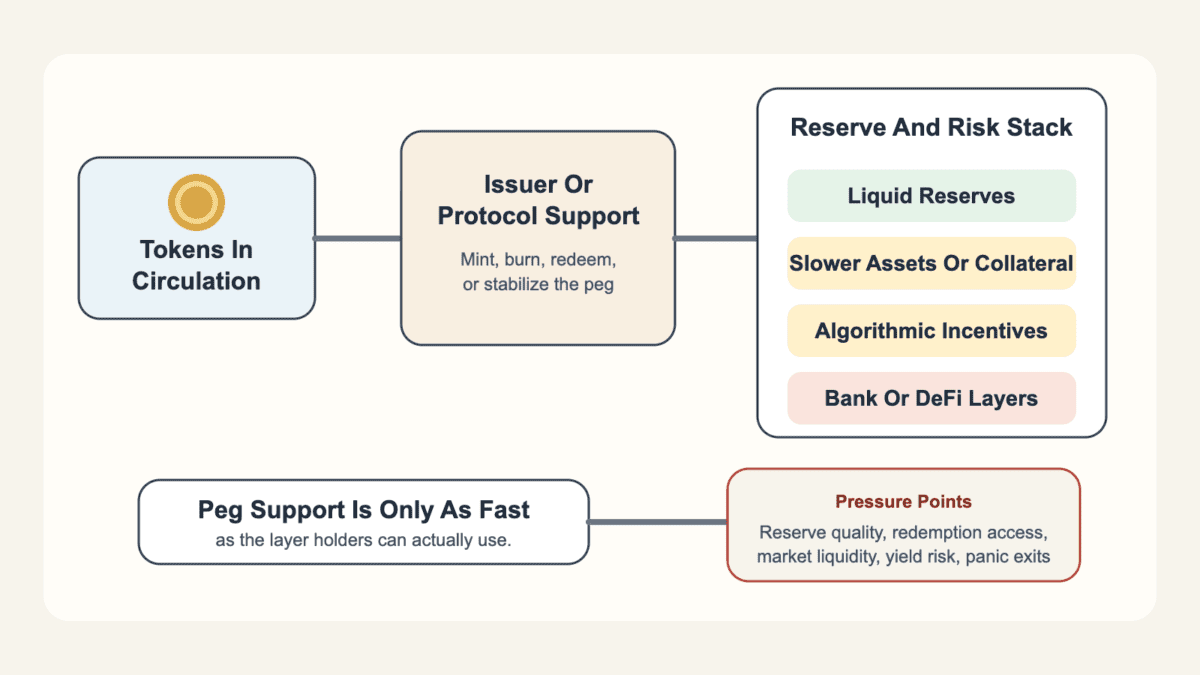
That support layer turns a fractional reserve stablecoin from a simple dollar token into a stack of reserve, redemption, market, and confidence risks.
The user test is direct: if the token slips, can someone buy it below $1, redeem at $1, and close the gap quickly? If only a small set of institutions can do that, the peg may still recover, but your personal exit route can be slower and messier.
A fractional reserve stablecoin can depeg when sellers arrive faster than buyers, redemptions, or reserves can absorb them. That does not always mean the token is insolvent. It means the market is no longer treating the $1 promise as instant cash.
Depegs often start in public trading venues. A DEX pool can become imbalanced. An exchange order book can thin out. Market makers can widen spreads. When everyone tries to sell through the same narrow door, exit liquidity becomes the real peg support, at least for that moment.
Direct redemption pressure is different. That is where holders ask the issuer or protocol for the asset behind the token. If the issuer has liquid reserves, clean banking access, and clear rules, redemptions can stabilize the market. If reserves are slower, reports are unclear, or access is limited, the market starts discounting the token before the final answer arrives.
Common break points look like this:
| Break Point | What The User Sees |
|---|---|
| DEX pool imbalance | The token trades below target on-chain. |
| Exchange liquidity dries up | Spreads widen and size becomes harder to exit. |
| Redemption pressure rises | Direct exits slow, queue, or become eligibility-limited. |
| Reserve doubts spread | Traders price the token below its stated backing. |
| Bank or custody access breaks | Funds may exist, but moving them gets harder. |
A bank run is the harsher version of the same story. Holders do not wait calmly for a spreadsheet. They try to redeem or sell before everyone else. Even a partly sound system can wobble if reserves need time, buyers step back, and confidence falls faster than assets can be converted.
> A depeg is a price signal, not an autopsy. It tells you the market wants faster proof, better liquidity, or a clearer exit path.
The right response depends on the layer that failed. A small pool imbalance may be temporary. A frozen redemption route is more serious. A reserve shortfall is serious enough to make “stable” feel like a branding department with a headache.
Fractional reserve stablecoin yield comes from economic activity around the token, not from magic. The yield may be paid by an issuer, an exchange, a lending market, a liquidity pool, a protocol incentive program, or a debt-funded DeFi strategy.
The source is more important than the headline rate. An issuer may earn income from reserve assets such as Treasury bills and keep it. An exchange may pay rewards to attract balances. A DeFi market may pay lenders because borrowers are paying interest. A liquidity pool may pay fees because traders use the pool. A protocol may pay incentives from its own token emissions.
Those sources are not equal. Reserve income can be relatively boring. Borrower interest depends on demand and collateral quality. Liquidity-pool fees come with price, pool, and smart-contract risk. Incentives can vanish when the token budget runs low. Recursive vaults can look clever until liquidation math stops being theoretical.
DeFi yield farming sits on the riskier end of that map. Farming can be a real source of stablecoin yield, but it usually adds protocol, liquidation, oracle, bridge, or counterparty risk. A stable token used inside a risky strategy does not make the whole strategy stable.
Before chasing yield, ask these checks in order:
Yield is not automatic proof of fraud. But it is always a clue. If the return is much higher than boring cash-like alternatives, the missing explanation is usually risk, subsidies, borrowed exposure, or a promotional budget. Sometimes it is more than one at once.
Bank-issued stablecoins and tokenized deposits change fractional reserve stablecoin risk because the token may be fully backed at one layer while still touching fractional-reserve banking underneath. That is why policy debates can sound like a fight over definitions.
A payment stablecoin can be designed around 1:1 reserves held in cash, Treasury bills, repurchase agreements, or similar liquid assets. In the U.S., the GENIUS Act framework described by the Richmond Fed says permitted payment-stablecoin issuers must hold high-quality liquid reserve assets backed at least 1:1, meaning a 100% reserve requirement, and prevents issuers from paying yield directly to holders.
That reduces one obvious danger: hidden issuer-level fractional backing. If a permitted issuer must hold qualifying reserves against outstanding tokens, the stablecoin should not depend on ordinary lending of those reserves to make the peg work.
But bank-layer risk does not disappear. Some reserves may sit as bank deposits. A bank-issued tokenized deposit may represent a claim on a bank balance sheet, not a segregated pile of assets waiting for every token holder. The holder’s legal claim, eligibility, transfer limits, insurance treatment, and redemption path all need separate checks.
The bank-issued version usually needs three separate checks:
Regulation also does not fix every crypto-native risk. Custody can still fail. A chain can halt. A bridge can break. An exchange can restrict withdrawals. An issuer can be sound while a wrapped version of its token is not. The label alone is not enough.
So a regulated stablecoin may be safer against one type of fractional reserve stablecoin risk, especially hidden backing risk. It is not a universal shield. Users still need to know who owes them money, where the reserves sit, how redemption works, and which layer they actually hold.
Before holding a fractional reserve stablecoin, check the model, reserve proof, redemption rights, custody path, and yield source. A token used for same-day trading deserves a different risk tolerance than a token used as a savings substitute.
Start with redemption. Can you redeem directly with the issuer, or are you relying on an exchange market? If only institutions can redeem at par, retail holders may still be fine most days. But during stress, they are using liquidity routes, not the issuer’s front door.
Then read the reserve information. Look for assets and liabilities together, not only a list of impressive assets. Check whether the report is an audit, an attestation, a dashboard, or a marketing page. If the stablecoin relies on collateral, ask whether that collateral can fall, freeze, or get liquidated.
Use this checklist before moving meaningful funds:
Custody is its own layer. If you hold through an exchange, you hold an exchange claim. If you self-custody, you need competent wallet custody and a chain route that actually supports the token you hold. If you bridge the token, you add bridge risk.
Opacity is another warning sign. A stablecoin does not need to collapse overnight to hurt users. Changing terms, weaker reports, shrinking redemption options, and quiet shifts in collateral quality can create soft rug risk long before the headline moment.
The useful rule is deliberately boring: match the stablecoin to the job. Trading cash, payroll settlement, DeFi collateral, and yield storage all need different standards. If the use case cannot survive a depeg, a withdrawal delay, or a week of ugly headlines, the position is too casual for the risk.
Start with the model, not the brand. A fractional reserve stablecoin can be a partly backed token, a fractional-algorithmic design, a bank-issued token, or a stablecoin wrapped into a riskier DeFi stack. Name that model before comparing yield or reputation, because the model tells you which failure path deserves the closest look.
Then work from your actual exit route. A token may have institutional redemption, deep exchange markets, and clean reserve reports. That is useful. But if you cannot access redemption, your real exit is the market someone else gives you. The check is not whether someone can exit cleanly. It is whether you can exit through the route you plan to use.
Use these next actions before holding size:
If you are using the token for one quick trade, market depth and withdrawal access may be enough. If you are parking funds for weeks, lending it out, or using it as dry powder, require a stricter answer on reserves, custody, and redemption. Test withdrawal limits, venue rules, and redemption terms before you need them.
You do not need to become a banking professor to use stablecoins safely. You just need to know which promise you are holding. If the peg depends on liquid reserves, clear redemption, and boring disclosures, fine. If it depends on confidence, loops, and everyone staying calm at once, maybe do not make it your emergency cash. That one distinction can save more stress than another hour staring at the price chart.
No. A fractional reserve stablecoin is not always undercollateralized in the same way. Sometimes the phrase means less-than-full backing. Sometimes it describes a fractional-algorithmic design. And sometimes it refers to a bank or tokenized-deposit layer connected to fractional-reserve banking.
The exact risk depends on what backs the token, who can redeem it, and whether the support is immediately liquid.
No, a fractional-algorithmic stablecoin is one type of fractional reserve stablecoin risk, not the whole category. It usually combines partial collateral with algorithmic incentives, arbitrage, or a second token.
The broader phrase can also cover undercollateralized structures, bank-issued tokenized deposits, and DeFi layers that create fractional exposure around a stablecoin.
Yes, a 1:1 backed stablecoin can still touch fractional reserve risk through banks, custody, wrappers, exchanges, or DeFi layers. The issuer-level reserves may be one-for-one, while another layer introduces a different claim or chokepoint.
That is why users should separate issuer reserves from the token route they personally use.
A fractional reserve stablecoin can depeg when selling pressure outruns liquidity, redemptions, or confidence. The trigger may be a thin pool, a rumor about reserves, a slow redemption process, a bank-access problem, or a failed DeFi strategy.
A depeg is not always permanent, but it is always a warning to inspect the exit route.
Fractional reserve stablecoin yield is a warning sign when the source is unclear, subsidized, debt-funded, or hard to exit. Yield can come from real activity, including lending demand or trading fees, but it is never free.
Ask who pays, what risk funds it, and who loses money if the strategy breaks.
Regulated stablecoins can be safer against hidden issuer-level backing risk when rules require high-quality reserves and clear disclosures. That does not make every regulated stablecoin risk-free.
Custody, jurisdiction, chain, exchange, redemption, and wrapper risks can still affect the token you actually hold.