Physical Address
304 North Cardinal St.
Dorchester Center, MA 02124
Physical Address
304 North Cardinal St.
Dorchester Center, MA 02124

Check freeze authority before a Solana token traps your exit.
Freeze authority is a token permission that lets an authorized address freeze specific token accounts and block that token from moving.
You will usually see the freeze authority flag around Solana SPL tokens, especially new meme coins, stablecoins, and token launches. It does not freeze your whole wallet or hand over your private key, but a frozen token account can leave that token position stuck until the authority holder thaws it.
Freeze authority in crypto means a designated address can freeze token accounts for a specific token. On Solana, this control is attached to the token mint, then used against individual token accounts for that mint.
A mint is the token’s shared record. It defines the token and stores core fields, including whether freeze authority exists.
A token account is where a wallet holds that token. If that token account is frozen, the wallet still exists and the balance can still show. Movement from that account is blocked.
The simplest way to read the flag is this:
The Solana Freeze Account reference describes frozen token accounts as keeping the same owner, mint, and balance while blocking receiving, transferring, or burning until thawed. For a trader, that means the sell button can become decoration. Expensive decoration.
Freeze authority works on Solana by letting the authorized signer change a token account’s state from initialized to frozen. The freeze affects that token account, not every asset in the wallet.
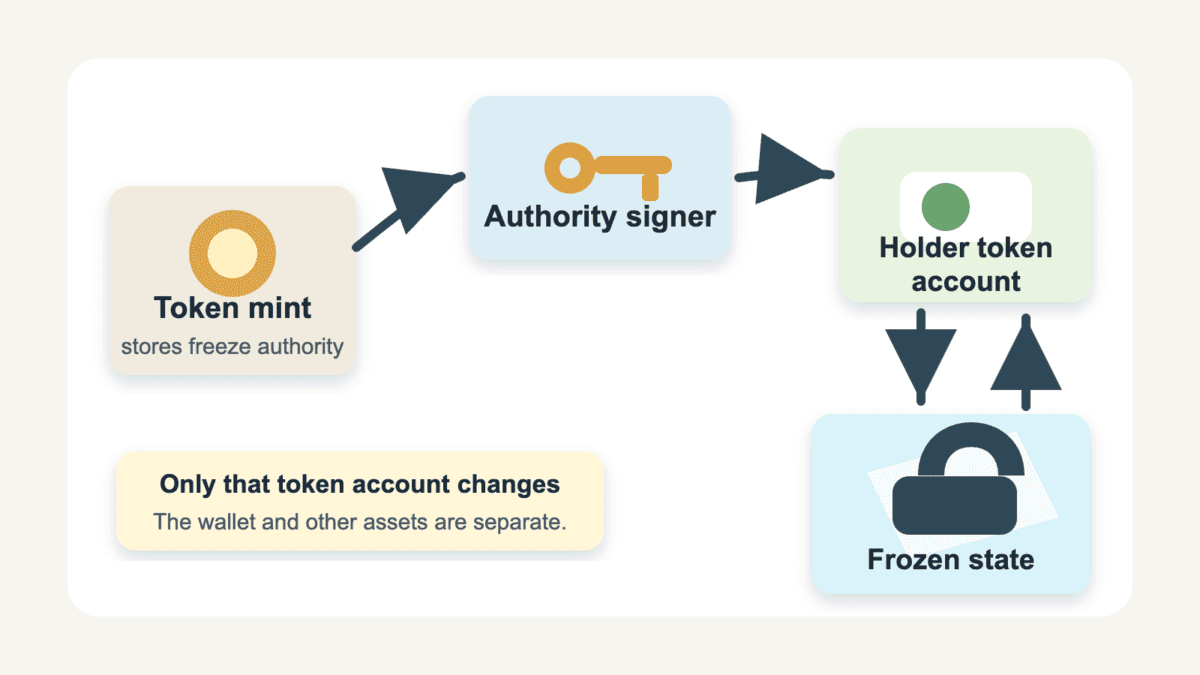
The moving parts are simple once you separate them:
| Step | What Happens |
|---|---|
| Token mint exists | The mint defines the token and may store a freeze authority. |
| Holder receives tokens | The holder’s wallet uses a token account for that mint. |
| Authority signs freeze | The token account state changes to frozen. |
| Holder tries to move tokens | Sends, swaps, burns, and many sells fail for that token account. |
| Authority signs thaw | The token account can move the token again. |
That is the mechanism in plain English. A chart, pool, or trading app can still show market activity because other token accounts may not be frozen.
So one buyer may sell while another cannot. That feels absurd if you expect tokens to behave like coins in one shared wallet balance. The risk depends on who controls the authority, how public the policy is, and whether the token is a serious product or a Friday-night meme launch with a logo and a prayer.
Freeze authority is a red flag before you buy when the token is speculative, anonymous, thinly traded, or promoted as trustless while still keeping active freeze control. It tells you someone may have a direct way to block selected exits.
The wider checklist is not theory. A 2026 SolRugDetector paper reported 76,469 rug-pull tokens among 100,063 tokens newly issued on Orca, Raydium, and Meteora in the first half of 2025, with freeze authority abuse among the representative patterns it studied.
The ugly version is easy to picture. A chart rises, Telegram celebrates, and your wallet shows a balance. Then your swap fails because your token account is frozen while other wallets keep moving. That can turn buyers into someone else’s exit while the chart still looks alive.
Do not stop at the freeze authority flag. Run the wider check before you buy:
Active freeze authority is not a full verdict. But on a tiny anonymous meme coin, it is enough to pause. The market will offer another casino table within minutes.
Freeze authority, mint authority, liquidity locks, and blacklist risk describe different controls. They can overlap in scams, but they are not the same signal.
Freeze authority is about moving existing tokens from token accounts. Mint authority is about creating more tokens. Liquidity controls affect whether buyers and sellers can trade against a pool. Use the table as a map, not a green-check machine:
| Control Or Signal | What It Changes For A Trader |
|---|---|
| Freeze authority | A specific token account may be blocked from moving that token. |
| Mint authority | More supply may be created if the mint authority remains active. |
| Liquidity lock or depth | A pool may be harder to drain, or too thin for real exits. |
| Holder concentration | A few wallets may control enough supply to crush price. |
| Blacklist or transfer restriction | Some addresses may be blocked by rules outside basic freezing. |
| Metadata authority | Token name, symbol, or image may still be changeable. |
Revoked freeze authority does not save a weak token by itself. A project can still drift into abandoned support, insider selling, or slowly fading liquidity.
A weak market can also create stuck-holder risk without any freeze at all. If liquidity disappears or holders dump into weak bids, the sell button may work while the exit price does not.
Use scanners as dashboards, not verdict machines. A revoked freeze authority flag is useful, but it does not put a halo over the token.
Check freeze authority before trading by verifying the token mint address in an explorer, then cross-checking the result in a scanner or trading interface. Screenshots and chat claims are not enough.
Start with the mint address, not a ticker. Tickers are cheap. Copycats are cheaper. A single wrong character can send you to a different token with different permissions. Use this workflow:
This check is most useful in the trenches, where new Solana tokens can move from invisible to overhyped before your coffee gets cold. Speed helps only when it does not replace verification.
Never connect your wallet to a random “authority checker” that asks for signatures, approvals, or seed phrases. A public mint lookup should not need power over your wallet.
Active freeze authority can be legitimate when the token is designed for compliance, controlled onboarding, fraud response, or a regulated asset structure. The control may fit the product, but it still creates holder risk.
Stablecoins, real-world asset tokens, and security-style tokens may need account controls for legal orders, sanctions compliance, fraud response, or issuer policy. The control can fit the product and still hurt users. Holders are accepting an administrator, not just a token.
Look for clear disclosure before accepting active freeze authority:
The weakest version is an anon dev asking buyers to trust active freeze authority with no policy, no identity, and no credible operating reason. That is not nuance. That is fog.
A stronger setup names the controller, explains the policy, and gives users a verification path. It still carries censorship risk. If your token account can be frozen, you are holding an asset with an off-chain power center attached.
If a token is frozen by freeze authority, the wallet app usually cannot thaw it for you. The relevant authority holder must thaw the token account, or the position may stay stuck.
First, confirm what is actually frozen. Check the token account in an explorer, verify the mint address, and compare the status with wallet or scanner warnings. Then avoid every panic link that promises a one-click unfreeze.
Use this checklist before you touch anything:
| Action | Reason |
|---|---|
| Verify the token mint | Fake tokens and fake support pages often share names. |
| Check the token account state | You need to know whether it is actually frozen. |
| Contact official project channels | Only the authority holder can thaw the account. |
| Avoid random unfreeze links | Many are wallet-drain attempts. |
| Refuse seed phrase requests | No legitimate thaw process needs your seed phrase. |
| Record transaction details | You may need evidence for support or reporting. |
That boring checklist is the point. Wallet support cannot simply reverse the control logic because the freeze lives in the token account state.
For basic wallet safety, treat “unfreeze” sites like a second trap. If the project disappears and liquidity is gone, the frozen position may become a stranded balance that looks real and exits nowhere.
Founders should usually revoke freeze authority for public meme coins and community tokens when there is no real need for account-level control. Buyers expect that signal because active freeze authority can block exits.
For compliant products, revocation may be the wrong move. A stablecoin, RWA token, or controlled-access asset may need freezing for policy reasons. In that case, the team should disclose the control instead of pretending the token is fully hands-off.
Before revoking freeze authority, founders should check a few basics:
Solana’s Set Authority flow is the authority-change path, including setting an authority to none. Once freeze authority is removed, founders should assume it is gone for good.
If a team keeps freeze authority, identity and disclosure become part of the trust question. A doxxed founder is not automatically safe, but visible accountability beats mystery-wallet control and vibes.
Related terms for freeze authority help separate different exit failures. The freeze control is only one way a position can become hard to move or sell.
Use the nearby vocabulary to name the actual failure mode:
Start freeze authority checks before you buy, not after the swap fails. The flag is easiest to read when you still have the option to walk away.
For traders, use a short routine every time:
For founders, decide whether the authority has a real reason to exist. If it does, disclose the controller, policy, and verification path. If it does not, revoke it and let the transaction speak.
Do not make the check a one-time launch ritual. If a token changes hands, migrates pools, adds market makers, or gets listed in new interfaces, revisit the wider risk map. Authority status is one line. Liquidity, holders, and wallet safety still write plenty of the story.
Then keep learning around the edges. CryptoProcent’s guides can help connect freeze authority with rugs, liquidity, wallet safety, and trading slang without turning every warning label into prophecy.
Freeze authority in crypto is a token permission that lets an authorized address freeze specific token accounts for that token. On Solana, it is usually discussed around SPL tokens and their mint authority settings.
The important detail is scope. Freeze authority affects token accounts for that token, not your whole wallet and not every asset you hold.
Yes, freeze authority can stop you from selling if the token account holding that token is frozen. A frozen token account usually cannot send or swap that token until it is thawed.
That does not mean every holder is frozen. Other token accounts may still trade, so a chart can keep moving while your own exit fails.
No, freeze authority alone does not give the creator your private key or permission to drain your whole wallet. It is a token-account control, not a wallet takeover tool.
But a frozen token position can still be financially painful. The token may sit in your wallet while liquidity disappears, support vanishes, or fake “unfreeze” links try to steal from you.
No, active freeze authority is not always a scam. Stablecoins, regulated assets, and controlled products may keep it for compliance, fraud response, or account-control reasons.
The controller and token type change the risk. Active freeze authority on a random anonymous meme coin is very different from active freeze authority on a clearly disclosed regulated asset.
Freeze authority revoked means the authority role has been removed or set to none, so that role should no longer be able to freeze new token accounts. It is a useful trust signal.
Other risks remain. Mint authority, liquidity depth, holder concentration, transfer restrictions, and insider wallets can still create serious risk.
Freeze authority generally cannot be turned back on after it has been permanently revoked through the token authority settings. That is why founders should check frozen accounts and policy needs before revocation.
For traders, revoked freeze authority is good to see. Still, it should be one line in the checklist, not the whole checklist.