Physical Address
304 North Cardinal St.
Dorchester Center, MA 02124
Physical Address
304 North Cardinal St.
Dorchester Center, MA 02124


Governance forum basics for DAO users.
A governance forum is the public place where a crypto DAO introduces proposals, debates changes, revises drafts, and links users to later votes or execution.
It sits between casual chat and formal voting. The forum shows who is asking for money, who wants a parameter changed, who is pushing back, and whether a proposal is still an idea or already moving toward a binding vote.
For holders and traders, the useful question is simple. Is this forum post noise, early warning, or the start of a real protocol change? The answer depends on the proposal stage, the voting rules, the people behind it, and whether the final action can move funds, change risk settings, or alter token incentives.
A governance forum in crypto is where a DAO or protocol turns public discussion into a more formal proposal path. It usually hosts early ideas, draft proposals, delegate questions, budget requests, risk changes, and implementation updates.
It is not the same thing as Discord, Telegram, Snapshot, Tally, or a normal customer support board. Discord can be noisy and fast. A governance forum is slower and more traceable. Snapshot often handles signal voting. Tally or another voting portal may handle on-chain votes. The forum is where the argument, context, and revisions usually live.
That trail is the point. If a proposal changes collateral rules, spends treasury funds, or gives a team new permissions, users can read the debate before the vote screen turns the issue into a simple yes-or-no button.
Crypto governance is messy enough that the record does real work. A proposal title can sound harmless while the details touch treasury funds, collateral rules, token emissions, or contract permissions. The forum gives users a place to inspect the proposal before it becomes a vote dashboard with a timer attached.
Think of it as the public notebook before the legal-ish machinery starts moving. The notebook can still be chaotic. Some threads are serious. Some are lobbying. Some are abandoned after two replies and a shrug. But a live governance forum is often where a future protocol change first becomes visible.
A governance forum fits into a DAO proposal as the discussion and drafting stage before any stronger signal or execution step. A forum post can become a vote, but many posts never leave the discussion stage.
The exact workflow changes by DAO. Some protocols require a forum post before a Snapshot poll. Others use a formal improvement-proposal process, a delegate review period, a temperature check, then an on-chain vote. In Arbitrum’s DAO proposal guide, a Snapshot temperature check needs an Ethereum wallet address with 500,000 votable tokens before eligible proposals move through forum discussion, Snapshot checks, and Tally on-chain voting.
This simple lifecycle keeps the stages separate:
| Stage | What It Means |
|---|---|
| Idea Or RFC | A forum thread introduces the problem, proposal, or rough direction. |
| Forum Discussion | Token holders, delegates, contributors, and service providers ask questions or push back. |
| Revised Proposal | The author updates details, budgets, timelines, or executable actions. |
| Signal Vote | A Snapshot poll or temperature check tests support, often without direct execution. |
| Binding Vote | An on-chain vote or formal vote checks quorum, thresholds, and final approval. |
| Execution | A timelock, multisig, smart contract, foundation, or service provider carries out the result. |
| Follow-Up | Users check whether the approved change actually happened as promised. |
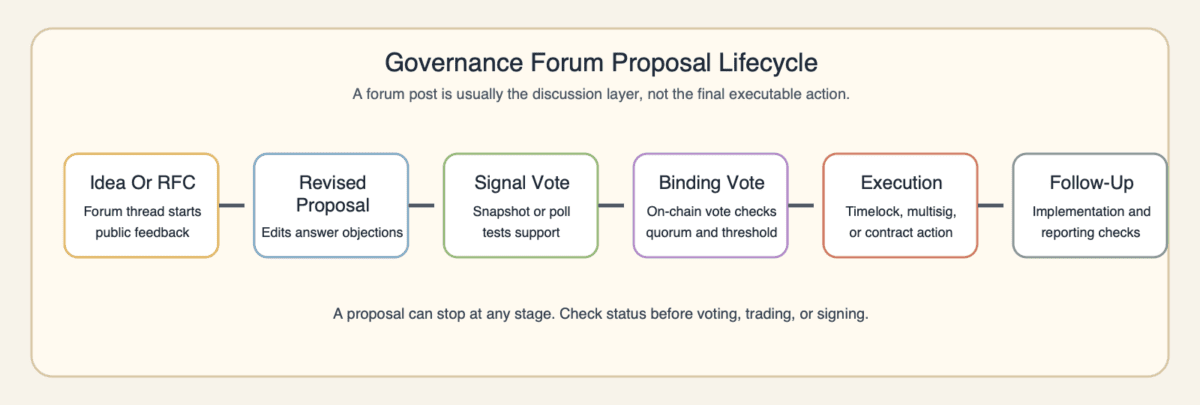
Passing one stage does not always guarantee the next one. A temperature check can pass and still fail later. A binding vote can pass and wait through a timelock. A multisig or security council may still have emergency authority. A service provider may need to perform off-chain work after the vote.
So read a governance forum post as part of a chain. Ask where it sits, what must happen next, and whether execution is automatic, manual, delayed, or still unclear.
A governance forum can usually be read by anyone, but posting, voting, and delegation depend on the DAO’s rules. The open forum is the public surface. Voting power is a separate question.
Common participants include token holders, delegates, delegators, proposal authors, forum moderators, core contributors, foundations, risk teams, and paid service providers. Their powers are not equal. A user with one token may be able to comment. A delegate with millions of votes may decide whether a proposal reaches quorum.
Custody changes the picture. If your governance tokens sit on a centralized exchange, you may not control the wallet that votes. Many DAOs require tokens to be in a compatible wallet, delegated to yourself, or delegated to someone else before voting power counts. That is where basic self-custody wallet knowledge stops being cosmetic and starts changing what you can actually do.
Before assuming you can vote, check these points:
Delegation deserves special attention. Delegating usually assigns voting power to another address without handing over custody, but every DAO can define mechanics differently. Good delegates publish rationales, vote history, conflicts, and what they will not support.
Small holders are not powerless, but they need realistic expectations. One small vote may not swing a whale-heavy DAO. A clear comment, a good question, or a careful delegate choice can still influence the process before the final vote hardens.
Traders track governance forum posts because they can change expectations before a final vote exists. A serious proposal can affect how the market prices risk, yield, liquidity, and future token demand.
The post itself is not confirmed policy. That is the trap. A thread can be early, contested, or dead on arrival. Still, markets often react to credible proposals because traders try to price the next step before everyone else notices it.
Trader-relevant forum posts often touch these areas:
A lending-protocol forum can signal that one asset may become safer, riskier, or less useful as collateral. A token-emissions proposal can change farming returns. A treasury-sale proposal can create expected sell pressure. A bridge deployment can move liquidity across chains.
The bad version is rumor trading. A forum screenshot spreads on social media, buyers chase the governance token, and late entrants become exit liquidity for people who understood the proposal was only a weak signal. Forum posts are useful. They are not magic price receipts.
The practical move is to separate proposal quality from market noise. Check author credibility, delegate response, vote stage, timeline, and whether the proposal touches real parameters. If nothing can execute, the market may only be trading a story.
Governance forum tools split discussion, signal, voting, and execution into different surfaces. The confusing part is that proposal links often travel together, so every page can look equally official.
A forum thread might link to Snapshot. Snapshot might link back to the forum. An on-chain vote might use Tally or another interface. Execution might then happen through a smart contract, timelock, multisig, or operational team. The tools are related, but they do not all carry the same weight.
Use this comparison before connecting a wallet:
| Tool Or Stage | What To Check |
|---|---|
| Governance Forum | Is the post an idea, draft, final proposal, or implementation update? |
| Snapshot | Is the vote a non-binding signal or a required temperature check? |
| Tally Or Voting Portal | Is the vote on-chain, binding, executable, or only recorded there? |
| Timelock | Is there a delay before approved actions can run? |
| Multisig | Which signers can execute, pause, or reject actions? |
| Dashboard | Does it show delegate votes, quorum, thresholds, and proposal status clearly? |
Snapshot is often used for gasless or off-chain signal voting. That can help measure sentiment without making every voter pay network fees. But a signal vote is not always final, and a DAO may still require a later binding vote.
On-chain votes can carry more force when they create executable actions. Even then, they may rely on quorum rules, proposal thresholds, timelocks, guardians, or specific contracts. A voting portal is the interface. The governance system behind it decides what the vote can actually do.
Governance forum risks start when public discussion creates the appearance of control without giving users meaningful power. A forum can be useful and still hide weak governance underneath.
The obvious risk is whale influence. Token-weighted voting can let large holders, foundations, market makers, or delegate blocs dominate outcomes. Low turnout makes that easier. A proposal can look community-approved while most holders never voted.
Fake control shows up in quieter ways too. A team may keep admin keys. A foundation may control budgets. A security council may bypass the normal process during emergencies. A multisig may execute the final step. Off-chain contracts, legal duties, and service-provider decisions can sit outside the vote.
Watch for these warning signals:
Some failures are blunt. If governance language hides direct fund movement, malicious permissions, or a staged exit, the risk can rhyme with a hard rug. If the forum stays open while development fades, responses slow, and promises drift, the pattern can look closer to a soft rug.
That does not mean every unpopular vote is fake governance. Disagreement is normal. The red flag is a mismatch between the public process and the real control path.
A useful forum leaves a trail. You can see objections, revisions, votes, execution status, and accountability. A decorative forum mostly leaves vibes, locked threads, and a polite invitation to stop asking expensive questions.
Reading a governance forum proposal safely means checking source, stage, authorship, vote status, and wallet risk before you comment, vote, delegate, trade, or sign anything.
Start with the official route. Find the forum from the protocol’s main website or official documentation, not from a random reply, ad, message, or cropped screenshot. Governance links are high-value phishing bait because they attract people who already expect to connect wallets.
Then slow the proposal down. A forum post can contain several versions, edits, comments, and linked votes. The first post may be outdated by page two. Delegate replies may reveal the real controversy. A later update may change the budget, recipient, payload, or vote timing.
Use this checklist before reacting:
Social media can help you notice a proposal, but it should not be the record you rely on. Crypto Twitter chatter can point you toward a thread, but the official governance forum and voting tools are where verification happens.
If a proposal asks you to connect a wallet, pause. Read what you are signing. Voting, delegation, and claiming are different actions. A fake page can copy the right logo and still ask for the wrong permission.
Governance forum posts use a small set of terms that can make a simple thread feel like legal paperwork with a token chart attached. The useful move is to define only the terms that change what you do next.
Most terms answer one of three questions. Is this proposal still discussion? Who has enough power to move it forward? What happens if it passes?
| Term | What It Means |
|---|---|
| RFC | A request for comments, usually an early draft before a formal proposal. |
| Temperature Check | A non-final signal vote or poll used to test support. |
| Quorum | The minimum voting participation or support needed for a valid result. |
| Proposal Threshold | The voting power needed to create or advance a proposal. |
| Delegate | A wallet or person voting with power assigned by others. |
| Delegator | A holder who assigns voting power to a delegate. |
| Voting Power | The counted influence a wallet has under the DAO’s rules. |
| Executable Payload | The transaction actions that can run if a proposal passes. |
| Timelock | A delay between approval and execution. |
| Multisig | A wallet requiring multiple signers before an action runs. |
| Treasury | DAO-controlled funds used for grants, operations, incentives, or reserves. |
| Risk Parameter | A setting that can change protocol safety, collateral, fees, or limits. |
These terms are not trivia. They tell you whether a thread is harmless discussion, early pressure, or a proposal that can change the protocol’s money and permissions.
When a forum post lacks these details, that absence is useful information. Serious proposals usually explain the stage, author, cost, timeline, affected contracts, and execution path. Vague proposals ask users to vote on fog.
Start with one governance forum, one protocol, and one recent proposal. Trying to understand every DAO at once turns governance into alphabet soup with wallet prompts.
Pick a protocol you already use, hold, trade, or depend on. Find its official governance forum from the protocol’s main site. Read pinned governance rules before reading the hottest proposal. Rules explain thresholds, vote stages, delegation, quorum, and who can execute approved actions.
If the protocol is a lender, watch risk-parameter and collateral threads. If it is an exchange, watch fee, incentive, and treasury threads. If it is an infrastructure network, watch upgrades, grants, validator sets, and emergency powers.
Then follow one proposal from start to finish:
After that, inspect a delegate. Look at voting history, rationales, conflicts, and whether they explain tradeoffs in plain language. A good delegate makes their reasoning visible before the vote, not just after the result is obvious.
This routine also helps you notice dead forums. If rules are stale, proposals never close, votes have no follow-up, or the same insiders answer every hard question, the governance forum may be more performance than process.
The goal is not to become a full-time governance analyst. The goal is to stop mistaking a forum post for final policy, or a viral screenshot for proof. That alone puts you ahead of a surprising amount of DAO discourse.
No. A governance forum is usually where proposals are discussed and revised, while a DAO vote happens through Snapshot, an on-chain voting portal, or another formal voting system.
Yes, a governance forum proposal can affect expectations when it touches fees, emissions, treasury spending, collateral rules, upgrades, or market deployments. But a forum post is not confirmed policy by itself.
Usually not directly. If your governance tokens sit on an exchange, the exchange controls the wallet, so you may need to withdraw to a compatible wallet before voting or delegating.
Delegation means assigning your voting power to another wallet or delegate so they can vote under the DAO’s rules. It usually does not transfer token custody, but mechanics vary by DAO.
Usually no. A governance forum post is normally a proposal record or discussion thread, not a legal contract. Legal, operational, and execution duties can sit outside the forum.
Verify the governance forum link from the protocol’s official website, documentation, or verified communication channels. Avoid links from DMs, replies, ads, and screenshots.