Physical Address
304 North Cardinal St.
Dorchester Center, MA 02124
Physical Address
304 North Cardinal St.
Dorchester Center, MA 02124


Gas sponsorship removes gas-token friction, not transaction risk.
Gas sponsorship is a crypto fee model where an app, wallet, or sponsor covers network gas for a user’s onchain action.
That can make a swap, mint, game action, or stablecoin transfer feel “gasless.” But gas still exists. The network still gets paid, and the cost moves to a sponsor, a wallet policy, a token-paid fee, a promotion, or a bundled route.
This is useful when you have the asset you want to move but not the native gas token. It is also a place where bad prompts, expired promotions, and vague “free gas” claims can get expensive.
Gas sponsorship in crypto means the user does not directly pay the network fee in the native gas token for a specific action. Instead, a sponsor pays it, abstracts it, deducts it another way, or absorbs it as part of the product cost.
You will see the term around wallets, DEX swaps, stablecoin transfers, DeFi deposits, games, mints, developer tools, and promotional campaigns. The common pain is simple: a user can hold USDC, a token, or an NFT and still be stuck because they have no ETH, SOL, SUI, POL, HBAR, or other native gas token.
That stuck balance can look like crypto dust when the user has value onchain but not enough fee token to move it. Gas sponsorship tries to remove that first bit of friction.
But it does not mean the chain has removed gas. It also does not mean no-KYC, a refund, a token reward, or an endorsement of the app. It only means this transaction may qualify for a different fee path.
Gas sponsorship changes who handles the fee. It does not make the transaction harmless, make irreversible risk reversible, or turn a weak app into something worth using.
Gas sponsorship, gasless transactions, and gas abstraction are related labels, but they do different jobs. Wallets often show the user-facing label first, while developer tools describe the machinery behind it.
Use the terms this way before assuming the fee disappeared.
| Term | What It Usually Means |
|---|---|
| Gas Sponsorship | A sponsor, wallet, app, or paymaster covers gas for an eligible transaction. |
| Sponsored Gas | The network fee is paid or authorized through a sponsor policy. |
| Gasless Transaction | A user-facing label where the user does not need native gas in the wallet. |
| Gas Abstraction | The broader idea of hiding or changing how gas is paid. |
| Paymaster | A smart-contract component that can sponsor or authorize gas in account-abstraction flows. |
| Relayer | A service that submits a transaction or operation for the user. |
| Meta-Transaction | A pattern where the user signs intent and another party submits the transaction. |
| Token-Paid Gas | The fee is deducted from a token, such as a stablecoin, instead of native gas. |
“Gasless” is the slipperiest word in the set. It can mean sponsor-paid, token-paid, fee-bundled, flat-fee, promotional, or gasless only under narrow wallet rules.
That is why the final received amount tells you more than the label. A route can be easier and still include spread, service fees, token deductions, or weaker execution.
The useful test is simple: who pays, what do I sign, and what happens if the sponsor says no?
Gas sponsorship works by separating the user’s signed action from the party that handles the network fee. The user still authorizes an onchain action, but the wallet, app, relayer, bundler, sponsor account, or paymaster manages the fee path.
The exact design depends on the chain and wallet. On Ethereum-style account abstraction, paymasters can verify sponsor rules and cover gas for qualifying operations, as outlined in the ERC-4337 documentation.
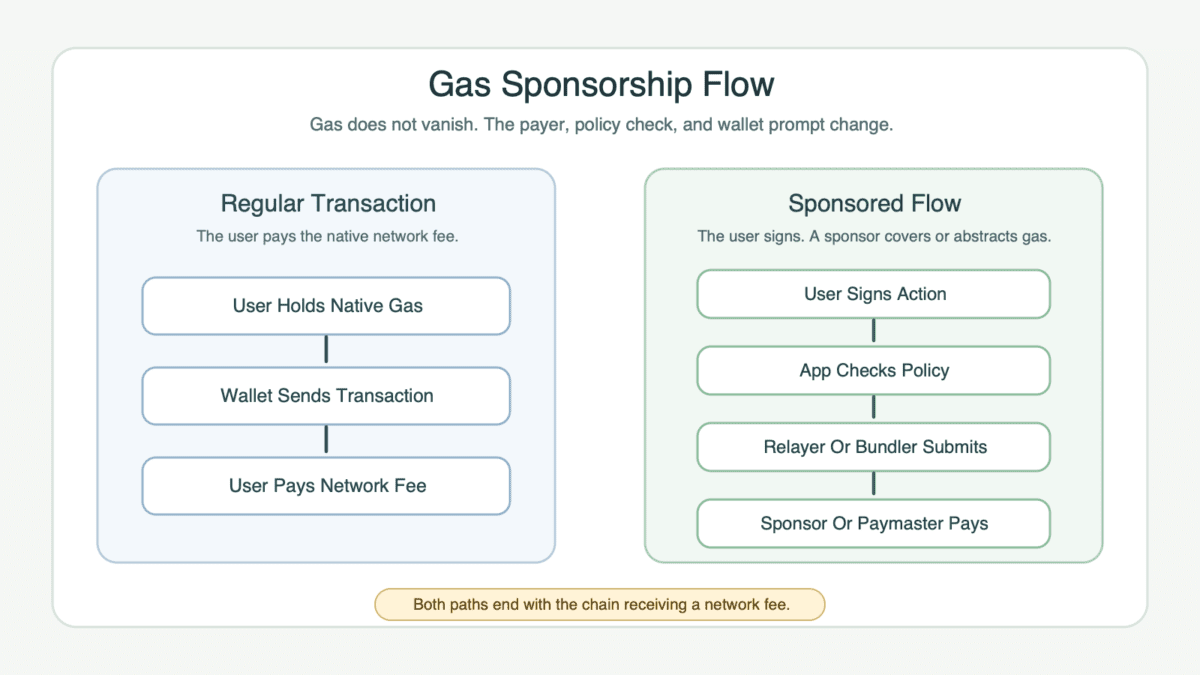
The user starts by signing a wallet prompt. That prompt can approve a swap, send, mint, deposit, game action, or contract interaction.
This is the important part. A gasless signature can still authorize a real transaction. It may include the target contract, token, amount, network, deadline, and spender permissions.
The sponsor checks whether the action qualifies. Rules can include chain, token, app route, contract allowlist, user limits, gas estimate, balance, country restrictions, or promotion status.
This is why sponsored gas often feels inconsistent. One simple send may qualify, while a bridge, hardware wallet transaction, advanced swap, or high-gas DeFi call does not.
After approval, a relayer or bundler may submit the transaction or operation. In an ERC-4337-style flow, the object is often a UserOperation, and a bundler submits it through the account-abstraction path.
Beginners do not need to memorize every component. The practical idea is enough: another service may carry the transaction to the chain while the sponsor handles the gas rules.
The chain still charges a network fee. A validator, sequencer, or block producer is not running a charity desk because the button says gasless.
If the transaction succeeds, the sponsor accounts for the cost. If it fails during validation, execution, or routing, the user may need to retry, pay normal gas, or accept that the sponsored path is closed.
Someone always pays for gas sponsorship. The payer may be obvious, hidden inside the quote, or limited by a sponsor budget that can disappear at the worst possible time.
The payment model tells you what to check before signing.
| Payment Model | What The User Should Check |
|---|---|
| App-Funded Sponsorship | Whether the action, chain, and token qualify. |
| Wallet Promotion | Whether sponsorship is temporary or limited to selected networks. |
| Token-Paid Gas | How much token is deducted and who receives the permit. |
| Merchant Or Game Sponsorship | Whether the subsidy applies after onboarding or only to first actions. |
| Fee-Bundled Route | Whether the final received amount is worse than a normal route. |
| Relayer Model | Whether the relayer can fail, delay, or reject the transaction. |
| Sponsor Credits | Whether credits are capped by user, app, day, or contract call. |
App-funded sponsorship can make onboarding easier. It can also invite bots, spam, and farming incentives when users chase subsidized actions instead of real product value.
Token-paid gas is not fake, but it is not free. If a wallet deducts a flat fee from the token being sent, the user avoids holding native gas while still paying through the transferred asset.
Promotions need extra caution. A sponsor can pause credits, tighten allowlists, exclude bridges, or end support. The label may stay in old posts long after the subsidy is gone.
Gas sponsorship helps traders and DeFi users when gas-token friction blocks a small but real action. The classic example is a user with USDC on Base but no ETH for a transfer, swap, or first DeFi deposit.
In that case, sponsorship can rescue the flow. The user can move value without buying a tiny amount of native gas first, which is exactly the kind of chore that makes new users leave.
For wallet UX, “gasless” can mean different things. In a support page updated May 18, 2026, Phantom support says eligible Solana gasless transactions must be worth at least $0.30 and deduct the network fee from the token being sent, swapped, or deposited instead of requiring SOL.
The trader use cases are usually practical:
That last point explains why GameFi onboarding comes up often. A game that asks players to buy gas before the first action is asking them to learn wallet plumbing before the game gets interesting.
The market angle is more restrained. Gas sponsorship can help new user inflow because it reduces a confusing early step. But it is not a valuation thesis by itself.
A token can turn sponsored gas into a narrative coin story before the app has durable demand. Adoption still depends on liquidity, useful products, wallet reliability, onramps, offramps, base fees, and security.
So the investor read is modest. Sponsored gas is a UX signal. It is not proof that a chain, app, or token deserves size.
Gas sponsorship fails when the transaction does not meet the sponsor’s rules or the sponsor path breaks. That can happen even when the wallet button looked eligible a minute earlier.
Eligibility rules can be narrow. One current MetaMask support example limits sponsored transactions to selected networks, with exclusions such as unsupported bridges, minimum requirements, gas limits, and unsupported hardware wallet accounts.
Eligibility failure means the sponsor rejects the transaction before it gets the fee treatment. The chain may be unsupported, the token may be ineligible, or the action may fall outside the sponsor policy.
Common misses include bridges, advanced swap settings, exact-output swaps, unsupported tokens, hardware wallets, old wallet versions, high-gas calls, and contract interactions that are not on the allowlist.
Sponsors cap usage because unlimited free gas is a bot magnet. Limits can apply per wallet, per app, per day, per contract, per gas amount, or per campaign.
When those caps vanish without clear communication, users can mistake a sponsorship problem for a wallet problem. Sometimes it is normal cost control. Sometimes it looks closer to slow project decay when a product’s promised feature quietly stops working.
A sponsored transaction can still revert after submission. The sponsor may pay for a failed attempt, or the user may need to retry with normal gas, depending on the design.
Troubleshooting should follow a simple sequence:
Paymaster-style error names can sound worse than they are. Most users only need to know whether the sponsor was unavailable, the policy rejected the action, the transaction reverted, or the wallet needs a normal gas path.
Gas sponsorship can be safe when it comes from a legitimate wallet or app and the prompt clearly shows what you are authorizing. It becomes risky when the “gasless” label distracts you from the actual permission.
A good prompt tells you the app, network, token, spender, amount cap, and expiry. A bad prompt asks for broad access, hides the spender, or sends you through a social link that does not match the official app.
Wallet safety is where the boring checks pay rent. Use official wallet support pages or in-app help when a gasless flow changes behavior, and do not let a smoother prompt push you into a full port move.
Check the prompt before you sign.
| Prompt Detail | What To Check |
|---|---|
| App Or Site | The URL, wallet connection, and official domain. |
| Network | The chain where the action will execute. |
| Token | The asset being sent, swapped, or approved. |
| Spender | The contract or paymaster allowed to use funds. |
| Amount Cap | The maximum token amount or fee allowance. |
| Expiry | When the signature or permit stops working. |
| Final Amount | What you receive after gas, spread, or fees. |
| Fallback Gas | Whether normal native gas is needed if sponsorship fails. |
The danger is not gas sponsorship by itself. The danger is signing blind because the fee looks free.
If the prompt is vague, reject it. If the app asks for unlimited approval to save a tiny gas fee, the math is already being rude.
Gas sponsorship becomes scam-friendly when “free gas” is used as bait. A legitimate sponsored transaction should be visible inside the official wallet or app flow, not pushed through a random DM, claim page, or token post.
The scam version usually leans on urgency. It says the gas window is closing, the claim is limited, or the sponsor covers everything if you connect now.
Watch for these patterns:
A fake claim page can drain wallets outright. A softer version can leave users holding a weak token because the promo sounded easy, which is classic bagholder risk with a shinier button.
Sponsored gas is a fee model. It is not proof that a token is safe, liquid, useful, or supported by a real product.
The simple move is still the best one. Start from the official app or wallet, not the post that found you first.
Check gas sponsorship by confirming the sponsor path, the signed permission, and the fallback before the wallet prompt becomes muscle memory. The goal is not paranoia. It is fewer dumb losses.
Run this checklist before signing:
That last point is most important when the transaction is time-sensitive. If you are moving collateral, joining a mint, claiming something valuable, or exiting a position, do not rely on a promotion as your only gas plan.
Gas sponsorship should make a good action easier. It should not become the only reason you take the action.
For investing, separate the UX feature from the thesis. A conviction play needs more than a gasless button. It needs demand, liquidity, credible execution, and a reason the subsidy can stop without breaking the product.
Related gas sponsorship concepts help separate the label from the machinery. The important split is between fee coverage, wallet approval, and transaction execution.
Gasless transactions are the user-facing promise. Gas abstraction is the broader design goal. Paymasters, relayers, bundlers, smart accounts, and permits are ways to make that promise work.
A paymaster can sponsor or authorize gas in an account-abstraction flow. A relayer submits a transaction or operation. A bundler is common in ERC-4337 flows. A permit can let a token cover a fee or approve a limited spend.
Smart accounts make more flexible wallet rules possible. EOAs are the older wallet model where the user usually pays native gas directly. EIP-7702 and ERC-4337 are two account-abstraction paths that appear in current sponsor-gas discussions.
Dust is the nearby wallet problem: value is present, but moving it can be awkward when the fee token is missing. Farming explains why free or subsidized actions can attract activity that looks busy but is mostly chasing rewards.
GameFi is a useful consumer-app example because the first action should feel like playing, not troubleshooting gas. Wallet support helps when a sponsored prompt changes behavior, stops qualifying, or asks for a normal gas fallback.
Scam risk sits next to the UX story too. A fake gasless claim can become a hard rug if the prompt drains funds instead of paying a fee.
The concept is useful because it removes one chore. It becomes dangerous when people confuse one removed chore with removed risk.
Start with gas sponsorship as a wallet-fee feature, not magic. The best use is a clear action where the app or wallet explains who pays, what qualifies, and what you still authorize.
That framing keeps the decision grounded. A sponsored transfer can be convenient. An unclear approval is still an unclear approval. Do the fee check and the permission check together.
Use these next actions:
Small tests are still useful. A tiny sponsored transaction can show whether the wallet, sponsor, token, and app route behave as expected.
For larger moves, compare the quote against a normal route before you lean on the gasless label. A sponsored path that gives you less after spread, token deduction, or routing cost may still be convenient, but it is not automatically cheaper.
If a product only works while gas is subsidized, that tells you something. If it still works after the sponsor stops paying, gas sponsorship was a useful layer, not the whole story.
Gas sponsorship is not always free. Sometimes the sponsor pays, sometimes a wallet promotion covers it, and sometimes the user pays through a token deduction, wider quote, or bundled fee.
The safest check is the final received amount. If that amount is worse than a normal route, the gasless label may be hiding a cost shift.
You may not need the native gas token for that specific sponsored transaction. You may still need it for unsupported actions, retries, bridges, hardware wallet flows, or transactions after the sponsor cap is gone.
Keep a small fallback balance when the move is important. The worst time to discover a promo ended is during a time-sensitive transfer.
A paymaster in gas sponsorship is a smart-contract component that can verify whether an action qualifies and then cover or authorize gas. It is common in account-abstraction flows.
For users, the paymaster is less important than the prompt. Check what action is being authorized, who can spend, how much can be used, and when the permission expires.
A gas sponsorship transaction can fail because the chain, token, wallet, or action is not eligible. It can also fail because the sponsor hits a cap, the paymaster is unavailable, gas estimation breaks, or the underlying transaction reverts.
Retrying blindly is a bad habit. Check the failure reason, reduce complexity, update the wallet, and keep native gas available for a fallback route.
Gas sponsorship can be safe when it comes from an official wallet or app and the prompt is clear. It is risky when “gasless” distracts you from broad approvals, fake sites, vague spenders, or unlimited permissions.
Reject prompts that hide the app, chain, token, spender, amount cap, or expiry. Saving a small gas fee is not worth signing a large blank check.
Gas sponsorship can improve onboarding, but it does not make a chain or token a better investment by itself. It is one UX feature, not proof of demand.
Look for liquidity, useful apps, reliable wallets, clear costs, stable onramps, offramps, security, and whether users stay after subsidies end.