Physical Address
304 North Cardinal St.
Dorchester Center, MA 02124
Physical Address
304 North Cardinal St.
Dorchester Center, MA 02124


Use Galxe quests without confusing rewards for guaranteed value.
Galxe is a crypto quest, credential, and growth platform. Projects use it to run campaigns, verify user activity, and distribute rewards.
You will usually meet Galxe on a task page, wallet prompt, airdrop campaign, Passport check, or token page for G. The confusing part is the naming. Galxe now sits beside Gravity, the old GAL token, and the current G token, so one name can point to several things at once.
Galxe in crypto is a platform that lets projects run quests, prove user activity, and distribute campaign rewards. Think of it as a campaign and identity layer between crypto projects and users.
A project might use Galxe to ask users to follow an account, join a community, answer a quiz, complete an on-chain action, mint a badge, or qualify for a reward. You see a campaign page. The project gets a structured way to measure participation. The trade is simple: attention and activity in exchange for possible access, status, or rewards.
Galxe Solutions Overview maps the current product suite around quests, identity, analytics, developer tools, Gravity, G, Passport, Score, Earndrop, and Alva. That map helps because old Galxe explainers often stop at “credential network” and skip the wallet tasks users see now.
Galxe also belongs to crypto’s attention-and-reward loop. Projects want users, activity, and proof that a campaign did more than produce empty social noise. Users want early access or rewards. Galxe is one place where those incentives meet, useful but still messy.
So Galxe can be a legitimate doorway into crypto campaigns, but the campaign still deserves scrutiny. A Galxe page is a venue, not a guarantee that the project, reward, token, or wallet action is worth doing.
Galxe, Gravity, GAL, and G are related, but each name points to a different job. Galxe is the platform brand, Gravity is the chain layer, GAL is the legacy token, and G is the current token used across Gravity and Galxe.
That naming tangle is where many users get stuck. An older guide may talk about GAL. A wallet may show G. A campaign may use Galxe Quest. A token page may say Gravity by Galxe. Same neighborhood, different doors.
| Term | What To Know Before Acting |
|---|---|
| Galxe | The platform for quests, credentials, identity products, reward campaigns, analytics, and builder tools. |
| Gravity | The chain and infrastructure layer connected to Galxe and the G token. |
| GAL | The old Galxe token name that was migrated toward G. Older articles may still use it. |
| G | The current token tied to Gravity and Galxe utility, including gas, staking, governance, payments, and incentives. |
Galxe’s migration post set the official conversion at 1 GAL to 60 G. It also listed G’s initial total supply at 12,000,000,000 G and described the token as the link across Gravity and Galxe utility, including transactions, governance, incentives, and payments.
That ratio is not the same as a live migration instruction. Before using any portal, exchange flow, or wallet guide, check the current official Galxe or Gravity page and the specific exchange notice that applies to your account. Token migrations are exactly where stale guides grow fangs.
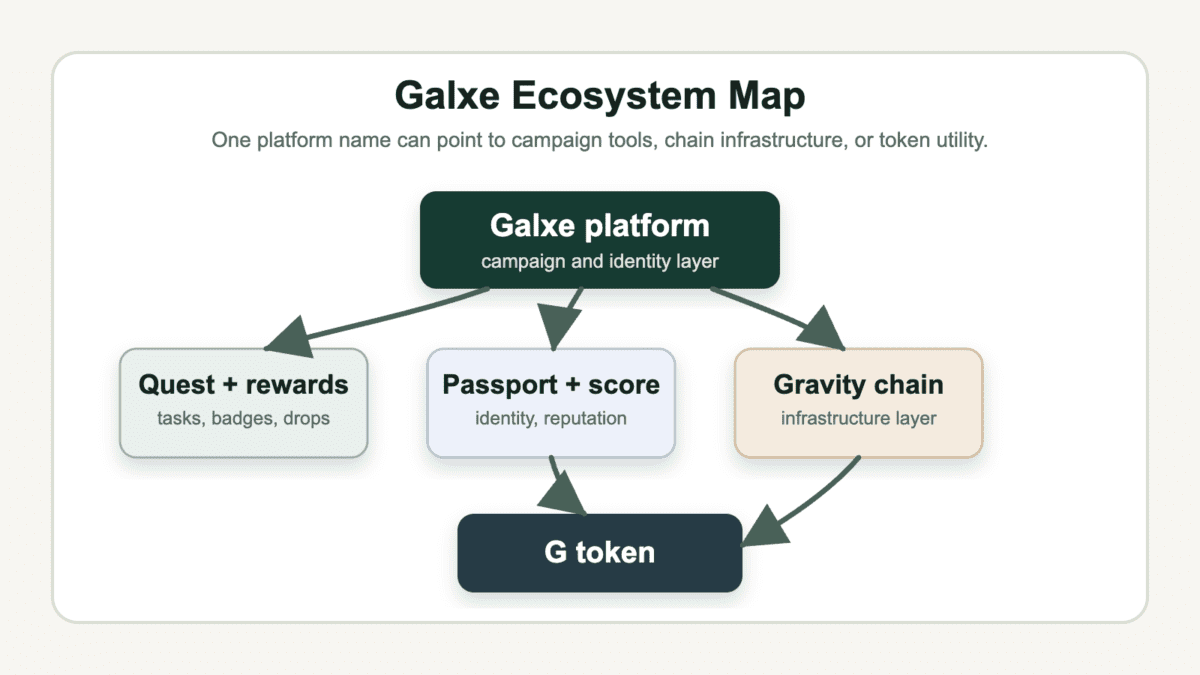
_Galxe is the platform layer. Gravity and G sit underneath the current token and infrastructure story._
Galxe Quest is the campaign product most users see first. A quest gives you tasks to complete, then checks whether you qualify for a badge, point balance, allowlist spot, token reward, NFT, Discord role, or another campaign benefit.
The tasks can be quick or surprisingly expensive. You may be asked to follow a project on X, join Discord, answer a quiz, connect a wallet, sign a message, bridge assets, make a swap, hold a token, mint an OAT, or prove a past on-chain action. The reward can also be conditional, delayed, limited, or worth less than the time and gas spent chasing it.
| Quest Step | What To Check |
|---|---|
| Find the campaign | Confirm the link came from the project’s official channel. |
| Connect a wallet | Check the domain, network, signature text, and requested permissions. |
| Complete tasks | Separate harmless social tasks from on-chain actions that cost gas. |
| Claim a badge or OAT | Confirm whether it is symbolic, useful, or only campaign decoration. |
| Chase rewards | Read eligibility, snapshot, region, Sybil, and distribution rules. |
This is why Galxe often appears in airdrop-farming discussions. Users repeat tasks across campaigns because early activity can sometimes lead to rewards. But repeated effort does not create a right to tokens, and campaign teams can change eligibility rules.
In airdrop circles, users often say they are doing a “farm” when they mean repeated reward-seeking activity, not agricultural finance cosplay. The farm rewards idea helps explain why low-friction quests attract huge participation, bots, and disappointment when the reward pool is small.
The useful habit is to price your effort before clicking through. If a quest asks for five social tasks, low gas, and no sensitive wallet action, the risk may be modest. If it asks for approvals, bridging, deposits, or identity checks, slow down.
Galxe Passport, Galxe Score, and related identity tools are meant to help campaigns decide who qualifies. They give projects a way to look beyond one wallet click and consider reputation, account history, or stronger user signals.
That can help projects filter spam. It can also make users nervous, because identity and eligibility systems can affect privacy, reward access, and account treatment. The key is to separate normal profile or reputation checks from stronger verification flows that may ask for more sensitive proof.
| Tool | User-Facing Job |
|---|---|
| Galxe ID | Connects a user profile and wallet-linked activity inside Galxe. |
| Galxe Passport | Helps prove stronger identity or eligibility signals where a campaign uses it. |
| Galxe Score | Turns activity and reputation signals into a campaign-friendly score. |
| Galxe Identity Protocol | Gives builders identity and credential infrastructure for apps and campaigns. |
| Earndrop | Helps users discover and join reward distribution campaigns. |
| Alva | Offers guided crypto learning and onboarding experiences. |
For users, the question is simple: “What does this campaign ask me to prove, and what do I get for doing it?” Some checks may be light. Others may be tied to stricter participation rules or stronger verification.
Do not assume every Galxe campaign needs KYC. Also do not assume Passport means a harmless badge. Check the exact page, the campaign sponsor, the requested data, the reward terms, and the privacy tradeoff before you continue.
The G token is the current token tied to Gravity and Galxe utility. It can be used for gas on Gravity, staking, governance, payments, and incentives across Galxe-linked products.
Token utility still needs a reality check. A token can have real functions and still perform badly as a trade. Demand depends on actual usage, incentives, liquidity, supply dynamics, staking behavior, and whether builders and users keep coming back after campaign rewards fade.
| G Token Use | What It Depends On |
|---|---|
| Gas on Gravity | Whether users and apps create enough real on-chain activity. |
| Staking | Reward design, governance participation, and user appetite for lockup risk. |
| Governance | Whether proposals affect decisions that holders care about. |
| Payments | Whether Galxe products create repeat fee demand. |
| Incentives | Whether rewards attract durable users or only temporary farmers. |
Keep platform activity separate from token value. Galxe can host active quests while G still faces normal market risk. A campaign can look busy while token buyers fund exits for earlier holders.
That setup can create bagholder risk. If you buy G because you like Galxe Quest, you still need to check liquidity, release schedules, trading volume, migration support, and whether the token has demand beyond a story. A used product is not automatically a winning chart.
Avoid live-price conclusions unless you have refreshed the numbers. Price, market cap, circulating supply, exchange support, and token-release schedules can change quickly. For a migrated token, stale data can be worse than no data.
Galxe risk starts at the campaign level. The platform may be legitimate, but a quest can still send you toward weak rewards, misleading links, expensive actions, unnecessary approvals, or a token that dumps after the farming crowd arrives.
The bigger user-level risk is trusting the wrong link or approving the wrong wallet action. A fake campaign can imitate the real brand. A malicious prompt can turn a five-minute quest into a hard rug for your wallet.
> Never enter a seed phrase for a Galxe quest, reward claim, migration page, or support message. A real campaign does not need it.
Use this quick risk scan before you connect:
Sybil and bot checks add another layer. Galxe’s Bot Identification System uses behavior and on-chain analysis to flag suspicious participation, with possible reward exclusions or account restrictions for some campaigns.
That can protect campaigns from bot farms. It can also frustrate real users who look suspicious because they use fresh wallets, shared funding paths, repeated actions, or multiple accounts. Galxe risk includes wallet safety, reward eligibility, and the chance that the payout is not worth the friction.
There is a softer version too. A campaign can be real, distributed properly, and still disappoint if rewards are tiny, token demand dries up, or the project loses momentum. That is closer to a soft rug than a wallet drain, but it still hurts if you paid gas and attention for scraps.
Using Galxe more safely means checking the campaign before you check the boxes. The goal is not to avoid every quest. It is to avoid turning a possible reward into a wallet, privacy, or time-cost mistake.
Start with source and wallet hygiene. A real campaign should be reachable from the project site, verified social channel, or official Galxe space. A random link in a reply thread is not research. It is a trap with better typography.
Run this checklist before you act:
After the quest, watch what happens next. If a campaign asks for new actions after the original task, review the request from scratch. Attackers love follow-up claims because users are already warmed up and impatient.
The best Galxe setup is boring. Separate wallet, official links, small approvals, no seed phrase sharing, and no heroic gas spend for unclear rewards. If that sounds less exciting than airdrop lore, good. Excitement is where the fee meter starts humming.
Galxe sits in the quest, loyalty, identity, analytics, and campaign-infrastructure category. It is more than a task board because Gravity and G add chain and token layers to the story.
That wider scope can be useful for projects that want campaign tools, identity checks, reward distribution, and user analytics in one place. It can also make Galxe harder to understand for users who only wanted to know whether a quest is safe.
| Platform Type | How Galxe Compares |
|---|---|
| Quest platforms | Galxe is strong where projects need repeated tasks, eligibility checks, and reward workflows. |
| Loyalty tools | Galxe can support points, badges, OATs, and campaign-based user retention. |
| Identity tools | Passport and Score add reputation and eligibility signals beyond one wallet click. |
| Analytics systems | Galxe can help projects see campaign activity and user behavior. |
| Chain projects | Gravity makes Galxe more than a campaign app, but adoption still needs proof. |
This is why Galxe often follows the current crypto meta. When a new chain, airdrop season, or app category heats up, quests become a convenient way to direct user attention. That can be useful discovery or noisy theater, depending on the campaign.
GameFi campaigns are a good example. A gaming project might use Galxe for onboarding tasks, social quests, badges, or reward eligibility. The platform can organize the campaign, but the game’s actual product still has to carry its own weight.
So compare Galxe by job. If you are a user, focus on wallet prompts, reward terms, and identity requests. If you are evaluating G, focus on real usage, liquidity, and token demand. Those questions overlap, but they are not the same decision.
Galxe sits near several crypto ideas that can change how you read a quest page. These concepts explain incentives, risk language, wallet habits, and market behavior around campaigns.
Keep these terms close when a Galxe campaign starts looking too neat:
Use these as filters, not automatic no-go labels. If a quest, token, or migration page triggers one of these concepts, slow down and check the specific action before spending time or gas.
Start with the reason you are looking at Galxe. A quest user, a GAL holder, a G trader, and a project researcher all need different checks.
Do not let one path borrow confidence from another. A useful quest says little about whether G is cheap. A listed token says little about campaign quality. A Passport prompt says little about whether the reward is worth the data tradeoff.
Use this order before taking action:
Galxe can be useful when it helps you discover campaigns, prove activity, and understand eligibility. It becomes expensive when you confuse a task list for guaranteed rewards or a platform explanation for an investment case.
The best first move is usually small. Try a low-risk campaign, read the prompt, track the result, and build from there. If the first step already feels rushed or vague, the next step is not deeper research. It is closing the tab.
Galxe is used for crypto quests, credential checks, identity-linked eligibility, reward campaigns, and user onboarding. Projects use it to organize tasks and measure participation, while users use it to find campaigns, earn badges, qualify for rewards, or prove activity.
No, Galxe is not the same as Gravity. Galxe is the platform brand and product suite, while Gravity is the chain and infrastructure layer tied to the current G token.
GAL became the legacy token after Galxe moved toward G. The official migration ratio was 1 GAL to 60 G, but current portal and exchange support should be checked before taking action.
Yes, some Galxe quests can lead to crypto rewards, points, badges, allowlists, NFTs, or other campaign benefits. The catch is that each campaign controls its own eligibility, reward size, timeline, and anti-bot rules.
Galxe quests can be safe when the campaign is legitimate and the wallet action is low risk. They can become unsafe if you use fake links, approve unnecessary permissions, spend too much gas, or chase unclear rewards from weak projects.
Galxe does not require KYC for every quest. Some campaigns or identity products may use stronger verification, so check the exact Passport, Score, or campaign requirement before sharing personal data.


