Physical Address
304 North Cardinal St.
Dorchester Center, MA 02124
Physical Address
304 North Cardinal St.
Dorchester Center, MA 02124


Understand Jito bundles before a fast Solana route costs more than expected.
A Jito bundle is an ordered group of Solana transactions sent through Jito infrastructure so they can execute together, in order, or fail together.
That sounds tidy until the word “bundled” appears in a wallet, bot, launch scanner, or memecoin chat. A Jito bundle can be neutral transaction routing. A bundled token warning can point to coordinated early buying. Same word, very different risk.
A Jito bundle in crypto is a Solana execution tool for sending several signed transactions as one ordered package. The sender wants those transactions handled together, usually because partial execution would be messy, costly, or useless.
Think of it as a transaction convoy. Each vehicle is still its own transaction, but the sender wants the group to move through the same route in a specific order. If the convoy breaks in the wrong place, the whole plan can fail.
Read the word by context:
That is different from a normal wallet swap. A standard Solana transaction can already contain multiple instructions, such as creating an account and making a swap. A Jito bundle is used when the sender needs multiple full transactions to stay ordered across a route.
The phrase also carries social baggage. In Solana memecoin circles, a “bundled” launch may mean early wallets bought in the same slot, shared a funder, or received supply in a way public buyers did not see clearly. That is a launch-risk signal, not proof that the Jito mechanism itself is shady.
Separate those meanings early, and the rest of the term gets less slippery.
A Jito bundle works by taking signed Solana transactions, preserving their order, and sending them through Jito’s routing infrastructure for possible same-slot execution. The bundle competes for selection, often with a Jito tip attached.
Jito Labs defines bundles as sequential, atomic transaction groups submitted through its Block Engine and caps each bundle at 5 transactions. In plain English, the sender is trying to make a set of actions land together instead of hoping several separate transactions arrive in the right order.
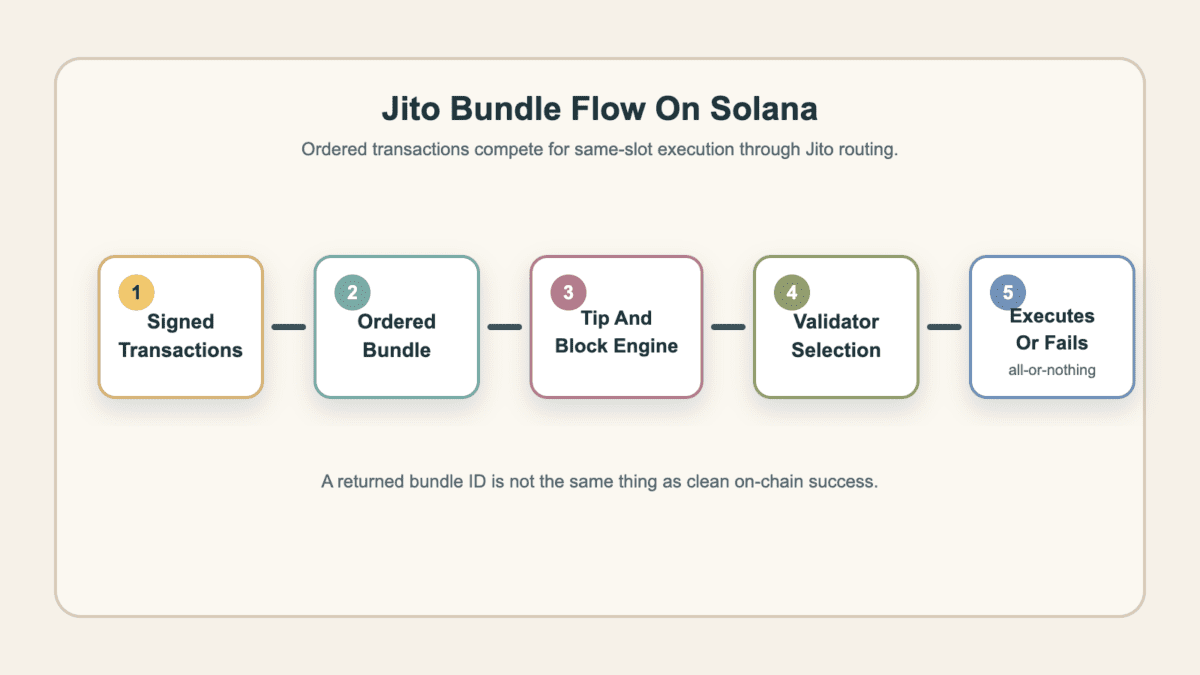
The basic flow is easier than the API names make it sound:
The “atomic” part does the heavy lifting. If one required transaction in the bundle fails, the group should not leave the sender with a half-finished sequence. That is useful for arbitrage, liquidations, multi-step DeFi routes, and other actions where one leg without the other can get expensive fast.
The named methods are mostly labels, not things a normal wallet user needs to call by hand:
sendBundle submits the ordered group.getBundleStatuses checks route status information.simulateBundle tests a bundle before sending.But submission still is not a success stamp. A bundle can miss the relevant leader, lose selection, fail simulation, hit account conflicts, use a stale blockhash, or return a status that is less clear than the trader hoped. Solana is fast. It is not polite.
A Jito bundle is different from a normal Solana transaction because it coordinates multiple full transactions through a specialized route. A normal transaction is enough for many wallet actions, but it does not solve every ordering problem.
The confusion usually starts with Solana instructions. One Solana transaction can include several instructions, so users wonder why a bundle exists at all. The answer is that bundles deal with groups of transactions, not just instructions inside one transaction.
Use this comparison before assuming a Jito bundle is always needed:
| Transaction Type | What Changes For The User |
|---|---|
| Normal transaction | One signed transaction goes through the usual Solana flow and either succeeds or fails on its own. |
| Multi-instruction transaction | One transaction contains several steps, but it still faces size, compute, and account limits. |
| Separate transactions | Several transactions are submitted independently, so ordering and partial success can become a problem. |
| Jito bundle | Several signed transactions are submitted as an ordered group through Jito-aware routing. |
A normal wallet transfer, token approval, or simple swap usually does not need a bundle. The wallet signs one transaction, the network processes it, and the user checks the result.
The quick rule is:
The tradeoff is complexity. Once a route uses Jito bundles, the user may also see bundle IDs, tips, private routing claims, or status labels that do not map neatly to a normal Solana explorer view. That is why “sent” and “landed” should never be treated as the same word.
Jito bundles are used most directly by searchers, bots, DeFi apps, RPC customers, and other Solana infrastructure users. Normal traders usually encounter them indirectly through a wallet route, trading terminal, launch tool, or status label.
That split changes the risk. A builder may care about atomic execution. A trader may care about landing a swap. A memecoin buyer may care that early wallets used bundles before public attention arrived.
Common Jito bundle users include:
Legitimate uses are not rare. A DeFi route may need several actions to happen together. An arbitrage bot may need both sides of a trade or neither. A liquidator may need speed and ordering because the opportunity disappears quickly.
The darker use cases usually share the same pattern:
The same speed and ordering can also show up in harsher markets. A launch sniper may try to buy in the first slot. A tool may submit many related buys. A token team may present bundling as clever market-making while public buyers are left reading tea leaves from a chart that already moved.
Most users do not need to call sendBundle themselves. They need to classify what they are seeing: route plumbing, an execution fee, or a launch-risk signal. That classification keeps a technical term from turning into trader folklore.
Jito bundle tips and Solana priority fees both try to improve execution, but they work through different paths. A priority fee is part of Solana’s native scheduling mechanics. A Jito tip is tied to Jito-aware bundle routing.
Trading interfaces often make this worse by using words like gas, priority, tip, and bribe on one screen. The labels may look interchangeable. They are not.
Use the table to keep the cost stack straight:
| Fee Or Setting | What It Tries To Do |
|---|---|
| Base transaction fee | Pays the basic network cost for processing a Solana transaction. |
| Solana priority fee | Adds urgency through Solana’s native compute-pricing path. |
| Jito tip | Adds an incentive for Jito-aware bundle or transaction routing. |
| Bribe label | Often a user-interface name for a route-specific execution incentive. |
| Slippage setting | Controls how much worse the trade price may become before failure. |
| Platform fee | Pays the wallet, bot, terminal, or service routing the trade. |
The split is simple:
The sharp edge is waste. A Jito tip can be useless if the transaction path does not reach a relevant Jito leader, if the bundle loses selection, or if the trade fails for reasons unrelated to ordering. Raising every fee field after one failed swap is how small trades get slowly sanded down.
A Jito tip is a targeted execution cost. It may be rational for a time-sensitive route. It is not a moral offering to the Solana gods, although some trading terminals do make it feel that way.
A Jito bundle can reduce some front-running and MEV risk when the route, ordering rules, validator path, and trade settings line up. It does not make a bad trade safe.
MEV means value extracted from transaction ordering. On Solana, that can include searchers racing for arbitrage, liquidations, or ways to profit from a user’s swap path. A sandwich attack is the ugly version most traders understand: someone places transactions around a victim’s trade to profit from price movement.
Jito-style routing can help because bundles are not simply thrown into the same public flow as ordinary transactions. Ordered submission, private routes, and protection tools can reduce the chance that another actor sees and reorders a trade in the worst way.
But the protection is limited. It depends on where the transaction is sent, which validator handles the slot, what ordering rules apply, whether the tool uses any anti-front-running feature, and whether the user’s own trade settings are reckless.
> Warning: A Jito bundle can protect the route better than a public send, but it cannot protect you from high slippage, thin liquidity, malicious token rules, or buying a launch after insiders already positioned.
Before trusting a “MEV protected” label, check the parts that decide the outcome:
The last point is where users get clipped. MEV protection sounds like a safety product, but it is closer to better execution hygiene. If a token is illiquid, hostile, or already controlled by early wallets, a Jito bundle only changes how the transaction tries to reach execution.
In memecoin launches, a Jito bundle can mean coordinated first-slot or same-slot buying, not just neutral transaction routing. That is why “bundled” can sound like a warning in Solana launch chatter.
The mechanism itself is neutral. A bundle can arrange liquidity steps, buys, sells, or setup actions in a chosen order. But in launch contexts, the same tool can help insiders, snipers, or tool users secure early allocation before public buyers understand who owns supply.
This is where the term leaves the developer manual and enters Solana launch chatter. A launch can look organic on the surface while early wallets already hold positions bought through coordinated timing.
A simple launch timeline usually tells more than the label:
That pattern does not prove fraud by itself. Some fast buyers are independent bots competing for the same window. Some tools submit similar-looking transactions because users copy the same setup. Still, a bundled launch deserves more inspection than a clean slogan.
> Launch warning: “Bundled” is strongest as a risk signal when first buyers, wallet funders, retained supply, early sells, and liquidity depth all point in the same direction.
Look at who benefits from the early order. If coordinated wallets bought before the public and then sell into later demand, late buyers can become exit liquidity without any dramatic exploit.
Check first buyers, shared funding wallets, retained supply, wallet clusters, early sell behavior, and liquidity depth. Also be wary when a launch page uses “bundled” as proof of sophistication without explaining who controlled the sequence. Crypto marketing loves a technical word with plausible deniability.
Jito bundle risks come from two places: infrastructure failure and trade risk. The bundle can fail as a transaction route, and the underlying trade can still be bad even if the route works.
Technical failure is common enough that users should expect it. A bundle may contain an invalid transaction. It may use accounts that changed after simulation. It may have a stale blockhash, missing account setup, contested write locks, or a tip that loses selection.
Status can also confuse people. A bundle ID means the route accepted a submission, not that every transaction succeeded on-chain. Status methods may have windows, delays, or incomplete visibility. Blindly resubmitting can create duplicate attempts or worse fills.
Use this checklist before assuming the bundle route is the problem:
The second risk layer is less technical and more painful:
A fast buy can still hit a hard rug if liquidity or token controls are malicious. A smooth bundled launch can still turn into soft rug risk if insiders sell slowly while the project keeps posting just enough noise to hold attention.
So split the job in two. Debug the route like infrastructure, then price the trade like risk. If both are weak, paying a higher tip just makes the mistake arrive faster.
Jito bundle, JTO, and JitoSOL are different things that share the Jito name. A Jito bundle is transaction infrastructure, JTO is a governance token, and JitoSOL is a liquid staking token.
That confusion is common because wallets, apps, and social posts can shorten everything to “Jito.” A user may see a Jito tip, a JTO chart, or a JitoSOL staking product and assume they are looking at the same kind of exposure.
A wallet route, token chart, and staking dashboard create different questions. One asks whether a transaction landed cleanly. One asks whether a governance token is worth owning. One asks whether a liquid staking receipt fits the user’s staking and liquidity needs.
They are separate:
| Jito Term | What It Means |
|---|---|
| Jito bundle | Ordered Solana transactions submitted through Jito-aware routing. |
| Jito tip | An incentive used in Jito bundle or low-latency routing paths. |
| JTO | The governance token connected to the Jito network. |
| JitoSOL | A liquid staking token representing staked SOL through Jito. |
Bundle usage can still affect the broader Jito story because it touches Solana execution, validators, and MEV-aware infrastructure. But a bundle status label is not a JTO price thesis or a token recommendation.
If a dashboard labels a transaction “Jito,” ask what the label is naming. It could be a router, a tip, a bundle status, a token, or a staking product. Each one sends you to a different check.
If you are evaluating an asset, evaluate the asset. If you are debugging a route, debug the route. Shared branding is convenient until it makes every “Jito” label look like the same risk.
Related Jito bundle concepts sit around transaction ordering, execution incentives, and launch-risk language. Learning the nearby vocabulary helps you avoid reading every label as either a safety badge or a scam alert.
MEV is value extracted from transaction ordering. A searcher looks for those ordering opportunities. A Jito tip is an incentive for Jito-aware routing, while a priority fee is Solana’s native urgency signal.
These two CryptoProcent guides help with the launch-risk side of the term:
Bundle landing means the bundle was selected and processed in the relevant window. Bundled supply points to early allocation across coordinated wallets. The memecoin side also adds wallet clustering and exit pressure. Wallet clustering looks for links between early wallets, while exit pressure appears when those positions sell into later public demand.
None of these terms should be read alone. The useful signal comes from the stack: timing, routing, funding, liquidity, wallet behavior, and whether the tool explains the tradeoff behind the label.
Start with the exact place where you saw the phrase “Jito bundle.” The right next step depends on whether it appeared in a transaction route, a fee setting, a launch scanner, or a token discussion.
If you saw it in a wallet or trading terminal, check whether the route used a Jito tip, a priority fee, or both. Then compare the fee with position size. A fast route that costs too much is just a cleaner way to overpay.
If you saw it in a bundle status message, do not stop at the bundle ID. Check the transaction signatures, account changes, and final on-chain result. A status label can be useful, but it is not a substitute for the actual transaction record.
Use these steps before acting:
Wallet hygiene is still part of the trade around launch tools and scanners. If a site asks for a connection or approval while you are chasing a fast token, slow down and review wallet safety basics. The worst trade is the one where the token was not even the thing that drained you.
For most users, start by naming the bucket. Decide whether “Jito bundle” is explaining transaction execution, a paid tip, a token launch pattern, or a Jito-branded asset. Once the label is in the right box, the risk gets easier to read.
A Jito bundle is an ordered group of Solana transactions submitted through Jito-aware routing so the transactions can execute together, in order, or fail together. It is mainly used when partial execution would create risk or waste.
No, a Jito bundle is not the same as JTO or JitoSOL. The bundle is transaction infrastructure, JTO is a governance token, and JitoSOL is a liquid staking token.
No, you do not need a Jito bundle for every Solana transaction. Simple transfers and many wallet swaps can use normal Solana transaction flow without bundle routing.
Yes, a Jito bundle can fail. Invalid transactions, stale blockhashes, account conflicts, low tips, missed selection, simulation mismatches, and unclear status windows can all break the route or hide the result.
A Jito bundle can reduce some sandwich-attack risk when used with the right private routing and protection rules. It does not protect you from high slippage, thin liquidity, or a malicious token.
A bundled Solana token usually means early buying or supply control may have happened through coordinated wallets or same-slot transactions. It is a risk signal to investigate, not automatic proof of a scam.