Physical Address
304 North Cardinal St.
Dorchester Center, MA 02124
Physical Address
304 North Cardinal St.
Dorchester Center, MA 02124


Understand Jito tip costs before a Solana trade eats your edge.
A Jito tip is extra SOL paid through Jito’s Solana transaction path. It helps a transaction or bundle compete for inclusion.
You usually notice it when a wallet, swap tool, or trading bot shows a JitoTip, “bribe”, or extra SOL transfer near a Solana trade. That label can look suspicious at first. Often, it is a real transaction cost tied to routing and inclusion, not a random drain.
The hard part is not spotting the fee. It is deciding whether the cost is worth paying. A Jito tip can help in crowded Solana routes, but it cannot fix bad liquidity, bad slippage, broken settings, or a trade that should never have been sent.
JitoTip, or bribe label.A Jito tip in Solana is an extra SOL payment attached to a Jito-routed transaction or bundle. It helps that transaction compete for attention through Jito’s Block Engine and participating validators.
A Jito tip is an inclusion bid, not a normal network toll. It tells a Jito-connected route that the transaction is willing to pay extra for a better shot at being selected. The route still has to be valid. The market still has to cooperate.
That makes it different from the normal Solana base fee. The base fee pays for ordinary transaction processing. A native priority fee is another Solana-level signal that can improve scheduling. A Jito tip belongs to a separate route, usually when an app, bot, searcher, or developer submits through Jito infrastructure.
Do not lump every extra SOL cost into one fee. Solana trading often stacks several costs at once:
So ask what the Jito tip was meant to improve. Was the transaction competing for a crowded route? Was the app using Jito at all? Was the trade large enough for the extra SOL to make sense?
If you are doing a calm swap, the answer may be no. If you are trying to land a time-sensitive route during congestion or a token launch, the tip may have a real purpose.
Separate inclusion from outcome. A Jito tip can help a transaction compete for a place in the block. It does not promise a better quote, deeper liquidity, or a smarter trade. It is a bid for better inclusion, not a coupon for a better price.
You see a Jito tip in your wallet or trading bot because the app may include a SOL transfer to a Jito tip account. Wallets and explorers can show that transfer as a separate line, which makes the fee feel more alarming than a buried route cost.
That anxiety is reasonable. A visible JitoTip does not automatically mean your wallet was drained. It does mean you should check what you signed.
The first check is the signing prompt. A good wallet flow should show enough detail for you to notice unusual transfers, permissions, and fee changes before approval. If your wallet makes that hard, the crypto wallets category is worth comparing because interface clarity is a security feature, not decoration.
After the trade, inspect the transaction hash. Look for the fee stack rather than one scary label. These are the usual suspects:
A real compromise looks different. It may show approvals you did not understand, transfers unrelated to the trade, repeated wallet activity you did not sign, or a malicious site that keeps asking for broad permissions.
A normal Jito tip is narrower. It should connect to a specific transaction route, trade attempt, or bundle. If the amount is higher than expected, the problem may be bad settings rather than theft. That still costs money. But the fix is fee control, not panic-clicking every revoke button in sight.
A Jito tip, priority fee, and bribe fee all touch execution. They are not three clean names for the same charge.
Priority fee is part of Solana’s native transaction fee mechanics. It tells the chain that the transaction is willing to pay more for scheduling. A Jito tip is tied to Jito routing or bundle competition.
A bribe fee is usually the blunt label a trading bot uses for an extra execution incentive. In Solana bot language, “bribe” usually means a fee meant to improve inclusion or ordering, not a legal conclusion by itself. Use this table to separate the labels before adjusting anything:
| Fee Label | What It Means For The User |
|---|---|
| Base fee | The normal network fee for a processed Solana transaction. |
| Priority fee | Extra Solana fee used to signal urgency through native scheduling. |
| Jito tip | Extra SOL used in a Jito route or bundle bid. |
| Bribe fee | A trading-tool label that may map to a Jito tip or another route incentive. |
| Platform fee | The bot, terminal, wallet, or app fee for using that product. |
| Slippage | The worst price movement you allow before the trade fails. |
| Token-account cost | Extra Solana account setup cost that can appear around some token flows. |
The expensive mistake is raising every setting after one failed trade. A higher priority fee may help one bottleneck. A higher Jito tip may help another route. Wider slippage may only let you accept a worse fill. These choices can work together, but they should not move together by reflex.
Before increasing anything, identify the failed point. Did the transaction not land, did it land late, did it fail on-chain, or did it fill at a bad price? Each answer points to a different fix.
A Jito tip works inside a bundle by paying extra SOL to help an ordered group of Solana transactions compete for selection through Jito’s Block Engine. The bundle still has to be valid, competitive, and selected.
In the official Jito low-latency transaction reference, bundles can contain up to five signed transactions that execute sequentially and atomically. The same reference also lists a 1,000 lamport minimum tip for bundles, tip accounts, auction selection, and the warning that submission does not guarantee on-chain landing.
The reference also says a bundle tip can transfer SOL to one of eight designated tip accounts. That is why a wallet may show the tip as a separate transfer rather than as a hidden line item. For users, the flow is simpler:
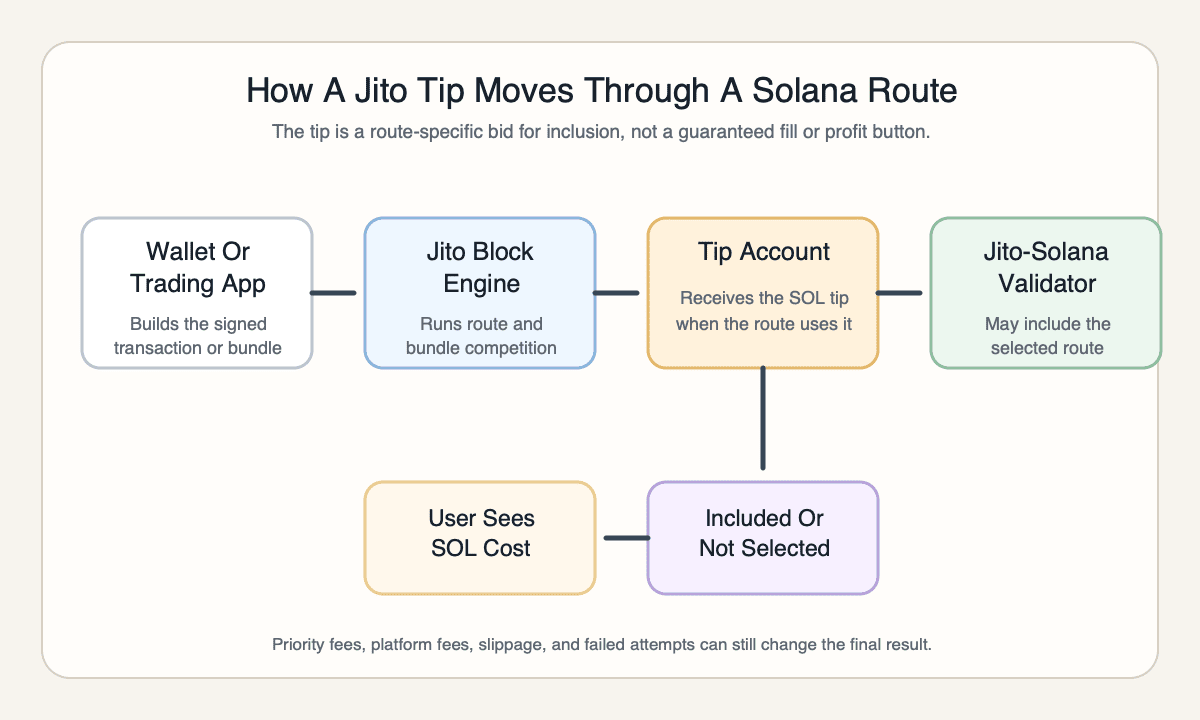
Bundles are useful when order matters. A multi-step trade may need each action to happen in sequence or not at all. Arbitrage, liquidation-sensitive routes, account setup plus a swap, and MEV-aware flows can all benefit from that all-or-nothing behavior.
A normal user does not need to write bundle code to understand the cost. If your app uses Jito behind the scenes, the visible result is usually a setting, transfer, or fee label. The mechanics happen under the interface.
Developers need a stricter rule too. Production integration belongs in current Jito documentation and tested code, not copy-pasted from an explainer.
A Jito tip can help a Solana trade when speed, ordering, or inclusion through the Jito route has real economic value. It is most useful when several users or bots compete for the same scarce execution window.
That includes crowded token launches, hot memecoin entries, liquidation races, arbitrage, and multi-step DeFi routes. In those moments, the market can become PVP trading: your transaction is not just waiting for the chain, it is competing against other traders and bots. Good-fit cases usually share a few traits:
The tip has a job only when the route and the market both support it. If the tool is not sending through Jito, the label may be irrelevant. If the token pool is thin, faster inclusion may still deliver a poor fill. If the trade size is tiny, the fee can eat the whole edge before the chart even updates.
A Jito tip helps only when the route can actually use it. It can improve your bid for inclusion, make a Jito-routed bundle more competitive, and help when the transaction reaches the right leader in valid form.
It cannot fix a poor quote, create liquidity, force a broken token route to work, or turn a crowded exit into a private door. So use Jito tips where execution pressure is real.
Ask whether delay changes the trade. If a few slots can decide whether the transaction lands, the tip may deserve a look. If the swap would work fine without urgency, a higher tip on a lazy trade is just an expensive way to look busy.
A Jito tip is just extra cost when the fee is larger than the practical benefit. Small trades feel this first because fixed SOL costs take a bigger share of the position. This shows up constantly in the trenches, where traders chase new Solana tokens with presets copied from bots, friends, screenshots, or yesterday’s market.
The trade may land quickly, but the final wallet balance may still look worse after priority fee, Jito tip, platform fee, slippage, and the sell-side cost. Use percentage logic instead of magic fee numbers. If a trade needs a 3% move just to beat its full fee stack, the setup is already fragile. The most common waste patterns are easy to spot:
The exit liquidity problem is the sharper version. If few buyers remain, paying extra to arrive earlier may only help you compete for a bad exit. Speed cannot create demand.
The received amount matters more than the chart move. A quick fill can still be a poor fill if the pool is thin, the token is moving against you, or the bot has already taken its platform fee. Check the full cost before celebrating the landing.
Paying extra to arrive first at a bad trade is still a bad trade with better punctuality.
Jito tips sit inside Solana’s MEV market, so they can be connected to both trading competition and protection patterns. That dual role is where users get confused.
MEV means value created by transaction ordering. Sometimes it is useful, such as arbitrage that aligns prices. Sometimes it is ugly, such as sandwiching a swap so the user receives a worse fill.
Jito infrastructure exists because Solana ordering is valuable enough for traders, validators, apps, and bots to compete over it. A Jito route can support protection patterns, including jitodontfront in certain developer flows. That does not mean every Jito-routed trade is protected from sandwiches. Keep the limit clear:
The label “MEV protection” deserves a closer look before you trust it. Ask what the setting changes, what it costs, and whether it applies to your exact route.
If a bot adds a Jito tip for an anti-MEV mode, review both sides of the trade. The buy may be protected in one path, while the sell still faces liquidity, slippage, fee, and route risk. Protection is not a profit shield. It is one control in a crowded execution stack.
Check whether a Jito tip makes sense by comparing the added SOL cost with the trade’s urgency, size, route quality, and expected edge. If the cost does not solve a clear execution problem, lower it or skip the trade.
Start before signing. The wallet preview, trading tool settings, and quote screen should tell a coherent story. If the app hides the fee stack or uses vague labels, slow down. This table gives a quick review routine:
| Check | What It Tells You |
|---|---|
| Trade size | Whether the tip is tiny or huge relative to the position. |
| Expected edge | Whether the opportunity can survive all fees. |
| Liquidity depth | Whether speed can actually improve the fill. |
| Slippage setting | Whether you are allowing a worse price than intended. |
| Priority fee | Whether you are already paying for native urgency. |
| Jito tip | Whether the Jito route has a clear inclusion purpose. |
| Platform fee | Whether the tool cost changes the trade math. |
| Failure history | Whether repeated attempts are compounding costs. |
| Route clarity | Whether the app explains how the transaction is sent. |
Make the trade prove itself before raising the tip. You do not need perfect certainty. You need enough clarity to avoid paying extra out of frustration.
Use these checks before raising a Jito tip:
The strongest signal is simple: you can explain what the Jito tip is trying to improve. If you cannot, you are probably paying for vibes with SOL.
Jito tips make more sense once the nearby terms are separated. The labels often appear on the same screen, but they do different jobs. Priority fee is the native Solana urgency setting. Slippage is price tolerance. MEV is value from ordering. A bundle is an ordered group of transactions that can succeed together or fail together.
A high priority fee can still fail if the route is bad. A high Jito tip can still waste money if the trade has no edge. Wide slippage can make a transaction easier to fill while making the result worse.
When fast exits turn social, early sellers and jeets helps explain why some Solana moves become a race to leave. If the fee looks normal but the token itself looks wrong, hard rug risk helps separate routing costs from projects designed to trap funds.
Wallet prompts, explorers, and bot settings are where users still have control. The route underneath may involve validators, tip accounts, Block Engine selection, and bundle status checks.
You do not need to become an infrastructure operator to trade carefully. You do need to know which cost is paying for which problem.
Name the cost before accepting it. If the label is vague, inspect the transaction. If the math is weak, do not let a faster route talk you into a worse trade.
A Jito tip is extra SOL attached to a Jito-routed Solana transaction or bundle. It helps the transaction compete for inclusion through Jito infrastructure, especially when many routes want scarce execution space.
No. A priority fee is part of Solana’s native fee path, while a Jito tip is tied to Jito routing or bundle competition. A trade can use one, both, or neither depending on the app and settings.
Your wallet may show a JitoTip transfer because the transaction included a SOL payment to a Jito tip account. Check the full transaction, the app settings, and any bribe or fast-route option you approved.
A Jito tip can be a real transaction cost, not a scam by itself. But surprise fees still deserve review. If the transfer does not match a trade you signed, inspect approvals, connected sites, and wallet activity.
No. A Jito tip can improve the transaction’s bid in the right route, but it cannot guarantee landing. Invalid transactions, low tips, crowded accounts, bad routes, and market movement can still cause failure.
Use a Jito tip for small memecoin trades only when the added cost makes sense relative to position size and urgency. If fees, slippage, and platform costs eat the edge, the faster route is not helping.