Physical Address
304 North Cardinal St.
Dorchester Center, MA 02124
Physical Address
304 North Cardinal St.
Dorchester Center, MA 02124


Jupiter route meaning, risks, and swap checks.
A Jupiter route is the swap path Jupiter selects on Solana to move a trade through available liquidity. That path may use one pool, several pools, or an intermediate token.
You may see a Jupiter route in the Jupiter app, inside a wallet swap, or in developer output such as a routePlan. The route can improve execution, but it is still just the path for one trade. It does not prove a token is healthy, liquid, or easy to sell later.
A Jupiter route in crypto is the trade path used to swap one Solana token for another through available liquidity. Jupiter searches for a path that can deliver the best available output, then builds a quote around it.
Sometimes the path is simple. If you swap SOL for USDC, a direct pool may be enough. If you swap SOL for a tiny new token, Jupiter may need an intermediate token, several pools, or no route at all. The route is the first clue about how much real liquidity sits between your wallet and the token you want.
Keep the pieces separate:
So a route is not a custody account, a deposit balance, or a guarantee from Jupiter. It is the execution map for one attempted swap. The map can be useful, but a bad destination is still a bad destination. If the token has weak liquidity, copied branding, or a one-way market, the route can only show the path that exists.
Read the route for three things: expected output, total cost, and whether a later exit would likely have enough liquidity. If one answer looks weak, shrink the trade or stop.
A Jupiter route works by checking Solana liquidity sources, quoting possible paths, and returning the path that fits the swap conditions. Solana trading liquidity is spread across many pools and venues, so one token pair may have several possible paths.
The route can then become a wallet transaction. You see an output estimate, a minimum received number, and sometimes route details. Nothing moves until your wallet approves the transaction.
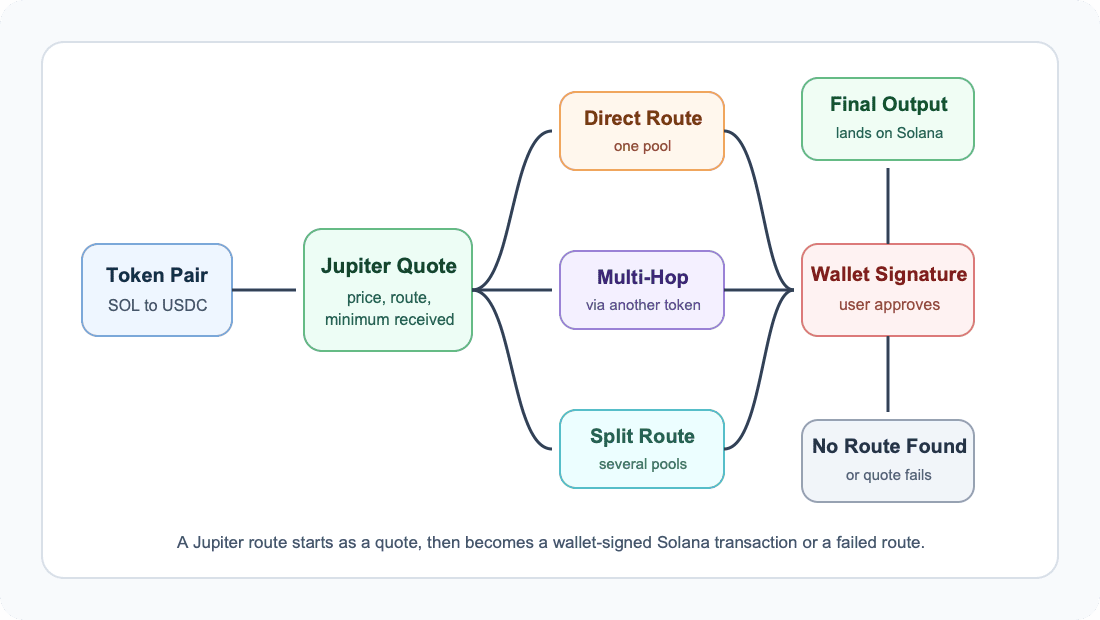
A direct route uses one liquidity pool between the two tokens. It is the clean version: input token in, output token out, fewer moving parts.
A multi-hop route uses another token in the middle. SOL might become USDC first, then the target token. That can improve output when the direct pool is shallow.
Watch for three route shapes:
A split route can reduce price impact for a larger swap, but it also creates more steps. More steps can mean more places where a stale quote, fee, or transaction limit becomes relevant.
A Jupiter quote is not a completed swap. The quote shows what the route expects under current conditions. Your signature approves the transaction. Execution is what actually lands on Solana.
Between those steps, conditions can move. Liquidity can change, another trader can hit the same pool, priority fees can shift, or the wallet can reject the transaction. Fast chains do not make stale quotes polite. They just make timing tighter.
Think of the order as three separate checks:
That is why the final received amount deserves more attention than the headline route. The route can look smart and still land worse if liquidity moves or slippage is set badly.
A Jupiter route shows the trade terms you should inspect before approving the transaction. The important parts are expected output, minimum received, price impact, slippage settings, token address, and any wallet fee or warning shown before signing.
The interface may not show every route detail. Some wallet swaps hide the full path and only show the output. That makes the visible checks more important, especially with new tokens or small trades where one extra cost can eat the point of the swap.
Use this checklist before the wallet prompt becomes muscle memory:
| Check | Why To Check It |
|---|---|
| Token address | Tickers can be copied. The mint address identifies the actual token. |
| Expected output | This is the route’s quoted result before final execution risk. |
| Minimum received | This is the floor after your slippage setting is applied. |
| Price impact | High impact means your trade size is moving the pool. |
| Route venue if visible | A route through unknown or thin liquidity deserves more care. |
| Network and priority fees | These can change the final cost, especially on small swaps. |
| Wallet warnings | A warning may flag token, transaction, or approval risk. |
The key number is usually minimum received. If that number is ugly, the route is already telling you something. You do not need to sign just because a quote exists.
For new or thin tokens, compare the route against a smaller test amount. If a tiny trade routes cleanly but a normal trade creates brutal price impact, the pool is shallow. That is not Jupiter being dramatic. That is liquidity being thin.
A Jupiter route can fail when Jupiter cannot build a usable path for the token pair, trade size, slippage setting, or current liquidity. The error may be temporary. It can also point to a token that is hard to sell.
The version that makes traders pause is no route found. Users often see it after buying a new token and trying to sell. That does not prove the token is a scam by itself, but it changes the next question from “What is the price?” to “Can this trade actually execute?”
A route can fail for several ordinary reasons:
A failed Jupiter route becomes more serious when buying was easy but selling has no path. At that point, the problem starts to look like weak exit liquidity rather than a random app error.
A no-route message can also appear near broader rug-risk patterns. Do not call every failed route a hard rug, but do check whether liquidity can be pulled, trading is restricted, or holders are all trying to exit through the same narrow door.
Before assuming the worst, verify the basics:
If none of those checks help, forcing the trade usually makes the problem more expensive. A route failure is information. Do not treat it like background music.
Jupiter route fees and wallet costs are separate layers. The route quote may look fine, while the final wallet result changes because of DEX pool fees, integrator fees, wallet fees, Solana network costs, priority fees, slippage, or price impact.
Two swaps that both use Jupiter routing can feel different. One happens directly in Jupiter. Another happens through a wallet interface that adds its own cost layer or hides some route detail. Same route engine, different checkout counter.
Here is the clean way to separate the cost stack:
| Cost Layer | What It Can Change |
|---|---|
| DEX pool fee | Reduces output inside the liquidity pool. |
| Jupiter or integrator fee | May appear when a route or integration charges a platform fee. |
| Wallet fee or markup | Can make wallet swaps cost more than the route alone. |
| Solana network fee | Pays for the transaction on Solana. |
| Priority fee or tip | Can help transaction landing during busy periods. |
| Slippage | Sets how far the final execution can move from the quote. |
| Price impact | Shows how much your trade size moves available liquidity. |
Small trades expose this fast. A few extra cents or a small percentage fee can be annoying on a large swap, but brutal on a tiny meme-coin trade. Crypto has a gift for making tiny costs feel loud.
Separate three numbers before signing:
Wallet context changes the math too. If a swap uses Jupiter routing inside a wallet, the route may be only one part of the final cost. Check wallet swaps by final received amount, not just by the routing brand.
Slippage is the lever users control most often. Too tight, and the transaction may fail. Too loose, and a bad route can land at a worse output than expected. For thin tokens, widening slippage can turn a failed trade into an ugly trade. That is not always an upgrade.
A Jupiter route can be safer in the execution sense because it reduces the need to manually shop across DEX pools. It can compare available paths and sometimes split a trade to reduce price impact.
That kind of safety is narrow. It is about execution quality, not token quality. A route cannot prove that a token has honest liquidity, clean contract controls, real demand, or a path out at the size you want.
The trade-off looks like this:
| Choice | Main Trade-Off |
|---|---|
| Jupiter route | Better path search, but route results still depend on liquidity and signing conditions. |
| One DEX directly | More control over the pool you use, but you may miss a better route elsewhere. |
For normal pairs with real liquidity, routing can save time and improve output. For thin tokens, routing can reveal the problem faster. If the route gets weird, fails, or shows harsh price impact, the token may be the weak link.
Direct DEX use can still make sense when you know the exact pool and want fewer moving parts. Active traders sometimes prefer that control. Beginners usually benefit from seeing the route quote first, then checking whether the trade still makes sense after fees and slippage.
Before choosing, ask three plain questions:
The useful habit is not blind trust in the aggregator or blind loyalty to one DEX. It is checking the final output, token address, price impact, and wallet prompt before signing.
Most traders need Jupiter route details when the trade is large, illiquid, expensive, or time-sensitive. If you are swapping a deep pair at a small size, the final output and minimum received may be enough.
Active traders need more detail. Route freshness, price impact, priority fees, and execution timing can decide whether the quoted path survives long enough to land. The faster the market moves, the less useful an old quote becomes.
Different users need different route details:
For builders, Jupiter’s Swap API overview separates a Meta-Aggregator path from a Router path and says RFQ market makers often beat onchain routing by 5 to 20 basis points on major pairs. The meta-aggregator path gives an assembled transaction and managed landing. The router path gives raw swap instructions and more transaction control.
That is where routePlan language appears. A routePlan is the structured version of the route, showing how the swap is split or sequenced. It can include percent splits, intermediate steps, and instructions that developers need for wallets, bots, or custom transactions. For everyday users, the takeaway is simpler: route details explain how the path is built, while your wallet prompt decides whether you approve that path.
Jupiter route examples help because the term can sound more abstract than it is. A route is just the path a swap takes. Different paths create different risks.
Here are common versions you may see or infer:
In the meme coin trenches, the fourth example is the one that stings. A token can look alive on a chart while the usable exit path is poor, delayed, or too costly for your size.
Now compare two trade sizes. Route quality changes with size, timing, and available liquidity.
| Trade Size | Route Lesson |
|---|---|
| Small test swap | The route may work because the pool can absorb the size. |
| Full exit | The route may split, fail, or land far below the quote. |
A route that works for a small buy may not work for a full exit later. A chart alone will not show that.
That is how people get stuck with unplanned bagholder risk. They bought because the entry route existed, then discovered the exit route was worse, slower, or missing. The fix is boring and useful: test size, read minimum received, check price impact, and do not assume “Jupiter found a route” means “this position will be easy to unwind.”
Related terms make a Jupiter route easier to read inside apps, wallets, and developer outputs. You do not need to become an API engineer, but you should know the labels that change trade decisions.
Use this quick translation table:
| Term | Plain Meaning |
|---|---|
| Quote | The expected swap result before you sign. |
| Route plan | The structured steps behind the route. |
| Direct route | One pool handles the whole swap. |
| Multi-hop route | The swap passes through another token. |
| Split route | The swap is divided across more than one path. |
| Price impact | Your trade size changes the available price. |
| Slippage | The movement you allow between quote and execution. |
| Transaction landing | The signed transaction is accepted on-chain. |
These terms all point to the same trade flow. A swap is not one magic button. It is a quote, route, signed transaction, and final settlement.
Once you can separate those stages, Jupiter route errors become less mysterious. You can see whether the problem is the token, the pool, the wallet prompt, the fee settings, or the timing.
Two related ideas help when a route looks strange. A soft rug explains the slower version of liquidity and commitment fading, where exits get worse without one dramatic shutdown.
The term jeets helps explain the sell-pressure side. When everyone is trying to dump through the same shallow pool, even a valid Jupiter route can turn into a rough exit.
No. A Jupiter route is the path selected for a swap, while the swap is the transaction that tries to execute that path. The route can be quoted before the swap is signed, and it can fail before anything settles.
A Jupiter route can say no route found when Jupiter cannot build a usable path for the token pair, trade size, slippage setting, or current liquidity. It can be temporary, but with new tokens it can also point to weak or restricted exit liquidity.
A Jupiter route can effectively change or fail between quote and execution if liquidity, fees, or transaction conditions move. Your wallet approval signs a transaction based on the quoted path, but the final result still depends on landing and settlement.
No. A Jupiter route can help with execution, but it does not prove the token is safe, liquid, or free from rug risk. Always check token address, price impact, minimum received, wallet warnings, and whether selling is actually possible.
A Phantom swap can use Jupiter routing while still showing different final costs because the wallet interface, fee settings, priority fee, and visible route details may differ. Compare the final received amount, not just the routing provider.
A routePlan is the structured route data used in Jupiter API contexts. It describes how the swap path is built, including steps, splits, or intermediate routes that developers may use when building wallets, bots, or custom transactions.
Start with the Jupiter route as evidence, not permission. If the quote is clear, the output is acceptable, and the wallet prompt matches your intent, the trade may be reasonable. If the route is missing, expensive, or ugly, pause before the wallet prompt turns into reflex.
The route gives you a snapshot of current liquidity. It does not tell you that the token is worth buying, that the pool will stay deep, or that a full exit will look like the entry. That distinction is boring, but it saves money.
Use these checks before signing:
Then decide whether the route fits the trade size. A clean route for $10 does not prove the same pool can handle $1,000, especially around new tokens where liquidity can vanish faster than confidence in a group chat. Size changes the route, and the route changes the outcome.
Jupiter can find useful paths across Solana liquidity, but it cannot make thin liquidity deep or a risky token clean. The route tells you what may happen next. Your job is to listen before the wallet asks for a signature.