Physical Address
304 North Cardinal St.
Dorchester Center, MA 02124
Physical Address
304 North Cardinal St.
Dorchester Center, MA 02124

Keeper networks automate DeFi actions, but the button pusher still matters.
A keeper network is a set of off-chain bots or operators that watch smart contracts and trigger on-chain actions when conditions are met.
That sounds like a small detail until a limit order misses, a vault harvest runs late, or a liquidation depends on someone paying gas at the right moment. Keeper networks sit in the awkward gap between “the contract allows this action” and “someone actually called the function.”
The confusing part is naming. A keeper network can mean the general DeFi automation pattern, a service such as Chainlink Automation, a specific project such as Keep3r Network, or an individual keeper bot. Same word, very different jobs. Crypto remains committed to sending simple terms through a fog machine first.
A keeper network in crypto is an automation layer for smart contracts. It watches for events or conditions, then sends a transaction when the contract needs an external call.
The key word is “external.” A smart contract can contain rules for a liquidation, limit order, rebase, vault harvest, or claim window. But it does not refresh itself like a trading app. It reacts when a transaction calls one of its functions.
A keeper fills that role. It may be a bot, node, team, searcher, market maker, service provider, or community operator. A keeper network is the broader set of actors and incentives that makes execution more reliable than one private script under someone’s desk.
Use the wording carefully because the same term gets reused:
Different protocols use different language. The task may be called an upkeep, job, trigger, automation, execution, or bot action.
That split matters for users. If a DeFi app says it relies on a keeper network, it is not automatically talking about Keep3r Network or KP3R. It may use Chainlink Automation, Gelato-style automation, protocol-run bots, independent liquidators, or a custom setup.
Check the roles behind the label: who watches, who pays gas, who gets rewarded, and what happens when the keeper does not show up.
DeFi needs a keeper network because many smart contract actions depend on time, prices, balances, or other conditions that change after deployment. The contract can define the rule. Someone still has to trigger it.
Blockchains execute transactions when an account submits them. That account could be a user wallet, a bot, a protocol operator, or an automation network. Without that external call, a condition can be true on paper while nothing happens on-chain.
That pattern shows up in ordinary DeFi flows:
Chainlink Automation Architecture describes a common version of this loop: off-chain nodes monitor conditions, check whether work is needed, and submit an on-chain transaction when execution is valid.
Without keepers, protocols often fall back to manual execution, team-run bots, or users pressing buttons themselves. That can work for small systems. It becomes brittle when timing, competition, and gas costs matter.
A keeper network does not make smart contracts magic. It adds an execution market around them. The contract still enforces the rule, but the keeper network helps get that rule called before the opportunity goes stale.
A keeper network works by turning a contract action into a monitored job. A keeper watches for a condition, checks whether execution is valid, submits the transaction, and receives payment if the call succeeds.
The exact design changes by protocol. Some systems use decentralized keeper sets. Some use approved operators. Some let anyone run a bot if they meet technical and capital requirements. But the basic flow is usually close to this:
| Step | What Happens |
|---|---|
| Register Job | A protocol defines the action that needs automation, such as a liquidation check or vault harvest. |
| Monitor Condition | Keepers watch prices, blocks, balances, timestamps, or contract state. |
| Check Or Simulate | The keeper tests whether the action should execute before spending gas. |
| Submit Transaction | A keeper sends the on-chain transaction that calls the contract function. |
| Verify On-Chain | The smart contract checks whether the transaction is valid under its rules. |
| Pay Keeper | The keeper receives a fee, reward, or reimbursement if the job pays successfully. |
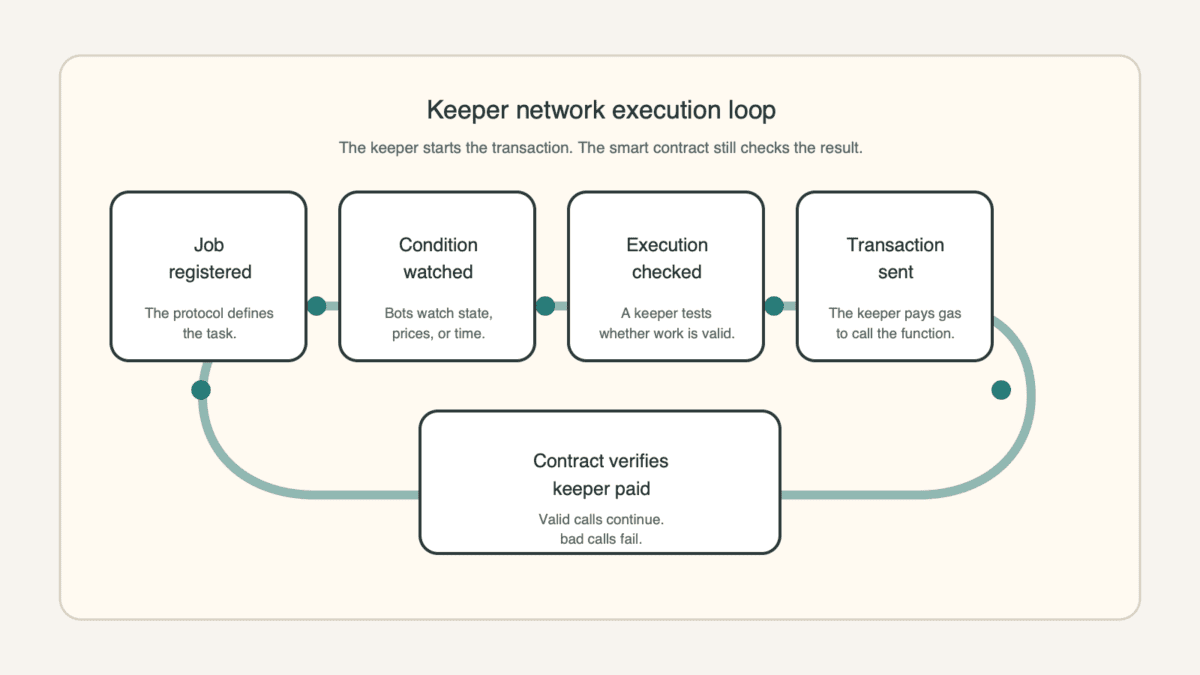
Gas is usually the pressure point. A keeper spends gas to submit the transaction. The job must offer enough payment, reimbursement, or profit for the keeper to bother. If gas spikes and the reward stays too low, skipping the job may be the rational move.
That is why funding and incentives are part of the mechanism, not an afterthought. A tidy automation design can still fail if the job runs out of funds, payments are misconfigured, or keepers earn more by chasing a different opportunity.
Keeper network examples make more sense when you start with the result users see. You may never notice the keeper, but you notice when an order fills, a vault updates, or a liquidation clears on time.
The common thread is conditional execution. The protocol has a rule. The market changes. Then a keeper bot or automation service submits the transaction that turns the rule into an on-chain action.
Traders and DeFi users run into keepers in places like these:
Wallet-level automation can also bring keeper-like behavior closer to the user. Some wallet workflows involve approvals, scheduled actions, account recovery, gas sponsorship, or transactions that fire only after a condition is met.
The risk changes by use case. A late DCA order may only annoy you. A late liquidation can change losses for borrowers, liquidators, and the protocol. A delayed vault harvest can reduce yield or leave positions exposed longer than expected.
So the useful question is not whether a keeper exists. Ask what the keeper is responsible for. A reminder bot and a liquidation bot do not deserve the same trust level.
A keeper network is often confused with oracles, validators, relayers, and bots because all of them can sit near smart contract execution. The useful difference is the job each one performs.
Keep the roles separate. A protocol can use several of them at once. For example, an oracle may provide the price, a keeper may notice that a liquidation is valid, a relayer may help transmit a transaction, and validators may include that transaction in a block.
| Term | Plain-English Difference |
|---|---|
| Oracle | Provides outside data, such as prices, rates, or event results, to smart contracts. |
| Validator | Helps secure a blockchain and include valid transactions in blocks. |
| Relayer | Passes a message or transaction between users, chains, or contracts. |
| Bot | A single automated program that watches and acts under its own rules. |
| Keeper Network | A coordinated set of keepers that monitors jobs and triggers valid smart contract actions. |
The overlap is real. A keeper can use oracle data. A keeper can be a bot. A relayer can submit transactions. But the keeper role is about execution responsibility: watching for a condition and calling the contract when the action should happen.
This distinction helps when protocol docs get breezy. If a lending app says it has an oracle, that does not mean liquidations will execute. If a DEX says it has validators, that does not mean limit orders will fire. You still need to know who performs the automated action.
It also keeps the decentralization discussion honest. A protocol can use a decentralized chain and a high-quality oracle while still relying on one narrow keeper setup for a critical function. The weak link may not be the chain at all.
Keeper network risks come from liveness, incentives, configuration, and market competition. Automation is not the problem by itself. Blind trust in perfect timing is.
A keeper-dependent protocol can look healthy while its automation layer is fragile. The jobs may be underfunded. The keeper set may be too small. The bot may depend on one RPC provider. The reward may stop making sense when gas spikes.
Use this checklist when a protocol depends on keepers:
Stale automation can look like quiet decay. If a protocol stops funding jobs, leaves docs outdated, or lets key maintenance scripts fade away, the risk can start to resemble a soft rug rather than a clean technical failure.
MEV adds another layer. A liquidation, auction, or trigger order can attract competing bots. The fastest or best-funded keeper may win. Users may still face worse execution, delayed settlement, or more aggressive liquidation behavior during volatile periods.
Centralization is not a yes-or-no label here. Some keeper networks are open and incentive-driven. Some are permissioned. Some protocols run their own bots and call that automation. Users need to spot concentration before a stressful market tests it.
The best setup has redundancy, clear incentives, visible funding, public docs, fallback execution, and a sensible failure path. The worst setup asks you to trust that “the bot handles it” and then changes the subject.
Keep3r Network is not the same as a keeper network. It is a specific project built around jobs and keepers, while keeper network is the broader category for DeFi automation.
The naming creates predictable confusion. A user searching “keeper network” may want the generic concept, Chainlink Automation, legacy Chainlink Keepers, the Keep3r Network project, or the KP3R token. Those are related enough to share vocabulary. They are not similar enough to research as one thing.
Here is the clean split:
| Name | What It Means |
|---|---|
| Keeper Network | The general DeFi automation pattern where keepers trigger contract actions. |
| Keep3r Network | A named project that connects jobs needing execution with keeper operators. |
| KP3R | The token associated with Keep3r Network, separate from the generic keeper concept. |
| Chainlink Keepers | Legacy name many users still see in older articles and docs. |
| Chainlink Automation | Current Chainlink product language for smart contract automation. |
Keep3r-specific research may involve jobs, credits, bonding, rewards, operator requirements, disputes, and token incentives. Generic keeper-network research focuses on automation reliability, execution paths, and protocol risk.
That difference is especially important for token-led users. Understanding how keeper networks work does not tell you whether KP3R is fairly valued, liquid, supported, or exposed to hype-driven selling. A thin token page can still turn a curious buyer into exit liquidity if the trade has more narrative than demand.
The sensible path is to separate the questions. First understand the automation role. Then, if you are researching Keep3r Network or KP3R, review the project’s current activity, docs freshness, job demand, token design, liquidity, and risks on their own merits.
To evaluate a keeper-dependent protocol, check whether automation is visible, funded, redundant, and recoverable. A protocol can have strong contracts and still suffer if the execution layer is brittle.
Start with the feature that depends on keepers. Is it a convenience feature, such as scheduled claiming, or a core safety feature, such as liquidations? The deeper the dependency, the more evidence you need.
Ask these questions before trusting the setup:
Then test the user-facing consequence. If a keeper misses an action, do you lose yield, miss a trade, face liquidation, wait for a claim, or simply try again later? Those outcomes belong in different risk buckets.
For investors, the keeper setup is part of protocol due diligence. It affects reliability, incentives, and maintenance quality. For users, it is part of trade safety. It tells you whether an action is actually automated or merely available for someone else to trigger.
The cleanest protocols make this boring. They name the automation provider, explain funding, expose fallback paths, and avoid vague promises. Boring infrastructure is underrated. It usually means someone did the unglamorous work before the market gets loud.
No. A keeper network is the general automation pattern, while Chainlink Automation is one major service that can provide that function. Older material may use the name Chainlink Keepers, so check current product language when reading old pages.
No. Keep3r Network is a specific project that connects jobs and keepers. A keeper network can also refer to Chainlink Automation, protocol-run bots, independent DeFi keepers, or another automation setup with no KP3R connection.
Yes. A keeper network can miss or delay execution if jobs are underfunded, gas costs spike, bots fail, conditions are misread, or operators stop running. The contract may still be fine, but the action can remain uncalled.
Payment depends on the protocol design. Keepers may receive gas reimbursement, fixed fees, token rewards, auction profits, liquidation incentives, or job-specific payments. If the payment is too low, rational keepers may ignore the job.
Some keeper networks are decentralized, some are permissioned, and some are just a small set of bots. The label alone is weak evidence. Check who can run a keeper, how rewards work, and whether fallback execution exists.
Smart contracts execute when a transaction calls them. They can store rules, check conditions, and reject invalid actions, but an external account or automation system must still submit the transaction that starts execution.