Physical Address
304 North Cardinal St.
Dorchester Center, MA 02124
Physical Address
304 North Cardinal St.
Dorchester Center, MA 02124


A practical guide to KOTH, Pump.fun visibility, and late-buyer risk.
King of the Hill on Pump.fun is a visibility status for a leading token. It can attract attention, but it does not prove safety.
You will usually see it as KOTH, a crown-style label, or a feature spot on Pump.fun, trading terminals, Telegram calls, or Solana memecoin screens. It means the token has reached a visible moment in the launch flow. It does not mean the creator is honest, the wallets are clean, or the next buyer is early.
Read it simply: King of the Hill is attention. Attention can help a real community form. It can also give early holders, bots, and creator-linked wallets a better crowd to sell into. The crown is loud. It is not a lie detector.
King of the Hill means a Pump.fun token has gained a prominent visibility position on the platform. Traders often shorten it to KOTH, especially in fast chat threads, bot alerts, and token screens.
That visibility usually points to strong activity, momentum, or ranking inside the Pump.fun launch environment. It can make a token easier to notice. It can also make the token more attractive to scalpers, snipers, and late buyers who are reacting to the label rather than the market structure.
If you are watching fast launch screens, KOTH may appear beside other quick-moving signals. Those screens compress a lot of noise into tiny labels. A crown can look official, but it still needs context.
The first trap is confusing attention with validation. King of the Hill does not inspect the creator wallet. It does not spread supply across healthy holders. It does not confirm organic demand, deep liquidity, or fair social traction.
The second trap is confusing the feature with a token name. A token called King of the Hill, KOTH, or $KOTH is not automatically the Pump.fun feature. Always check the token page, mint address, and source of the label before assuming the screen is talking about the platform milestone.
For a beginner, KOTH is best read as a status marker. It tells you where attention is gathering. It does not tell you whether that attention is deserved, durable, or safe to trade.
King of the Hill sits inside the Pump.fun token lifecycle as a visibility stage, not as the final market state. It appears after launch activity has built enough attention, while the token may still be tied to bonding-curve dynamics or nearing a later transition.
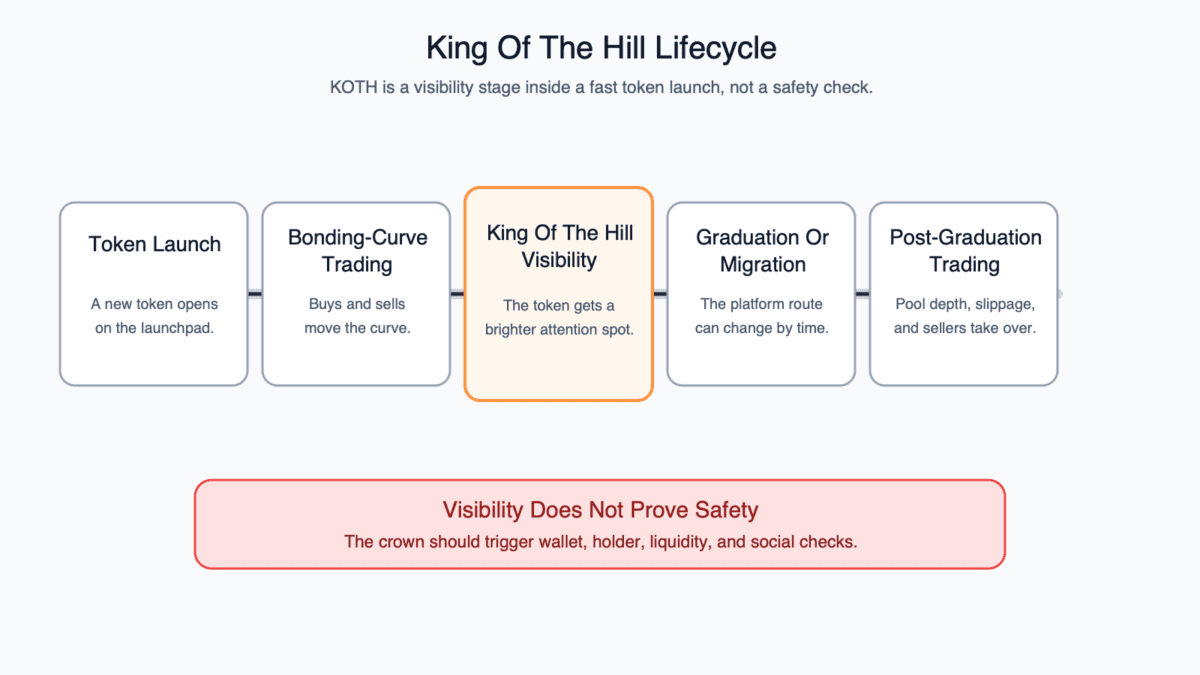
Launch and bonding-curve trading are the early phase where a token opens and buyers interact with the platform’s pricing path. The curve helps define how the token price changes as demand enters or leaves.
Pump.fun tokens can move quickly here. A small amount of public attention can push activity higher, while early wallets may already hold better entries. A beginner may see a rising curve and think the market is confirming the token. Sometimes it is. Sometimes it is just speed wearing a nice hat.
During this phase, do not only ask whether the token is moving up. Ask who bought early, whether sells are already appearing, and whether activity looks broad or clustered.
King of the Hill visibility is the stage where the token gets a brighter platform spotlight. The label can draw more eyes, more social chatter, and more bot monitoring.
That attention can feed momentum. A token with real community energy may use the moment to pull in new traders. But the same label can also attract rushed buys from people who do not check wallets, holders, or liquidity.
Think of KOTH as a notification that the token is now more public. More public can mean more demand. It can also mean better exit conditions for earlier holders.
Graduation is a separate lifecycle transition, usually tied to platform conditions after the bonding phase. Current Pump.fun fee details place graduated coins in canonical PumpSwap pools, while older guides and threads may still mention Raydium.
That creates messy source language. One source may describe an older Raydium route. Another may describe PumpSwap. A trading tool may show its own label. Your check stays the same: confirm the current platform page, token mint, venue, and pool before trading.
The lifecycle is easier to read as stages:
| Stage | What It Does And Does Not Prove |
|---|---|
| Token launch | Shows a token exists, but not that the creator is trustworthy. |
| Bonding-curve trading | Shows curve activity, but not that demand is organic. |
| King of the Hill visibility | Shows attention, but not safety or guaranteed graduation. |
| Graduation or migration | Shows a platform transition, but not deep liquidity. |
| Post-graduation trading | Shows a new venue, but not clean exits for late buyers. |
Follow the token through the stages without letting one label do all the work. If KOTH, graduation, and the live trading venue do not line up clearly, wait until they do.
King of the Hill and graduation are related, but they are not the same thing. KOTH is a visibility label. Graduation is a platform-defined transition into a later trading state.
King of the Hill changes how visible the token is to other traders. It can move the token into a more watched part of Pump.fun, trading bots, Telegram calls, and quick-scan dashboards.
That can create a feedback loop. More people see the label, more people open the chart, and more people react to the same short-lived signal. The token may keep moving. It may also stall once the first wave of attention has arrived.
KOTH does not create a new market by itself. It does not prove the curve completed. It does not make the token easier to exit if everyone tries to sell at once.
Graduation changes the token’s lifecycle state. It usually means the platform’s completion or migration condition has been met, and trading context can shift toward an AMM-style pool or another post-launch venue.
That shift can change execution. Pool depth, slippage, routing, and live buy-sell pressure become more important. A token can graduate and still dump if early holders, bots, or creator-linked wallets sell into the new attention.
Here is the clean split:
| Label | What To Check |
|---|---|
| King of the Hill | Why the token is visible, who holds supply, and whether attention looks organic. |
| Graduation | Whether the platform transition happened, where the token trades, and how deep the pool is. |
If someone uses KOTH and graduation as if they mean the same thing, slow the conversation down. The difference can decide whether you are checking a visibility spike or a market-structure change.
King of the Hill thresholds look different because sources often describe different dates, platform versions, market-cap displays, SOL prices, and lifecycle labels. A fixed number can go stale fast.
Some older pages mention dollar thresholds. Others mention SOL-based thresholds. API pages may expose bands or fields that are useful for tracking, but too technical for a casual buyer. Social posts can repeat old numbers long after the platform has changed.
Use threshold claims as clues, not gospel. Before you act on one, check what the number is measuring:
Do not hard-code a single KOTH threshold. Verify the current token page and platform label at the moment you trade. A stale threshold can make you feel precise while pointing at the wrong event.
The core meaning survives the number debate. King of the Hill means the token has reached a visibility moment. The exact trigger can change. The risk checks should not.
If a tool gives you a number, pair it with the visible status on the live token page. One without the other is weak evidence.
King of the Hill can be bullish for attention, but it can also be a trap for late buyers. The label shows visibility. It does not show clean demand.
King of the Hill can suggest that a token has enough activity to draw a crowd. That may include real buyers, social momentum, and traders watching for a breakout.
In a strong setup, KOTH can help more people discover the token. New buyers may arrive, volume may expand, and the token may push toward the next lifecycle event. That is the optimistic case.
The catch is that the same visibility attracts everyone else too. Bots can monitor it. Early holders can wait for it. Creators can promote it. Late buyers can see the same label and pile in at the worst possible time.
King of the Hill cannot prove that demand is organic. It cannot prove the top holders are separate people, the creator wallet is clean, or the social push is real.
This is where many beginners get clipped. They see a crown and read it like a quality mark. Experienced traders read it as a reason to inspect the trade more closely.
The signal should push you into verification:
| Signal | What To Verify Next |
|---|---|
| KOTH label | Confirm the token page and mint address. |
| Fast volume | Check whether buys are broad or clustered. |
| Strong comments | Compare social activity with wallet behavior. |
| Near graduation | Confirm the venue and expected route. |
| Big green candles | Check whether sells are already hitting strength. |
The label can help you find the token. It cannot do your risk work. That is rude of it, but honest.
Attention can become exit liquidity because a public signal attracts buyers after earlier wallets already have profit. Those late buyers may give early holders the demand they need to sell.
That does not mean every KOTH move is a scam. It means the incentive is obvious. A visible token with fresh buyers is more useful to sellers than a quiet token nobody is watching.
So the strongest KOTH question is not “is it bullish?” It is “who benefits if I buy here?” If the answer is mostly early wallets, creator-linked wallets, or bots, you may be walking into exit liquidity.
KOTH can also mark top-signal territory when the crowd arrives late. A signal can be real and still be late. Crypto enjoys that little cruelty.
King of the Hill tokens dump when attention brings in buyers faster than the token can support them. Selling pressure, weak liquidity, bot activity, and creator behavior can overwhelm the visibility spike.
Fast sellers dump into KOTH because they entered earlier and want to lock profit while attention is high. Crypto slang often calls them jeets, especially when they sell quickly into a move.
That selling is not always malicious. Some traders scalp by design. Others panic when momentum slows. But the result is the same for a late buyer who assumed the crown meant the move had just started.
Watch the shape of the sells. A few normal profit-takers are different from repeated heavy sells into every bounce.
Creator or insider wallets become a bigger concern when they hold meaningful supply, bought early, or appear linked through funding patterns. A token can look active while control remains concentrated.
This is where a dump may become more than ordinary volatility. If creator-linked wallets sell slowly while social accounts keep promoting the token, the pattern can resemble a slow creator exit.
You do not need to accuse every seller of a rug. Start with wallet behavior. If a small group controls supply and sells into every burst of attention, the setup is fragile.
Bots and bundled buys can make a KOTH move look healthier than it is. They can create fast volume, tight timing, and repeated transactions that look like crowd demand from a distance.
Useful warning signs include:
None of these signs proves a rug alone. Together, they tell you the move may be more staged than organic. At that point, the crown is decoration on a risk chart.
Before buying a King of the Hill token, check whether the token, wallets, holders, liquidity, and social activity support the signal. One clean check is not enough.
Start with identity. Confirm the token page, mint address, ticker, and source link. A real Pump.fun KOTH label and a random $KOTH token are different things, even if the screen makes them look close during a rush.
Then move from identity to behavior. The best checks are concrete:
| Check | Why It Matters |
|---|---|
| Token page and mint address | Confirms you are looking at the intended token, not a copycat. |
| Creator wallet history | Shows whether the creator has launched, sold, or abandoned similar tokens. |
| Holder distribution | Reveals whether supply is broad or controlled by a few wallets. |
| Bundled or timed buys | Helps spot activity that may not be organic demand. |
| Recent sell pattern | Shows whether early wallets are already using attention to exit. |
| Volume shape | Separates steady interest from sudden manufactured bursts. |
| Social links and comments | Tests whether public attention has real humans behind it. |
| Graduation or venue status | Clarifies whether you are buying during curve trading or after migration. |
| Pool depth and slippage | Shows whether you can exit without eating ugly price impact. |
| Wallet approval safety | Reduces the chance of signing a bad link while rushing. |
The table is a slowdown tool. If you cannot answer most of it quickly, you are probably not early. You are just moving fast.
Also check your own trade size. A high-risk memecoin position should be small enough that a full loss is painful but not life-changing. If the amount would make you stare at the chart like it owes you rent, it is too large.
One more check is timing. If KOTH appeared after a long green run, the easy entry may already be gone. If it appeared while holders are still broad, sells are modest, and socials look human, the signal has more room to be useful.
Avoid signing anything new while rushing from a KOTH screen. Use known routes, check the domain, and separate chart research from wallet approvals. Many bad trades start as market mistakes. Worse ones start as wallet mistakes.
Creator-side users face the same problem from the other side. Buying your own token toward KOTH may create a visible milestone, but it can also make experienced traders assume the demand is artificial. Real trust usually comes from cleaner distribution, transparent links, and behavior that does not scream “please provide my exit.”
The most common King of the Hill mistakes come from reading one label as several different signals. KOTH can mean visibility, but users often stretch it into safety, graduation, or guaranteed momentum.
That stretch is expensive. A beginner may buy because the token looks officially featured. A creator may chase the label with self-buys. A trader may quote an old threshold while the current platform route has already moved on.
Here are the mistakes to avoid:
| Mistake | Better Read |
|---|---|
Confusing $KOTH with the feature |
Check the mint and platform page before assuming the label means King of the Hill. |
| Treating KOTH as graduation | Separate visibility from the later lifecycle transition. |
| Hard-coding old thresholds | Verify the live platform label instead of trusting stale numbers. |
| Buying because the crown looks official | Use the label as a prompt for checks, not a permission slip. |
| Ignoring holder concentration | A visible token can still be controlled by a few wallets. |
| Trusting social noise alone | Compare comments, links, wallets, volume, and sells together. |
The better habit is boring, which is why it works. Confirm the token, locate the stage, inspect wallets, and size the trade like the screen is trying to hurry you.
KOTH can still be useful. It helps you spot where attention is gathering. Just do not let the most visible token become the least examined one.
Related King of the Hill terms help you read Pump.fun screens and trader chatter without mistaking slang for proof. KOTH rarely appears alone, so the nearby terms keep the screen readable.
KOTH means King of the Hill, usually the visibility label. Bonding curve means the early pricing path that launchpad trades move through. Graduation means the platform transition after the token reaches its completion condition.
Keep those timeline terms separate from actor-risk terms. Bonding and graduation tell you where the token is in the launch flow. Wallet clusters, quick sellers, and bundled buys tell you who may be using that moment.
Start with trenches, the high-speed memecoin environment where users scan new launches, wallets, social posts, and charts. That context explains why a KOTH label can feel urgent even when the trade still needs basic checks.
For rug language, hard-rug risk means something sharper than an ordinary dump. A hard rug points to abrupt malicious failure, while slower abandonment or insider selling needs wallet evidence before the claim gets stronger.
Quick sellers, sniper bots, bundled wallets, and exit-liquidity risk are the nearby ideas to watch. They describe who may be acting around the KOTH label, not whether the label is automatically good or bad.
The connection is simple. KOTH sits inside a cluster of launchpad, attention, and exit-risk terms. If you understand those nearby terms, the crown looks less magical and more like a warning light with good branding.
King of the Hill on Pump.fun means a token has reached a visible platform status or feature spot. It can attract more attention, but it does not prove the token is safe, organic, or likely to keep rising.
No. King of the Hill is a visibility status, while graduation is a platform lifecycle transition. A token can be visible before a later market-state change, so check the token page and venue instead of merging the two labels.
No. King of the Hill does not verify the creator, holder distribution, liquidity depth, or wallet behavior. It only tells you that the token has drawn enough activity or ranking strength to become visible.
Some King of the Hill tokens dump because early buyers, bots, or creator-linked wallets sell into the attention spike. The label can bring late demand, which may become an exit lane for wallets that entered earlier.
Check the token page, mint address, creator wallet, holder distribution, bundled buy patterns, recent sells, volume shape, social links, graduation status, pool depth, slippage, and wallet approvals. Skip the trade if basic facts do not line up.
Not necessarily. $KOTH can be a token ticker or meme name, while King of the Hill is a Pump.fun visibility feature. Always confirm the mint address and platform page before assuming the token is tied to the feature.
Start with King of the Hill as a signal to verify, not a signal to chase. The label tells you attention has gathered. Your job is to find out who benefits from that attention.
Use this quick order before taking any trade:
The same order helps if you are not buying. It can tell you whether a token is worth watching, whether a creator is building trust, or whether the move is already late enough to skip.
You do not need a perfect answer to every question. You need enough evidence to avoid obvious traps. If the basic facts are unclear, the trade is not cleaner because the chart is moving.
The same habit also protects you from stale screenshots. KOTH posts move fast, and the token state may change before the screenshot reaches your feed.
If those checks feel too slow, that is useful information. KOTH trades often punish rushed clicks. The crown can show you where the crowd is looking, but it cannot tell you whether the crowd is early, late, or about to get served as liquidity.