Physical Address
304 North Cardinal St.
Dorchester Center, MA 02124
Physical Address
304 North Cardinal St.
Dorchester Center, MA 02124


A clear guide to launch sniping, bot speed, and launch-risk traps.
Launch sniping is the high-speed attempt to buy a new crypto token the moment trading opens, usually before slower buyers can react.
It is most common around meme coins, new DEX pools, and token launches where early wallets can move the chart before normal traders even find the pair. A sniper may be a human using alerts, but the term usually points to bots that watch for launch signals and submit transactions within seconds.
That speed can look like secret alpha. It can also push you into a broken token, burn fees, or hand a shady tool your wallet keys. So ask the real question: what game am I entering, and who already has a better seat?
Launch sniping in crypto is a token-launch tactic where a trader or bot tries to buy as soon as trading becomes possible. The trigger can be a new liquidity pool, a pair appearing on a DEX, a launchpad event, or a contract setting that finally allows buys.
That makes launch sniping different from simply buying early after a coin starts trending on X. A person who buys a meme coin two hours after it goes viral is early in the social cycle. A launch sniper is trying to enter around the first tradable moments, before the crowd gets a clean look at price, liquidity, holders, or chart history.
The word shows up most often when the launch feels impossible to read in real time. A pair goes live, the first candle jumps, wallets appear instantly, and slower buyers are left asking whether they saw demand or just automation.
In meme-coin launch chatter, launch sniping usually carries that bot-speed meaning. Traders use it when wallets appear instantly after launch, buy a large chunk, then sometimes sell into the first wave of attention. That is why later buyers often read the chart as unfair, even when the trades were just fast on-chain execution.
Manual launch sniping exists, but it is the hard mode in the meme-coin trenches. You might watch DEXScreener, Solscan, RugCheck, Telegram alerts, or launchpad feeds and click fast. A bot can monitor more signals, build transactions faster, and retry when a transaction fails.
The definition is simple. The market around it is not.
Launch sniping works by detecting the moment a token becomes tradable, then racing other buyers for the earliest possible execution. The launch window can be so short that a chart looks “already moved” by the time a manual buyer refreshes.
The sequence usually starts before the public chart looks useful. A bot may watch for a new contract, a new pair, liquidity being added, trading being enabled, or a bonding curve reaching a migration point. On Ethereum-style chains, mempool visibility can be part of the edge. On Solana, the edge often comes from fast RPC access, launch feeds, priority routing, and transaction handling most users never touch.
A current DEXTools tutorial frames token sniping around liquidity creation, mempool monitoring, and block 0 buys. A block 0 buy means a purchase placed in the first block or first available execution window after trading opens. The phrase sounds clean. The actual race is crowded, noisy, and full of failed attempts.
The launch path often looks like this:
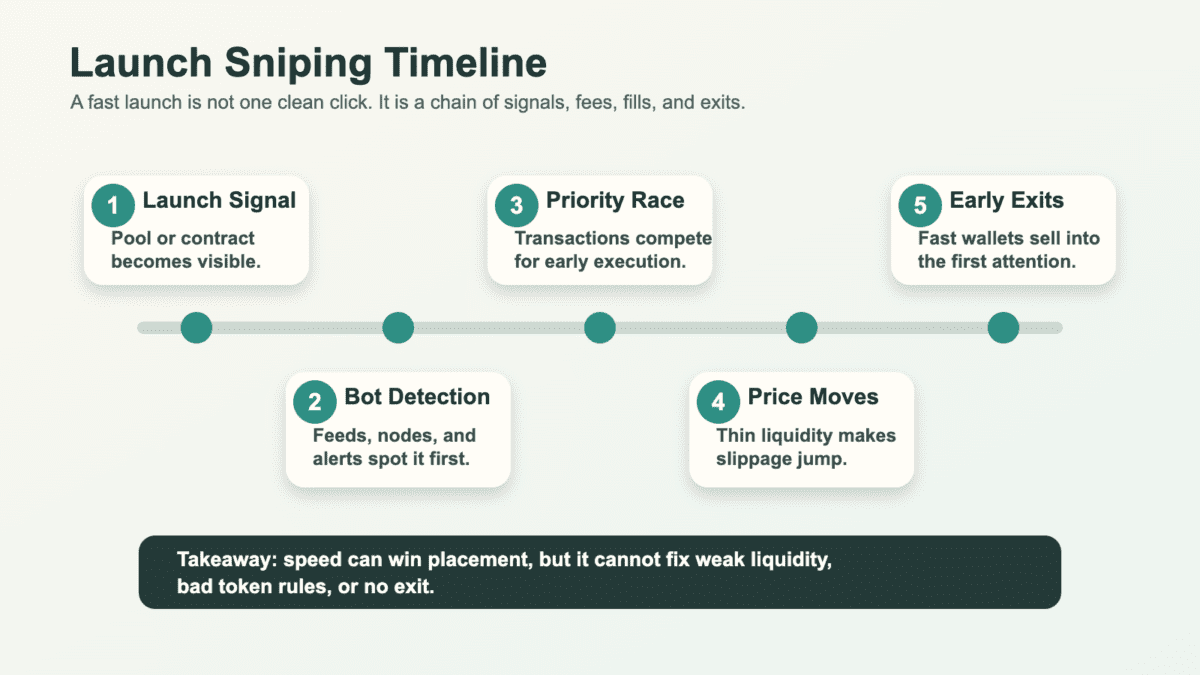
Failed transactions are part of the cost. A bot can submit too late, lose priority, hit a changed price, or buy after the pool already moved. A manual buyer sees the clean candle later and imagines one perfect entry. The chain usually records a messier fight.
Slippage is where the fantasy meets the bill. If buyers rush into a thin pool, the price can jump quickly. A transaction that looked acceptable when submitted can settle at a worse price, fail, or leave the buyer holding a token that is already being sold by earlier wallets.
Traders use launch sniping bots because early token launches can move before a human can react. The promise is simple: detect the launch, buy instantly, and sell before the crowd realizes the chart is already hot.
Meme coins make that promise feel tempting. Attention can arrive in waves, and a fast-moving crypto meta can turn one ticker into a short-lived stampede. Bots try to compress discovery, entry, and exit into a few automated steps.
The bot pitch usually comes wrapped in sharp words and smooth screenshots. The translation is less glamorous:
Some traders also use bots for discipline. A bot can apply a fixed buy size, reject launches with bad settings, or exit after a specific price move. That can reduce panic-clicking, which is useful when the chat is screaming and the candle looks vertical.
But automation does not make the token better. A bot can execute the trade exactly as designed and still buy a honeypot, a pool with weak liquidity, a launch controlled by concentrated wallets, or a chart already crowded with faster systems. “First” is not the same as “good.” Sometimes it is just a front-row seat for the dump.
Launch sniping is risky for regular investors because the tactic combines bad information, fast execution, thin liquidity, and scam-prone tools. That is a lot of ways to lose before the token even has a real market.
The biggest risk is buying a launch that cannot support a clean exit. A token may trade for a minute, then collapse after liquidity is pulled. It may also have transfer limits, high taxes, blacklist controls, mint authority, freeze authority, or wallet clusters that control the float. A hard rug can turn a perfect entry into a near-total loss.
Honeypots are especially cruel. A buyer can enter, watch the chart rise, and then discover that selling is blocked or punished. The screenshot looks profitable. The wallet does not.
Then come execution costs. Priority fees, failed transactions, bot subscriptions, referral fees, slippage, and taxes can eat the trade. On a crowded launch, a small buyer may spend real money just to lose a race that better-funded systems were built to win.
Run these checks before you even think about touching a fresh launch:
None of those checks makes launch sniping safe. They only reduce the chance that you walk into the obvious trap while congratulating yourself for being early.
The deeper problem is information quality. Launch charts begin with almost no history. Holder counts can be distorted. Volume can be wash-like. Social hype can be coordinated. A token can look alive because snipers created the first burst, not because real demand arrived.
That is why a slower, boring check often beats a heroic entry. If you cannot explain who can sell, who controls liquidity, and what your exit looks like, speed only gets you into trouble faster.
Launch sniping gets mixed with other trading terms because the same launch can involve several timing games at once. Separate them by the signal the trader is reacting to.
Launch sniping focuses on the moment a token becomes tradable. Liquidity sniping focuses more tightly on liquidity appearing in a pool. MEV involves transaction ordering and value extraction. Manual early buying is slower and often happens after the first bot fight has already played out.
| Term | What It Means For A Launch-Sniping Reader |
|---|---|
| Launch Sniping | Trying to buy a new token at or near the moment trading opens. |
| Liquidity Sniping | Reacting specifically when a pool or liquidity event appears. |
| MEV Sniping | Using transaction-ordering advantages to capture value around on-chain activity. |
| Technical-Analysis Sniping | Waiting for a chart setup, not necessarily a token launch. |
| Manual Early Buying | Buying soon after launch without automation or priority infrastructure. |
| Bot-Assisted Trading | Using software to detect, submit, retry, or exit trades. |
These categories overlap in real markets. A launch sniper may be liquidity sniping if the pool event is the trigger. A bot may use MEV-style routing or priority paths if transaction order affects the outcome. A chart trader may call a clean entry a “snipe” even if no launch race happened.
The distinction helps because the risks differ. Liquidity sniping can fail if the pool is tiny or fake. MEV-style competition can make a normal user late. Technical-analysis sniping depends on chart quality. Manual early buying depends on patience, contract checks, and not confusing a fast candle with proof of demand.
Use the term that matches the actual edge. If the edge is speed at launch, it is launch sniping. If the edge is only a chart entry after the dust settles, it is not the same game.
Launch sniping affects new token launches by shaping the first chart, holder list, and trust signal before most buyers arrive. That can make a project look explosive, broken, or manipulated within minutes.
For a launch team, snipers can concentrate supply in wallets that have no interest in the project. Those wallets may sell into the first wave of organic demand. Later buyers then become exit liquidity for traders who were early because they had speed, automation, or better data.
For a normal buyer, the damage is harder to read. A chart spike may look like broad demand, but it may come from a handful of bot wallets. Holder count may rise fast, but the quality of those holders can be poor. Volume may look active, while early churn hides weak conviction.
This is why launch sniping can blur into insider-style suspicion. A buyer sees large wallets enter instantly, price runs, and then early sellers dump. The buyer may not know whether that was public bot execution, private information, bundled wallets, or team-linked activity.
The visible symptoms are usually familiar:
Projects can survive early snipers if the token has clear rules, locked liquidity, transparent supply, and real demand after launch. But a tiny meme coin with thin liquidity can lose trust fast. Once the first chart looks like a trap, the community has to spend energy explaining the mess instead of building momentum.
The hard part is that not every sniper is malicious. Some are just fast traders. But the effect on launch trust can still be ugly, especially when late buyers cannot tell the difference.
Projects can reduce launch sniping, but they rarely stop it completely. Any public launch creates signals, and bots are built to watch signals.
Common anti-sniping measures include whitelists, fair launches, buy limits, delayed trading, liquidity locks, bot filters, and transparent launch windows. Each one changes who can enter, when they can enter, and what the project asks buyers to trust.
The tradeoffs are real:
Teams also use contract controls, launchpad settings, and monitoring tools to reduce obvious abuse. But heavy controls can become their own risk. A buyer may avoid snipers, then discover the team kept powers that make selling harder later.
Transparency usually helps more than theater. Clear launch rules, visible liquidity plans, supply disclosures, and plain anti-bot tradeoffs give buyers something concrete to check. Vague “anti-sniper protection” is not enough.
A launch team should also plan for the first five minutes after trading opens. If snipers appear, the team needs clear communication, not panic. If liquidity is locked, say so. If buy limits exist, explain them. If a chart looks wild because the pool is thin, do not pretend it is organic demand.
Bots adapt. The goal is not a perfect shield. The goal is to make the launch harder to exploit and easier for honest buyers to understand.
Launch sniping tools should be evaluated as wallet-risk software first and trading software second. A bot that needs dangerous access can cost more than any missed trade.
Start here: what can this tool do if it turns hostile, breaks, or gets compromised? Telegram bots, public GitHub repos, browser extensions, closed-source dashboards, and copied scripts can all become wallet-risk surfaces. A fake profitable bot only needs one careless key paste.
Clean wallet setup is the minimum. Use burner wallets for risky experiments, keep main funds separate, avoid seed phrase entry, and revoke approvals you do not need. A bot should never need your seed phrase. If it asks, the conversation is over.
Check these points before connecting funds:
Open-source claims need care. A repository can be public and still unsafe. Dependencies can change. A release binary may differ from the code. A script can hide a drain in setup steps, imported packages, or wallet handling.
Telegram bots deserve extra caution because they make speed feel easy. Convenience is the bait. If a bot holds keys, sends trades, and routes through infrastructure you do not control, you are trusting both the bot operator and the tool’s security.
The safer rule is boring: never test a launch-sniping tool with funds you would hate to lose. If the tool cannot work with a limited wallet, limited size, and clear permissions, it is not a trading edge. It is a custody problem wearing sunglasses.
Beginners should study launch sniping before trying it, because understanding the tactic is usually more valuable than joining the race. The first useful skill is learning why a launch chart moved, not trying to buy before it moves.
Watch launches without trading. Track when liquidity appears, which wallets buy first, how quickly sellers arrive, whether the contract is sellable, and what happens after the first five minutes. That practice teaches more than one rushed trade with shaking hands and heroic slippage.
If you trade anyway, keep the risk tiny and boring. The goal is survival, not bragging rights.
Waiting can feel expensive when the chart goes vertical. But many launches punish impatience harder than patience. Buying after basic checks may miss the first candle, yet it can avoid becoming a bagholder in a token that only looked alive because bots were fighting over scraps.
You can also learn from failed entries. Look for early wallets that bought, sold, and left. Check whether the first spike had follow-through. See whether social hype arrived before or after early sellers exited. Those clues help you separate real demand from launch noise.
Launch sniping is a useful term to know. It explains why some charts feel rigged from the first candle. For most beginners, that knowledge should lead to better caution, not a bot subscription and a prayer.
Launch sniping is not automatically illegal, but the legal answer depends on the tactic, market, jurisdiction, and whether fraud or market manipulation is involved. Buying quickly after a public launch signal is different from using stolen information, deceptive contracts, wash trading, or coordinated manipulation.
Even when the trade itself is allowed, a platform may ban certain bot behavior. Token teams may also use launch rules that restrict who can buy and when. If money, bots, and public markets meet in a gray area, assume rules can bite.
Launch sniping is not always the same as front-running. Launch sniping usually targets the moment a token becomes tradable, while front-running means placing a transaction before another known or expected transaction.
They can overlap when a bot uses transaction-ordering advantages around a launch. But a sniper that buys when liquidity appears is not always front-running a specific user. The clean label depends on what the bot saw and how it gained priority.
You can do launch sniping manually, but manual launch sniping is slower and less reliable than bot execution. A human can watch dashboards, alerts, and contract changes, then submit a transaction as soon as trading opens.
The problem is speed and error. Humans mistype, hesitate, misread contracts, accept bad slippage, and react after bots have already moved the pool. Manual buying can still work in quieter launches, but it is not the same as competing with automated systems.
Launch sniping does happen on Solana, especially around meme-coin launches and fast DEX trading. The mechanics are not a simple copy of Ethereum-style mempool sniping, because Solana has different transaction flow, priority handling, and routing paths.
That difference does not make Solana safe for manual buyers. Fast infrastructure, launch feeds, bots, and wallet clusters can still dominate early activity. If anything, the speed can make the first chart feel even harder to read.
A launch sniping bot can steal your crypto if it gets unsafe wallet access, private keys, seed phrases, malicious approvals, or control over a funded wallet. The danger is highest with unknown Telegram bots, copied GitHub scripts, fake downloads, and referral-heavy tool links.
Use a burner wallet if you experiment at all. Never paste a seed phrase into bot software. Never connect your main wallet to a tool you do not fully trust. Missing a launch is annoying. Losing the wallet is the whole circus catching fire.