Physical Address
304 North Cardinal St.
Dorchester Center, MA 02124
Physical Address
304 North Cardinal St.
Dorchester Center, MA 02124


A plain-English guide to native yield, sources, custody routes, and exit risks.
Native yield is crypto yield designed to accrue automatically to an asset, chain balance, or account balance.
The return still has to come from somewhere. It may be staking, lending, reserve income, a vault route, fees, incentives, or a wrapper that passes rewards back to users.
The word “native” tells you where the yield sits in the product. It does not make the product safe, simple, guaranteed, or immune from bad design. Crypto does love giving old risk a nicer interface.
Native yield in crypto means a held balance can earn without the user manually moving funds into a separate reward pool. The yield is part of the asset, chain, wallet balance, or account design.
That sounds simple until the word “native” starts moving around. It can mean native to an L2, native to a stablecoin, native to a wallet balance, or native to one app’s marketing page. Same word. Different risk stack.
Use this split before trusting the label:
| Meaning | What The User Should Check |
|---|---|
| Chain-Native Balance Yield | What the chain does with bridged assets and how withdrawals work. |
| Asset-Native Yield | Whether the token itself rebases, earns, or represents a yield-bearing claim. |
| Stablecoin Native Yield | Whether the return comes from reserves, lending, vaults, or incentives. |
| Account-Native Yield | Whether the app routes funds behind the scenes while showing a simple balance. |
| Marketing-Native Yield | Whether “native” is just a cleaner name for a normal strategy. |
A useful definition starts with the source. A balance earns because something underneath produces value or distributes rewards. The interface may make the process feel passive, but passive is not the same as permissionless, transparent, or low risk.
Read native yield as a design claim. It says the earning route is built into the product experience. It does not say the route is durable, fairly priced, easy to exit, or free of custody risk.
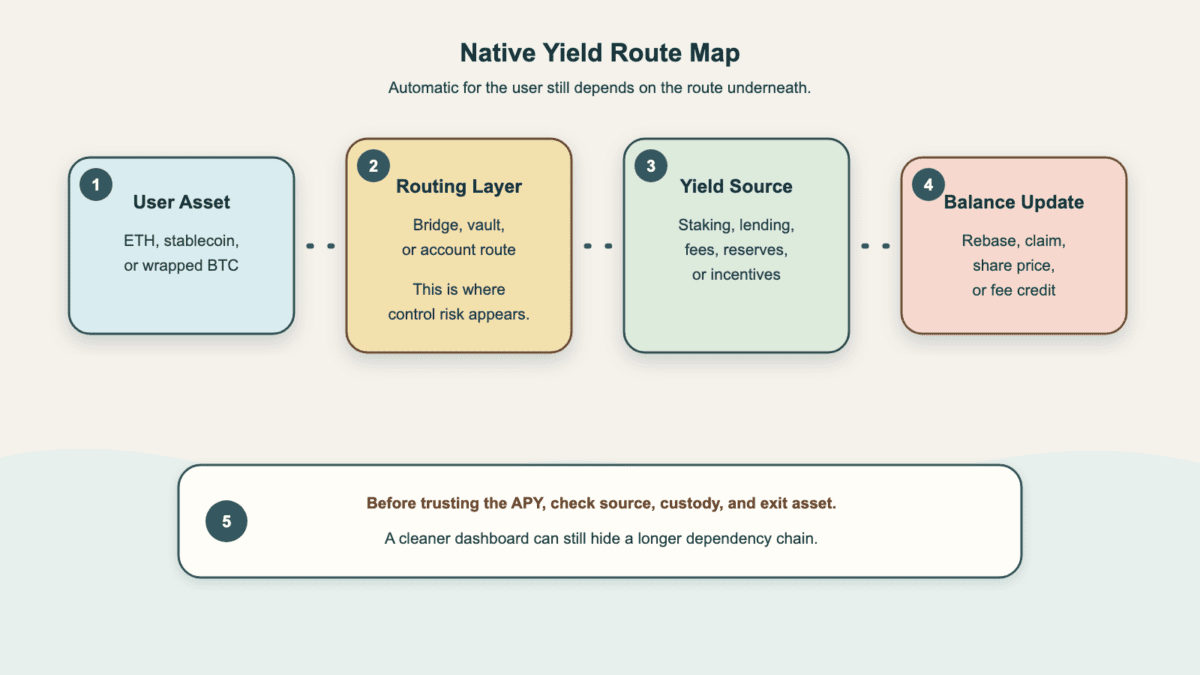
Native yield works by routing an asset or balance through a yield source, then returning some result to the user. The user may only see a growing balance, a claimable reward, a tokenized share, or lower fees.
Behind that clean view, the route can do a lot. A user may bridge ETH to an L2. The chain or protocol may route underlying ETH into staking, liquid staking, a reserve strategy, a lending market, or a vault. The system then passes some yield back through rebasing balances, reward claims, or another accounting method.
Most native yield routes show up in a few forms:
Conduit described those three broad chain-operator patterns in October 2025 and noted that one yield-by-default provider was already connected to more than 20 networks. That map is useful because it shows why native yield is broader than one project.
The source depends on the asset. ETH routes often point toward staking or liquid staking. Stablecoin routes can depend on lending demand, reserve assets, or vault strategies. App balances may use one or more protocols under the surface.
Auto-rebasing is one common accounting style. The displayed balance grows because the token supply or account balance adjusts. Other systems keep the balance fixed and issue claimable rewards. Others use tokenized shares where the share price changes as the underlying position earns.
The dashboard label is secondary. The asset route decides the risk. If you cannot explain what funds the return, who can change the route, and what you receive when leaving, the yield is not yet clear enough.
Native yield differs from staking, yield farming, lending, and token rewards because it describes where the earning route sits in the user experience. The other terms usually describe the source or strategy.
Staking can be the source behind native yield. For example, an ETH balance on a chain may earn because underlying ETH is staked. But not every staking product is native yield. If you manually delegate, lock, or choose a validator yourself, that is regular staking behavior, even if the interface is polished.
A side-by-side view makes the split clearer:
| Route | What The Yield Really Depends On |
|---|---|
| Native Yield | The built-in route, its source, and its withdrawal rules. |
| Staking | Validator performance, slashing exposure, lockups, and network rewards. |
| Yield Farming | Pool demand, incentives, fees, smart contracts, and exit timing. |
| Lending | Borrower demand, collateral quality, liquidation rules, and pool liquidity. |
| Token Rewards | Emissions policy, token price, vesting, and whether rewards keep demand. |
Yield farming is usually more active. A user deposits assets into a pool, vault, or strategy to chase rewards, fees, or incentives. That makes yield farming the cleanest contrast. Native yield tries to make earning feel built in, while farming usually asks the user to choose and manage a strategy.
Lending can also sit behind a native-yield wrapper. A stablecoin balance may earn because deposits are placed into lending markets. The user may see a single asset, while the actual return depends on borrower demand and liquidation rules.
Token rewards are easy to misread. They can be real claimable tokens without being durable economic yield. If the rate mostly comes from new incentives, the return can fade when emissions slow or token demand weakens.
Native yield is not automatically “real yield.” It can pass through real sources, promotional rewards, or both. The label helps only after you know what pays the bill.
Blast made native yield visible because it turned the phrase into an L2 selling point. Users could bridge assets and see balances tied to yield routes rather than manually picking a separate farm.
That helped the idea spread, but it also tied the phrase too tightly to one chain. Native yield now appears in discussions about L2 design, stablecoin balances, wallet accounts, yield-bearing gas tokens, and Bitcoin-linked products.
Read Blast as a popular example, not the full definition:
Each example has a different trust model. A chain-level design may depend on bridges, validators, sequencers, governance, and asset accounting. A stablecoin design may depend on issuer reserves, redemption terms, lending markets, or vault contracts.
Blast is useful context without owning the term. It made native yield easier to notice. It did not turn every automatic return into the same product.
If a product says “native yield L2,” ask what is native to the chain and what is merely routed through it. The answer decides whether you are looking at simple balance growth or a multi-hop dependency stack with nicer furniture.
Native yield changes meaning by asset type. ETH, stablecoins, and Bitcoin-linked assets do not earn in the same way, even when a product screen uses the same APY box.
ETH has one of the clearer native-yield paths because Ethereum staking can be a real underlying source. A chain, wrapper, or app may route ETH exposure through staking or liquid-staking infrastructure, then pass rewards back through rebasing balances, claimable rewards, or share pricing.
Use this asset map before comparing rates:
| Asset Type | Main Question To Ask |
|---|---|
| ETH | Is the yield from staking, liquid staking, incentives, or a wrapper route? |
| Stablecoins | What funds the return, and what happens during redemption stress? |
| Wrapped BTC | Who controls the wrapped asset, and where does the yield actually come from? |
| L2 Balances | What bridge, vault, sequencer, or governance layer routes the asset? |
| App Balances | Is the user holding an asset, a claim, a share, or a custodial balance? |
Stablecoins are different. A stablecoin can target a stable price while the yield comes from lending, reserve assets, vault strategies, fees, or incentives. Price stability and yield safety are separate questions. A dollar-looking token can still carry issuer risk, redemption risk, contract risk, and liquidity risk.
Bitcoin-linked native yield needs extra caution. Bitcoin base-layer BTC does not have ETH-style staking yield. When a product talks about Bitcoin native yield, identify the wrapper, bridge, sidechain, lending route, or protocol layer doing the earning.
The Bitcoin distinction is not pedantry. It changes the risk. If BTC must be wrapped, bridged, lent, or placed into a sidechain system, the user is no longer dealing with plain base-layer Bitcoin custody.
For stablecoins, the cleanest question is not “does it pay?” It is “what risk is paying me?” If the answer is vague, the stable target price is only one part of the story.
Native yield risks start where the automatic route touches contracts, bridges, issuers, validators, custodians, or governance. The user may see one balance, but several systems may be working underneath it.
Custody is the first split. If you hold an asset in your own wallet, you control signing. If the yield route requires bridging, approvals, vault shares, wrapped assets, or app accounts, more dependencies enter the path. Good wallet custody habits still count because signing the wrong approval can turn a yield experiment into a very educational afternoon.
Common risk layers include:
Bridge risk is especially important for L2 native yield. A bridge contract, message route, or withdrawal process may control how assets move back to the base chain. If the route pauses, upgrades, or faces congestion, the balance on the screen may be less useful than it looks.
Exit risk deserves its own attention. Native yield often feels harmless while entering. The harder question is what asset you get back when leaving. It may be the same token, a wrapped token, an underlying asset, a vault share, or a delayed withdrawal claim.
That is where exit liquidity becomes practical, not just dramatic crypto slang. If everyone tries to leave a thin pool or wrapper at the same time, the exit can become worse than the advertised yield ever was good.
Rebasing systems add another wrinkle. Your balance may change while the token price, share accounting, or withdrawal asset behaves differently. A larger number on the screen is not enough. You still need to know what can be redeemed, where, and under whose rules.
Automatic yield can reduce user work, but it does not remove risk work. It moves that work into the route.
Checking a native yield claim means tracing the source, route, controls, and exit before comparing rates. APY comes late, after the basic map makes sense.
Start with the funding source. If the yield comes from staking, lending, reserve income, fees, or a known vault route, you can examine the risk attached to that source. If the answer is only “protocol design” or “native rewards,” keep digging.
Use this checklist before moving meaningful funds:
Then check whether the route is structural or promotional. Structural yield can still fall, but it is tied to an ongoing mechanism. Promotional yield can vanish when incentives slow, token emissions change, or the campaign stops feeding the dashboard.
Terms can drift quietly. A product can start with clear rewards, then slowly weaken terms, add friction, reduce rewards, or make exits less attractive. That kind of drift is closer to soft rug risk than a single dramatic failure.
APY should be the comparison tool, not the starting point. A lower rate with a visible source and clean exit may be better than a higher rate with a route nobody can explain. Boring can be a feature when the alternative is an adventure with admin keys.
Keep records if you do use a native-yield product. Save the product terms, deposit route, withdrawal route, reward asset, and transaction hashes. That helps with your own review, tax records, and any future dispute over what the product promised at entry.
Native yield is useful when it makes an asset you already need more productive without adding risk you cannot understand or accept. It is weakest when the route is opaque, the yield is tiny, or exiting adds more stress than the reward justifies.
The setup is more useful when these conditions hold:
Good use cases are usually boring. Idle ETH on a chain may earn from a clear staking route. A stablecoin balance may earn through a disclosed source. A network may use yield to reduce the cost of keeping assets onchain. None of that needs fireworks.
Weak setups have a different smell. The APY is the headline, the source is vague, the route depends on several wrappers, or the yield only exists while new users arrive. That is not always fraud. Sometimes it is just complexity charging rent.
Small positions can also make native yield pointless. If the extra return is low and the route adds bridging, approvals, tax tracking, and exit risk, the cleaner choice may be to avoid the product. Not every idle balance needs a job.
A good native-yield design should make the route easier to inspect, not harder. If the pitch needs you to stop asking where the return comes from, the pitch is doing too much work.
Start by mapping one native-yield product from asset to exit. Do not begin with a leaderboard, a screenshot, or the largest APY on the page.
Pick the asset first. ETH, a stablecoin, wrapped BTC, and an L2 account balance all have different routes. If the product cannot explain the route in plain language, the rate is not ready to compare.
Use a small checklist before moving past research mode:
Then decide whether the extra return beats the extra work. A visible staking route, clear withdrawal asset, and tested exit path are easier to evaluate than a product that asks you to trust five moving parts because the APY has nice lighting.
If the route still feels vague after those checks, skip it. There will always be another yield product. There may not always be another chance to undo a bad approval, bridge choice, or redemption mistake.
Native yield can be useful when it turns idle assets into clearer earning balances. It becomes expensive when the yield hides the actual risk transfer. The goal is not to avoid every yield route. The goal is to avoid being the person funding the lesson.
Native yield in crypto is yield built into an asset, chain balance, or account balance so it can earn without manual farming. The return still comes from an underlying source such as staking, lending, reserves, fees, incentives, or a wrapper.
Native yield is not the same as staking, though staking can fund some native-yield routes. Staking describes a network reward mechanism, while native yield describes how a product passes earnings into the user balance or asset design.
Native yield is not automatically safer than yield farming. It may reduce manual pool hopping, but it can still carry bridge risk, smart contract risk, slashing exposure, issuer risk, liquidity stress, and governance changes.
Stablecoins can have native yield when a product routes the stablecoin or its backing into a yield source and passes returns to users. The stable price target does not remove redemption, reserve, lending, issuer, or contract risk.
Bitcoin base-layer BTC does not have native yield like ETH staking. Bitcoin-linked yield usually depends on a wrapper, sidechain, lending market, bridge, vault, or BTCFi protocol layer that adds its own risk.
Native yield can disappear if the source dries up, incentives end, governance changes the route, lending demand falls, or withdrawals stress the system. A native-yield product should explain what happens when the return falls or stops.