Physical Address
304 North Cardinal St.
Dorchester Center, MA 02124
Physical Address
304 North Cardinal St.
Dorchester Center, MA 02124

Avoid bad public RPC endpoints before they slow your wallet.
Public RPC is an open or shared endpoint that lets a wallet, dApp, script, or backend ask a blockchain node for data. It can also submit signed transactions without running its own node. It is the URL behind many balance checks, swap previews, custom network fields, and “try another RPC” fixes.
Public RPC is useful because it removes setup friction. But it is still shared infrastructure, so congestion, rate limits, stale data, privacy leaks, and bad endpoints can turn a simple wallet action into a tiny networking lesson nobody ordered.
Public RPC means an open or shared endpoint is available for wallets, dApps, scripts, and backends that need a blockchain node. The endpoint is usually a URL. The node behind that URL reads chain data, answers requests, and can relay signed transactions.
The “public” part describes access. It does not mean public relations, a public company, or a node that participates in consensus for everyone. It means the endpoint is open to broad use, or shared by many users instead of reserved for one app or account.
Three pieces are easy to mix up:
A public RPC endpoint sits between your screen and the chain. When a wallet shows a token balance, it may ask an RPC endpoint for account data. When a dApp previews a swap, it may ask for contract state, token accounts, fee estimates, or a transaction simulation.
That endpoint does not own your wallet. It does not create your private key. But it does shape the information your wallet receives and the route a signed transaction takes after you approve it.
> Public RPC is shared plumbing: handy, boring, and invisible right up to the moment the tap coughs.
Public RPC connects wallets, apps, and nodes by receiving requests from user software and passing them to blockchain infrastructure. It handles both read requests and signed transaction submissions, but those two jobs carry different risks.
A read request asks for information. Your wallet might ask for an ETH balance, a token account, a nonce, a blockhash, or a contract result. A dApp might ask for pool reserves, liquidation data, or the state of a mint contract.
A write request works differently. Your wallet signs locally first. Then the endpoint broadcasts the signed transaction to the network or another routing layer.
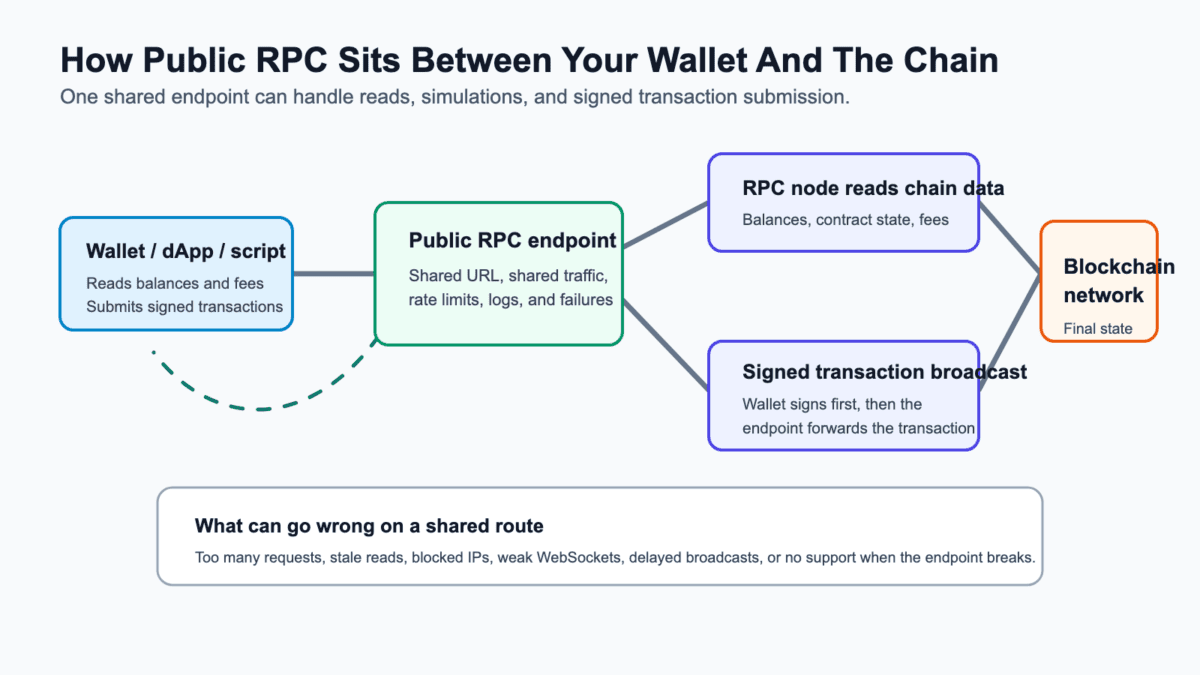
_A public RPC endpoint sits in the request path. It can shape speed, reliability, logs, and failure behavior._
That route is why wallet settings often include a custom RPC field. Changing the public RPC URL can change which endpoint handles reads, simulations, and broadcasts. It can also remove a helpful default if you replace it with a weak one.
Some apps use WebSocket connections for subscriptions. Those connections can struggle when many users want real-time data at once.
The important split is simple:
So public RPC is more than a developer setting. It is part of the path between what you try to do and the chain’s response.
Public RPC shows up wherever a wallet, dApp, explorer, bot, or backend needs a blockchain connection without running its own node. Most users meet it through custom network settings, default wallet endpoints, or support advice to “switch RPC.”
In a wallet, the setting usually appears as an RPC URL beside a chain ID, network name, currency symbol, and block explorer URL. MetaMask-style custom networks make this visible. Other wallets hide most of it behind defaults until something breaks.
Endpoint directories can help users find public RPC URLs. But they do not make every listed link safe for every task.
Use a quick check before adding one:
dApps may hide public RPC behind their own backend. That can make the experience feel smoother, but the app still depends on endpoint quality. If its provider lags or blocks traffic, users may see stale balances, failed swaps, or loading screens that develop a personality. Token display can confuse things too, because metadata, prices, logos, and warnings often come from separate services.
The clean habit is to verify the network, then verify the transaction on an explorer after it settles. Public RPC helps you reach the chain. It should not become the only thing you trust.
Public RPC is useful for light wallet use, learning, basic scripts, testing, and low-volume reads. It breaks when too many users share the same endpoint, the workload needs real-time data, or the app needs reliable production behavior.
Free public RPC is attractive because it removes accounts, API keys, billing, and node maintenance. A beginner can add a network. A developer can test a read call. A trader can try a backup endpoint when a wallet default is slow. The trouble starts when the endpoint becomes a shared bottleneck and has to protect itself.
| Good Use | Why Public RPC Fits Or Fails |
|---|---|
| Learning a network | Good for simple reads, small tests, and basic wallet setup. |
| Checking balances | Usually fine, unless the endpoint is stale or overloaded. |
| Running a dashboard | Can fail when subscriptions lag or rate limits hit. |
| Sending swaps during congestion | Risky because stale data and delayed broadcasts can hurt execution. |
| Running bots or monitors | Usually weak because repeated calls, WebSockets, and speed needs pile up. |
| Serving a production dApp | Poor fit because public endpoints offer limited guarantees and support. |
Common symptoms show up in a few familiar ways:
A swap can fail because the quote was stale. A dashboard can miss events because the subscription lagged. A bot can hit a request limit during the exact window it was built to catch.
Public RPC is shared by design, so the limits are shared too. Shared tools work best when nobody expects priority service from the free line. For serious use, test repeated reads, transaction submission, subscriptions, historical lookups, and fallback behavior.
Public RPC, private RPC, and running your own node are different ways to reach blockchain data and submit transactions. The right choice depends on access, reliability, privacy, support, and maintenance.
Public RPC is the easiest starting point. It is shared, cheap or free, and often good enough for light use. It also gives you the least control when traffic spikes, methods are blocked, or responses lag. Private RPC usually means restricted access to an endpoint, which may still be shared behind the scenes.
| Option | Best Understood As |
|---|---|
| Public RPC | A shared endpoint for general access with variable limits and reliability. |
| Authenticated Shared Endpoint | A provider route with API keys, usage tracking, and clearer limits. |
| Private RPC Endpoint | A restricted endpoint that may offer better capacity or routing. |
| Dedicated Provider Node | Provider-managed infrastructure reserved for one workload or customer. |
| Self-Hosted Node | Your own node with more control and more operational burden. |
Running your own node gives more control over reads and verification. It can reduce provider dependence, but it does not remove every problem. You still need hardware, bandwidth, updates, monitoring, backups, and operational time. Dedicated nodes and private endpoints sit in the middle: better capacity and support, with provider trust and cost still in the deal.
Public RPC belongs in light-use work. It becomes the wrong option when your use case needs uptime, low latency, high throughput, private routing, or clear accountability when things break. Pick the route that matches the failure you cannot afford.
Public RPC is usually safe for normal wallet use when the endpoint is reputable and the wallet signs locally. The endpoint alone should not be able to move funds from a non-custodial wallet.
That answer needs a sharp edge. A public RPC cannot sign a transaction for you, but it can influence what you see and how a signed transaction is sent. That leaves enough room for bad outcomes.
Real risks include:
Privacy is also limited. A public RPC endpoint may see request metadata, while the public chain still exposes settled activity. Changing RPC does not hide wallet history, token transfers, or contract calls that land onchain. If that trail gets tied to a person or team, it starts to look like doxxed in crypto, not just a server log.
> A public RPC cannot steal a seed phrase from a normal wallet request. A scammer can still trick you into typing it somewhere else.
The reliable habit is boring. Never paste seed phrases. Verify chain IDs. Avoid RPC URLs from strangers. Read transaction prompts. Confirm results on a known explorer. If an endpoint makes the wallet show strange data, remove it before sending funds.
Public RPC behaves differently across Ethereum, L2 networks, and Solana because each network handles data, transaction ordering, and infrastructure pressure differently. One-chain advice gets sloppy fast.
On Ethereum-style networks, JSON-RPC is the common interface for wallet reads, contract calls, gas estimates, and signed transaction submission. If a transaction enters a public mempool, other actors may see it before inclusion. Many L2s add another layer, where sequencers, provider endpoints, bridges, and app backends can change reliability or ordering.
| Network Context | What Public RPC Changes |
|---|---|
| Ethereum mainnet | It affects reads, gas estimates, simulations, and transaction broadcast routes. |
| L2 networks | It may sit beside sequencers and provider infrastructure that shape ordering. |
| Solana | It affects blockhash freshness, account reads, subscriptions, and transaction submission. |
| Public endpoint directories | They help discovery, but they do not guarantee safety or uptime. |
Solana deserves special care because speed-sensitive users often feel RPC quality directly. Public endpoints are useful for learning and testing. But Solana’s public endpoint reference lists a mainnet ceiling of 100 requests per 10 seconds per IP and warns that public endpoints are not intended for production applications. That is why Solana traders and builders talk about WebSockets, gRPC, blockhash freshness, and private providers more often.
In crypto trenches, that timing gap can feel brutal. A public RPC endpoint that is fine for checking a wallet may be poor for watching a fresh launch, submitting fast swaps, or tracking program events in real time. Public RPC can be a fine default for one task and a weak link for another, so test the chain, endpoint, and workload together.
Public RPC affects trades, bots, and MEV by changing data freshness, simulation quality, transaction timing, and visibility before inclusion. It still cannot turn a bad trade into a good one.
For a trader, the endpoint can shape what the wallet sees before approval. If the pool state is stale, the quote can be wrong. If the simulation lags, the wallet may estimate poorly. Bots and dashboards add repeated pressure through reads, subscriptions, logs, account updates, and block data.
The failure usually shows up in a few places:
MEV adds another layer. On chains with public pending transaction visibility, other actors can react to visible order flow. That is the same adversarial setup behind PVP trading: other participants may move faster, read the same signals, or react to your transaction path.
Public RPC also cannot fix weak liquidity. If a pool is thin, the token is toxic, or the buyer is late, a faster endpoint may only deliver the bad news sooner. You can still become exit liquidity with a cleaner connection. Use stronger routes only when the workload proves it needs better limits, faster data, or clearer failure handling.
Choose or test a public RPC by verifying the source, checking the network details, and trying the exact workload before trusting it with meaningful funds or production traffic. Do not let a green wallet screen do all the due diligence.
Start with the source. Official network pages, reputable endpoint directories, and known wallet defaults are safer than random links from social replies. A public RPC URL is just a URL until you confirm which chain it serves and who operates it.
Before adding or depending on an endpoint, run these checks:
Builders should test beyond the happy path. Try bursts, retries, subscriptions, unsupported methods, historical reads, failed simulations, and provider outages. If the endpoint cannot fail cleanly, your app may hand users confusing data.
Wallet users need fewer tests, but the basics still count. Add the endpoint, view a known address, compare the result with a trusted explorer, then test a tiny transaction only if you need to submit through that route. The best public RPC can handle your actual task without inventing new problems.
Public RPC in crypto is a shared endpoint that lets wallets, dApps, scripts, or backends read blockchain data and submit signed transactions through a node. It is often a URL used in wallet network settings or app infrastructure. Public RPC saves users from running their own node, but shared access can mean rate limits, stale data, and weaker reliability.
Public RPC is generally safe when it comes from a reputable source and your wallet signs transactions locally. It should not receive your private key or seed phrase. The main risks are misleading data, wrong network settings, metadata logs, delayed broadcasts, and scam flows that pair a bad endpoint with a harmful approval prompt.
A public RPC endpoint alone should not be able to steal crypto from a normal non-custodial wallet because the wallet signs locally. But it can still help a scam by showing false data, routing you to the wrong network, delaying a transaction, or pairing with a malicious transaction prompt. Your approval is still the dangerous part.
Public RPC is shared access, often free and easy to use. Private RPC usually means restricted access through an API key, allowlist, paid plan, private route, or dedicated capacity. Private RPC can improve limits, routing, or reliability, but it does not automatically make transactions anonymous or safe.
Public RPC endpoints have rate limits because many users and apps share the same infrastructure. Limits stop one wallet, bot, dashboard, or broken script from consuming too much capacity. Without limits, a free endpoint can become unusable for everyone during congestion or spammy traffic.
A production dApp should not depend only on public RPC unless the workload is tiny and failure is harmless. Production apps usually need authenticated endpoints, backups, monitoring, support, and clear rate limits. Public RPC can be useful for testing or fallback, but it is a weak primary route for serious traffic.
Start with public RPC as a useful default, then move up only when the task proves it needs more control. Free endpoints are fine for learning, basic wallet access, and small tests. They are poor places to park a production app or a trading bot with main-character syndrome.
Your next move should match the failure you are trying to avoid. If a wallet is not loading balances, a verified backup endpoint may be enough. If a bot is missing real-time events, a public endpoint is probably the wrong tool. If privacy is the concern, separate RPC metadata from public onchain history before changing infrastructure.
Use the next step that matches your role:
Then keep a backup. Even a good endpoint can rate-limit, lag, or block traffic. A saved alternative RPC URL can turn a broken wallet session into a five-minute fix instead of an hour of noisy troubleshooting. The goal is simple: know when shared infrastructure is quietly becoming the weakest part of the trade, wallet, or app.