Physical Address
304 North Cardinal St.
Dorchester Center, MA 02124
Physical Address
304 North Cardinal St.
Dorchester Center, MA 02124


Check PumpSwap fees, pools, and wallet routes before a fast trade gets expensive.
PumpSwap is Pump.fun’s native decentralized exchange on Solana, where tokens can trade in liquidity pools after the Pump.fun launch and bonding-curve phase.
The trap comes after that definition. PumpSwap is easy to mix up with Pump.fun, a wallet route, the PUMP token, or a safety badge for every meme coin that reaches a new venue.
The important part comes next: what changes when a token leaves launchpad-style trading and enters a PumpSwap pool. Fees, routing, liquidity, creator rewards, bots, and wallet prompts can all change with it.
PumpSwap is a Solana DEX tied to Pump.fun’s token lifecycle. Its job is to provide liquidity pools where users can swap tokens after the early launch and bonding-curve phase.
Think of Pump.fun as the launch machine and PumpSwap as the market venue that can appear later. A token may start on Pump.fun, attract early buys, complete the bonding curve, and then trade through a PumpSwap pool where AMM mechanics shape the price.
That does not make PumpSwap a wallet. Phantom, Solflare, or another wallet may show the trade screen, but the wallet is only the interface and signing layer. PumpSwap is the pool and swap venue behind the path.
PumpSwap is not a token either. Users may see PUMP, tokens named PumpSwap, or random tickers trying to borrow the brand’s glow. The DEX and those assets are separate things.
Keep the layers separate:
If a token is still on the curve, PumpSwap pool logic may not apply yet.
The real shift is price formation. Before graduation, the launch curve controls early trading. After graduation, an AMM pool brings reserves, fees, price impact, and route choice into the trade.
PumpSwap fits into Pump.fun as the later trading layer. Pump.fun is where many tokens begin. PumpSwap is where many of those tokens can trade after the early curve phase.
The confusion comes from seeing both names attached to one token. A user may buy during the Pump.fun phase, then later see the same token on a PumpSwap pool, a charting site, or a wallet route. Same token, different part of the lifecycle.
| Term | What It Does |
|---|---|
| Pump.fun | Helps users create and trade new tokens during the launch and bonding-curve phase. |
| PumpSwap | Provides DEX liquidity pools and swaps after a token reaches the post-curve phase. |
| Bonding curve | Sets early token pricing through the launch mechanism before the pool exists. |
| PumpSwap pool | Holds token and paired-asset reserves for AMM-style swaps. |
| Wallet | Shows a transaction and asks the user to sign from a Solana address. |
These layers can overlap in one trade. Pump.fun is the launch context. PumpSwap is the venue that can handle later swaps. A wallet may touch both, but it is not either one.
Pump.fun markets also attract tokens built around memes, social hooks, and fast attention cycles. Those often behave more like narrative coins than slow fundamental assets, so the token story can move faster than the liquidity behind it.
That speed is the charm and half the danger. A token can graduate because the curve filled, not because the project became durable. First comes creation and curve trading. Then the pool can become the main place where swaps happen.
PumpSwap works after a bonding curve by moving post-launch trading into a pool-based AMM. The token leaves the launch curve and enters a liquidity pool where reserves help set swap prices.
The first phase is token creation. A creator launches a token on Pump.fun, and early buyers trade through the launch mechanism. The bonding curve adjusts pricing as demand changes, so early trades do not require a normal DEX pool yet.
The second phase is completion or graduation. Once the platform condition is met, the token can move into the next trading setup. Users may call this migration, graduation, or moving to PumpSwap, depending on the app or chart in front of them.
The third phase is the PumpSwap pool. The pool holds reserves, usually the token and its paired asset. After that, swaps behave more like AMM trades where depth, fees, price impact, and route choice all show up.
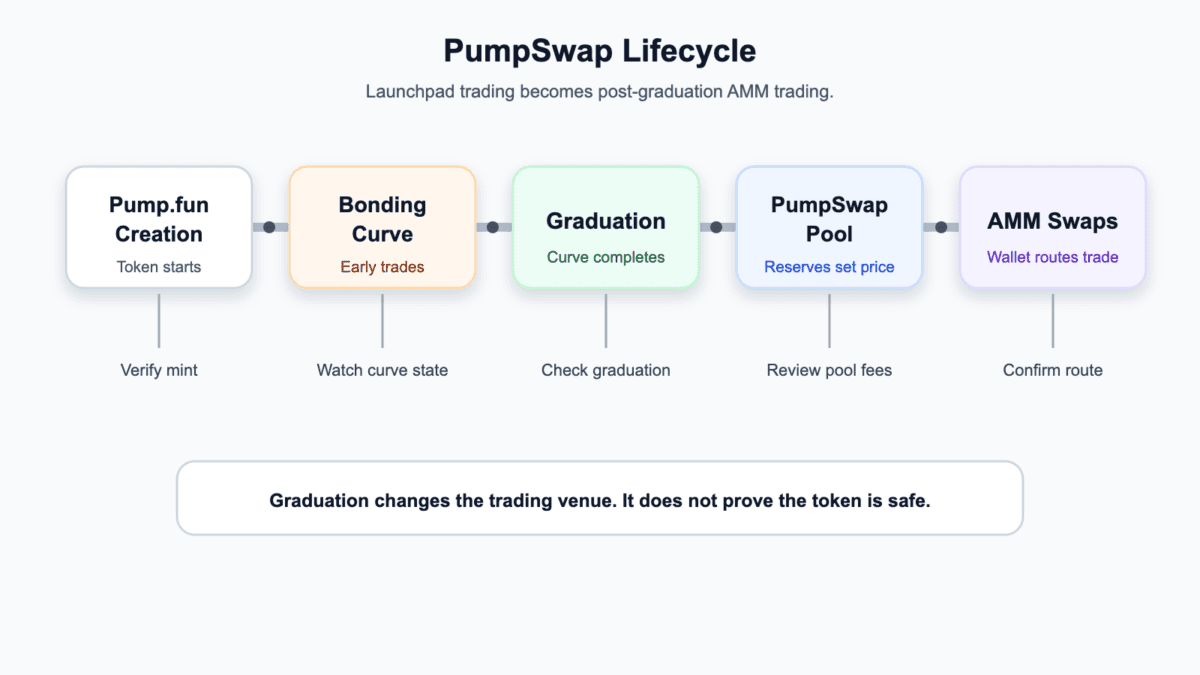
The diagram shows the handoff. The token starts in Pump.fun creation, trades through the bonding curve, reaches graduation, lands in a PumpSwap pool, and then trades through AMM swaps.
That handoff creates user-facing changes:
That is why the same token can look paused, moved, or newly listed depending on the interface. One tool may still be watching launchpad activity. Another may be watching the PumpSwap pool. A wallet may route only after it recognizes the pool.
Users who trade the trenches see this mismatch often. The token may be real, but the route, chart, and pool can disagree for a while. That gap is where rushed clicks get expensive.
So identify the phase first. If the token is still on the curve, AMM-pool assumptions may be early. If the token has graduated, pool depth and route quality become the bigger questions.
PumpSwap fees are not one flat number to copy from an old launch post. They include different fee categories, and some current official fee details changed after earlier PumpSwap coverage was written.
Pump.fun’s official Fees page was last updated on May 20, 2026. It lists coin creation at 0 SOL or 0 USDC, graduation from Pump.fun to PumpSwap at 0.015 SOL, bonding-curve trades at a 1.25% total fee, and separate creator, protocol, and LP fee categories.
That creates a trap for anyone reading older 2025 summaries. Launch-era writeups often focused on a single trading fee. Current fee language is more layered, especially after USDC paired tokens became available on May 21, 2026.
| Fee Term | What It Means |
|---|---|
| Create fee | The listed cost to create a coin on Pump.fun. |
| Graduation fee | The listed cost when a coin graduates from Pump.fun to PumpSwap. |
| Creator fee | The part of trading fees directed to a token creator or fee recipient. |
| Protocol fee | The part directed to the Pump.fun platform. |
| LP fee | The part that goes back to the pool as liquidity compensation. |
| Canonical pool fee | The fee schedule for graduated Pump.fun coins with associated PumpSwap pools. |
| Non-canonical pool fee | The separate fee schedule for other PumpSwap pools. |
The fee table is not a promise about your exact wallet cost. A third-party interface, wallet, priority fee, or Solana network fee can still change the final amount before signing.
Canonical pools need a closer look. A canonical PumpSwap pool is associated with a coin that launched on Pump.fun and graduated. The official schedule varies by the token’s SOL or USDC market-cap band, so the total fee can differ across pools.
Non-canonical pools are a separate bucket. If a pool is custom, direct, or outside the canonical setup, read the pool details before assuming the same economics apply.
Creator rewards cut both ways. A creator fee can encourage creators to keep a token active because trading volume can pay them. But incentives do not remove scam risk, insider selling, low liquidity, or fake social momentum.
Fees explain who gets paid. They do not tell you whether the token deserves a bid. If a pool shows creator rewards, thin liquidity, and aggressive hype, the reward model is only one part of the risk.
Before a PumpSwap trade, check the displayed fee, the pool type, the route, the paired asset, and the minimum received. If an interface shows numbers that clash with official fee language or the token’s pool type, pause before signing.
PumpSwap vs Raydium is mostly a venue question, while Jupiter and wallets add routing and interface layers. Mix those roles together and a simple swap screen starts looking like alphabet soup with fees.
Raydium, Orca, Meteora, and PumpSwap can all be DEX venues with pools. Jupiter is commonly used as an aggregator that looks across routes. A wallet is the place where the user reviews and signs the transaction.
| Venue Or Tool | Role In A Solana Swap |
|---|---|
| PumpSwap | Native Pump.fun-linked DEX venue for many post-graduation token pools. |
| Raydium | Solana DEX venue that older Pump.fun migration explanations often mention. |
| Orca | Solana DEX venue with separate pools and interface choices. |
| Meteora | Solana DEX and liquidity venue with its own pool designs. |
| Jupiter | Routing aggregator that may compare several Solana liquidity sources. |
| Wallet | Signing interface that may display or route the swap. |
This separation explains why two apps can show different outputs for the same token. One may route through a PumpSwap pool. Another may use an aggregator. A third may fail because it does not support the token path.
It also explains why “safer” is the wrong shortcut. A Raydium pool, PumpSwap pool, or Jupiter-routed swap can each be reasonable or risky. The risk depends on token controls, liquidity depth, route quality, fees, slippage, and the site asking for a signature.
Older content may still say Pump.fun tokens migrate to Raydium. That can be true in older context, but it should not be pasted onto every current Pump.fun token. Check the current platform state, the pool, and the wallet route.
For a normal user, the clean question is not “which brand name is best?” It is “which pool am I using, what route is my wallet signing, and what amount can actually land?”
PumpSwap risks usually come from assuming a graduated token has been filtered for quality. Graduation means a market-structure step happened. It does not mean the token is honest, liquid, or immune to a brutal chart.
Start with buyer-side exit pressure. A token can attract late buyers right as early holders, bots, or creator-linked wallets sell into fresh liquidity. That is the classic exit liquidity setup, dressed in a faster Solana outfit.
Then check liquidity depth. A PumpSwap pool may exist, but depth can still be thin. Thin pools make price impact worse, make exits harder, and give bots more room to shove the chart around.
Token control is the next problem. A graduated pool does not clean up mint authority concerns, creator wallet concentration, suspicious funding wallets, or social accounts that vanish on the first red candle.
Watch for red flags that belong before the swap, not after it:
A hard rug is still possible when control, liquidity, or wallet permissions are abused. PumpSwap does not remove that category of risk. It only gives the token a place to trade.
Bots and snipers can also distort the first read. A pool can look active because automated accounts are cycling trades, chasing priority, or fighting over entry and exit. Volume is useful only when it sits beside holder quality, liquidity depth, and route clarity.
The rule is blunt. Do not use PumpSwap as a safety label. Use it as one signal in the token’s lifecycle, then run the token checks like the pool owes you money.
Checking a PumpSwap token starts with confirming the exact asset and pool before your wallet opens. Symbols and names are cheap. Mint addresses and transaction details carry the truth.
Start with the token mint. A fake token can copy the name, ticker, logo, or social phrasing. If you are trading from a chart, wallet, or aggregator, confirm the mint against the official token source and the pool you intend to use.
Then check whether the pool is canonical or custom. A canonical PumpSwap pool has a different context from a non-canonical pool, which affects fee and lifecycle assumptions.
Use this checklist before signing:
Wallet setup belongs in the check because most users meet PumpSwap through a signing prompt. CryptoProcent wallet guides can help separate the interface from the pool, route, and token being traded.
Creator identity is another signal. An anonymous creator is common in meme coins, but anonymous does not mean risk-free. Check creator risk separately when rewards, token control, and wallet behavior all sit in the same trade.
Do not skip slippage. A token can look tradable at a tiny size and still punish a larger order. Compare expected output with minimum received, then ask whether the possible fill is still acceptable.
The clean habit is boring and valuable: verify asset, verify pool, verify route, verify amount. Then decide size. The market will still be there in ten seconds, unless the trade only worked because everyone was rushing.
PumpSwap data can look messy because launchpad trades, graduation events, pool creation, AMM swaps, wallet routes, and chart indexing do not always appear as one neat timeline. Different tools may be watching different pieces.
A trader might see activity on Pump.fun, then a gap, then a PumpSwap pool. A developer or data tool may separate bonding-curve events from AMM pool events. A wallet may care only whether it can build and submit the swap route.
That split is normal, but it still deserves a check. If your chart, wallet, and explorer disagree, check the token mint, pool address, recent transactions, and route.
Common wallet and data problems include:
Bots deserve a separate warning. Fast automated wallets can create volume, snipe early pools, and crowd normal users during volatile launches. They can also make liquidity look more useful than it feels when you try to exit.
Wallet errors are not always scam signals. A failed swap can come from slippage, routing, priority fees, token support, or a pool mismatch. But repeated errors near a hyped token should still slow you down.
For a beginner, the answer is not to become a data engineer. Cross-check the token and pool across more than one interface, keep size small until routing is clear, and avoid signing when the prompt does not match the trade.
PumpSwap and PUMP are easy to confuse because the names sit close together in the Pump.fun world. PumpSwap is the DEX. PUMP is associated with Pump.fun’s token context. A random token named Pumpswap is not the DEX.
That distinction is more than branding trivia. Search results, wallet search boxes, and charting tools can show tickers or token names that look official. A bad token can borrow a familiar word and still have nothing to do with the platform.
Use three checks when the name looks familiar:
The same caution applies to PUMP. Do not assume that a PUMP-related token, reward, or market page proves a PumpSwap pool is safe. The DEX layer, token layer, and user interface layer each need its own check.
Wallet prompts can make this mess worse. A prompt may show a symbol, contract, route, or spender. If the symbol says one thing but the route or mint says another, believe the details over the name.
Use the full context before you click. Are you visiting the swap app, viewing a Pump.fun token, inspecting a PumpSwap pool, or buying a token that copied the word PumpSwap? Those are different actions with different risks.
Names are marketing. Addresses are mechanics.
Related PumpSwap terms help because the venue sits inside a fast meme-token workflow. The pool is only one part of the story. The surrounding market language explains why users rush, why liquidity dries up, and why creator identity still carries weight.
Start with the trenches if you want the social setting behind many Pump.fun and PumpSwap trades. That term explains the high-speed market corner where new tokens, social signals, bots, and late buyers collide.
Then use anonymous dev risk when a token’s creator is unknown, lightly verified, or hiding behind a fresh account. An anon creator can still build something real, but the trade needs stronger wallet, liquidity, and control checks.
Exit-liquidity and rug-pull ideas belong nearby too, but those checks already sit in the risk section above. Keep the related reading selective. If every term becomes a link, the page turns into a navigation dump instead of a useful PumpSwap guide.
The connection is concrete. PumpSwap tells you where the token can trade after graduation. These related terms help explain the behavior around that pool, especially when the chart looks exciting and the details look thin.
Use the terms as context, not as a checklist that proves a trade. A token can live deep in trench culture and still have clean mechanics. Another can look polished and still carry ugly wallet concentration. The best next read explains the risk you are actually facing.
No, PumpSwap is not the same as Pump.fun. Pump.fun is the launchpad context for token creation and early bonding-curve trading.
PumpSwap is the DEX layer where many graduated Pump.fun tokens can trade through liquidity pools. One token can pass through both phases.
When a token moves to PumpSwap, trading can shift from the Pump.fun bonding curve into a PumpSwap pool. That pool supports AMM-style swaps after graduation.
After that, check the pool address, liquidity depth, fees, route, and minimum received. Graduation changes the venue, not the token’s quality.
PumpSwap fees depend on pool type and current fee rules. The current rules separate creator fees, protocol fees, LP fees, canonical pool fees, and non-canonical pool fees.
The exact amount shown to a user can also include wallet, interface, priority, or network costs. Read the wallet quote before signing.
PumpSwap is not automatically safer than Raydium or another Solana venue. Any venue can host risky or reasonable trades depending on the token, pool depth, route, fees, and wallet prompt.
The stronger check is token-specific. Verify the mint, liquidity, holder concentration, creator behavior, and route before using either venue.
Yes, you can use PumpSwap through a Solana wallet when the wallet or connected interface supports the route. The wallet signs from your address.
Still read the route, token mint, fee display, slippage, and minimum received. The wallet is the signing layer, not a guarantee that the token is safe.
PumpSwap is the DEX, not a token by itself. Users may see PUMP, Pump.fun token context, or unrelated tokens named PumpSwap or Pumpswap.
Do not trust a ticker because the name looks familiar. Confirm the official app, mint address, pool, and wallet prompt first.
With PumpSwap, start by verifying the trade instead of racing it. The pool can be real and the trade can still be bad if the route, fees, or token controls are wrong.
Open the trade like a technician, not like someone racing a countdown timer. First prove that the token, pool, route, and wallet prompt all describe the same transaction.
Run the checks in this order before you trade:
If one check fails, do not solve it with optimism. A meme coin does not become safer because the pool exists, and a wallet route does not become correct because the button is green.
If the checks pass, size still comes last. A small test swap can reveal route failures, bad slippage, or a pool that behaves differently from the quote. Bigger size should earn its way in.
That slower start is boring. It is also cheaper than debugging a bad signature after it lands.
PumpSwap is useful because it gives many Pump.fun tokens a post-graduation trading venue. Keep that narrow meaning. It is infrastructure, not a blessing from the chain.