Physical Address
304 North Cardinal St.
Dorchester Center, MA 02124
Physical Address
304 North Cardinal St.
Dorchester Center, MA 02124


Pump.fun explained without the hype fog.
Pump.fun is a Solana-based meme-coin launchpad where users can create and trade new tokens through a simplified interface and bonding-curve launch process.
That simple answer needs a warning label. Pump.fun can make token creation feel casual, but the market around it is fast, crowded, and powered by attention. A token can be real and tradable while still being dangerous.
Before you care what Pump.fun does, identify what you are looking at. Check the token’s lifecycle stage, supply control, trading venue, and whether the screen shows the platform, the PUMP token, PumpSwap, or a random coin borrowing the name.
Pump.fun is a token-launch and trading environment for Solana meme coins. It gives creators a token page, gives early buyers a place to trade, and can move the token toward a later market venue if it reaches the platform condition.
You may meet Pump.fun as a web app, a mobile app, a token page, a social feed, a chart link, or a brand name inside trader chatter. That is why the term can feel slippery. One person may mean the launchpad. Another may mean a token launched there. Someone else may be talking about PUMP, PumpSwap, or a platform feature.
Keep the layers separate:
Separate the platform from the token. Pump.fun is a real product surface. The tokens on it are user-generated. Some are jokes, some are coordinated trades, some are experiments, and many disappear after attention moves on.
That makes Pump.fun unlike a normal exchange listing page. A token can appear quickly, trade quickly, and become famous before anyone has checked the creator wallet, holder spread, liquidity path, or basic story.
Start there. Pump.fun helps users launch and trade new Solana meme coins. Then move to the lifecycle, because expensive mistakes often start when users mistake one stage for another.
Pump.fun works by lowering the friction between an idea, a token page, and early trading. A creator can launch a token, and buyers can trade it before it looks like a normal DEX pool.
A bonding-curve-style launch process handles the early price path. In plain English, the curve gives the token a way to trade before a regular liquidity pool becomes the main venue. As buyers and sellers act, the price and progress change. That speed is why Pump.fun tokens can move before the wider market knows what the token even is.
Read the flow as stages:
| Stage | What The User Should Understand |
|---|---|
| Token creation | A creator makes a new token page, but creation does not prove quality. |
| Early discovery | Social posts, feeds, bots, and chat rooms can push attention fast. |
| Bonding-curve trading | Buys and sells move the launch price before normal pool trading dominates. |
| Curve progress | A token can look exciting because it is moving, not because it is durable. |
| Graduation path | If the platform condition is met, trading context can shift to a later venue. |
The table is neat. The actual screen is not. A user sees a fresh candle, a funny ticker, a flood of comments, and a wallet prompt. The interface can make the flow feel clean. The market behind it may be messy.
Pump.fun is common inside the trenches because that is where fast meme-token launches, short attention spans, and high-risk trades collide. Users are often reacting to the same signal at the same time, while bots and early wallets may already have better entries.
The wallet signature is part of the mechanism, too. A token screen may show a buy or sell, but your wallet still controls the final approval. Always read the route, amount, fees, and minimum received before signing. A clean button does not make the transaction clean.
Before signing, pause on the boring details:
So read Pump.fun as a lifecycle, not just a button. It can create a tradable token quickly, but it does not slow the market down for you.
A Pump.fun token graduates when it moves out of the early launch phase into a later trading setup. Graduation is a lifecycle handoff, not a trophy.
Old explanations can trip users here. Some older Pump.fun material talks about Raydium-era migration. Current Pump.fun context points users toward PumpSwap and canonical pools, so stale wording can send you to the wrong mental map.
After graduation, the checks change:
The official Pump.fun fees page was last updated on 20 May 2026 and lists graduation from Pump.fun to PumpSwap at 0.015 SOL. It also lists coin creation at 0 SOL or 0 USDC, separates creator, protocol, and LP fee categories, and notes that USDC paired launches became available on 21 May 2026.
Graduation changes what to inspect. Before graduation, you care about the curve, creator wallet, holders, and early sell pressure. After graduation, you also care about the pool, route, liquidity depth, fees, price impact, and whether your wallet is using the venue you think it is using.
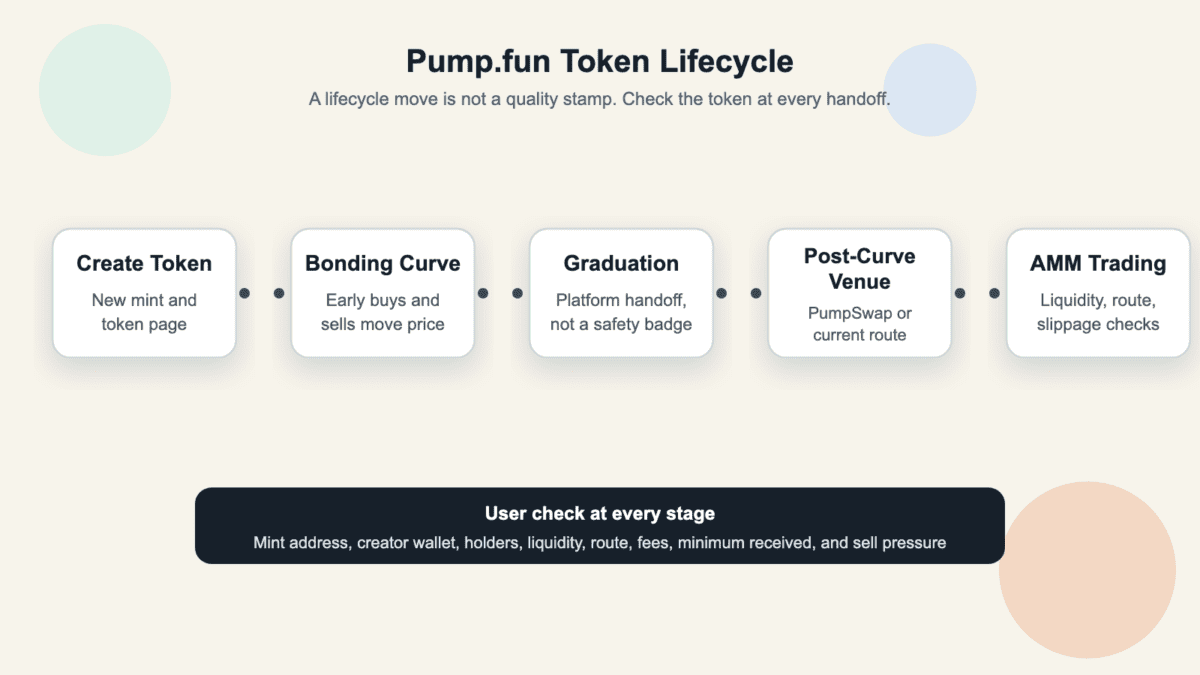
A graduated token can still dump. It can still have concentrated holders, creator-linked selling, weak liquidity, or a misleading social push. If token controls or liquidity are abused, hard rug risk does not vanish because a lifecycle box changed color.
Make the check boring. Confirm the token mint, then confirm the current venue and pool. If the app, chart, wallet, and thread disagree, wait until the route is clear. Being late by a minute is cheaper than being confidently wrong.
Pump.fun became popular because it compressed meme-coin creation, discovery, and trading into a fast social loop. It made launching a token feel closer to posting than building a full project.
Solana helped that loop. Fast confirmations and low fees made small trades feel possible, and meme-coin culture already rewarded speed, jokes, and early attention. Pump.fun put those forces in one place.
That speed changes creator behavior. A creator does not need to spend weeks building a launch page, seed liquidity, and wait for a centralized venue to care. They can test whether a joke, character, ticker, or community hook catches attention in real time.
It also changes trader behavior. Users stop thinking like slow investors and start scanning like operators watching a live feed. That can teach market structure, but it can also make impulse feel like research.
The appeal is obvious:
The catch is churn. If anyone can launch quickly, users have to filter quickly. Many Pump.fun tokens act more like narrative coins than durable assets, because the story, meme, or social clip may be the main reason anyone buys.
That does not make every launch fake. It means the token has to prove itself. The platform does not do that job for it. A real community can start on Pump.fun. So can a two-hour chart with a punchline and a dev wallet looking for fresh buyers.
The popularity came from access and attention. The cost is that weak launches can borrow the same visibility as stronger ones until users check wallets, liquidity, and seller behavior.
That is the Pump.fun tradeoff in one line: lower barriers create more experiments, and more experiments create more junk to filter.
Pump.fun, PumpSwap, and PUMP are related terms, but they point to different layers. Mixing them up can send a user to the wrong chart, fee page, or trade.
Use this split before taking any price, fee, or safety claim seriously:
| Name | What It Is |
|---|---|
| Pump.fun | The Solana meme-coin launchpad and trading environment. |
| PumpSwap | The Pump.fun-linked DEX layer for many post-graduation tokens. |
| PUMP | A separate token or market topic, not the same thing as the platform. |
| Pump.fun App | A mobile or web interface for accessing platform features. |
| Live Or Social Features | Attention tools around tokens, not proof that a token is safe. |
| Similar Name Tokens | Random assets that may borrow the brand, ticker, or hype. |
The PUMP confusion is especially common because exchange pages, price pages, and social posts can use platform language and token language in the same breath. If you are learning what Pump.fun is, do not let a PUMP price chart hijack the basic definition.
PumpSwap confusion works differently. A token may start on Pump.fun and later trade through PumpSwap, so the names can appear on the same path. That does not make them interchangeable. Pump.fun is the launch context. PumpSwap is the later venue in many current cases.
Before acting, label four things:
The interface adds another layer. A mobile or web app can display the trade, but the wallet signature still decides what you approve. If a token name copies Pump.fun, PumpSwap, or PUMP, verify the mint address before assuming it has any official connection.
Clean labels prevent sloppy trades. First identify the platform, token, venue, and interface. Then decide whether the screen in front of you is worth more attention.
Pump.fun risk starts when users assume the platform removes more danger than it does. It may reduce some old launch frictions, but it does not remove bad actors, bad liquidity, bad timing, or bad clicks.
The word “rug” gets used too loosely around Pump.fun. Some tokens are actual abuse. Some are creator dumps. Some are failed jokes. Some are normal speculative trades that ran out of buyers. Those categories can all hurt, but they are not the same.
Here is the risk map to keep beside the chart:
| Risk | What To Check |
|---|---|
| Creator selling | Track creator-linked wallets and repeated sells into strength. |
| Bundled supply | Look for coordinated early buys or clustered top holders. |
| Snipers and bots | Compare volume with wallet variety and timing. |
| Thin liquidity | Test whether the displayed depth fits your position size. |
| Graduation confusion | Confirm the current venue, route, pool, and token mint. |
| Wallet signing risk | Read permissions, output, fees, and minimum received. |
| Social manipulation | Check whether hype survives outside one clip or call group. |
| App execution risk | Avoid trade sizes that require perfect timing or no lag. |
Soft selling pressure deserves its own mention. A creator or insider group can avoid a dramatic liquidity pull and still drain demand over time. That pattern fits soft-rug risk better than a lazy “everything rugged” label.
Late buyers face another common problem. Attention can arrive right as earlier wallets need new demand to exit. That is the classic exit liquidity setup, only faster and with more memes in the air.
When risk signals cluster, slow down:
Pump.fun also attracts execution risk. A token can move while your app lags, your wallet route changes, or your slippage setting fails to match the actual pool. User-reported complaints about failed sells or missing balances should not be treated as proof of fraud, but they do show why sizing matters.
Keep the risk labels separate. Ask whether the issue is token control, liquidity, route quality, wallet approval, social hype, or platform access. One red flag may be survivable. A cluster of them is the market tapping you on the shoulder.
Checking a Pump.fun token starts with identity. Names, tickers, logos, and screenshots are easy to copy. Mint addresses and wallet behavior are harder to fake.
Before you buy or sell, slow the trade down enough to answer these checks:
The checklist is not a guarantee. It is a pause button. Pump.fun moves fast enough that ten extra seconds can feel expensive. That feeling is exactly why the pause is useful.
Creator behavior is often the cleanest early signal. A creator can be anonymous and still act honestly, but wallet concentration plus constant selling is a weak setup. If the story is loud and the wallet behavior is ugly, believe the wallet first.
Liquidity is next. A trade can look easy at a tiny size and painful at a larger one. Compare the quoted output with the minimum received. If the route changes between screens, stop and re-check.
Stop the trade when these basics do not line up:
Finally, inspect the story. A meme can carry a token for a while. It cannot make concentrated supply, bad routing, or thin liquidity disappear. The best Pump.fun check is boring: token, wallet, holders, route, liquidity, amount, then signature.
Pump.fun is a real platform, but that does not make every token on Pump.fun safe. User-generated markets can contain scams, failed jokes, honest experiments, rushed launches, and short-lived trades in the same feed.
Calling the whole platform a scam is usually too blunt. Calling every bad token a rug is also sloppy. A user can lose money because a creator dumped, because liquidity was thin, because bots moved first, because a wallet route failed, or because the token simply stopped attracting buyers.
Separate the accusation into cleaner buckets:
User-reported complaints from app stores, review sites, and Reddit are useful because they show pain points. They are not courtroom proof. Use them as warnings to check execution, size, route, and support expectations before funds are involved.
The clean answer is direct. Pump.fun itself is a platform for launching and trading high-risk meme coins. The dangerous part is that the platform can make weak tokens look tradable before trust, liquidity, or real community have formed. Ask what exact token, route, wallet prompt, and risk you are accepting, because that question gives you something you can actually check.
Some users should avoid Pump.fun because the market rewards speed, risk tolerance, and careful wallet checks. If those do not match your situation, stepping away is a valid strategy.
This is not about being timid. Pump.fun asks users to make decisions while price, route, liquidity, and social proof can all change at once. A slower investor may be perfectly reasonable and still be badly matched to that pace.
Avoid Pump.fun if any of these describe you:
Creators should pause too. Pump.fun can help test attention, but the venue carries reputation baggage. If a project needs serious trust, long-term holders, or institutional-style credibility, a churn-heavy meme market may fight the brand from day one.
There is also a learning gap. If a user cannot explain the difference between a token mint, a pool, a wallet prompt, and a route, they are probably too early for live trades. Observing costs less than learning through failed exits.
The platform is best suited to users who understand small speculative bets, can read wallet and liquidity data, and can walk away from a fast screen. Everyone else can still learn the mechanics by watching first, which is cheaper than donating SOL to the tuition fund.
Pump.fun is not safe in the way a beginner may mean it. The platform is real, but the tokens are high-risk, user-generated assets that can dump, fail, or become impossible to exit cleanly.
No, Pump.fun is the launchpad and trading environment, while PUMP is a separate token or market topic. Always separate the platform from any ticker or price chart using a similar name.
A Pump.fun bonding curve is the early launch pricing path that lets a new token trade before normal pool trading becomes the main context. It helps create a market, but it does not prove demand is healthy.
Graduation on Pump.fun means the token has moved from the early launch phase into a later trading setup, often tied to PumpSwap in current platform context. It is a lifecycle change, not a safety badge.
Yes, a Pump.fun token can still rug or collapse. Creator selling, concentrated holders, wallet-control issues, thin liquidity, social manipulation, or normal buyer exhaustion can still wreck the chart.
You can have trouble selling a Pump.fun token because liquidity may be thin, the route may change, slippage may be too tight, the app may lag, or many users may try to exit at once.
Start with observation, not a wallet signature. Watch a few launches move from creation to curve trading and, if they get there, graduation. The goal is to understand the machine before it asks for money.
Track a few hypothetical entries first. Write down the token mint, entry price, expected exit, route, slippage, and what changed after attention arrived. If the paper version already feels chaotic, the live version will not get calmer because funds are involved.
Use a simple starting path:
Then decide whether you need to trade at all. Pump.fun is useful to understand because it shapes Solana meme-coin markets, PumpSwap routes, PUMP confusion, and trader language. That does not mean every fresh token deserves a click.
If you do trade, keep the first goal small. Prove that you can identify the token, read the wallet prompt, understand the route, and exit without guessing. Profit is a bonus. Clean process is the part that keeps you alive for the next chart.
The best first move is boring and effective: read the screen, check the wallet, inspect the route, and let the fastest trade pass if the facts are not clear.