Physical Address
304 North Cardinal St.
Dorchester Center, MA 02124
Physical Address
304 North Cardinal St.
Dorchester Center, MA 02124

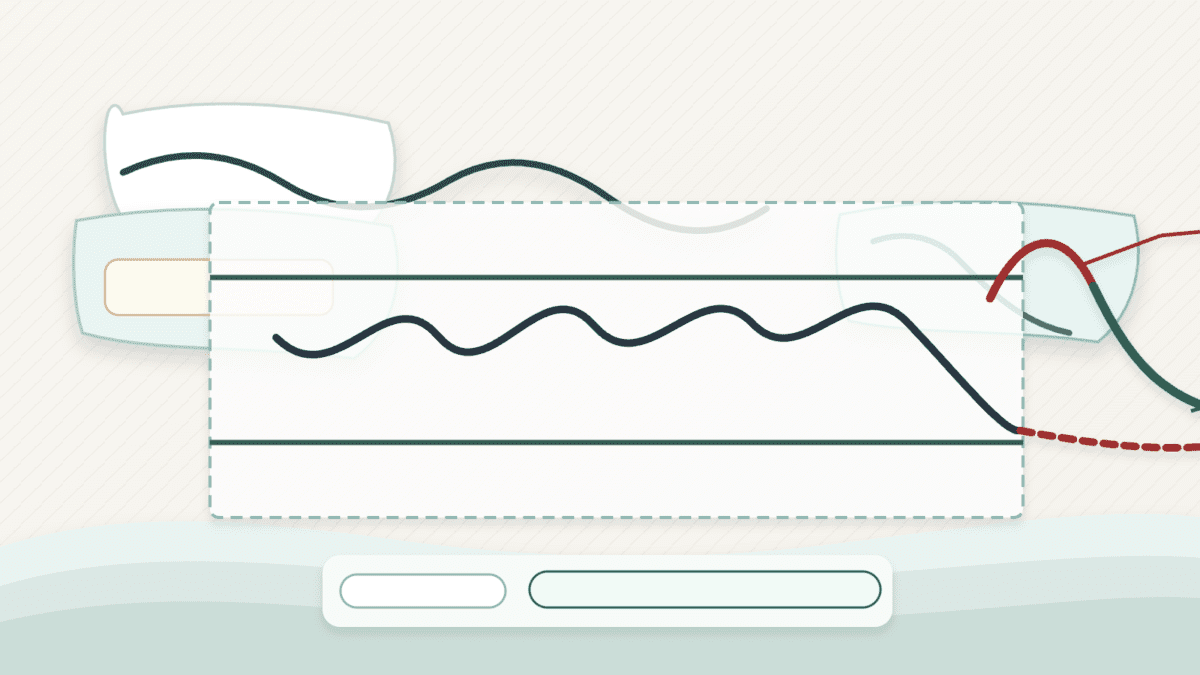
A plain-English guide to range jail, sideways crypto, and fakeout risk.
Range jail means a crypto asset is stuck between support and resistance long enough that clean trend trades keep failing.
The phrase is trader slang, not a legal restriction, exchange lock, or custody problem. It describes price action that keeps bouncing inside a visible box. That box can break up, break down, keep chopping, or turn into something bigger when the evidence changes.
Range jail in crypto means price is trapped in a clear trading range. Buyers defend a floor, sellers defend a ceiling, and the middle never gets a clear invite to trend.
You may also hear the same condition called a range-bound market, sideways market, chop, or consolidation. “Range jail” is the annoyed version. You’ll see it in CT threads, trading chats, and comment replies when price keeps teasing a move then doing nothing useful.
The phrase is useful because it captures both structure and mood:
Range jail is not automatically bullish or bearish. It can be a pause before continuation, a distribution area before weakness, quiet accumulation, or plain indecision. The chart alone does not confess its intentions. It only tells you there is friction.
So the first job is not prediction. The first job is recognizing the box and deciding whether your plan actually fits a box.
Crypto gets stuck in range jail when buyers and sellers stay balanced enough to block a clean trend. Price still moves, but every push meets enough opposite pressure to pull it back.
That usually happens after a sharp rally, after a selloff, before a major catalyst, or during a quiet period when capital is moving elsewhere. A coin can feel frozen while attention rotates between Bitcoin, Ethereum, Solana, sector leaders, meme coins, and stablecoins.
This is why the coin sits in crypto rotation without feeling dead. Some traders rotate to the asset they can justify. Others wait for one cleaner idea. The tape can still be busy even when the main move is on hold.
Common causes include:
High volume does not always mean direction. It can mean buyers and sellers are doing business at similar prices. That is absorption: one side keeps hitting, the other keeps taking the other side, and the candle looks less dramatic than the activity underneath.
This is why range jail feels confusing. The market is not asleep. It is just refusing to give a clean trend signal.
Coinbase’s Crypto Market Positioning report (May 2026) said altcoin open-interest dominance was around 0.6, near its lowest level in years, while BTC and ETH positioning improved without aggressive perp leverage returning at the same pace. That supports why many sideways periods look like major-asset pauses rather than full speculative relaunches.
You spot range jail by finding repeated reactions around the same support and resistance zones. The chart should look boxed in, with repeated failed attempts to build higher highs or lower lows.
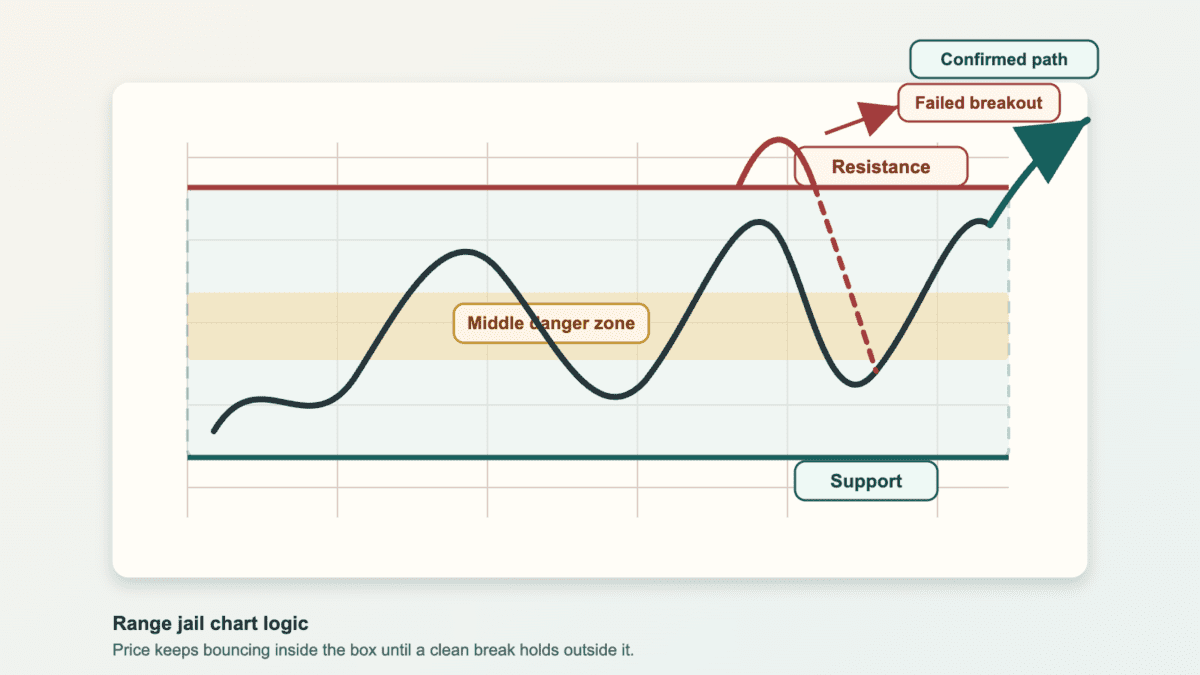
Do not demand perfect horizontal lines. Crypto wicks are rude. Look for zones where price repeatedly reacts, not exact prices that hold to the decimal.
| Signal | What It Suggests |
|---|---|
| Repeated reactions near support | Buyers keep defending the lower area |
| Repeated rejection near resistance | Sellers keep capping the upper area |
| Flat moving averages | Trend strength is weak or paused |
| Compressed volatility | Price is coiling inside a tighter box |
| Lower ADX or weak trend strength | Directional follow-through is missing |
| Failed breakouts | Chasers are getting pulled back inside the range |
| Lower conviction volume | Moves may lack fresh participation |
Indicators confirm context, not destiny. Bollinger Bands can show compression, ADX can show weak trend strength, and RSI can flag stretched moves near range edges, but none of them knows the future.
The worst area is often the middle. Near support, risk can be defined below the floor. Near resistance, risk can be defined above the ceiling. In the middle, you are mostly betting that the next candle likes you personally.
This rule is simple: if price is in the middle, you should size smaller and execute as if the market might do anything. That mindset keeps you safer while the range is still arguing with itself.
Range jail is the visible box. Consolidation, accumulation, and distribution are interpretations of that same box, and they need confirmation before becoming your trade call.
This distinction protects you from hopeful chart reading. A sideways Bitcoin, Ethereum, or Solana chart can look calm while traders argue whether it is a bottom signal, a top signal, or just another stretch of market boredom.
| Market Read | What Would Strengthen That Read |
|---|---|
| Neutral range | Repeated bounces with no clear volume shift or higher-timeframe change |
| Consolidation | Price holds structure after a trend and then breaks with follow-through |
| Accumulation | Downside attempts fail while demand improves near the lows |
| Distribution | Upside attempts fail while supply appears near the highs |
| Failed breakout | Price leaves the range briefly, then closes back inside fast |
The chart can hint, but it cannot prove intent alone. Accumulation and distribution are often identified too confidently after the fact, when everyone suddenly becomes a historian with a trendline.
Better evidence comes from follow-through. A clean candle close, a retest that holds, stronger volume, and higher-timeframe agreement all matter more than what you hope the range means.
Use this section as a risk filter. If confirmation is missing, your read is usually wrong in real time and only looks right in hindsight.
Traders handle range jail by matching the trade to the market condition. A trend strategy that works during clean momentum can bleed slowly when price only bounces between walls.
Range jail often feels like PVP trading because participants fight over the same obvious highs and lows. If you also go full port inside that noise, the real mistake may be size, not the chart.
Practical choices are boring for a reason:
The cleanest range trades usually happen near the edge of the box, not in the center. Buying near support gives a clear invalidation below the range low. Shorting or trimming near resistance gives a clear invalidation above the range high.
But a range trade is still a trade, not a personality test. If fees, spreads, stress, or timeframes make the setup poor, doing nothing can be the highest-edge move. Boredom is not a signal.
The most important adjustment is emotional: if your plan fails only when price is noisy, it is a regime-selection issue, not a character issue.
Range jail ends only when price leaves the box and stays outside long enough to prove follow-through. A single wick above resistance or below support is not enough.
Fakeouts are common because obvious range levels attract stops, breakout orders, and late FOMO. That can turn eager buyers into exit liquidity for sellers, especially when a “send it” candle spreads faster than confirmation. The send it instinct is fun until the next candle has other hobbies.
Use a simple confirmation checklist before chasing:
A breakout moves above resistance. A breakdown moves below support. A fakeout briefly leaves the range, pulls in traders, then returns inside the same box.
The retest is often the calmest filter. If old resistance becomes support, the breakout has more credibility. If price instantly falls back under the old ceiling, the market just rang the doorbell and ran away.
A clean end to range jail helps your decision speed. You can move from “maybe” to “plan says yes” only when the breakout or breakdown test holds.
Grid bots can fit range jail because they are designed to buy and sell repeatedly inside a chosen price band. That logic can work when price keeps bouncing and the range stays alive.
But a grid bot does not make the market safer. It turns a sideways assumption into a set of repeated orders. If the range breaks, fees stack up, tax events multiply, or borrowed size is added, the neat dashboard can hide ugly risk.
| Grid-Bot Appeal | Risk To Check First |
|---|---|
| Repeated buy-low-sell-high logic | The range may have been obvious only in hindsight |
| Many small trades | Fees and spreads can eat the edge |
| Automated entries and exits | The bot still follows your flawed settings |
| Spot grids | Exchange custody and tax lots still matter |
| Futures grids | Funding, margin, and liquidation risk increase |
| Wider grids | Capital can sit idle for long stretches |
| Tight grids | Noise can produce churn instead of profit |
The phrase “grid profit” can also mislead. A bot may show realized grid gains while the unsold inventory loses value after a breakdown. The whole position matters, not just the neat little trade counter.
So use grid bots only when the range, fees, venue, position size, and exit rule are clear. A backtest built on a perfect old range is a mirror that flatters.
That line matters most for beginners: a range may look clean in a graph replay, but live price is a stream, not a script.
Long-term investors should read range jail as a patience test, not an automatic trading order. Sideways price action can be emotionally loud even when the portfolio plan has not changed.
If you already have a conviction play, the range should push you back to the thesis. Has the reason for holding changed, or are you just reacting to a chart that has stopped entertaining you?
Useful investor responses are simple:
Sideways markets can tempt holders into becoming bad short-term traders. That is usually expensive tuition. If your plan is multi-month or multi-year, every intrarange wick does not deserve a new identity crisis.
The key is separating signal from irritation. A confirmed break of the range may deserve attention. A quiet week inside the same box may deserve a walk.
For long-term plans, the right answer is often boring: keep the original thesis, keep risk rules tight, and let conviction beat noise.
Range jail sits next to several crypto slang and market-structure terms. Understanding the cluster helps you read posts without turning every phrase into a trade.
The related concepts around range jail do different jobs:
Crypto rotation, exit liquidity, send it, and conviction play round out the wider read. They explain why price stalls, why fakeouts trap late buyers, and why a planned hold should not change just because a chart got boring.
Together, they keep range jail in context. The phrase names a market condition, while the surrounding terms explain the behavior, risk, and psychology around that condition.
Each linked term has one direct use: moving from feeling stuck to deciding what to do next.
Range jail is neutral by itself. It only says price is stuck between support and resistance, not whether the next confirmed move will be up or down.
The bullish case gets stronger if price holds support, demand improves, and a breakout closes above resistance with follow-through. The bearish case gets stronger if every rally gets sold, support weakens, and price breaks down cleanly.
Range jail and consolidation can describe the same sideways chart, but they are not always the same idea. Consolidation usually implies price is pausing after a trend, while range jail emphasizes the frustrating trapped condition.
A consolidation can resolve in the direction of the prior trend. Range jail can keep chopping, fake out both sides, or break the other way. Confirmation decides which label holds up.
Bitcoin can go sideways for weeks when buyers and sellers are balanced around a price zone. That can happen after a big move, before a catalyst, or when the market is waiting for clearer liquidity and risk signals.
Sideways Bitcoin does not mean nothing is happening. Coins can change hands, short-term traders can reset, and larger players can build or reduce exposure while the headline price barely moves.
If your answer to this question is “nothing matters,” you are not reading the market cleanly. The market can be active without showing trend.
You should trade during range jail only if your strategy is built for ranges and your risk is clear before entry. If you need a trend to make money, the range may be telling you to wait.
Good range traders usually focus near support or resistance, not the middle. Beginners often do better by setting alerts, reducing size, or skipping the chop until the market gives a cleaner setup.
Range jail is more likely ending when price closes outside the range and then holds that break. A retest, stronger volume, higher-timeframe agreement, and clear invalidation all improve the signal.
A wick alone is weak evidence. Crypto often pokes above resistance or below support to trigger orders, then returns inside the same box. That is the fakeout people complain about after the candle already looked obvious.
Grid bots can make money in range jail when the range stays intact and trading costs are manageable. They are built for repeated buying and selling inside a band.
The risk is that the band breaks. Then the bot may keep buying a falling asset, sell too early in a breakout, or show small realized gains while the open position loses value. Fees, taxes, custody, and margin can make the result worse.
That is the clean takeaway: a bot can execute a range plan, but it cannot replace regime awareness.
Start by drawing the range high and range low, then mark the middle. If price is sitting in the center, admit that the setup may be weak before inventing a trade.
Then decide what kind of participant you are before price moves. A range trader, breakout trader, and long-term holder should not all take the same action from the same candle.
The point is to avoid trading the chart, and instead trade your process. If the box is still intact, your options are to wait, tighten risk, reduce exposure, or skip. Trading because the chart is noisy usually hurts more than it helps.
Use one pass only. If your plan is not clear, leave it in the checklist instead of the order ticket. A market that stays boxed for days asks for discipline, not heroics.
Use a small checklist before acting:
Range jail is frustrating because it makes activity feel necessary. It is not. The market can sit inside the same box longer than your patience can pretend to be a strategy.
If the setup is unclear, the highest-quality action is often inaction. Keep your process clean, and the next candle has a better chance of finding your real bias.